
00:00 / –:–
A news report does not have to contain false facts to impose a particular viewpoint on the reader. Sometimes a headline, lead and a crucial missing sentence are enough. The current n-tv report about Israel’s Finance Minister Bezalel Smotrich shows quite precisely how this works.
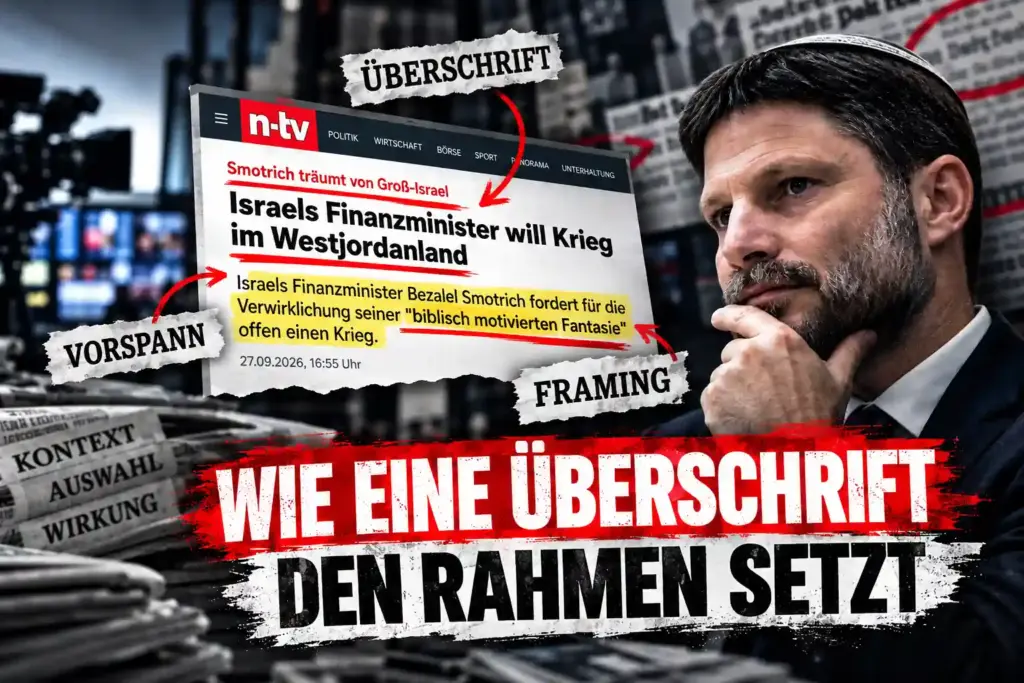
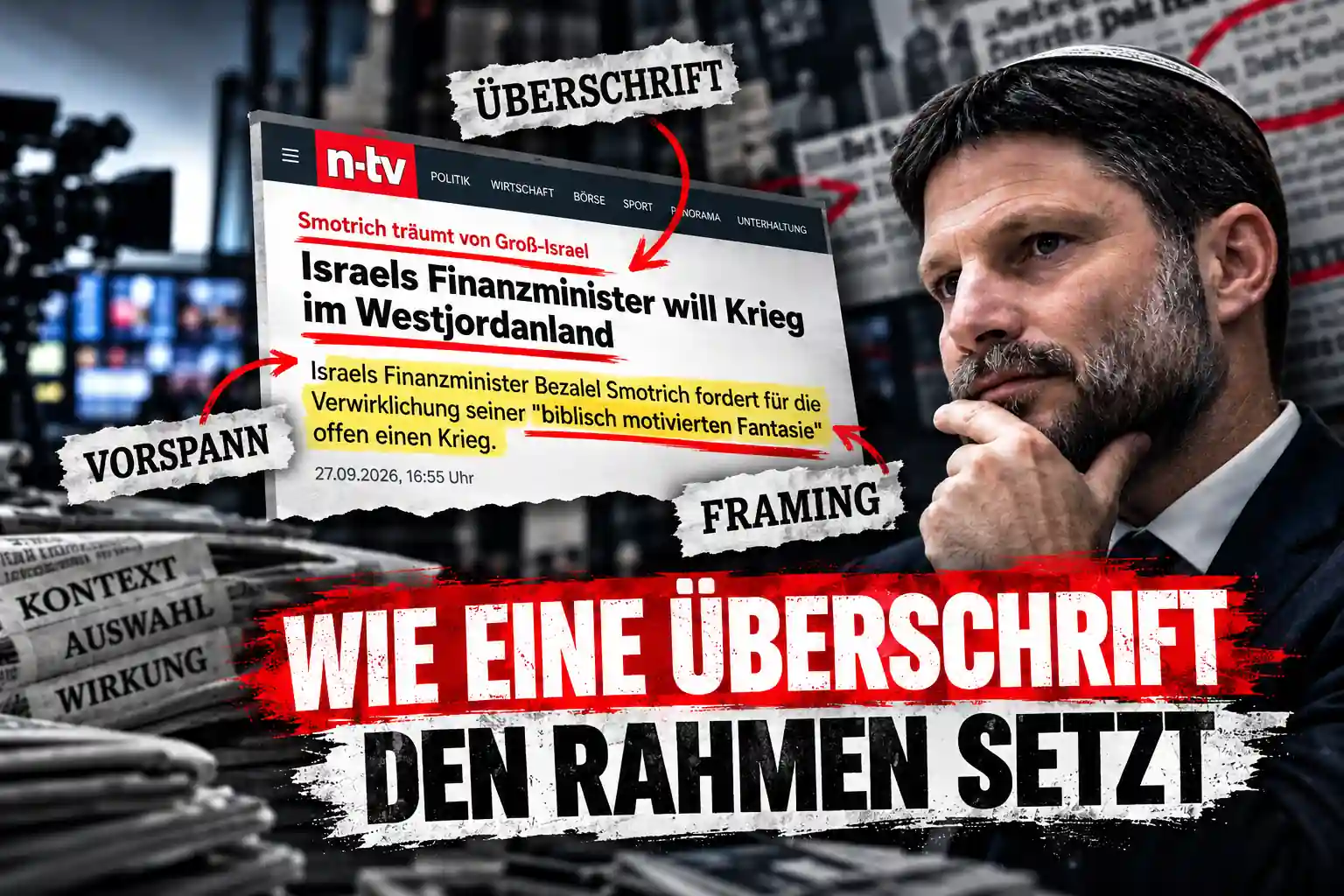
“Smotrich dreams of Greater Israel,” appears above the report. The headline below reads: “Israel’s finance minister wants war in the West Bank.”
In the lead, n-tv goes further. Smotrich is said to be openly calling for a war to realize his “Bible-inspired fantasy.” That is exactly how the report was published.
In the Ynet interview Smotrich does in fact call for annexations in Gaza and southern Lebanon. That is documented. “Dreams of Greater Israel” is nevertheless not a description of these specific demands, but an editorial attribution.
As a result, the reader is given the assessment before learning what Smotrich actually said. “Smotrich dreams of Greater Israel.” “Bible-inspired fantasy.” “War.”
This is not a neutral introduction to the news. This is framing.

Passende X-Beiträge
Aus dem SCHLAGSEITE X-ArchivSmotrich does in fact speak of war
There is no need to sugarcoat anything. Smotrich uses the word himself.
In the detailed interview with Ynet he says that Israel must “go to war” in Judea and Samaria and do there what it did in Gaza. He also calls for the dissolution of the Palestinian Authority, which he describes as a terrorist authority.
n-tv does not conceal the call to dissolve the Palestinian Authority. It appears in the report. The decisive point lies elsewhere.
Ynet does not simply leave the word “war” standing. The interviewer immediately follows up: What does war mean?
And this follow-up is missing from n-tv.
What Smotrich means by “war”
Smotrich’s answer is anything but soft.
He refers to three evacuated refugee camps and says that the population was evacuated for its protection. He then expressly explains that he wants to kill all terrorists and collect all weapons.
He formulates his demand to the army just as clearly: no terrorists, no weapons, no tunnels, no terrorist infrastructure. If vehicles were used as weapons for ramming attacks, he says vehicle access should also be restricted.
That is the complete statement. Smotrich calls for war. He uses harsh language. He calls for harsh military measures. And, when asked directly, he defines whom and what this war is intended to target.
Terrorists. Weapons. Tunnels. Terrorist infrastructure.
This does not change the fact that Smotrich himself limits the objective. But it also does not change the fact that his comparison with Gaza and the evacuation of camps would have far-reaching consequences for civilians. That is precisely why it is insufficient to turn his statement into “war against Palestinians.” Both things must be allowed to stand: the objective he names and the severity of the means he demands to pursue it.
Not a single word of this needs to be softened. On the contrary: it is precisely the complete statement that makes visible what n-tv turns it into.
Terrorists become “Palestinians”
Citing AFP, n-tv writes of a “war by the Israeli army against Palestinians in the occupied West Bank.”
This turns the objective explicitly described by Smotrich into a statement about an entire population group.
Smotrich does not say that he wants to fight all Palestinians. When asked specifically about his understanding of war, he names terrorists, weapons, tunnels and terrorist infrastructure.
n-tv turns this into “war against Palestinians.”
That is not an insignificant difference. A war against terrorists is linguistically and substantively something different from a war against Palestinians. Smotrich’s comparison with Gaza does not make this distinction unnecessary, but all the more important.
His own statements are harsh enough. Anyone wishing to criticize them has ample material. But they should criticize his statements, rather than first turning them into a broader statement.
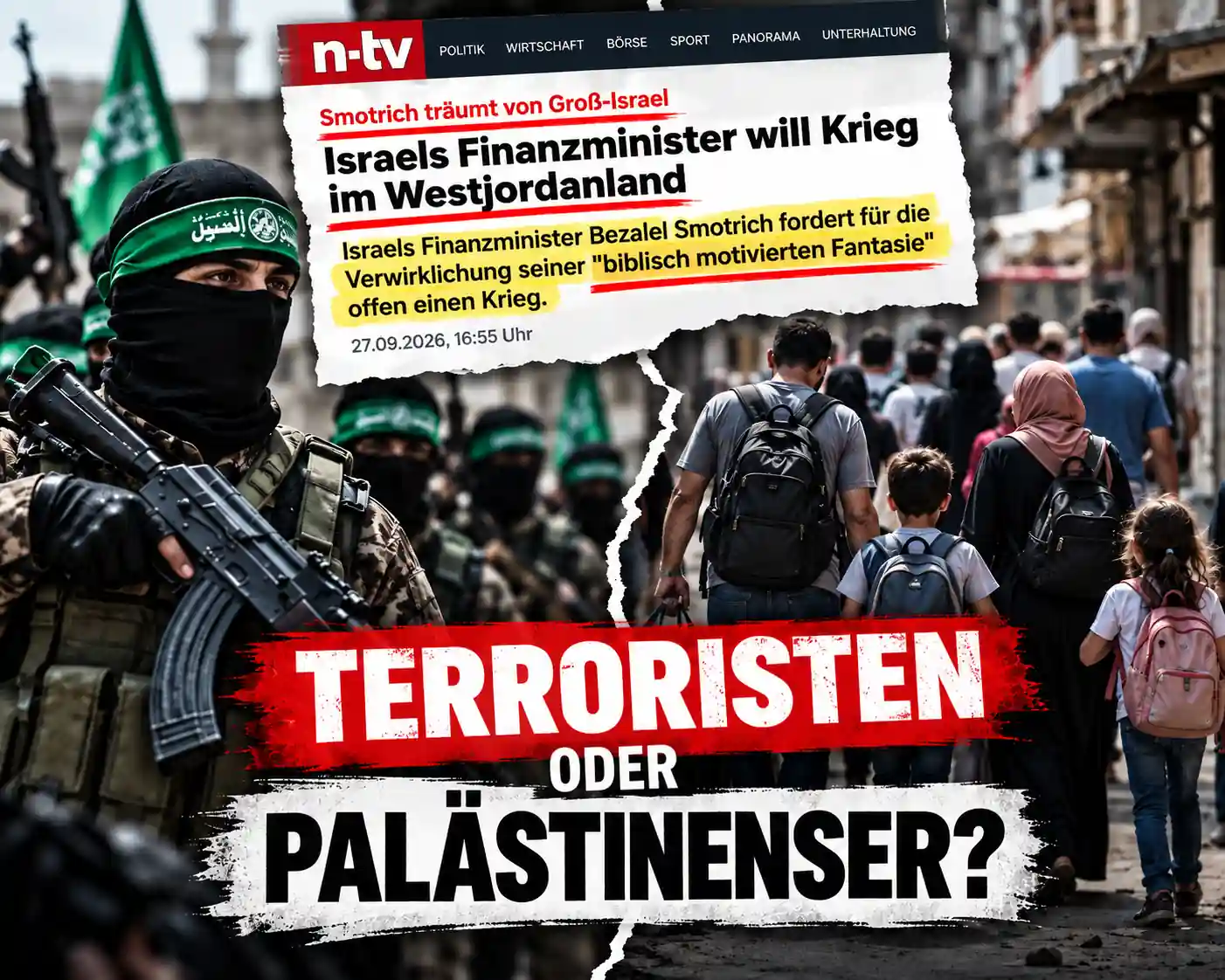
n-tv builds the evaluation directly into the lead
This becomes even clearer in the phrase “Bible-inspired fantasy.”
“Fantasy” is not a factual term. It is an evaluation.
n-tv names Smotrich’s annexation demands and also describes which territories he mentions in that context. But the lead does not stop at this description. There, his position is additionally evaluated as a “Bible-inspired fantasy.”
That is the language of commentary in a news report. And it does not appear somewhere after an extensive presentation of the facts, but right at the beginning.
Before the reader knows Smotrich’s reasoning. Before the reader knows Ynet’s follow-up question. Before the reader knows what Smotrich means by “war” at all.
The opinion comes first. The context follows, partially.
“Judea and Samaria”: Historical names with political significance
n-tv explains “Judea and Samaria” as a biblical designation for the so-called West Bank. It is true that the names appear in the Bible. As an explanation, however, this is abbreviated.
Judea and Samaria are considerably older geographical names. After the 1948 war, the area came under Jordanian control. In 1950, the territories east and west of the Jordan were united under the Jordanian Crown. The United States expressly did not recognize Jordanian sovereignty over the area.
The designations “East Bank” and “West Bank” were part of this Jordanian political and geographical order. The historical and political significance of the names was later also disputed at the United Nations.
Today, the State of Israel continues to use “Judea and Samaria” officially. The term appears in state administration, legislation and within the Israeli armed forces. In 2025, the Knesset approved a bill in its first reading, under which this designation is to be used uniformly in Israeli legislation.
Anyone who explains “Judea and Samaria” merely as a “biblical designation” leaves out this historical and official context.
The combination is effective: first the religious framework, then the evaluation “Bible-inspired fantasy.” This creates a narrative.
Smotrich needs no journalistic assistance in sharpening his rhetoric
The absurdity is that Smotrich himself provides enough harsh statements.
He calls for a war in Judea and Samaria. He calls for the destruction of terrorist structures. He wants to dissolve the Palestinian Authority. He speaks of killing all terrorists and collecting all weapons.
His territorial demands are also far-reaching.
There is no need to make any of this harmless. But there is also no need to add anything.
That is the decisive journalistic standard.
Anyone who considers Smotrich’s position wrong can criticize his position. Anyone who considers his demands dangerous can explain why. Anyone who rejects his ideas politically can say so in a commentary.
But a news report should first accurately reproduce what was said. And this is precisely where n-tv becomes problematic.
The omitted follow-up question is decisive
n-tv adopts Smotrich’s call for war and his demand concerning the Palestinian Authority. What is missing is Ynet’s immediate follow-up question, “What does war mean?”—and thus the passage in which Smotrich himself describes the targets he names for this war.
Instead, the German reader is given the phrase “war against Palestinians.” This very selection changes the framework of the statement.
“Smotrich dreams of Greater Israel” shapes the interpretive framework
Many people now read news via X, Facebook, Google News or push notifications. They see an image, a kicker, a headline and perhaps two more sentences of the lead. Then they scroll on.
That is why the claim that a headline is merely harmless packaging for the actual article is nonsense. For a considerable part of the audience, the packaging is the news.
“Smotrich calls for war in Judea and Samaria and names terrorist structures as the target” conveys something different from “Israel’s finance minister wants war in the West Bank.”
Combined with “Smotrich dreams of Greater Israel” and a “Bible-inspired fantasy,” this creates a clearly established interpretive framework.
One describes – The other evaluates.

Framing does not require invented facts. It works through selection, choice of words, sequence and omitted context. A report can therefore consist largely of correct individual pieces of information and still provide the reader with a ready-made interpretation.
The reader should judge, not the headline on the reader’s behalf
This is not about making Smotrich appear more pleasant.
His statements are there. In their entirety, they are even harsher than some summaries. That is precisely why there is no journalistic reason to rework them linguistically.
Anyone who says “kill all terrorists” needs no editorial intensification. Anyone who calls for war and refers to Gaza in doing so needs no headline that turns the targets he names into an entire population group. Anyone making far-reaching territorial demands needs no “fantasy” in the lead. The facts are enough.
That is precisely the problem with the n-tv report: It is not invented facts that shape the story, but the editorial framing of real facts. Smotrich’s harsh statements, his comparison with Gaza and his annexation demands stand on their own. n-tv nevertheless adds an evaluative framework and leaves out precisely the follow-up question in which he specifies his concept of war. Thus, the report does not merely state what was said. It already dictates how the reader is supposed to understand it.
ℹ️ Factual basis and primary sources for the article 📑
▶️ Ynet:
Interview with Bezalel Smotrich
Original interview featuring Smotrich’s call for war in Judea and Samaria. What matters is not only the call for war, but the immediate follow-up question, “What does war mean?” and Smotrich’s answer to it.
▶️ n-tv:
Israel’s finance minister wants war in the West Bank
The analyzed report with kicker, headline, lead and the phrase “war against Palestinians.”
▶️ US Department of State, Office of the Historian:
Jordanian decision to unite the two banks of the Jordan River of April 24, 1950
Contemporary diplomatic documentation of the unification of the territories east and west of the Jordan.
▶️ US Department of State, Office of the Historian:
US document on the legal status of the territory before 1967
Documents that the United States did not recognize Jordanian sovereignty over the area.
▶️ United Nations:
Letter from Israel’s UN representative of July 17, 1978
Primary source on Israel’s position regarding the historical use of the terms “West Bank,” “Judea” and “Samaria.”
▶️ Government of Israel:
Land registration in Judea and Samaria
Example of the official use of the designation “Judea and Samaria” in Israeli administration.
▶️ Knesset:
Legislative initiative concerning the use of “Judea and Samaria”
Documents the first reading of 31 March 2025. The draft proposes replacing other designations with “Judea and Samaria” in Israeli legislation.
🔎 Found an error, criticism, or addition?
SCHLAGSEITE.eu stands for careful research and transparent corrections. Have you discovered a factual error, unclear wording, or a broken link? Then send me your tip. If possible, please provide a verifiable source.