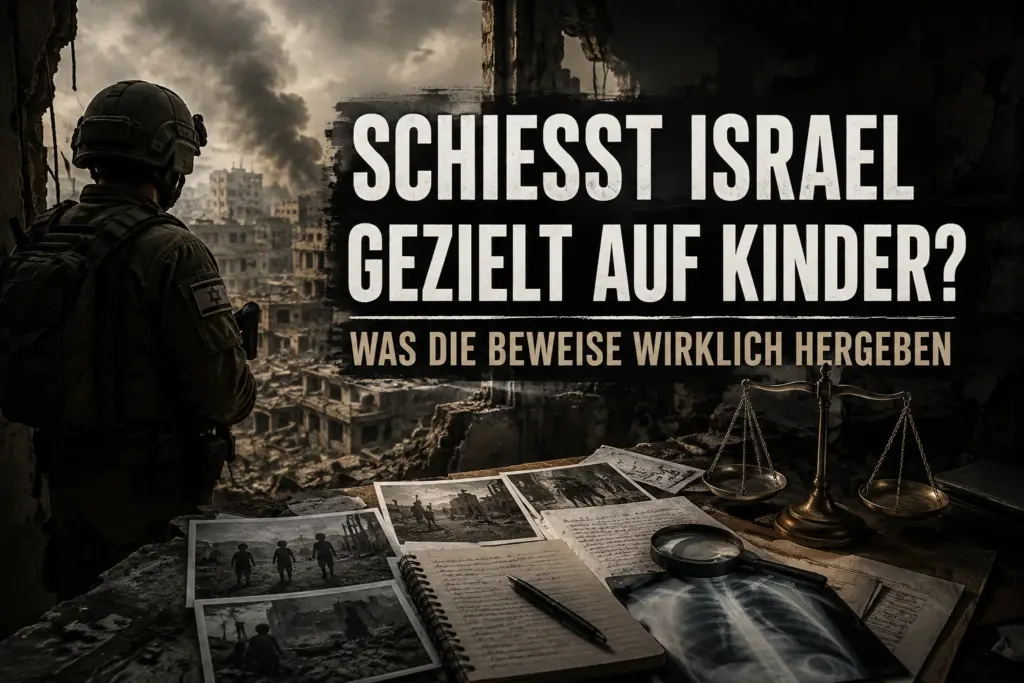

Deliberate shooting of children in Gaza is among the most serious allegations against Israel: Israeli soldiers are said to deliberately shoot children in the head or chest. This claim is now frequently circulated as though it were an established fact and is supported by statements from international doctors, X-rays, medical records and journalistic investigations. The underlying material must be taken seriously: children with corresponding gunshot wounds have been documented, doctors report striking injury patterns, and witnesses have held Israeli forces responsible for numerous cases.
The crucial question, however, is how far this evidence actually goes. A gunshot wound initially documents an injury, a witness statement can provide indications of the possible shooter, and a striking pattern can substantiate suspicion of deliberate fire. However, additional evidence is required for the substantially broader claim of a systematic practice by the Israeli army.

Medical findings, attribution of responsibility, intent and institutional responsibility are different levels. The broader a claim, the more it must be supported by additional, independent evidence.

Passende X-Beiträge
Aus dem SCHLAGSEITE X-Archiv
114 children with gunshot wounds to the head or chest
One of the strongest investigations into this allegation was published by the Dutch newspaper de Volkskrant. The investigation, later awarded the European Press Prize’s Distinguished Reporting Award, is based on interviews with 17 doctors and one nurse who had worked at various medical facilities in the Gaza Strip during the war.
The doctors were asked to state how many children aged 15 or younger they had seen with a single gunshot wound to the head or chest. Fifteen of the 17 doctors reported such cases and together arrived at a total of 114 children. Some had photographs or their own records, while others relied on their memories. The editorial team itself points out that possible overlaps between the information provided by different doctors could not be completely ruled out.
The newspaper additionally received photographs, videos, X-rays and medical records. Some of this material was presented to two forensic pathologists, who, according to the investigation, assessed the injuries examined as projectile wounds rather than typical shrapnel wounds. In individual images, one of the experts considered shots from a greater distance likely.
This provides strong support for the conclusion that children in Gaza were struck by individual projectiles in the head or upper body. The figure of 114 cases is striking and demands serious investigation. It is not, however, a complete reconstruction of 114 incidents, each with a clearly identified shooter, firing position and proven intent.

Deliberate shots at children: What medical images prove—and what they do not
An X-ray can document a projectile or the consequences of a gunshot wound, while pathologists can draw further medical or forensic conclusions from suitable material. The identity of a shooter, however, cannot be read from such a finding alone. Even within the Volkskrant investigation, Belgian pathologist Wim Van de Voorde reportedly said that the quality of the material presented to him was insufficient to draw legal conclusions from it.
Nor does determining a caliber automatically resolve this question. In a detailed counterstatement by The Times of Israel it was pointed out, among other things, that Hamas fighters also use weapons capable of firing the same 5.56-millimeter ammunition as numerous Israeli rifles. The trauma surgeon Tyler Reynolds, quoted there, also questioned how far the complete sequence of events leading to an injury could be reconstructed from individual X-rays.
These objections do not answer the question of responsibility. They do, however, show why this question must be investigated in addition to the medical findings.
Feroze Sidhwa himself draws a narrower line
A central figure in the debate is the American trauma surgeon Feroze Sidhwa, who reported seeing 13 children with single gunshot wounds to the head or chest after working in Gaza. In the Volkskrant investigation, he described how the accumulation of these injuries led him to suspect that an especially brutal shooter or a drone team might have been responsible in the area.
However, in a later interview with The Times of Israel Sidhwa explicitly did not go so far as to claim that Israel’s military leadership had made such a decision. His suspicion concerned possible conduct by individual soldiers, and when asked, he acknowledged that he could not prove this suspicion.
Thus, even the position of one of the best-known doctors behind the allegation is narrower than the sweeping statement that “the IDF” engages in a deliberate practice of shooting children.
The BBC investigation provides significant witness testimony
The allegation is given additional weight by a BBC investigation, to which de Volkskrant also refers. According to it, the BBC examined more than 160 cases of children with gunshot wounds; in 95 of them, the injury was to the head or chest. In 59 cases, the BBC was able to speak with eyewitnesses; in 57 cases, eyewitnesses held Israeli forces responsible, and in two cases, Palestinian fire.
These witness statements are relevant to the assessment because, in numerous cases examined, they identify Israeli forces as a possible source of the shots. Taken on their own, however, they do not constitute an independently established attribution of responsibility and do not replace a reconstruction of the specific sequence of events.
Witness statements can carry considerable weight, particularly when supported by further independent evidence. However, a statement about where a shot is said to have come from is not automatically equivalent to a forensic identification of the shooter.
Witness testimony from Gaza needs independent corroboration

Palestinian witness statements must neither be dismissed wholesale nor accepted as facts without scrutiny. War, extreme stress, limited visibility of combat and a lack of independent crime-scene work can influence perceptions, while the possibility of deliberate false statements cannot in principle be ruled out either.
The political environment of a Gaza Strip under Hamas rule must also be considered. This circumstance does not prove a false statement, but it makes the most independent possible verification through additional witnesses, video recordings, firing directions, the positions of forces involved or other verifiable data all the more important.
The correct journalistic wording must therefore reflect the respective state of the evidence. Where eyewitnesses hold Israel responsible, that is precisely what should be reported. A conclusively established Israeli responsibility may only follow when additional evidence supports that conclusion.
The IDF rejects the allegation
The Israeli response also merits critical examination. In response to The Times of Israel the IDF rejected the allegation that it intentionally attacks civilians, including children. In the later Volkskrant investigation, however, its response remained general, according to the newspaper, and did not address the individual cases described in detail.
A more detailed Israeli response would be appropriate given allegations of this severity. Particularly relevant would be information about which cases were investigated, which units were present in the areas concerned, and whether specific allegations could be confirmed or disproved. The public absence of such answers leaves questions open, but it does not itself replace proof of the allegation.
Hamas conducts the war from civilian surroundings
The nature of the battlefield is also relevant to assessing the specific sequences of events. Hamas and other Palestinian armed groups operate from densely populated areas and have used civilian spaces for military purposes. This finding does not come exclusively from Israeli sources.
Amnesty International documented that Palestinian armed groups stored ammunition in civilian areas and fired rockets from there. The UN Human Rights Office also found that armed groups conducted hostilities from densely populated areas, thereby exposing the civilian population to additional dangers.
The UN report also addressed allegations that military objectives and civilians had deliberately been placed in close proximity to one another in order to prevent or hinder attacks. Such deliberate use of the presence of civilians may constitute the prohibited use of human shields under international humanitarian law.
Anyone who deliberately moves military activities into densely populated civilian spaces or deliberately uses civilians to protect military targets from attack themselves increases the danger to their own population. This responsibility does not disappear because Israel subsequently responds militarily.
This context does not excuse an unlawful Israeli shooting and does not prove an alternative cause in any of the cases examined. It does, however, show why the shooter’s position, perception of the target, forces involved and the immediate course of the fighting must be clarified before an injury becomes evidence of deliberate Israeli intent.

“Child” initially describes age

Precision is also necessary regarding the general casualty figures. Under the Convention on the Rights of the Child, all people under the age of 18 are generally considered children. This category therefore includes both small children and older adolescents, while by itself it says nothing about the military status of a specific person.
That this distinction may be relevant in Gaza is shown by earlier UN reports, which documented individual cases of the recruitment and use of minors by Palestinian armed groups, including the Qassam Brigades. For 2023, the UN Secretary-General also reported on summer camps run by the Qassam Brigades and Palestinian Islamic Jihad in which children were exposed to military content and activities.
This must not lead to the conclusion either that Palestinian minors are automatically combatants or that every person statistically recorded as a “child” was automatically entirely uninvolved militarily. The specific status must be established in each individual case.
For the 114 Volkskrant cases, an important limitation must be noted: The investigation explicitly recorded only children up to and including the age of 15. These cases therefore cannot be explained by pointing to older minor combatants and deserve particularly careful examination precisely because of the young age involved.
The 114 cases are striking, but not a representative statistic
The 114 cases described by the doctors do not constitute a representative sample of the Gaza Strip as a whole. The doctors worked at different times and in different locations; some documented their cases immediately, while others later reconstructed their number from memory, and possible overlaps could not be completely ruled out.
The 114 cases therefore cannot be used to calculate a reliable rate of how frequently children were hit by deliberate gunfire during the war. This does not make the clustering meaningless, but it limits the statistical conclusions that can be drawn from it.
🔎 What the investigations establish—and what remains open
This fact-check is not an investigation of crime scenes conducted independently, but an examination of publicly available investigations and primary sources. The underlying BBC investigation also contains accounts from Palestinian eyewitnesses and families and additionally reconstructed individual cases using videos, satellite imagery, medical records, and forensic assessments. However, not all witness attributions were independently reconstructed in the same manner.
A clustering of similar injuries can constitute a relevant pattern and thus justify an investigation. On its own, however, it still does not answer the separate questions of who the perpetrator was, intent, and an alleged institutional practice.
An individual war crime and an institutional practice are not the same thing
Legally, a clear distinction must be made between individual misconduct and an alleged practice of the army as a whole. If an Israeli soldier deliberately attacks a clearly uninvolved civilian child, even that single incident can be a serious violation of international humanitarian law and would have to be investigated and, where appropriate, prosecuted criminally.
The broader claim that the IDF, as an institution, engages in a systematic practice of deliberately firing at children requires additional evidence. Relevant evidence could include corresponding orders, rules of engagement, documented instructions, credible statements from different units, or proof of a widespread practice that was knowingly tolerated.
The doctors’ reports examined here, the Volkskrant investigation, and the BBC investigation cited by it have so far not provided such institutional evidence. They document serious injuries, witness statements, and substantial grounds for suspicion, but no proven IDF-wide instruction to select children as targets.

What remains after examining the evidence?
The investigations available allow for a much more precise assessment than the usual slogans. It is well supported that international doctors treated children with individual gunshot wounds to the head or chest and that a striking clustering of such cases was documented. Expert assessments that at least some of the shots may have been fired deliberately must be taken equally seriously.
What the investigations available do not reliably establish, by contrast, is the identity of the perpetrators. The BBC documents witness statements attributing responsibility for numerous shots to Israeli forces. These statements form part of the evidence and must be examined, but they do not independently identify the particular shooter and do not replace a reconstruction of the specific sequence of events.
The publicly available sources therefore establish gunshot wounds and a striking injury pattern, but do not reliably establish for the cases examined who fired, from which position the shots were fired, what combat situation existed, or with what intent the act was committed. Still less do they establish an institutionally ordered or systematically tolerated practice by the Israeli army.
The publicly available investigations document serious gunshot wounds in children and provide grounds for a serious investigation. However, they provide neither a reliable attribution of responsibility for all the cases examined nor proof that the IDF, as an institution, systematically and deliberately selects children as targets of attack.
The decisive boundary therefore lies where documented injuries, medical assessments, and witness statements are used to construct perpetration as an already established fact. Between establishing that a gunshot wound exists and proving which actor fired and with what intent, there are several independent evidentiary steps.
A complete assessment must also include the documented combat environment: Hamas and other Palestinian armed groups operate from densely populated areas and use civilian spaces for military purposes. UN reports also document individual cases of the recruitment and use of minors by Palestinian armed groups, including the Qassam Brigades. In such a combat environment, the origin and circumstances of an individual shot cannot be inferred solely from the medical injury pattern or a witness attribution made after the fact.
Serious evidentiary practice therefore requires the documented cases to be investigated consistently, without presuming who was responsible. Anyone claiming that the IDF systematically and deliberately fires at children must provide not only injuries and witness statements, but must separately establish responsibility, intent, and the alleged institutional practice. That proof is not present in the publicly available material to date.
For all the documented cases, there is so far no reliable, independently confirmed evidence that the shots can be attributed to Israeli soldiers. Still less has any systematic IDF practice of deliberately selecting children as targets of attack been established.
⚖️ International humanitarian law analysis of the chain of evidence
The claim that the IDF systematically and deliberately fires at children combines several separate levels of evidence. Medical findings, attribution of responsibility, intent, and the assertion of an institutional practice must each be substantiated independently.
1. Medical finding
A documented gunshot wound to the head or chest is initially a medical and, where applicable, forensic finding. It can establish that a person was hit by a projectile and, under suitable circumstances, provide further indications of how the injury occurred.
On its own, it identifies neither the shooter nor answers the decisive questions concerning the combat situation, the shooter’s perception, and intent. The medical finding is therefore an important starting point for an investigation, but on its own is not yet proof of a deliberate attack on a protected civilian.
2. Attribution of responsibility
The question of who fired constitutes a separate level of evidence. Witness statements can provide important indications, but should, wherever possible, be compared with further evidence such as the direction of fire, the positions of the forces involved, visual material, crime-scene findings, and other verifiable information.
The fact that a child was hit therefore does not automatically prove which party to the conflict was responsible for the particular shot. Nor do technical details about a projectile or caliber, on their own, permit reliable identification of the perpetrator.
3. Intent
The law of armed conflict prohibits attacks deliberately directed against the civilian population or individual civilians. For the criminal-law assessment of such an attack, it is therefore decisive what the perpetrator knew at the relevant time and which target he deliberately selected.
A hit to the head or chest can be an indication of deliberate fire. On its own, however, it does not prove that the shooter recognized the particular victim as a protected civilian and deliberately made that person the target of the attack.
Children enjoy special protection under international humanitarian law. At the same time, minors too may be subject to a limitation of protection against direct attacks during direct participation in hostilities. Whether such a situation existed must be established in each individual case on the basis of concrete facts and may be inferred neither from age nor from a general assumption.
4. Claim of a systematic IDF practice
This is the decisive additional evidentiary step. A deliberate and unlawful attack by an individual soldier against a protected civilian may already constitute a war crime . That, however, does not yet prove that the Israeli armed forces, as an institution, pursue a systematic practice of deliberately selecting children as targets of attack.
For such a broader claim, additional evidence would be highly significant, such as orders or rules of engagement, reliably documented recurring procedures across different units and periods, corresponding knowledge on the part of the military leadership, or demonstrable tolerance of unlawful attacks.
The doctors’ reports, medical findings, forensic assessments, and witness statements publicly available to date provide serious indications of possible unlawful individual cases and a striking injury pattern. They do not, however, so far provide publicly reliable proof of an IDF policy of systematically selecting children as targets of attack.
Legal conclusion
Medical finding → attribution of responsibility → intent → alleged institutional practice are four separate levels of evidence. A striking injury pattern can and should trigger investigations, but it does not replace the additional evidence required in each case for responsibility, intent, and an alleged systematic practice.
International humanitarian law protects civilians, including children, from direct attacks. The investigations available therefore provide grounds for a serious examination of specific cases. On the basis of the material publicly available to date, however, they do not establish reliable proof of a systematic policy by the Israeli armed forces of deliberately selecting children as targets.
ℹ️ Factual basis and primary sources for the article 📑
▶️ European Press Prize / de Volkskrant:
What the wounds are telling us
Investigation into statements by international doctors, 114 reported cases involving children up to and including the age of 15, medical imagery, forensic assessments, and the BBC investigation cited.
▶️ BBC World Service:
BBC examines how some children died in Gaza
BBC investigation into more than 160 examined cases of children with gunshot wounds in Gaza. In 95 cases, the injury was to the head or chest; for some of the cases, witness statements concerning the possible origin of the fire were evaluated.
▶️ The Times of Israel:
After doctors accuse Israel of shooting Gazan kids, experts see need for a second opinion
Contextualization of the evidentiary value of medical images, as well as statements by Feroze Sidhwa and other medical and military experts.
▶️ UN Human Rights Office:
Update report on the human rights situation in Gaza
Contextualization of combat operations by Palestinian armed groups from densely populated areas and an assessment under international law of the spatial interconnection between military targets and civilians.
▶️ Amnesty International:
Amnesty International report on Gaza
Contextualization of the storage of ammunition and military activities by Palestinian armed groups in civilian areas.
▶️ United Nations, Children and Armed Conflict:
Children and Armed Conflict – Report of the Secretary-General
Documentation of verified cases involving the recruitment and use of underage boys by Palestinian armed groups, including Hamas’s Qassam Brigades.
▶️ United Nations, 2023 report:
Children and armed conflict – Report of the Secretary-General
Documentation of grave violations against children, as well as military content and activities in summer camps operated by Palestinian armed groups.
▶️ International Committee of the Red Cross:
Human shields
Assessment under international law of the prohibited use of civilians as human shields.
▶️ ICRC, principle of distinction:
Rule 1. The Principle of Distinction between Civilians and Combatants
Protection of civilians from direct attacks and the obligation to distinguish between civilians and combatants.
▶️ ICRC, direct participation in hostilities:
Rule 6. Civilians‘ Loss of Protection from Attack
Contextualization that civilians are protected from attack unless and for such time as they take a direct part in hostilities.
▶️ ICRC, protection of children:
Rule 135. Children
Special respect and protection for children in armed conflicts under customary international law.
▶️ International Criminal Court, Rome Statute:
Rome Statute of the International Criminal Court
Article 8 includes, among other things, intentionally directing attacks against the civilian population or individual civilians not directly taking part in hostilities as war crimes.
▶️ International Criminal Court, Elements of Crimes:
Elements of Crimes
Specification of the elements of the offenses and the subjective requirements of the international crimes governed by the Rome Statute.
▶️ IDF:
Hamas and Islamic Jihad Use Children for Terrorist Activities and Incitement
Israeli information on the military training and use of minors by Hamas and Palestinian Islamic Jihad.
🔎 Found an error, criticism, or addition?
SCHLAGSEITE.eu stands for careful research and transparent corrections. Have you discovered a factual error, unclear wording, or a broken link? Then send me your note. If possible, please provide a verifiable source.