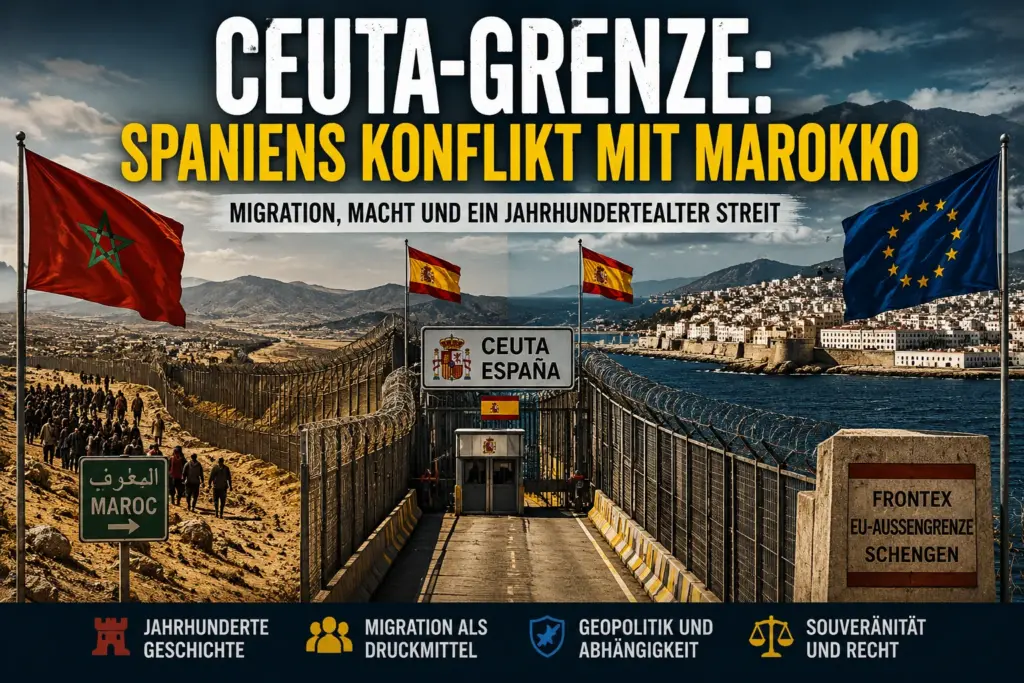

The Ceuta border is not only a flashpoint for irregular migration. The Spanish city in North Africa is also the visible fault line of a centuries-old sovereignty conflict between Spain and Morocco. When the border there begins to falter, therefore, much more is at stake than fences, coast guards and returns.
Facts as of: August 4, 2026, 09:07 CEST
At the end of July 2026, tens of thousands of people reached Ceuta from Morocco within a very short time. Many came by land, while others attempted the dangerous journey by sea. According to Reuters on August 3, 2026 Spanish officials estimated that around 69,500 people had meanwhile returned to Morocco. Moroccan authorities, by contrast, spoke of around 40,000 people who had previously reached Ceuta. The figures apparently rely on different methods of recording and are therefore not directly comparable.
Between 3,000 and 5,000 people were still believed to be in Ceuta at that point, including more than 860 unaccompanied minors. The casualty figures were also corrected several times. Most recently, Spanish officials reported 72 deaths on the Spanish side, while Morocco spoke of 11 deaths on Moroccan territory.
The Ceuta Border as a Political Lever
Morocco said the mass movement had been fueled by false reports on social networks, smuggling networks and a misinterpretation of a Spanish court ruling. The ruling of July 8, 2026, limited the possibility of immediately turning back people who reach Ceuta or Melilla by sea. Rabat also denied having previously loosened its border controls. The Spanish Interior Ministry publicly emphasized its cooperation with the Moroccan security authorities.
That does not settle the political question, however. Ceuta’s head of government, Juan Jesús Vivas, accused Rabat of having “encouraged and allowed” the influx. Spanish intelligence assessments cited by Reuters suggested that Morocco may not have centrally organized the mass crossings, but could have facilitated them through relaxed controls. Morocco rejects this account.
There is still no publicly reliable evidence of a centrally directed operation by the Moroccan government. The distrust nevertheless does not come out of nowhere. In 2021, Moroccan forces had already temporarily loosened controls around Ceuta after Spain admitted the leader of the Polisario Front, Brahim Ghali, for medical reasons.
Passende X-Beiträge
Aus dem SCHLAGSEITE X-Archiv

Two Cities, Two Entirely Different Historical Narratives
Ceuta lies on the North African coast, directly opposite mainland Spain. Ceuta and Melilla, farther east, form the only land borders between the European Union and Africa. Ceuta and Melilla are autonomous Spanish cities. Spanish citizens there vote in Spanish and European elections, hold Spanish—and therefore European—passports, and pay with the euro.
Politically, both cities belong to Spain and the European Union. At the same time, special customs and tax rules apply: Ceuta and Melilla are not part of the customs territory of the European Union.
Spain points to centuries of state affiliation. Ceuta was conquered by Portugal in 1415. Portugal recognized Spanish rule over the city in 1668. Melilla has been under Spanish control since 1497. Both cities had therefore belonged to Spain long before the independence of modern Morocco in 1956.
Morocco views this historical argument as a continuation of European colonialism. Rabat refers to Ceuta as “Sebta” and Melilla as “Melilia” and claims both cities. Madrid, in turn, treats them not as colonies, but as integral parts of Spanish territory.
The political dispute is real. Under international law, however, it is not equivalent to the conflict over Western Sahara. The United Nations continues to list Western Sahara as a Non-Self-Governing Territory. Ceuta and Melilla are not on that list. However, the omission is not an independent judicial ruling on Spanish sovereignty, but initially a clear distinction within the framework of UN decolonization.

More Than Ceuta and Melilla
The two cities are only the largest parts of a complicated territorial mosaic. Spain also controls several smaller islands and rocks off the Moroccan coast, often grouped under the term “Plazas de soberanía”. They include the Chafarinas Islands, the Alhucemas Islands and the Peñón de Vélez de la Gomera.
How explosive even an almost meaningless rock can become was shown in 2002 on the uninhabited Perejil Island, known in Morocco as Leila. After Moroccan forces took up positions there and raised their flag, Spain deployed special forces. The incident ended without deaths, but brought the two states dangerously close to a military confrontation.
Territories are not defended solely because of their economic value. They often become particularly significant precisely because they have turned into symbols of national dignity and state sovereignty.
Western Sahara as the Conflict Behind the Conflict
The most important point of contention between Spain and Morocco lies farther south. Spain colonized Western Sahara in the late 19th century. In 1975, Morocco organized the Green March, while Spain began its withdrawal and signed the Madrid Accords. The Spanish presence did not formally end until February 26, 1976. Morocco later took control of most of the territory, while the Algeria-backed Polisario Front calls for an independent Sahrawi state.
The International Court of Justice found in 1975 that historical ties of allegiance existed between the Moroccan sultan and individual tribes in Western Sahara. The Court did not find any territorial sovereignty link to Morocco and stated that these ties did not override the population’s right to self-determination.
A United Nations-backed ceasefire took effect in 1991 and was intended to lead to a referendum. This never took place because the parties to the conflict could agree neither on the electorate nor on the options to be put to the vote. In November 2020, the ceasefire effectively collapsed, after renewed escalation in the Guerguerat buffer zone.
Morocco now offers autonomy under Moroccan sovereignty. The Polisario continues to demand that full independence be an option. The final status of Western Sahara under international law remains unresolved to this day.
Spain moved significantly closer to Morocco’s position in 2022. Prime Minister Pedro Sánchez described Rabat’s autonomy plan as the “most serious, credible and realistic basis” for a solution. At the same time, the Spanish government emphasized that a solution would have to be accepted by both sides and reached within the framework of the United Nations.
When Migration Becomes a Political Lever

The 2021 crisis made this connection particularly clear. At the time, around 9,000 people reached Ceuta, after Moroccan border forces temporarily relaxed their controls. The European Parliament explicitly condemned the use of border control and migration, particularly unaccompanied minors, as political pressure against an EU member state.
Comparable state control over the events of 2026 has not yet been conclusively established. Nevertheless, the structural dependency remains unchanged: Spain and the European Union need Morocco’s security forces to control their southern external border. Rabat is aware of this influence.
The current crisis also became the first major stress test of the EU Migration Pact, in force since June 2026. European Commission President Ursula von der Leyen proposed additional technical and financial support for Morocco, along with improved early-warning systems at the borders of Ceuta and Melilla. This is the European dilemma: The more the EU outsources its border control to partner countries, the greater their political leverage may become.
At the same time, Morocco is closely intertwined economically with Spain and the European Union. Trade, investment, tourism and infrastructure create mutual dependence. Political escalation is therefore regularly followed by a return to demonstrative cooperation.

⚠️ The Distinction Is Crucial
The instrumentalization of migration by states is a real political tool, documented in connection with the 2021 Ceuta crisis. This does not, however, automatically mean that the mass crossings of 2026 were centrally directed. False reports, smuggling networks and economic motives are documented. A deliberate loosening of Moroccan border controls is reported by the Spanish side but denied by Rabat. A direct order from the Moroccan government has not been proven to date.
A Joint World Cup, Unresolved Borders
The contradictions between Spain and Morocco will be particularly visible in 2030. Morocco, Spain and Portugal are the main hosts of the 2030 FIFA World Cup. One additional anniversary match will be held in each of Argentina, Paraguay and Uruguay. Teams, fans and officials will travel between Europe and Africa, while sovereignty, migration and political influence continue to be contested along the same strait.
Ceuta shows that a border is never merely a line on a map. It is a relationship of power, dependence and mutual distrust.
Spain needs Morocco to secure Europe’s southern border. Morocco needs Spain as an economic and political gateway to Europe. Yet as long as the claims to Ceuta and Melilla and the conflict over Western Sahara remain unresolved, every new wave of migration can once again become a geopolitical signal.
The World Cup may turn the Strait of Gibraltar into a symbolic bridge for a few weeks. But it replaces neither a robust border policy nor a political solution to the unresolved sovereignty conflicts.
✔️ In Summary
Ceuta and Melilla are Spanish cities on the African continent, but they are claimed by Morocco. The unresolved Western Sahara question, Europe’s dependence on Moroccan border control and recurring migration crises make Ceuta a geopolitical pressure point. Cooperation prevents an open rupture, but resolves none of the underlying conflicts.
ℹ️ Factual basis and primary sources for the article 📑
▶️ Spanish Interior Ministry:
Statement on the Situation in Ceuta of July 30, 2026
Official Spanish account of cooperation with Morocco and the coordination of border measures.
▶️ Reuters:
Spain’s Ceuta overwhelmed as thousands remain after migrant border rush
Current status as of August 3, 2026, regarding returnees, people remaining, minors, casualty figures and political tensions.
▶️ Reuters:
Morocco says Spain should have foreseen migration impact of court ruling
Moroccan account of the causes, information on the court ruling and rejection of the allegation of relaxed controls.
▶️ Reuters:
EU can give Morocco more border support, von der Leyen tells Spain
EU response, stress test for the migration pact and planned additional support for Morocco.
▶️ European Parliament:
Resolution on the 2021 Ceuta migration crisis
The Parliament condemned the use of border control and migration, particularly of minors, as political pressure against Spain.
▶️ International Court of Justice:
Advisory opinion on Western Sahara of October 16, 1975
Finding historical ties of allegiance, but no territorial sovereignty link to Morocco, as well as confirming the right to self-determination.
▶️ United Nations:
Western Sahara as a non-self-governing territory
Official UN status and reference to the formal end of Spain’s presence on February 26, 1976.
▶️ United Nations:
Statement on the escalation in Guerguerat of November 13, 2020
Documents the escalation and the collapse of the ceasefire framework in place since 1991.
▶️ Spanish Government:
Pedro Sánchez’s statement on Morocco’s autonomy proposal
Documents Spain’s policy shift and its continued stated commitment to a mutually agreed solution within the UN framework.
▶️ European Commission:
Special customs arrangements for Ceuta and Melilla
Official classification of the special customs status of the two autonomous Spanish cities.
▶️ FIFA:
Hosts of the 2030 FIFA World Cup
Official information on Morocco, Spain and Portugal as the main hosts, as well as the three anniversary matches in South America.
▶️ i24NEWS:
Morocco, Spain and the borders history never settled
Starting point and overview of Ceuta, Melilla, the smaller Spanish territories and Western Sahara.
▶️ i24NEWS on YouTube:
Video on the historical dimension of the Spanish-Moroccan border conflicts
Audiovisual contextualization of the current crisis and its historical background.
🔎 Found an error, criticism or addition?
SCHLAGSEITE.eu stands for careful research and transparent corrections. Have you discovered a factual error, unclear wording or a broken link? Then send me your note. If possible, please provide a verifiable source.