

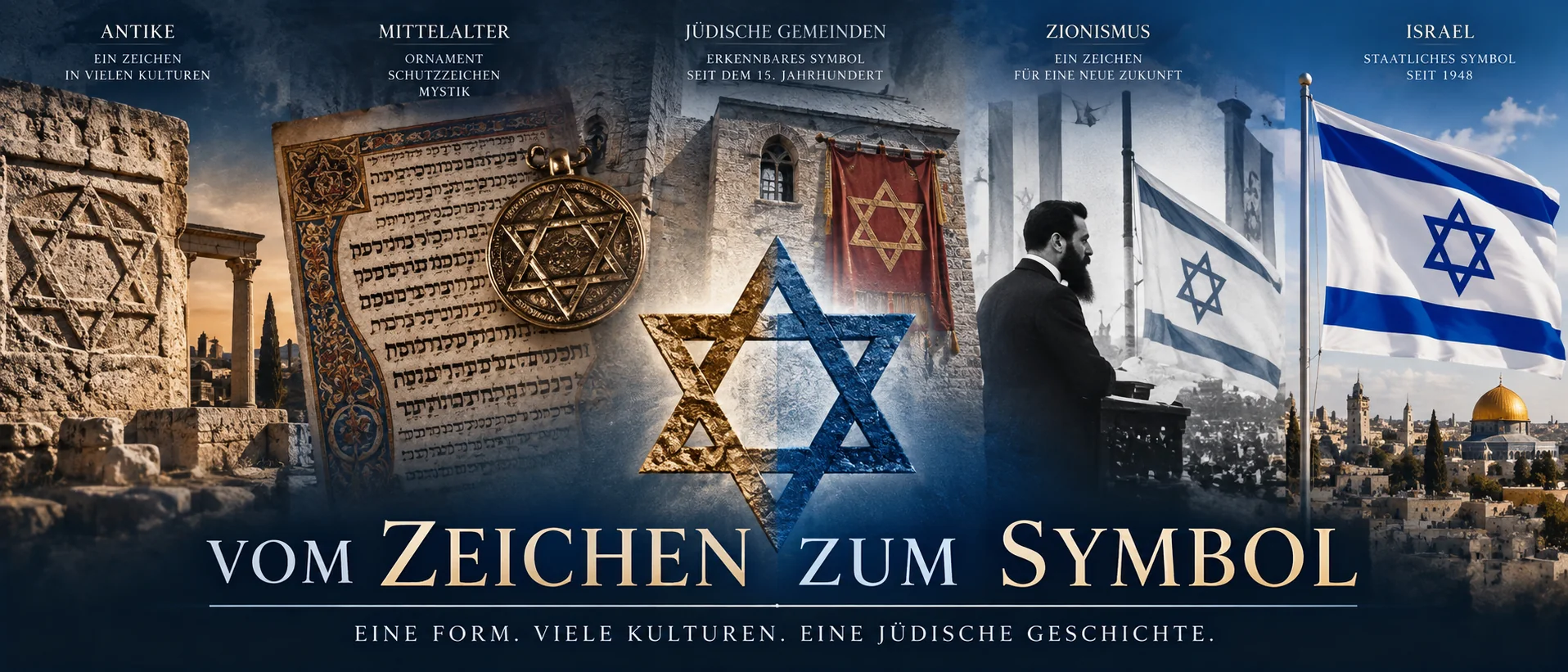
Few signs today are as immediately associated with Jewish identity as the Star of David. It appears on synagogues and gravestones, is worn as jewelry, and forms the center of the Israeli flag. Yet its history did not begin as an exclusively Jewish symbol. That is precisely where its true significance lies: Over the course of centuries, an ancient geometric form became a sign of Jewish community, persecution, self-assertion, and national self-determination.
In Hebrew, the Star of David is called מגן דוד, Magen David, literally “Shield of David.” Its form consists of two interlocking equilateral triangles and is geometrically known as a hexagram. However, no historical connection between this sign and the biblical King David can be established. Neither the Hebrew Bible nor contemporary archaeological sources prove that David carried a six-pointed star as a personal emblem or on a shield.
The Jewish historian of religion and scholar of Kabbalah Gershom Scholem examined this development in detail. In his study published in 1949, “The Curious History of the Six-Pointed Star” he contradicted the idea that the Magen David had been a central symbol of Judaism since biblical times. The hexagram was considerably older and had been used in different cultures and religious contexts. According to Scholem’s assessment, it only became a generally comprehensible symbol of Jewish identity much later, especially in the modern era and finally on a mass scale in the 19th century.
Passende X-Beiträge
Aus dem SCHLAGSEITE X-Archiv
The Star of David was not originally a Jewish symbol
This does not mean that the hexagram was unknown in early Jewish history. Scholem refers to individual Jewish finds from antiquity as well as depictions in late antique synagogues. The National Library of Israel also describes early Jewish uses. What matters, however, is the function: A geometric sign can appear on a seal, a wall, or an item of jewelry without already being a generally understood religious or national symbol.
A particularly tangible example dates from the early 11th century. On an elaborately designed page of the Leningrad Codex from 1008 or 1009, the oldest completely preserved manuscript of the Masoretic text of the Hebrew Bible, a large hexagram made of micrographic Hebrew text appears. This demonstrates an unequivocally Jewish use of the form. However, it does not yet prove that the star already had the same general symbolic function at that time as it does today.
At the same time, the hexagram is also found outside Judaism, including in Christian, Islamic, and Asian contexts. It was used as an ornament, protective sign, and in mystical traditions. Its mere existence in a Jewish setting therefore does not yet prove the meaning that the Star of David has today.
The older and unequivocally Jewish symbol was the menorah. The seven-branched candelabrum is directly connected to the Temple in Jerusalem and thus to a much older Jewish religious tradition. The fact that the State of Israel uses the menorah in its state emblem and the Magen David on its flag therefore connects two different historical levels of Jewish symbolism.

ℹ️ Name and symbol are not the same thing
The expression “Magen David,” Shield of David, already appears in the Babylonian Talmud. In Pesachim 117b, “Magen David” is mentioned as the concluding formula of the blessing after the Haftarah. It does not refer there to a six-pointed star or a geometric symbol, but to a liturgical and theological formula connected with David. The name and the hexagram were only linked at a later point.
From ornament to protective sign: The hexagram in the Middle Ages
In the Middle Ages, the hexagram increasingly appeared in religious manuscripts, amulets, and mystical contexts. Here too, the development was not linear. In Jewish as well as non-Jewish traditions, the hexagram was for a long time also associated with the so-called Seal of Solomon. Even this designation was not always unambiguous, since both six- and five-pointed forms could be called the Seal of Solomon.
The term “Seal of Solomon” and the later Jewish designation “Magen David” are therefore not simply two names for a symbol that was clearly defined from the outset. They belong to different lines of tradition that partly overlapped. This in particular shows how slowly the now self-evident connection between the six-pointed star and Jewish identity developed.
In magical and mystical ideas, geometric signs could be attributed protective powers. Such forms also appeared on amulets and in manuscripts within Jewish traditions. Only gradually did Magen David become established as a specifically Jewish designation for the hexagram.
The popular idea that King David himself carried this star on his shield, by contrast, belongs to a later formation of tradition. What can be historically traced is not a symbol invented suddenly, but a gradual shift in meaning: An already familiar form increasingly came to be read as Jewish and was ultimately permanently linked to a Jewish name.
Prague becomes a turning point in the history of the Star of David
The Jewish community of Prague played a central role. Here in particular, however, it becomes clear why historical sources are more important than plausible-sounding traditions.
Popular accounts repeatedly claim that Emperor Charles IV had already allowed Prague’s Jews to carry their own flag with the Star of David in the 14th century. Different years appear in these accounts, especially 1354 and 1357. Historian Alexandr Putík of the Jewish Museum in Prague examined the tradition more closely. According to his account, the specific date of 1357 comes from the Bohemian chronicle of Václav Hájek of Libočany, published in 1541. Hájek is said to have retrospectively moved the granting of the right to carry a flag to the year 1357.
By contrast, the banner of Prague’s Jewish community is historically reliably documented only for 1490. At that time, Prague Jews took part in the public celebrations for the coronation of Vladislaus II as King of Hungary. The Jewish community appeared with its own banner, which displayed the six-pointed star. Putík assumes that Vladislaus himself probably authorized the production of this flag.
A sign that had previously been used in various contexts had thus visibly become a public symbol of a Jewish community. For the history of the Star of David, this is more important than the retrospective legend concerning Charles IV.
⚠️ 1354, 1357, or 1490?
Popular accounts often name 1354 or 1357 for an alleged Prague Star of David flag under Charles IV. Alexandr Putík traces the specific tradition to Václav Hájek’s chronicle of 1541, which backdated the event to 1357. The banner of Prague’s Jewish community bearing the Magen David is reliably documented only for 1490.

From Prague, the use of the Magen David spread further. The sign increasingly appeared on community seals, synagogues, books, and later also on gravestones. In 1598, Rudolf II allowed the influential Prague community leader Mordechai Maisel to produce another flag for his synagogue, modeled on the existing Prague community flag. By then, a recognizable Jewish communal symbolism had developed from a single sign.
In the 19th century, the Star of David becomes a Jewish identifying sign
Its decisive spread took place in the modern era. In the 18th and especially the 19th century, an increasing number of Jewish communities used the Star of David on synagogues, seals, letterheads, and other public signs. Its function changed once again.
This is also a central point of Gershom Scholem’s study. For many centuries, the hexagram had primarily been an ornament, magical sign, or protective symbol and by no means the general emblem of Judaism. Only in the modern era, and especially in the 19th century, did the Magen David widely become a Jewish symbol that made belonging immediately recognizable.
It was no longer merely a mystical or decorative motif. At a time when Jewish communities in Europe were becoming more visible in public life, the star offered a simple and recognizable symbol. This very familiarity made it interesting to the Zionist movement a few decades later.
Zionism gives the Magen David a national meaning
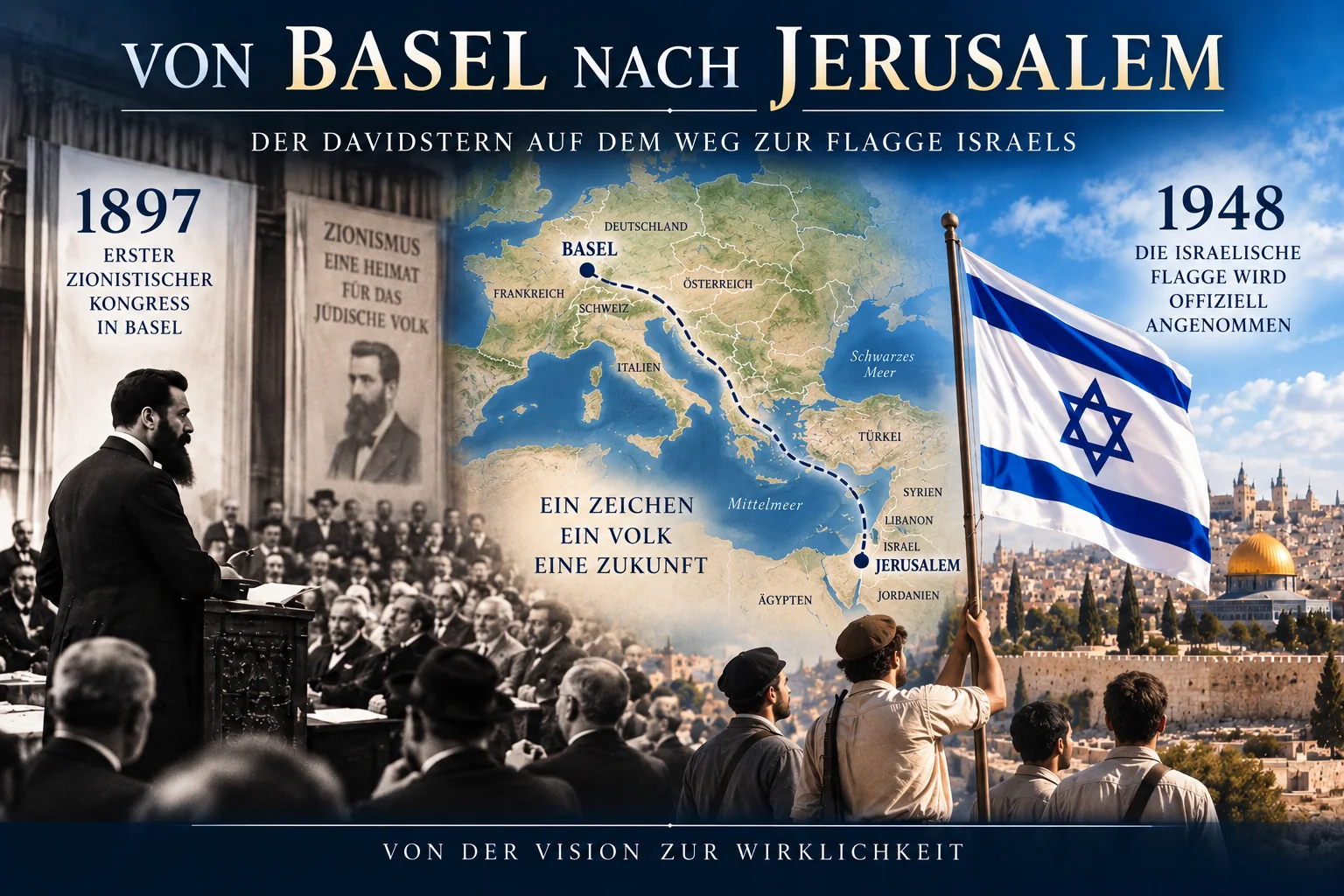
At the First Zionist Congress in Basel in 1897, the young political movement needed a visible common sign. David Wolffsohn, a close associate of Theodor Herzl and later president of the Zionist Organization, played a central role in establishing the blue-and-white flag.
An official Israeli account of the history of the state flag attributes the blue-and-white design at the First Zionist Congress of 1897 to Wolffsohn. The colors were associated with the Jewish prayer shawl, the tallit. The Magen David was placed in the center. This gave the Star of David as a Jewish symbol another meaning. It no longer stood only for Jewish religion or Jewish communities, but increasingly also for the idea of Jewish national self-determination.
After the founding of the State of Israel, the question arose in 1948 whether the new state should adopt the flag of the Zionist movement or create its own state symbol. The decision favored the already established blue-and-white flag. The Provisional State Council officially declared it the flag of the State of Israel on October 28, 1948. The proclamation specified a white field, two blue stripes, and the blue Magen David in the center.
The Flag and Emblem Law adopted in 1949 explicitly referred back to this decision of October 28, 1948.
The Nazis turned the star into a compulsory marking
Between the Zionist adoption of the Magen David and its later use on the Israeli state flag lies one of the darkest phases of its history.
The Nazis used the six-pointed star to forcibly mark Jews. The United States Holocaust Memorial Museum documents that Jewish identifying badges had already been introduced in various German-occupied territories from 1939 onward. In the German Reich, Jews were required to wear a yellow star from September 1941.
The star did not simply serve bureaucratic identification. It was intended to publicly stigmatize Jews, exclude them, and make their movements controllable. The marking ultimately also facilitated persecution and deportation. A sign that Jewish communities themselves had increasingly adopted as an expression of their identity was deliberately turned against them by an antisemitic regime.
Gershom Scholem saw this as a profound rupture in the history of the Magen David. In his interpretation, the symbol acquired through the Shoah a historical weight that it had not previously possessed in this form. This classification is Scholem’s interpretation from the history of religion. The historical process itself is clear: Nazi rule temporarily transformed the Star of David into a forcibly imposed sign of exclusion and persecution.
In 1948, the star appears on the flag of a Jewish state
Only a few years later, the same six-pointed star appeared in a completely different context. No longer forced onto clothing by persecutors, but chosen by Jews themselves, the blue Magen David now stood at the center of the flag of the State of Israel.
This temporal proximity gives the symbol a particular historical tension. The Star of David did not become Jewish only through the Shoah, and the national flag did not emerge as a direct response to the yellow star. Both developments have a longer prehistory. Nevertheless, forced identification and national self-determination lie so close together historically that they inevitably shape how the symbol is perceived today.
The Magen David can therefore express religious, cultural, and national belonging at the same time. A Star of David on a synagogue does not mean exactly the same thing as a Star of David on a necklace or on the flag of Israel. The form is the same. The specific context determines its concrete meaning.
Why the older hexagram became a Jewish symbol
The pre-Jewish history of the hexagram is occasionally used to support the claim that the Star of David is not actually a Jewish symbol at all. Historically, this is too narrow a view.
A symbol does not become a symbol of a community because no one previously used the same geometric form. Its meaning arises through shared use, memory, tradition, and history. Two intersecting lines are, geometrically, also merely two lines. Nevertheless, their specific cultural use can possess a meaning that extends far beyond the form itself.
This process can be traced particularly clearly in the case of the Star of David. The hexagram existed long before it acquired its unambiguous Jewish meaning. Jewish communities adopted it, used it publicly, and made it a sign of their own identity. Zionism gave it an additional national dimension. The National Socialists abused this already existing Jewish symbolism for persecution. The State of Israel ultimately placed the Magen David at the center of its flag.
The Star of David did not become a Jewish symbol on a particular day. Its meaning developed over centuries. An old geometric sign became the Magen David through Jewish use, memory, and history.
That is precisely why the question of its origin is less decisive than the question of its meaning. The hexagram may be older than its Jewish use. The Magen David, as we understand it today, is nevertheless the result of Jewish history: shaped by community and religion, by persecution and the Shoah, by Zionism, and finally by Israel’s national self-determination.
ℹ️ Factual basis and primary sources for the article 📑
▶️ Gershom Scholem:
The Curious History of the Six-Pointed Star
Foundational historical study of the development of the hexagram into a Jewish symbol, published in 1949.
▶️ National Library of Israel:
The Story of the Star of David
Overview of the history of the hexagram, its early Jewish use, and the later development of the Magen David.
▶️ Babylonian Talmud, Pesachim 117b:
Pesachim 117b
Textual evidence for “Magen David” as a liturgical concluding formula of the blessing after the Haftarah, not as a designation for a hexagram.
▶️ Leningrad Codex and Seal of Solomon:
What Is the Seal of Solomon?
Depiction of the hexagram in the Leningrad Codex from 1008 or 1009, respectively, as well as an explanation of the medieval designation “Seal of Solomon.”
▶️ Alexandr Putík, Jewish Museum in Prague:
O tradičním znamení Židovské obce v Praze
Historical study of the Prague Jewish community flag, the 1357 legend in Václav Hájek, and the reliably documented banner from 1490.
▶️ Israeli Ministry of Aliyah and Integration:
Symbol, Anthem and Flag
Official Israeli account of the blue-and-white flag, David Wolffsohn, the First Zionist Congress of 1897, and the connection between the colors and the tallit.
▶️ Knesset, Proclamation of the Israeli Flag:
Documents on the Proclamation of the Flag and State Emblem
Official documentation of the decision by the Provisional State Council to declare the blue-and-white flag with the Magen David the flag of Israel on October 28, 1948.
▶️ Knesset, Flag and Emblem Law:
Flag and Emblem Law, 1949
Official legal record. The law explicitly refers to the Provisional State Council’s flag decision of October 28, 1948.
▶️ United States Holocaust Memorial Museum:
Jewish Badge: During the Nazi Era
Documentation of the Nazis’ compulsory identification of Jews and its function in exclusion, control, and deportation.
▶️ Ynet:
Magen David: From mystical talisman to Zionist symbol
Journalistic account of the history of the Magen David based on the research of Gershom Scholem.
🔎 Spotted an error, criticism, or addition?
SCHLAGSEITE.eu stands for careful research and transparent corrections. Have you discovered a factual error, unclear wording, or a broken link? Then send me your tip. If possible, please provide a verifiable source.