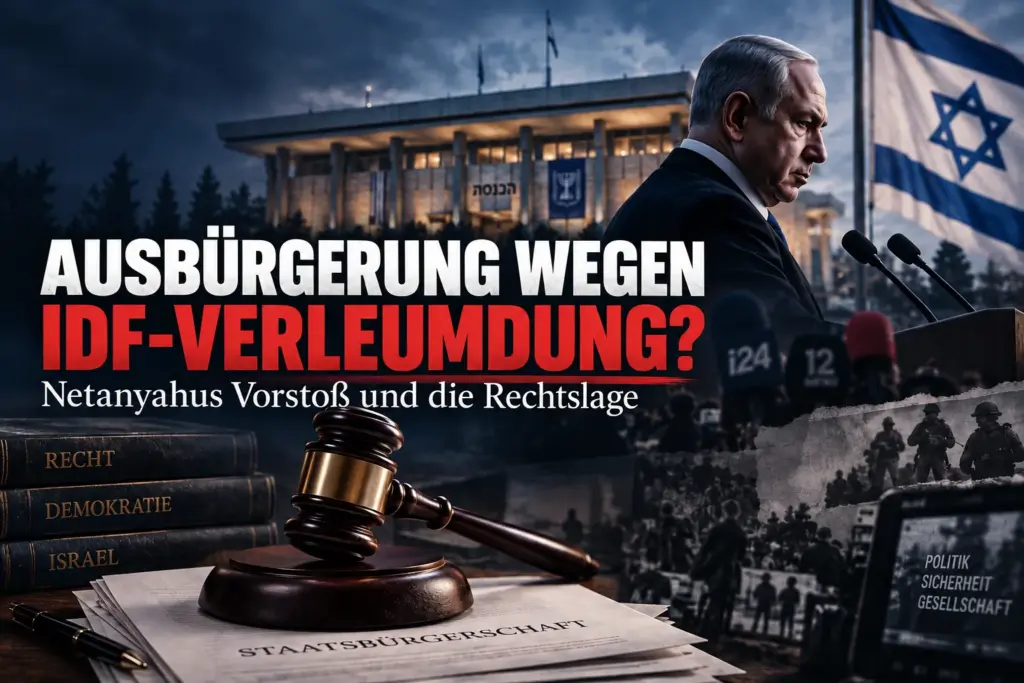
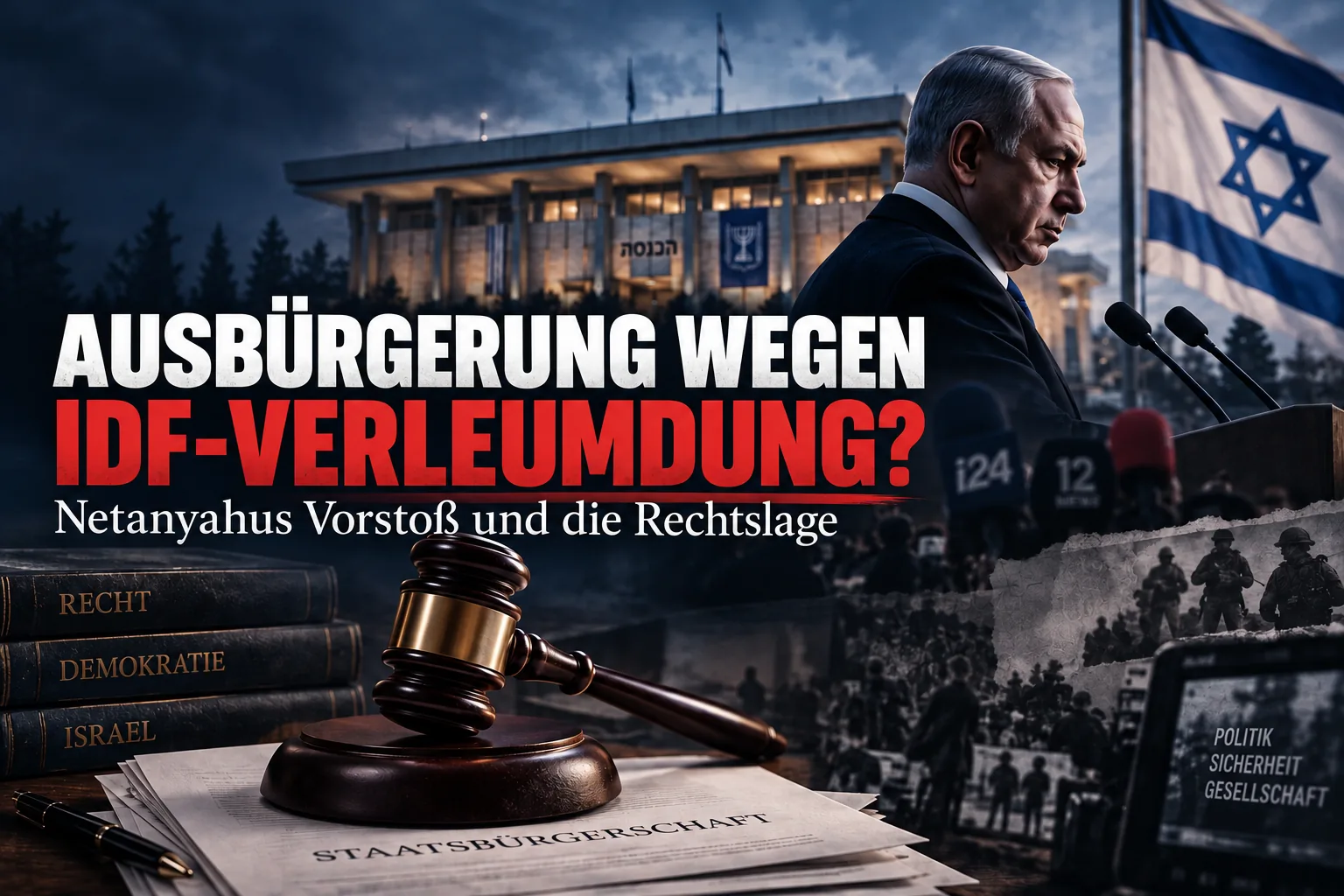
Israeli Prime Minister Benjamin Netanyahu wants to use two new laws to combat the smearing of Israeli soldiers abroad. One of them is intended to make it possible in future to revoke Israeli citizenship as well. The controversy surrounding the documentary “NAZA”. But decisive legal questions lie between Netanyahu’s political announcement and an actually applicable law.
Netanyahu announced the initiative in a video message on September 16, 2026. According to matching reports by the Times of Israel, the Jerusalem Post and Reuters two government bills are to be introduced. The first is intended to make citizenship revocation possible, while the second would increase possible compensation claims in defamation proceedings twentyfold.
Smearing Israeli soldiers: What Netanyahu announced
The wording hinges on a distinction that has already become blurred in some international headlines. Netanyahu did not speak generally of Israelis who criticize the IDF. He spoke of people who defame or smear Israeli soldiers. The Times of Israel uses “slander,” Reuters “defame,” and the Jerusalem Post “smearing.”
This distinction is essential. Political criticism of the army, a false statement of fact, and defamation established by a court are not the same thing. That is precisely why, for example, the headline in Novara Media saying that Netanyahu wants to strip Israelis of their citizenship for “criticizing” the IDF goes beyond the wording substantiated so far.
Netanyahu named three examples that, in his view, had caused serious harm to Israel and IDF soldiers. He referred to statements by Democratic Party chairman and former deputy chief of staff Yair Golan, former military advocate general Yifat Tomer-Yerushalmi, and filmmakers Yuval Abraham and Rachel Szor behind “NAZA”.
In the case of Tomer-Yerushalmi, he was referring to the leak of surveillance footage broadcast in 2024 from the Sde Teiman military prison, which was purported to show the alleged mistreatment of a Palestinian detainee by Israeli soldiers. Tomer-Yerushalmi later acknowledged authorizing the release of the video. Netanyahu described the leak as serious defamation and said the video had been edited. At the same time, the Times of Israel points out that there was no credible evidence that the video was inauthentic. According to Netanyahu, the two announced laws are to be introduced as government bills.
אנחנו נשמור על הלוחמים הגיבורים שלנו. נשלול אזרחות למי שיכפיש את חיילי צה״ל בעולם – ונפגע לו עמוק בכיס. pic.twitter.com/ziS6N37Jpe
— Benjamin Netanyahu – בנימין נתניהו (@netanyahu) September 16, 2026
“NAZA” is the trigger, but not the only case
The documentary “NAZA” by Yuval Abraham and Rachel Szor is at the center of the current dispute. The film is based on anonymous statements by Israeli soldiers and members of the military intelligence service and makes serious allegations about Israeli warfare in the Gaza Strip. Among other things, it claims that high expected civilian casualty figures were systematically factored into certain targeting decisions.
The IDF rejects key statements in the film. As the Times of Israel reported, the military said that the publicly known statements and materials contained false claims and distortions. At that point, the IDF said it had not yet seen the full film and asked to be able to review it in full in order to respond to the allegations individually.
Chief of Staff Eyal Zamir also had possible legal action against the film and those involved examined and separately ordered an investigation into possible leaks of classified material.
The political dispute intensified after “NAZA” received the Special Jury Prize at the Venice Film Festival. Culture Minister Miki Zohar called for the two directors’ citizenship to be revoked and subsequently approached the Shin Bet. According to the Times of Israel he requested an investigation into how material might have reached the filmmakers.
Here too, a clear distinction is necessary: political accusations and demands have been made against Abraham and Szor. This does not establish that the two had committed a criminal offense because of the film in a final, legally binding ruling.
Passende X-Beiträge
Aus dem SCHLAGSEITE X-Archiv


Israel can already revoke citizenship today
The revocation of Israeli citizenship is not an entirely new legal instrument. However, the existing provisions concern other, narrowly defined circumstances.
Since an amendment to Israel’s Citizenship Law in 2008, a court, upon application by the interior minister, has been able to revoke citizenship for a serious breach of loyalty to the state. These include, among other things, acts of terrorism, treason, serious espionage, and other cases defined by law. In 2022, the Supreme Court generally upheld the constitutionality of this provision. A legal summary of the decision is documented by the Legal Center Adalah.
Under the 2008 provision, a criminal conviction is not necessarily a prerequisite for this route. However, the Supreme Court made clear that citizenship revocation should be reserved for particularly serious and exceptional cases. The current procedure also shows how high the threshold is: According to the Times of Israel the interior minister must apply for revocation, the justice minister must approve it, and a court must confirm the decision.
In addition, in February 2023 the Knesset adopted another special provision. It concerns Israeli citizens or permanent residents who have been convicted of an offense deemed a breach of loyalty to the state, received an actual prison sentence for it, and demonstrably received payments from the Palestinian Authority in connection with the offense. The Knesset documents the enacted law and the procedure provided for it.
These existing provisions cannot simply be applied to “NAZA”. Acts of terrorism, treason, or serious espionage are legally different from a controversial publication or possible defamation. Netanyahu’s initiative would therefore have to create a new legal area of application.

ℹ️ Legal background
Israel already provides for citizenship revocation in cases of serious breaches of loyalty and, under certain conditions, for convicted persons who receive payments from the Palestinian Authority for such an offense. Netanyahu’s announced provision against smearing IDF soldiers would be distinct from these. The decisive issue will be how a specific bill defines the offense, procedure, and judicial oversight.

The decisive text of the law is still missing
Netanyahu has described the political direction, but not yet the decisive legal details. His statements published so far do not indicate which specific offense would in future make citizenship revocation possible or what judicial finding would be required for it.
It is open, for example, whether a final conviction for defamation would be required, whether special conditions would apply to statements made abroad, and which court would decide on possible citizenship revocation.
This is not a legal side issue. A law that, through a rule-of-law procedure, covers demonstrably false statements of fact would be something different from a provision that makes harsh criticism of the government or army itself a possible reason for citizenship revocation.
The wording that Netanyahu wants to strip Israelis of their citizenship for “criticizing the IDF” is too sweeping based on the wording known so far. What is substantiated is his announcement concerning people whom he accuses of smearing Israeli soldiers. How far an actual law would reach can only be assessed on the basis of the text of the law.
Herzog criticizes “NAZA” and citizenship revocation
Israeli President Isaac Herzog drew a notable distinction. According to the Times of Israel, he told Channel 12 that revoking the filmmakers’ citizenship had “no chance” and was “completely irrelevant”. At the same time, Herzog described the film as a “disgrace and humiliation”.
He objected in particular to the anonymous military personnel who made their allegations for the film instead of using existing internal investigative channels. Herzog is therefore not defending the film, but separating two questions: the substantive criticism of “NAZA” and the political demand to revoke citizenship.
This distinction is also important for the debate. Rejecting the film does not automatically mean supporting Netanyahu’s proposed law. Conversely, criticism of the law does not automatically make the claims in “NAZA” true.
Israel’s reaction redirects the debate toward freedom of expression
At the same time, concern is growing within Israel that the political reaction could give the film additional international attention. Channel 12 reported on an internal paper and assessments by Israeli diplomats, according to which an aggressive public reaction would shift the debate from the film’s content to the issue of freedom of expression. The Times of Israel documents these statements, but points out that they are assessments by involved bodies and diplomats, not a new official government position.
On September 17, the Times of Israel also reported that the Foreign Ministry had advised its diplomats to scale back the attacks on the filmmakers. According to the assessment quoted there, the continuing sharp Israeli reactions were by then doing more harm internationally than benefiting Israel. The political conflict has thus long since grown larger than the original dispute over a documentary.
At its core, two questions now stand side by side: How well-founded are “NAZA”’s serious allegations against the IDF, and how far may the state go against its own citizens when, in the government’s view, their statements abroad defame Israeli soldiers?
Netanyahu’s announcement is politically clear, but has not yet been formulated in legal terms. A law revoking citizenship for defaming IDF soldiers would constitute a substantial expansion beyond the cases of application known so far and would therefore have to be assessed according to its specific wording, procedural rules, and judicial oversight.
What is clear so far: Netanyahu wants to significantly tighten the legal and financial consequences for people whom he accuses of smearing Israeli soldiers. What is not clear is that general criticism of the IDF would in future lead to denaturalization. Precisely this boundary must not become blurred in reporting, whether in defense of the government or in its sensationalization.
ℹ️ Factual basis and primary sources for the article 📑
▶️ The Times of Israel:
PM pledges bill to strip citizenship from those who smear IDF abroad amid ‘NAZA’ outcry
Documents Netanyahu’s announcement of the two legislative initiatives, the cases he cited, Herzog’s reaction, the applicable procedure for revoking citizenship, and the Israeli debate over the public reaction to “NAZA”.
▶️ Reuters:
Netanyahu steps up threats against directors of Gaza documentary ‘NAZA’
Independent agency confirmation of the legislative announcement and contextualization within the controversy surrounding the documentary.
▶️ Jerusalem Post:
Benjamin Netanyahu says he will push for law revoking citizenship for slander of IDF
Confirms Netanyahu’s announced revocation of citizenship and the planned twentyfold increase in possible damages claims.
▶️ Knesset:
Approved in final readings: Bill to revoke citizenship of a person convicted of terrorism who receives funds for his actions from the Palestinian Authority
Official documentation of the special law adopted in 2023 on revoking citizenship or residency status under defined conditions.
▶️ Adalah / Supreme Court proceedings:
Q&A: Israeli Supreme Court allows government to strip citizenship for ‘breach of loyalty’
Documents the 2008 provision, the 2022 decision by the Supreme Court, the statutory grounds, and the fact that a prior criminal conviction is not necessarily required for this route.
▶️ Times of Israel on the IDF’s reaction to “NAZA”:
Israeli politicians assail Israeli film alleging AI-powered killing in Gaza
Documents the film’s allegations and the IDF’s response to the publicly available materials.
▶️ Times of Israel on Zamir’s legal review:
IDF chief floats legal action against ‘NAZA’ film, orders probe of leaked material
Documents the ordered review of possible legal action, as well as the separate investigation into possible leaks of classified material.
▶️ Times of Israel on Zohar’s demand for a Shin Bet investigation:
Minister urges Shin Bet to probe how sensitive materials reached ‘NAZA’ filmmakers
Documents Zohar’s demand for an investigation into the origin of the filmmakers’ material.
▶️ Times of Israel / Daily Briefing of September 17:
Foreign Ministry tells diplomats to dial down attacks on ‘NAZA’ film
Reports on the Foreign Ministry’s recommendation to Israeli diplomats to tone down the public line of attack against the filmmakers.
▶️ Novara Media:
Netanyahu Vows to Strip Citizenship From Israelis Who Criticise the IDF
Example of an international headline that broadens Netanyahu’s wording, “slanders IDF soldiers,” to general criticism of the IDF.
▶️ Times of Israel on the Sde Teiman leak:
Netanyahu says leaking of video ostensibly showing abuse of prisoners at Sde Teiman marks ‘a terrible libel’
Documents Netanyahu’s portrayal of the video as edited and his accusation of serious libel. The source also notes that there was no credible evidence that the video was inauthentic.
🔎 Spotted an error, criticism, or addition?
SCHLAGSEITE.eu stands for careful research and transparent corrections. Have you discovered a factual error, unclear wording, or a broken link? Then send me your note. Please provide a verifiable source where possible.