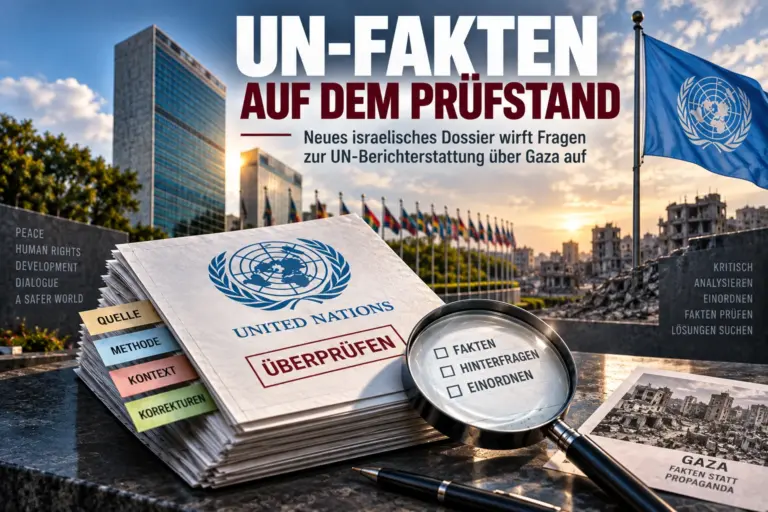

The accusation of genocide against Israel is raised by two Israeli NGOs, German media pick up the allegation, and political assessments can quickly create the impression of an almost established finding. The problem is not that such allegations are reported. The problem begins where politically and methodologically clearly positioned organizations are presented as neutral authorities, counterevidence is given insufficient attention, and even verifiable information is reproduced incorrectly.
The accusation of genocide is among the most serious allegations that can be made against a state. Accordingly, the level of journalistic care should be exceptionally high. Anyone claiming that Israel is deliberately attempting to destroy the Palestinian population in the Gaza Strip in whole or in part is not reporting on just any political dispute. The issue is a clearly defined offense under the Genocide Convention, whose decisive prerequisite is not destruction or a high number of victims alone, but a specific intent to destroy a protected group as such.
This makes it all the more important to examine precisely how media outlets handle reports by human rights organizations. One example is provided by a report by Tagesschau dated July 28, 2025. It presents the Israeli organizations B’Tselem and Physicians for Human Rights Israel, PHRI at length in connection with their genocide allegation.
It is of course right for German media to report on this. But journalism does not begin by passing on an allegation; it begins by examining it.

Passende X-Beiträge
Aus dem SCHLAGSEITE X-Archiv


Being a human rights organization does not mean being politically neutral
B’Tselem is an Israeli human rights organization. That makes its information neither automatically right nor wrong. But it also does not make the organization a politically neutral arbiter.
B’Tselem has taken an expressly critical position toward Israel for years. On its own website, the organization explicitly describes Israeli rule as a system of “apartheid and occupation” and states that its own goal is to end this system. The report published in July 2025, “Our Genocide” goes even further and expressly concludes that Israel is committing genocide in the Gaza Strip.
Whether this political position is described as left-wing, progressive, or activist is secondary to the factual examination. What matters is this: The organization has a clearly recognizable normative and political perspective on Israel. That perspective is precisely part of source criticism.
This applies not only to B’Tselem. Several of the NGOs particularly visible in the Israel debate represent progressive or explicitly critical political positions toward Israel, or operate within corresponding civil-society networks. This too does not automatically make their documentation wrong. But it means that political self-positioning, campaign objectives, funding, methodological foundations, and long-standing positions are just as much part of source criticism as they are for state or government-affiliated institutions.
In the case of Israel in particular, it is striking that this obvious principle is not always applied consistently. A statement by the Israeli government is regularly accompanied by the observation that it comes from a party to the conflict. That is correct. But in the case of an NGO with a clear political agenda, this caveat must not suddenly be treated as irrelevant.
If an Israeli organization close to the government were involved, its proximity to the government would naturally be mentioned. The same standard must also apply to NGOs.

ℹ️ Source criticism does not mean rejecting sources
A politically positioned organization can provide accurate and important information. The decisive questions are whether its claims can be verified, what methodology is used, which countervailing information is taken into account, and whether a distinction is made between documented facts and political or legal assessment.
PHRI does not merely examine the healthcare system; it already assesses it as genocide
The same applies to Physicians for Human Rights Israel. PHRI focuses primarily on medical care and human rights and extensively documents damage to medical infrastructure, deaths, injuries, and the difficult conditions of care in the Gaza Strip.
This information deserves serious examination. Yet the framework chosen is already apparent in the report’s title: “A Health Analysis of the Gaza Genocide”.
Genocide here is therefore not merely an open question for examination; it is already part of the analytical starting framework. That is also permissible for an NGO. Media outlets must then, however, make clear to readers that they are dealing with the organization’s assessment and not with a judicial finding.
1,580 healthcare workers become more than 1,500 doctors
The importance of such cross-checking is shown by an easily verifiable figure.
In its report, Tagesschau writes that more than 1,500 doctors were killed in the Gaza Strip.
But that is not what the underlying PHRI report says.
It refers to 1,580 killed “healthcare workers”—that is, healthcare workers. PHRI explicitly includes senior doctors and hospital directors among them. However, the total does not refer exclusively to doctors.
That is a significant difference. Doctors are healthcare workers, but healthcare workers do not consist exclusively of doctors. This can include, among others, nurses, emergency personnel, medical-technical staff, and other employees of medical facilities.
The NGO did not make this exaggeration. The media outlet did.
Especially in the case of an accusation on the scale of genocide, this is not an insignificant linguistic inaccuracy. Figures have an impact. Turning healthcare workers into doctors alone makes the statement more dramatic and, at the same time, factually less precise.

“No evidence” of Hamas in hospitals?
The portrayal of the military use of hospitals is even more problematic.
In the Tagesschau report, PHRI director Guy Shalev essentially explains that if Israel had found evidence of Hamas using the hospitals, the public would have seen it. In his view, no such evidence exists.
This sweeping portrayal does not withstand scrutiny, at least in the case of the Al-Shifa complex.
The Israel Defense Forces published as early as November 2023 footage from the surveillance cameras at Al-Shifa Hospital, showing hostages abducted to Israel on October 7 being brought into the hospital complex accompanied by armed Hamas terrorists. Israel also published material on tunnels and weapons finds at or beneath the site.
It is therefore not necessary to accept every Israeli statement about every hospital without scrutiny. The more expansive initial claims about the size and function of Hamas infrastructure beneath Al-Shifa were publicly debated and, in some cases, critically questioned.
But that does not undo the central point. The claim that no evidence whatsoever had been presented of military use by Hamas is too sweeping.
What is decisive here is that this assessment does not come only from Israel. An assessment published in January 2024 by the U.S. intelligence services independently concluded that Hamas and Palestinian Islamic Jihad had used the Al-Shifa complex for military purposes.
According to this assessment, parts of the complex and areas beneath it were used to house command infrastructure, conduct certain command-and-control activities, store weapons, and hold at least some of the hostages abducted on October 7.
The American assessment expressly did not confirm every further-reaching Israeli claim about the size and significance of the infrastructure beneath the hospital. That is precisely why it is relevant to the assessment. It does not simply adopt the maximal Israeli account, but independently confirms the decisive core point: the military use of the hospital complex.
Thus, the sweeping claim that Israel had presented no evidence whatsoever of military use at Al-Shifa fails—not merely because of Israeli statements.
The military use of Al-Shifa was not merely an unsubstantiated Israeli narrative.
An attacked hospital does not prove genocide
Hospitals enjoy special protection under international humanitarian law. This protection is fundamental. But it does not mean that a medical facility remains inviolable under all circumstances regardless of its actual use.
If a protected medical facility is used for military purposes outside its humanitarian function, its special protection can be lost under certain conditions. Even then, strict requirements regarding warning, military necessity, precautions, and proportionality continue to apply.
This leads to two conclusions.
A hospital may not be attacked merely because a terrorist is somewhere inside it. But the following is equally true: The damage to or destruction of a hospital does not, by itself, prove either a war crime or genocidal intent.
This intermediate legal level is precisely what can quickly be lost in emotionally charged portrayals. Destroyed clinic, many victims, genocide allegation. Three images do not yet constitute a complete legal chain of proof.
The decisive point is called dolus specialis
The Genocide Convention requires more than deaths, extensive destruction, or catastrophic living conditions. What is decisive is the specific intent to destroy a national, ethnic, racial, or religious group as such, in whole or in part.
In legal terms, this specific intent to destroy is referred to as dolus specialis. It distinguishes genocide from other serious crimes under international law.
High numbers of civilian casualties, massive destruction, and immense human suffering may be relevant to examining an allegation of genocide. But they do not replace proof of this specific intent to destroy.
It is precisely this problem that the international lawyer Kai Ambos—interviewed by Tagesschau itself—points out. He explains that, in his view, the decisive requirements for an intent to destroy are not examined explicitly enough in the two NGO reports.
This is not a legal footnote. It is the core of the crime of genocide.
The International Court of Justice has clearly articulated this threshold in its genocide jurisprudence to date. In the case of Croatia v. Serbia the Court made clear that genocide consists of a physical element, the actus reus, and a special mental element, the dolus specialis, exists.
If there is no express plan to destroy a group and the intent is instead to be inferred from a pattern of conduct, that pattern must, according to the case law of the ICJ, be such that the intent to destroy is the only reasonable inference from the acts in question.
That is precisely why the equation often encountered, “many deaths plus extensive destruction equals genocide” is legally insufficient.
A tangible comparison makes the difference clearer: A military operation may be unlawful, disproportionate or even a war crime without therefore automatically constituting genocide. In the case of a war crime, it may be decisive that an attack is carried out despite foreseeable excessive civilian harm. For genocide, even the most serious unlawful conduct is insufficient unless it is additionally established that the protected group is specifically intended to be destroyed as such.
ℹ️ The difference in one sentence
Severe destruction describes what happened. Dolus specialis describes why it happened. Only the specific intent to destroy, in whole or in part, a protected group as such turns the acts listed in the Genocide Convention into genocide.
It must additionally be examined what Israel seeks to achieve with its military operations, which targets are actually attacked, what measures are taken to protect civilians, and whether the documented acts can reasonably also be explained by other military objectives.
This means that Israel’s stated war aims must be taken into account in particular: the fight against Hamas following the massacre of October 7, 2023, the destruction of its military and terrorist infrastructure, and the return of the hostages who were abducted.
This does not mean that every Israeli military operation would automatically be lawful. But it does mean that another plausible military objective cannot simply be skipped over when a specific intent to destroy is to be inferred from destruction.

Israel’s counterarguments also form part of the evidentiary examination
Anyone who criticizes the media for adopting NGO reports without verification must, conversely, also identify the Israeli argument and subject it to the same critical scrutiny.
Israel denies waging a war against the Palestinian population. Rather, the Israeli government and the armed forces state that the military objective is to dismantle Hamas, eliminate its military infrastructure, and free or return the hostages.
This counterposition consists of more than merely a political assertion. Israel points to concrete protective measures, aid deliveries and military targets. In addition, there are individual non-Israeli assessments that support at least parts of this account. This is central to examining an alleged intent to destroy.
Warnings and evacuation measures
The IDF documents having called on civilians to evacuate numerous operations via leaflets, phone calls, text messages and recorded voice messages . According to an IDF interim report published in April 2024, by that point, according to Israeli figures, around 9.3 million evacuation leaflets, 15.5 million text messages, 17 million recorded voice messages and approximately 100,000 phone calls had been used.
These figures come from the IDF and must therefore be treated as Israeli self-reported figures. They prove neither that every warning was issued in good time nor that every civilian actually had a safe escape route. But they are a concrete part of the evidentiary record when it is alleged that Israel’s actual objective was the physical destruction of the population.
Humanitarian aid on a substantial scale
Humanitarian provision must also be included in this examination. The official COGAT dashboard stated that, as of July 23, 2025, a total of approximately 1.87 million tons of humanitarian goods had entered the Gaza Strip by land, air and sea since the beginning of the war. The figures recorded were 96,245 trucks and 10,450 pallets.
These figures also require context. The dashboard itself notes that between March 2 and May 19, 2025 no aid entered the Gaza Strip on political instructions. And the entry of aid at the border, in itself, says nothing about whether it was fully distributed within Gaza or quantitatively sufficient at every point in time.
It is precisely this limitation that makes the figure informative rather than propagandistic. The aid deliveries do not exonerate every Israeli decision. But they contradict an analysis that effectively ignores measures to supply the civilian population and then infers an intent to destroy solely from the catastrophic living conditions.
Hamas fighters, recruitment and military infrastructure
Israel also states that it is specifically targeting Hamas’s military structures. According to Israeli figures, these include tunnel networks, command centers, rocket sites, weapons depots and production facilities. The al-Shifa complex is not the only example. In May 2025, the IDF also reported a Hamas command and control center in Nasser Hospital in Khan Younis and published information during the same period on underground Hamas infrastructure beneath the European Hospital.
These claims initially also come from Israeli military sources. They therefore must not simply be treated as independent factual findings, but they are concrete claims about identified military targets and not merely the abstract formula “Hamas is somewhere in Gaza.”
There is also an important non-Israeli assessment. Reuters reported in January 2025, citing U.S. intelligence information, that Hamas had recruited an estimated 10,000 to 15,000 new members since the beginning of the war and lost fighters in a similar range. Many of the new recruits were young and inexperienced, but the assessment showed that Hamas remained an organized armed adversary despite heavy losses.
This is relevant to the genocide debate: Israel was not fighting merely a diffuse political movement, but a terrorist organization that continued recruiting during the war, maintained armed structures and, according to the U.S. assessment, represented an ongoing threat.
The composition of the casualty figures also forms part of the context. The Hamas-controlled health authority does not distinguish between civilians and fighters in its overall total. Reuters reported on July 29, 2025, that the Israeli army had stated in January of the same year that it had killed nearly 20,000 Hamas fighters . Reuters also pointed out that Israel had not published an updated overall figure since then and that Hamas rejects the Israeli estimates as inflated.
The figure of nearly 20,000 Hamas fighters killed is an Israeli estimate and not an independently established factual figure. It must not be adopted uncritically as fact. But neither may it disappear when conclusions about Israel’s military objective are drawn from a total casualty figure that does not distinguish between civilians and fighters.
What these counterfacts mean for the genocide allegation
None of these points alone proves that Israel is not committing genocide. Warnings may be inadequate, aid deliveries may be insufficient, and attacks on military targets may nevertheless be unlawful or disproportionate.
But the genocide thesis requires more than proof of destruction and suffering. Anyone asserting a specific intent to destroy must explain how millions of warnings, extensive aid deliveries, the documented targeting of specific Hamas structures, the continued existence of an armed Hamas and, according to Israeli estimates, a significant proportion of fighters among those killed can be reconciled with the thesis of destruction directed at the Palestinian population as such.
This is the decisive counterfinding: These facts and counterclaims do not automatically refute every allegation of genocide, but they make a serious examination of the dolus specialis considerably more complicated than the mere addition of casualty figures and destroyed buildings would suggest.
A serious genocide analysis must not disregard incriminating facts. But it must equally not ignore exculpatory or contradictory facts.
ℹ️ The overall picture is decisive
Warnings, evacuations or humanitarian aid do not automatically rule out genocide. Likewise, civilian casualties and massive destruction do not automatically prove genocide. What is decisive is whether the totality of the evidence supports the specific intent to physically destroy, in whole or in part, the protected group as such.
Many claims are repeated, but that does not automatically make them true
The problem extends beyond this individual Tagesschau report.
In the Gaza war, chains of claims repeatedly emerge: an NGO publishes an assessment, other organizations take it up, political actors cite it, international institutions address it, and the media subsequently report that multiple actors are now making the same accusation.
Repetition can create the impression of several independent confirmations, even though different actors partly use the same underlying data, the same sources or similar political assumptions.
That is why it is not enough to count how many NGOs, activists, politicians or institutions endorse a particular claim. What matters is what evidence lies behind it, how independent the sources are from one another and whether they withstand critical scrutiny.
Particularly in connection with Israel, it repeatedly becomes apparent that individual far-reaching claims are corrected, qualified or at least become significantly more complicated upon closer examination. This applies to casualty figures and occupational groups as well as to the military use of civilian infrastructure, legal assessments or statements about alleged war crimes that have supposedly already been established.
A frequently repeated claim is not yet an independently confirmed fact.
Political motivation does not refute an allegation. But it makes careful examination all the more important. The more serious an accusation, the more precisely its origin, methodology, interests and counterevidence must be disclosed.
South Africa’s genocide case also did not arise in a political vacuum
This problem is particularly clear in South Africa’s case against Israel before the International Court of Justice.
South Africa initiated the proceedings on December 29, 2023 and accused Israel of violating the Genocide Convention. This constituted a serious legal allegation. But there had been no judicial finding of genocide.
A complete assessment must also include the claimant’s political background.
The African National Congress, ANC, which was then governing, had clearly positioned itself politically against Israel long before the proceedings. As early as February 2023, months before Hamas’s massacre on October 7, the ANC described Israel in its own statement as an apartheid state and opposed Israeli observer status with the African Union.
The political background becomes even clearer in December 2023. In an official ANC statement dated December 6, 2023 reports that the party met with representatives of various Palestinian organisations. Fatah, Hamas and Islamic Jihad are explicitly named. The ANC already uses the accusation of genocide against Israel in this statement.
Three weeks later, South Africa filed the case with the International Court of Justice.
This does not prove that every one of South Africa’s legal arguments is wrong. It would be equally unserious to dismiss a statement of claim solely because of the claimant’s political stance.
It does, however, show something else very clearly: South Africa’s accusation of genocide did not arise from a politically impartial legal examination in a vacuum. It was part of an existing political line of the ANC, which had classified Israel as an apartheid state long before and had made a demonstrative show of solidarity with the Palestinian cause.
The proceedings therefore obviously have a legal dimension. But they also have a documented political context.
German media in particular should distinguish between the two.
⚠️ The claimant is not the judge
South Africa’s application proves that South Africa is making the accusation of genocide. It does not prove that genocide took place. The claimant’s political history does not decide the proceedings, but it is an essential part of a complete journalistic assessment.
Provisional measures are not a guilty verdict
This distinction is particularly important because a different impression has stubbornly taken hold in public debate.
To date, the International Court of Justice has not found that Israel committed genocide in the Gaza Strip.
Since January 2024, the ICJ has issued several provisional measures. Such measures are intended to protect rights during ongoing proceedings and prevent possible irreparable harm. They are not a decision on the merits of the application and not a guilty verdict for genocide.
The merits proceedings are continuing. The official proceedings page of the International Court of Justice now also lists a further decision dated 21 May 2026. There is still no judgment on the merits as to whether Israel violated the Genocide Convention.
One formulation that is regularly reproduced in abbreviated form in public debate is particularly important here.
In January 2024, the Court did not declare that an Israeli genocide or the accusation of genocide itself was already “plausible” as a fact. In its later decision of May 2024, the ICJ expressly recalled that it had considered certain rights under the Genocide Convention claimed by South Africa to be plausible. These include the right of Palestinians in the Gaza Strip to be protected from acts that could fall under the Genocide Convention.
Plausible rights to protection are not the same as a genocide declared plausible or already proven.
taz also turns plausible rights into plausible accusations
The problem is therefore not limited to the Tagesschau report.
The taz also reported in detail on 28 July 2025 about the genocide accusations made by B’Tselem and PHRI.
The article also presents the Israeli counter-position at several points. At the end of the article, however, it says of South Africa’s case against Israel that the International Court of Justice had “accepted the plausibility of the accusations”.
This wording goes further than what the Court actually found.
The ICJ declared certain rights under the Genocide Convention claimed by South Africa to be plausible. It did not find that South Africa’s accusation of genocide as such had already been plausibly proven.
In the media shorthand, plausible rights to protection become plausible accusations of genocide.
That sounds like a minor linguistic difference. Legally, it is not.
The preliminary examination is specifically not intended to conclusively determine whether genocide took place. It is intended to prevent possible rights from being irreparably impaired before the Court has decided the actual dispute.
This reveals a second concrete example of how a complicated legal situation can become a much more unequivocal impression through linguistic abbreviation.
Other media also reported the NGOs’ accusations in a similar way, although not always with a comparable factual error. Deutschlandfunk reported on the same day that two Israeli human rights organisations described Israel’s actions as genocide, cited the high number of deaths and the massive destruction, but did not place the political positioning of the two NGOs in context in the brief report and did not present an Israeli counter-position either.
The Tagesschau is therefore not an isolated special case. The specific form varies from one outlet to another, but the recurring pattern remains: The NGO accusation is prominently placed, while its origin, methodology, political context and substantiated counterarguments receive considerably less space.

A UN commission is not a court either
The current factual situation also includes the fact that, in September 2025, an independent commission of inquiry of the UN Human Rights Council concluded that Israel was committing genocide. Israel rejected this assessment.
This finding must be mentioned when presenting the current state of the international debate.
But this commission, too, is not an international court that has convicted Israel of genocide.
An NGO report, a political statement, a UN commission of inquiry, a statement of claim, a provisional measure and a legally binding court judgment are different categories.
Anyone who linguistically merges them creates an impression of legal certainty that does not exist.
Political positioning does not make a source worthless
It would be too easy to dismiss B’Tselem, PHRI or other NGOs wholesale simply because their political orientation is left-wing, progressive or strongly critical of Israel.
Human rights organisations can document abuses, secure important witness testimony and scrutinise state action. Israeli authorities and the Israeli military must also be examined with journalistic distance.
But source criticism must not be a political one-way street.
If Israeli government statements are identified as being driven by vested interests, an NGO’s recognisable political agenda must also be mentioned. If IDF statements are checked, NGOs’ claims must also be checked. If the political motives of the Israeli government are discussed, the ANC’s political history in connection with South Africa’s genocide case must not suddenly become irrelevant.
This is not special treatment for Israel; it is precisely the journalistic standard that should apply everywhere.
When media outlets even intensify the source
In the end, the incorrect number of doctors may be the most revealing detail of the entire Tagesschau report.
PHRI writes of 1,580 healthcare workers killed. Tagesschau turns this into more than 1,500 doctors.
Here, the reporting does not fail because of a complicated borderline issue of international law, but already at the level of correctly reading the original source.
At the same time, the blanket claim that Israel had presented no evidence of Hamas’s use of hospitals is repeated, even though publicly available material on the Al-Shifa complex existed and even an independent US intelligence assessment confirmed the complex’s military use.
On the decisive legal element of dolus specialis the international law expert interviewed by Tagesschau itself points out that this precise question is not sufficiently examined in the NGO reports.
And in taz, the plausibility of certain rights to protection before the International Court of Justice becomes the supposed “plausibility of the accusations”.
This produces a remarkable pattern: The gravest accusation is given plenty of space, while precisely the points that make it more complicated legally and factually are abbreviated, toned down or not presented at all.
Many of these statements appear unequivocal at first glance. On closer examination, however, it repeatedly becomes clear that terms have been transferred incorrectly, legal decisions have been abridged, counter-evidence has been omitted, or assessments by actors with a clear political position have been treated as almost neutral findings of fact.
The accusations of genocide against Israel may be reported. They must even be reported. But journalism must not end where an NGO publishes its report, a UN commission presents an assessment or a state files a statement of claim. That is where it must begin.
An NGO report is not a court judgment, a claimant is not a judge, and frequent repetition is no substitute for independent confirmation. Particularly in the case of the accusation of genocide against Israel, political interests, source dependencies, counter-evidence and the high legal threshold of dolus specialis must be disclosed. Anyone who omits this does not provide complete information.
ℹ️ Factual basis and primary sources for the article 📑
▶️ Tagesschau:
War in the Gaza Strip: Israeli NGOs speak of genocide
Starting point of the media analysis. The report mentions more than 1,500 doctors and reproduces statements by B’Tselem, PHRI and international law expert Kai Ambos.
▶️ Physicians for Human Rights Israel:
A Health Analysis of the Gaza Genocide
Original report by PHRI. The report names 1,580 healthcare workers killed and forms the basis for the comparison with Tagesschau’s presentation.
▶️ B’Tselem:
Our Genocide
Original report containing B’Tselem’s genocide assessment and the analytical perspective used by the organisation.
▶️ B’Tselem:
The organisation’s self-description and current work
B’Tselem itself describes Israel’s rule as a system of apartheid and occupation and declares ending it to be one of the organisation’s goals.
▶️ Israel Defense Forces:
Documentation on the Al-Shifa Hospital
Material published by Israel concerning hostages, armed Hamas terrorists, tunnels and other infrastructure in the hospital complex.
▶️ Associated Press / US intelligence assessment:
US intel confident militant groups used largest Gaza hospital in campaign against Israel
Report on the independently obtained US intelligence assessment concerning Hamas’s and Palestinian Islamic Jihad’s use of the Al-Shifa complex for command activities, weapons storage and hostages.
▶️ African National Congress:
ANC statement on the Israeli delegation at the African Union Summit
Official ANC statement from February 2023, in which Israel is already described as an apartheid state before 7 October.
▶️ African National Congress:
Statement by ANC Secretary General Fikile Mbalula, 6 December 2023
The ANC documents a meeting with representatives of Palestinian organisations, including Fatah, Hamas and Islamic Jihad, and uses the accusation of genocide against Israel even before South Africa’s case was filed.
▶️ International Court of Justice:
South Africa v. Israel: official status of proceedings
Primary source for the ongoing proceedings under the Genocide Convention. There is still no judgment on the merits concerning the genocide accusation.
▶️ International Court of Justice:
Order of 24 May 2024
The Court explains that certain rights under the Genocide Convention claimed by South Africa were considered plausible. The decision is not a judgment that Israel committed genocide.
▶️ International Court of Justice:
Croatia v. Serbia: Judgment of 3 February 2015
Case law on the specific intent to destroy, the dolus specialis, and the high threshold for inferring genocidal intent from a pattern of conduct.
▶️ taz:
War in Gaza: Israeli NGOs accuse Israel of genocide
Another German media example. The article states that the ICJ accepted the “plausibility of the allegations,” whereas the Court itself refers to plausible rights under the Genocide Convention.
▶️ COGAT / Israeli Foreign Ministry:
Humanitarian Aid to Gaza: official data dashboard
Official Israeli data on the entry of humanitarian goods. The data as of July 23, 2025, records around 1.87 million tons of aid and also notes the interruption of deliveries from March 2 to May 19, 2025.
▶️ Israel Defense Forces:
Data Regarding Evacuation of Civilian Population Within Gaza
Official interim IDF figures on phone calls, leaflets, and text and voice messages used to urge civilians to evacuate.
▶️ Reuters:
How many Palestinians has Israel’s Gaza offensive killed?
Reuters explains the differing casualty figures and reports that the IDF said in January 2025 that nearly 20,000 Hamas fighters had been killed. Reuters also points to the lack of subsequent updates and Hamas’s rejection of this estimate.
▶️ Reuters / US intelligence information:
Hamas has added up to 15,000 fighters since start of war, US figures show
Citing US intelligence information, Reuters reports an estimated 10,000 to 15,000 new Hamas recruits since the start of the war and similarly high losses. The assessment demonstrates the continued existence of an organized Hamas structure despite heavy losses.
▶️ Israel Defense Forces:
Command and control center located in the Nasser Hospital in Khan Yunis
Official Israeli claim from May 2025 regarding a Hamas command and control center in Nasser Hospital. The source is explicitly classified in the article as an Israeli military claim.
▶️ Deutschlandfunk:
Israeli NGOs describe conduct in Gaza as “genocide”
Another example of German reporting from July 28, 2025, in which the NGO allegation is prominently reproduced without explaining the organizations‘ political positioning or presenting an Israeli counterposition.
▶️ UN Human Rights Council:
Assessment by the UN Commission of Inquiry from September 2025
A later genocide assessment by a UN Commission of Inquiry. The Commission is not an international court, and its assessment does not constitute a court judgment against Israel.
🔎 Error discovered, criticism, or addition?
SCHLAGSEITE.eu stands for careful research and transparent corrections. Have you discovered a factual error, unclear wording, or a broken link? Then send me your note. If possible, please provide a verifiable source.