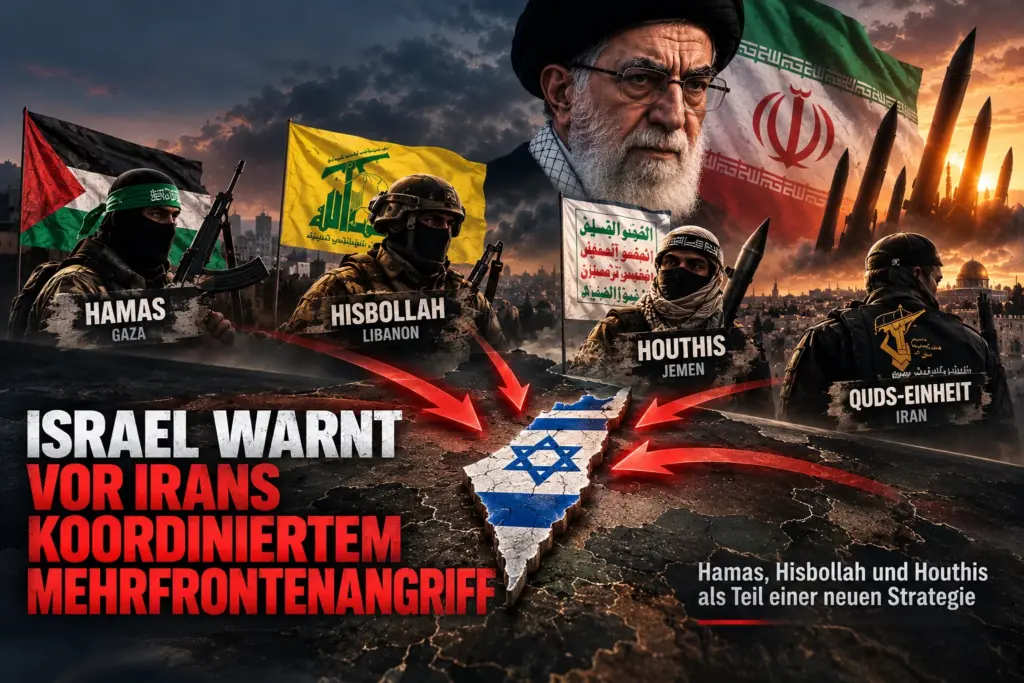

Israeli security circles are warning of a new phase in Iran’s multi-front strategy against Israel. Tehran is reportedly working to coordinate Hamas, Hezbollah, the Houthis and other allied forces more closely so that several fronts can exert pressure on Israel as simultaneously as possible in the future. What has been publicly substantiated is an Israeli threat assessment and a recognizable strategic development—not a finalized joint attack order.
The decisive point is not so much the existence of individual Iranian allies. That has been known for years. What is new is the warning that fronts that have so far operated largely separately could develop into a closely coordinated regional system. That is where the real danger for Israel lies: Not every organization has to be equally strong if several actors coordinate their military actions in time and politically more effectively.
The starting point is a report by The Jerusalem Post dated September 5, 2026. It describes Israeli assessments according to which Iran is trying to draw conclusions from its experiences since October 7, 2023. The current warning is an Israeli intelligence assessment of the situation reported by The Jerusalem Post, not an official IDF operational announcement. This must be distinguished from an assessment explicitly identified as an IDF assessment dated August 16.
The Hamas attack at that time did trigger a regional war, but from the outset it was not conducted as a fully synchronized offensive by all of Iran’s partners.

Passende X-Beiträge
Aus dem SCHLAGSEITE X-ArchivOctober 7 also revealed the limits of Iran’s axis
The Hamas terrorist attack of October 7, 2023, struck Israel with devastating effect. From Iran’s perspective, however, what was missing was a regional offensive conducted simultaneously from the outset. Hezbollah, pro-Iranian militias and, later, the Houthis opened or intensified their own fronts, but they did not act as a single force striking at the same moment.
That Hamas had long been considering a far broader regional escalation is not a retrospective Israeli claim. The Washington Post reported in October 2024 on documents seized by Israeli troops in Gaza. According to the newspaper, these documents showed that Hamas leaders had considered significantly larger attacks, wanted to involve external fronts and sought Iranian support for money and training.
These documents concern Hamas planning at the time, before October 7, 2023. They do not substantiate an Iranian operational order or a specific joint attack plan for 2026. They do show, however, that the idea of a regionally expanded confrontation was already part of the strategic considerations within Hamas at that time.
The strategic logic behind this is easy to recognize. Israel can tie down an adversary militarily on one front while simultaneously deploying forces for a second front. It becomes more difficult when rockets, drones, border attacks, terrorist operations and political escalation converge from several directions within a coordinated time frame. This simultaneity would place greater strain on air defenses, intelligence services, reservists, logistics and political leadership.
Iran is apparently trying to reorganize its damaged axis
The warning comes at a time when the balance of power within Iran’s network has changed. In this context, The Jerusalem Post points to Hezbollah’s losses and the fall of the Assad regime in Syria. As a result, pro-Iranian militias in Iraq and the Houthis in Yemen have reportedly gained importance within Iran’s strategy.
The September 5 report cites several specific indications of closer coordination. According to The Jerusalem Post, senior representatives of the Quds Force are said to have held talks with commanders from Hezbollah, the Houthis and Iraqi militias about expanding the confrontation. Two senior officers of Iran’s Revolutionary Guards reportedly also said that representatives of the Quds Force had held conference calls with commanders from these fronts during an earlier period of calm. According to these accounts, Iranian advisers also worked with them on the ground.
At the same time, The Jerusalem Post reported on Iranian efforts to accelerate the production of missiles and drones and restore damaged capabilities. It also cited joint training measures, closer operational and personal contacts, and greater coordination of political and military decisions within the network.
These claims must be weighed carefully. The talks and coordination mechanisms are reported by The Jerusalem Post, citing reports and Iranian officers. This does not allow for the conclusion that there is a joint operational plan timed to the minute. They do, however, provide concrete building blocks for the Israeli assessment that Iran’s multi-front strategy is to be geared more strongly toward coordination and simultaneity.

ℹ️ Israeli security circles see increased coordination among several actors close to Iran. There have also been reports of talks between the Quds Force and Hezbollah, the Houthis and Iraqi militias, as well as efforts by Tehran to restore the damaged military capabilities of its regional network. What has been publicly substantiated is a strategic development and an Israeli threat assessment. No specific joint attack order with a date, target planning or defined sequence of events has been publicly presented.
The IDF had already observed closer coordination in August
The current warning does not stand in isolation. On August 16, The Jerusalem Post reported on an explicit IDF assessment. According to it, Hamas and Hezbollah had begun coordinating their increased activities with Iranian support.
The Israeli military assessed this development as a possible attempt to rebuild Iran’s damaged axis while simultaneously increasing pressure on Israel from the north and south. This is precisely where the September report differs: The August report conveys an assessment explicitly identified as an IDF assessment, while the September report describes broader assessments by Israeli security and intelligence services.
This shifts the question. What matters is no longer only whether Hamas, Hezbollah or the Houthis have individually become militarily stronger or weaker. What matters is whether Iran can compensate for the losses of individual organizations through a better division of labor. A weakened actor can remain strategically dangerous if its actions become part of a larger coordinated system.
For Israel, this means that the threat cannot be measured solely by missile stocks, fighter numbers or individual front sections. Communication, operational coordination, shared objectives and the ability to force Israeli responses in several places simultaneously are equally important.
The current September warning is not an official IDF operational announcement, but an Israeli security and intelligence assessment reported by The Jerusalem Post. This must be distinguished from the warning of August 16, explicitly identified as an IDF assessment. Both point in the same strategic direction, but they do not have the same source status.
Khalil al-Hayya strengthens the connection between Hamas and Tehran
The new leadership of Hamas is also relevant in this context. On July 20, 2026, Khalil al-Hayya was elected the new overall leader of the terrorist organization. Reuters confirmed the election and wrote that al-Hayya was considered tougher than Khaled Meshaal, who had also been considered a candidate for the leadership.
The broader political assessment must be attributed more precisely. Palestinian analyst Reham Owda told Reuters that al-Hayya’s election was a signal that Hamas would maintain its armed struggle, reject disarmament, seek to rebuild its military strength and at the same time preserve its alliance with Iran and the so-called Axis of Resistance.
For years, al-Hayya was a central figure in Hamas’s relations with Tehran. His election therefore eliminates none of the strategic points of connection between Hamas and Iran. Within the organization, it does at least strengthen the leadership line that seeks to maintain close relations with Tehran.
This does not automatically mean that Hamas, Hezbollah and the Houthis will plan every attack together in the future. It does mean, however, that leadership figures and political interests exist on several sides that fundamentally favor closer coordination.
A multi-front war does not mean a single joint army
The term multi-front attack can easily create a misleading picture. Iran does not have to force its partners into a joint command structure modeled on a regular army. A coordinated escalation alone can have a significant impact.
If Hezbollah increases pressure in northern Israel, the Houthis simultaneously deploy missiles or drones, Iraqi militias launch additional attack attempts and Hamas uses its remaining capabilities, several operational problems arise at the same time. Each individual front may be limited. Taken together, they can place greater demands on Israel’s military and civilian systems than an isolated confrontation.
That is precisely why coordination itself is a military capability. Coordinating timing, sharing information, synchronizing political decisions or bringing different weapons systems into the same time frame increases effectiveness without necessarily requiring the creation of new formations.
Iran’s multi-front strategy: What is substantiated and what is not
With news of this kind, precision is more important than dramatic certainty. There is currently no publicly presented Iranian operational plan specifying dates, concrete targets, attack strengths and binding assignments for Hamas, Hezbollah, the Houthis and Iraqi militias.
Several building blocks, however, are substantiated: Israeli authorities are observing increased coordination between Iran and allied organizations. The IDF warned as early as August about the rebuilding of Iran’s axis. The Jerusalem Post has reported on talks between the Quds Force and several allied actors, conference calls, Iranian advisers, as well as efforts involving missile and drone production and joint training.
These points amount to a strategic warning, not an announcement of an imminent attack date. Anyone who turns this into an already approved large-scale attack with a fixed sequence of events goes beyond the publicly substantiated information. Anyone who dismisses the development as mere rhetoric, by contrast, ignores the recognizable direction of Iran’s efforts.
Israel’s problem is not one front, but the interaction between them
In recent years, Iran has repeatedly relied on a network that creates distance between Tehran and the actual combat zones. This structure allows the regime to build regional pressure without having to carry out every military action directly with its own forces.
Following the setbacks of recent years, Tehran does not appear to be abandoning this model, but rather realigning it. The logic remains the same; the implementation is apparently to be more closely integrated. For Israel, that would be the decisive change: not a new adversary emerging, but known adversaries potentially working together more systematically.
Israel’s warning should therefore neither be inflated into certainty about an imminent major attack nor dismissed as mere rhetoric. What matters is Tehran’s ability to bring several of Israel’s known adversaries into closer coordination and thereby turn individual fronts into a greater collective burden.
Iran does not need to merge its allies into a single army to pose a greater problem for Israel. It is enough if previously separate fronts work together more closely at the decisive moment. This is precisely the development that Israeli security circles are warning about.
ℹ️ Factual basis and primary sources for the article 📑
▶️ Jerusalem Post, September 5, 2026:
Iran coordinates with Hezbollah, Hamas, Houthis for attack, Israeli intel suggests – report
Report on Israeli security and intelligence assessments of a more closely coordinated Iranian multi-front strategy, as well as talks by the Quds Force, Iranian advisers, missile and drone production, and joint training.
▶️ Jerusalem Post, August 16, 2026:
Hamas, Hezbollah coordinating attacks with Iran as IDF warns of rebuilt axis of evil
Report on an explicit IDF assessment of increased coordination between Hamas and Hezbollah with Iranian support.
▶️ Reuters, July 20, 2026:
Hamas names Khalil Al-Hayya as new overall leader
Confirmation of the election of Khalil al-Hayya as Hamas leader. Reuters describes him as more hard-line than Khaled Meshaal and presents the broader assessment of his orientation toward Iran and the resistance axis as analyst Reham Owda’s assessment.
▶️ Washington Post, October 12, 2024:
Captured documents reveal Hamas’s broader ambition to wreak havoc on Israel
Analysis of confiscated Hamas documents concerning considerations at the time for a regionally expanded attack and the involvement of external fronts. The documents do not establish any operational planning for 2026.
🔎 Found an error, criticism, or addition?
SCHLAGSEITE.eu stands for careful research and transparent corrections. Have you discovered a factual error, unclear wording, or a broken link? Then send me your note. If possible, please provide a verifiable source.