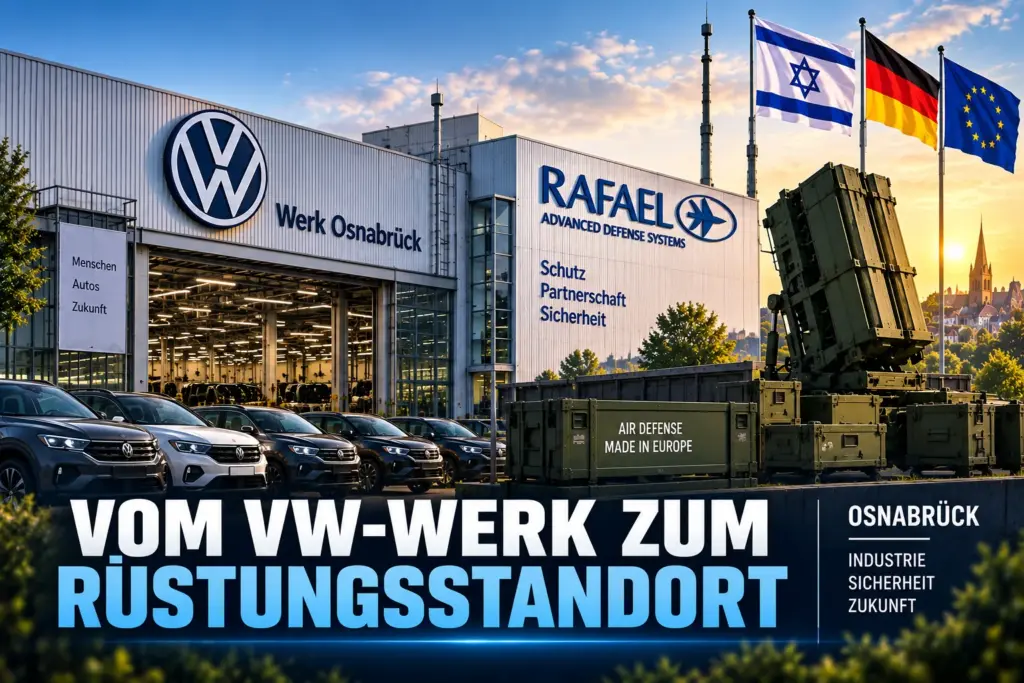

The VW plant in Osnabrück is facing fundamental change: Where cars have been produced up to now, security and defence systems are to be developed in the future. The Israeli defence company Rafael Advanced Defense Systems is to become the central technology partner. However, according to the current plan, Rafael will not become the owner of the plant.
On Monday, 7 September 2026, Volkswagen announced that the group had agreed with the state of Lower Saxony and Aurelius Capital on key points for a possible sale of Volkswagen Osnabrück GmbH. Aurelius is to become the majority owner, while Lower Saxony is to acquire a minority stake. The site is subsequently to be gradually developed into a centre of expertise for security and defence solutions.
Aurelius Capital is not just any financial investor. Volkswagen describes the company as an international investment firm headquartered in Tel Aviv that focuses on investments in defence, cybersecurity, artificial intelligence and critical infrastructure.
On 7 September, two different processes were made public. First, Volkswagen, Lower Saxony and Aurelius agreed on the key points for a possible sale of Volkswagen Osnabrück GmbH. Second, Lower Saxony, Rafael and Aurelius signed a separate declaration of intent on a strategic partnership for the future security and defence site. It is therefore clear who agreed what with whom.
The first so-called anchor project is to involve cooperation with Rafael Advanced Defense Systems. According to Volkswagen, this concerns the possible production of systems and components for air-defence systems for Germany and Europe.

Passende X-Beiträge
Aus dem SCHLAGSEITE X-ArchivRafael comes to Osnabrück, but will not buy the plant
This requires an important distinction. According to the structure currently published, Rafael is not to become the owner of the former VW plant. The buyers are to be Aurelius Capital and the state of Lower Saxony. Rafael will instead take on the industrial anchor role and contribute its experience and technology in air defence as a strategic partner, without becoming the owner of the plant itself.

The agreements published today, on 07.09.22026, do not mean that the VW plant is being sold to Rafael.
Volkswagen explicitly refers to key points for a possible sale to Aurelius Capital and the state of Lower Saxony. Rafael is the technology and industrial partner. Completion remains subject to final agreements, the necessary resolutions by the relevant bodies and regulatory reviews.
The Lower Saxony State Chancellery also does not describe Rafael as a buyer, but as a partner in a strategic cooperation with Lower Saxony and Aurelius. The aim is to transform the Osnabrück site into a centre of expertise for innovative security and defence solutions.
The Qatar factor: Why the deal is being conducted through Aurelius
The unusual ownership structure has a history. The Handelsblatt reported on 10 July 2026, that Volkswagen had been pursuing cooperation with Rafael for Osnabrück and that the Qatari VW major shareholder had opposed these plans. The Jerusalem Post also reported that Qatar had blocked the original plan.
Qatar’s stake in Volkswagen is substantial. Qatar Holding LLC, which belongs to the Qatar Investment Authority, held 17.0 percent of the voting rights according to the official Volkswagen shareholder structure as of 31 December 2025. This makes Qatar one of the group’s most important shareholders.
It is important to maintain a clear distinction between the documented ownership structure and the reported conflict. Volkswagen and the Lower Saxony state government do not mention any opposition from Qatar in their statements of 7 September. Nor has the Qatar Investment Authority publicly confirmed the reported blockade with comparable clarity. The background is therefore based on media reports and must be identified as such.
Against the backdrop of these reports, the structure now chosen can be read as a political bypass for the previously blocked direct cooperation: Volkswagen is to sell the site, in accordance with the agreed key points, to Aurelius and Lower Saxony, after which Rafael will become a strategic industrial partner of the new owners. No official confirmation from Volkswagen, Lower Saxony or the Qatar Investment Authority that this ownership structure was expressly chosen for this reason has been issued so far.
The T-Roc plant becomes a new industrial site
For Volkswagen, the decision also marks the provisional end of a long search for a future for the traditional plant. The group had already decided in 2024 to phase out vehicle production in Osnabrück in summer 2027. Most recently, the T-Roc Cabriolet was among the models produced there.
Volkswagen will not disappear from the site overnight. The group says it intends to support the transition to the new corporate structure and contribute industrial experience, development and industrialisation expertise, as well as the existing infrastructure.
Different figures are circulating regarding jobs, and they do not necessarily contradict one another. Daniela Cavallo, chairwoman of the group and general works councils, officially refers to more than 1,200 people who are to receive a perspective at the site. According to the NDR, citing the works council and IG Metall , initially just under 1,400 of the approximately 1,800 current employees are to receive a perspective.
According to these figures, the workforce is subsequently to be reduced to around 1,200 positions through retirements and phased retirement. These jobs are covered by employment guarantees until the end of 2029. The collective bargaining coverage in the metal and electrical industry, as well as existing collective agreements, works agreements, employment contracts and works council structures, are also to remain in place after the change of ownership.
Osnabrück could thus become an example of a larger industrial transformation. While Germany’s automotive industry is struggling with overcapacity, international competitive pressure and the restructuring of its model ranges, the need for production capacity in the security and defence sector is simultaneously increasing in Germany and Europe.

Israeli air-defence components to be produced in Germany
Rafael’s role is particularly noteworthy. The Israeli company is one of the internationally significant developers of air-defence systems and has already been present on the German market for more than 20 years. Lower Saxony points to Rafael’s German industrial presence, including Dynamit Nobel Defence and holdings and joint ventures such as EuroSpike and EuroTrophy.
The German primary sources deliberately remain general about the specific production. Volkswagen speaks of the possible production of systems and components for air-defence systems for Germany and Europe. The State Chancellery initially describes the possible development and production of corresponding components.
Israeli reports are more specific. According to information from the Jerusalem Post , Osnabrück is to produce components and equipment associated with the Iron Dome air-defence system. These reportedly include military vehicles, launchers, generators and other system equipment. The Tamir interceptor missile itself is expressly not to be produced in Osnabrück, according to the report.
This distinction is important. According to the publicly documented information currently available, no complete production line for all components of Iron Dome is being created in Osnabrück. Likewise, the German primary sources of 7 September contain no confirmation that the Bundeswehr has already ordered Iron Dome.
Rafael CEO Yoav Tourgeman nevertheless states the strategic ambition clearly. According to the Lower Saxony State Chancellery, the idea is that “the technology will be produced entirely in Germany to protect Germany and Europe”. The partnership is therefore aimed not only at individual contracts, but at establishing permanent industrial capacities in Germany.
More than just a new use for an old plant
The decision therefore has significance extending beyond Osnabrück. A traditional German automotive site is to become part of German-Israeli cooperation in modern defence technology. At the same time, industrial capacities and a substantial portion of the workforce that Volkswagen no longer needs for its own vehicle production are to be retained.
For Lower Saxony, this combines industrial policy with security policy. The state government explicitly refers to a changed security environment in Europe and the need to expand its own capabilities. Rafael, in turn, contributes Israeli technology and many years of experience. Osnabrück is not intended to become merely an extended workbench for a single project. According to Volkswagen, further partnerships and projects are planned under the umbrella of the new company.
A VW plant whose traditional vehicle production is being phased out is to become a new site for Europe’s security and defence industry. Aurelius and Lower Saxony are to take over the industrial base, while Rafael is to assume the technological anchor role.
The transformation could hardly be greater: an era of automobile production is ending in Osnabrück, while a new German-Israeli industrial partnership may be beginning. What is to be produced there in the future is not the only noteworthy aspect; so too is the structure of the deal. Rafael is coming to Osnabrück without buying the VW plant. That is precisely where a key part of this story lies.
ℹ️ Factual basis and primary sources for the article 📑
▶️ Volkswagen Group:
Path set for the future of the Osnabrück site
Official statement of 7 September 2026 on the ownership structure, Rafael partnership, employment, transition phase and further steps.
▶️ Lower Saxony State Chancellery:
Lower Saxony, Rafael and Aurelius sign declaration of intent
Official statement on the strategic partnership, the planned air-defence components and the statement by Rafael CEO Yoav Tourgeman.
▶️ Volkswagen Group Annual Report 2025:
Shareholder structure as of 31 December 2025
Official Volkswagen data on the voting rights held by Qatar Holding LLC.
▶️ Handelsblatt:
Volkswagen: Qatar opposes deal with Israel
Report dated 10 July 2026 on the opposition of Volkswagen’s Qatari major shareholder to the cooperation with Rafael planned at the time.
▶️ NDR:
Declaration of intent: Plans for VW Osnabrück become more concrete
Report on employee figures, employment guarantees until the end of 2029, phased retirement and continuing collective bargaining coverage.
▶️ Reuters:
Volkswagen finds defence future for German plant amid major overhaul
Report on the planned takeover, ownership structure and employment at the site.
▶️ Jerusalem Post:
Rafael, Aurelius to build Iron Dome components at former Volkswagen plant
Background report on the history involving Qatar, as well as the planned components and the delineation of production of the Tamir interceptor missile.
🔎 Spotted an error, criticism or addition?
SCHLAGSEITE.eu stands for careful research and transparent corrections. Have you discovered a factual error, unclear wording or a broken link? Then send me your information. Please provide a verifiable source where possible.