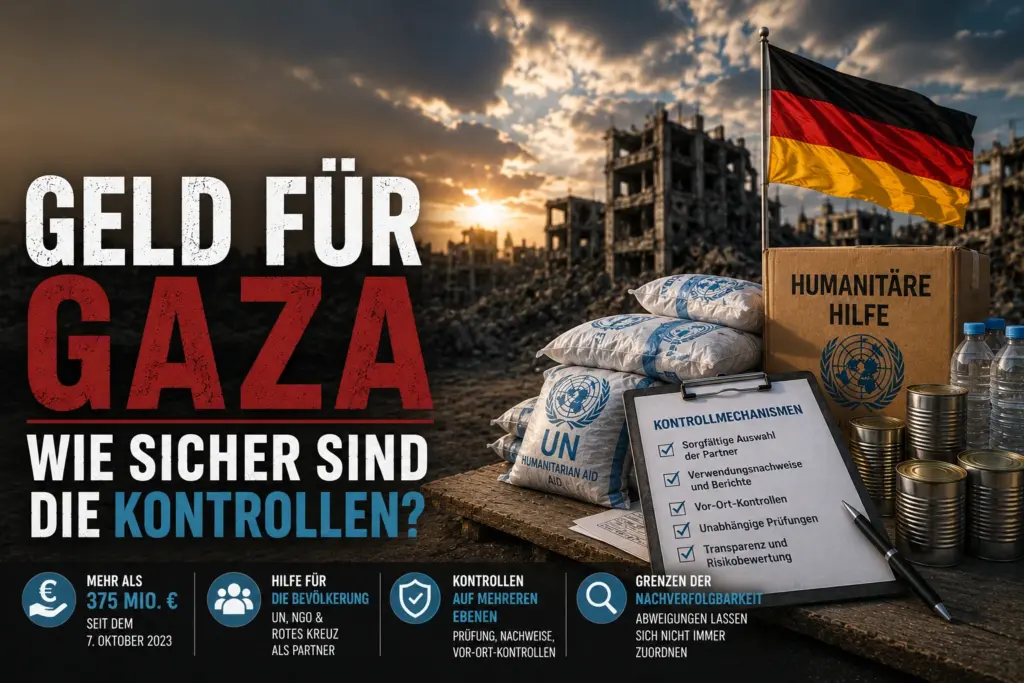

German aid for Gaza: Since the Hamas massacre of October 7, 2023, Germany has provided more than €375 million for humanitarian aid. At the end of 2025, according to the federal government, more than 90 percent of the €374 million recorded at that time had gone to the population in the Gaza Strip. Berlin points to strict controls and says it has found no indications that German funds were misused. But the federal government’s own responses also show the limits of this certainty: Known diversions cannot be reliably attributed to a German share of the funding, and in the case of UNRWA, existing control mechanisms had to be significantly strengthened after October 7.
The German development cooperation system itself shows how quickly an apparently functioning control system can reach its limits. In projects run by the government-owned Gesellschaft für Internationale Zusammenarbeit in Yemen, suspected damage in the low double-digit millions is at issue. According to the Federal Ministry for Economic Cooperation and Development, 24 local employees were dismissed or not retained. The investigations had not yet been completed in the summer of 2026. As a consequence, GIZ tightened its control mechanisms for risk and high-risk countries.
The case concerns Yemen and is not evidence that German funds in Gaza were misused. But it highlights a fundamental question: How robust are controls when large sums flow into an area that was ruled for years by a terrorist organization and where external donors have only limited insight into local structures?
German aid for Gaza: More than €375 million
Germany is one of the significant donors supporting humanitarian assistance in the Palestinian territories. In a Bundestag response from December 2025 the federal government put its humanitarian aid since October 7, 2023, at €374 million. More than 90 percent of it had gone to the population in the Gaza Strip. The aid was implemented, among other channels, through United Nations organizations such as WHO and UNICEF, non-governmental organizations and the German Red Cross.
On August 3, 2026 the federal government already cited an updated total of more than €375 million. The support would continue to be implemented through UN organizations and humanitarian non-governmental partners.

ℹ️ The crucial distinction
German humanitarian aid for Gaza, German payments to UN organizations and actual financing of Hamas are three different matters. Anyone claiming a direct flow of money to Hamas must also substantiate it.
It is therefore crucial not to conflate different flows of money. A payment to UNRWA or another aid organization is not, in itself, evidence that this money ends up with Hamas.
That is precisely why the claim circulated on social media that European UNRWA payments are simply Hamas financing does not qualify as serious evidence. It turns different flows of money into one and replaces proof with inference.

Passende X-Beiträge
Aus dem SCHLAGSEITE X-Archiv
Berlin relies on multilayered controls
Berlin is aware of the risk and therefore points to extensive review procedures. Immediately after October 7, 2023, the Federal Ministry for Economic Cooperation and Development had its cooperation with the Palestinian territories reviewed.
On December 13, 2023 the BMZ said the control mechanisms had proved robust. No indications of misuse had been identified.
For development cooperation, the BMZ describes a multilayered procedure. Local partners and their employees would be screened, among other things, for links to Hamas and other listed terrorist organizations. Materials for Gaza would be subject to checks, and financial flows would be compared with relevant UN and EU sanctions lists. Organizations using federal funds would have to ensure that no money reaches Hamas.
These controls therefore exist. The crucial question is not whether Berlin conducts checks, but how far those checks reach under the actual conditions.
“No indications” is not the same as “ruled out”
A response from the federal government from February 2026 shows this limit particularly clearly.
It states that, according to a United Nations investigation, one percent of all UN aid deliveries had been diverted since October 7, 2023. The so-called UNOPS mechanism records deliveries by the UN system to Gaza until they arrive at their destination and also registers trucks that have been looted.
This one-percent figure is the federal government’s official account of a UN investigation. It describes aid deliveries by the UN system. It cannot automatically be taken as a complete picture of all humanitarian delivery routes, all organizations involved or other forms of influence over supply and distribution in Gaza.
There is a second point as well. The federal government cannot quantify what share of German- or EU-funded relief supplies was among the known diversions. Partner reports do not separately identify the German share of the funding involved.
Berlin considers the known diversions extremely small in relation to the overall volume of aid. If such cases become known, the federal government says it intends to press the implementing organizations for immediate investigation.
When the federal government says it is not aware of any cases in which German funds were misused, it is describing the state of its knowledge. At the same time, it cannot statistically quantify the German share of the funding in known diversions.
This produces a differentiated picture: There is a system for tracking UN aid deliveries. But Germany cannot statistically determine what share of the known diversions is attributable to German or European funding.
This does not prove that German aid for Gaza ended up with Hamas. Rather, it shows where the established state of knowledge ends.
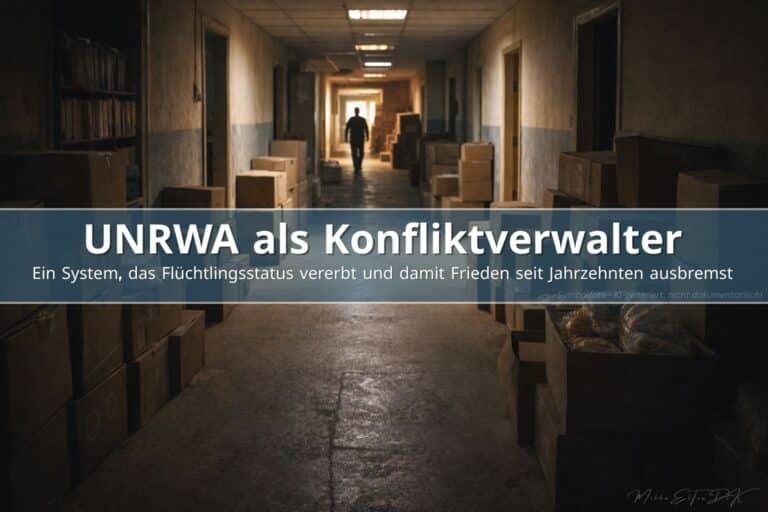
UNRWA became a stress test
The vulnerability of control systems became particularly clear in the case of UNRWA.
The UN’s Office of Internal Oversight Services investigated allegations against a total of 19 UNRWA employees over possible involvement in the terrorist attacks of October 7, 2023. OIOS found no evidence against one employee. In nine other cases, the available information was insufficient to support involvement.
In the remaining nine cases, OIOS concluded that the information collected pointed to possible involvement in the attacks. Their employment was terminated.
Accuracy also requires acknowledging the limits of this investigation. The United Nations said OIOS had been unable to independently authenticate a large part of the material provided by Israel because it remained in Israeli possession. The investigators accordingly formulated their conclusions cautiously.
Nevertheless, the incident was serious for UNRWA and its donors. After all, the organization already had personnel, neutrality and control procedures in place before October 7.
At the same time, UN Secretary-General António Guterres had UNRWA’s neutrality mechanisms reviewed under the leadership of former French Foreign Minister Catherine Colonna. The report found that UNRWA had extensive neutrality mechanisms, but at the same time made 50 recommendations to improve oversight, personnel screening, neutrality, educational content and internal procedures.
In its own progress report for the first quarter of 2026 UNRWA reported that 40 of these 50 recommendations had been fully implemented or closed. Ten were still outstanding or remained under implementation.
This figure is initially the organization’s own report. Although the progress report describes internal reviews and the involvement of the relevant working group of the UNRWA Advisory Commission, it is not independent evidence that the neutrality and control problems that came to light have thereby been resolved in practice. Formally closing a recommendation is not the same as demonstrating its lasting effectiveness.
Germany is contributing financially to this reform process. According to the federal government, Berlin is supporting UNRWA with €1.5 million for measures to strengthen neutrality, including a more comprehensive screening of employees.
At the same time, Berlin has restricted its own funding. The Bundestag response from February 2026 states that since June 2025, the use of certain funds provided from the Federal Foreign Office’s budget for UNRWA “in the Palestinian Territories” has been contractually excluded. The federal government’s official wording is deliberately reproduced here. Berlin says it will make the scope of future support dependent on further reforms.
This is politically quite noteworthy. If a control system requires additional personnel screening, neutrality measures and dozens of reform steps after a serious incident, it is at least necessary to explain how robust the previous mechanisms actually were.

Berlin sees no Hamas infiltration of funded NGOs
UNRWA is only one part of German aid for Gaza, however. A significant share of humanitarian support is provided through other international organizations and non-governmental organizations.
Here too, the federal government’s position is unequivocal. In a response from February 2026 it said that over the past five years there had been no indications of possible influence or infiltration by Hamas among the non-governmental organizations it funded in Gaza.
Berlin points to regular reviews of program and compliance data as well as preliminary checks of projects and ultimate recipients. These reviews had produced no findings of misconduct or direct political influence.
This is a relevant finding. General assumptions are not enough to support the claim that German NGO projects in Gaza were systematically controlled by Hamas.
However, the same applies here: A compliance review can only capture what can be identified on the basis of available data, people, documents and checks. Informal dependencies, local pressure or concealed loyalties are considerably harder to measure in an authoritarian environment.
Controls do not take place in a political vacuum
This is precisely where Gaza’s political context becomes decisive. Hamas seized control of the Gaza Strip by force in 2007 and exercised de facto governmental authority there for many years. Administration, security structures and essential parts of political and economic daily life therefore did not develop in a neutral environment, but under the rule of an armed terrorist organization.
The war since October 7, 2023, has massively shaken this power structure. However, it did not disappear completely. In July 2026, Hamas did announce the dissolution of its de facto government and the transfer of responsibilities to a technocratic transitional body. Reuters reported at the same time, that the organization continues to have administrative and security influence in parts of the Gaza Strip.
This is not a minor aspect when assessing German aid. Partner reviews, sanctions lists and proof of proper use must function in an environment whose state, economic and local structures have been shaped by Hamas over many years.
This does not prove any specific misuse of German funds. But it describes the risk that German control mechanisms must be designed to address in the first place.
Direct financing and indirect relief are two different questions
This brings a second level into play, one that is regularly conflated with the first in the political debate.
The first question is: Does German money flow directly or through a demonstrable misappropriation to Hamas? The federal government’s publicly available information provides no evidence of such a systematic flow of funds.
The second question is: Can international financing of civilian tasks indirectly relieve a ruling organization?
In principle, external financing of healthcare, food aid, shelter or infrastructure can mean that a de facto authority does not have to finance these services from its own resources. This can create an economic relief effect.
How large this effect actually was for Hamas, and whether it thereby freed up additional funds for military or terrorist purposes, cannot be quantified seriously on the basis of publicly accessible German data.
That is why linguistic precision is important here as well. Possible indirect relief is not the same as direct terrorist financing.
Yemen is a warning signal, not proof regarding Gaza
This brings the article back to its starting point.
According to the Federal Ministry for Economic Cooperation and Development, GIZ now assumes that the possible damage from the irregularities in Yemen is in the low double-digit millions. Twenty-four local employees were dismissed or not retained. According to GIZ, the total volume of the development projects concerned amounted to around €208 million between 2019 and 2024.
Some of these projects were managed remotely for years because of the security situation. After the cases became known, GIZ tightened its control mechanisms for risk and high-risk countries, digitized further accounting processes and increased inspections.
Gaza is not Yemen. A possible case of fraud in one country cannot be used to infer misuse in another.
But Yemen does show something that extends beyond the specific case: Regulations, audit reports and control systems can exist and still have gaps when the donor can only verify what is actually happening on the ground to a limited extent.
That is why the decisive question regarding German aid to Gaza is not whether controls are being carried out. It has been demonstrably established that they are. What matters is how far these controls reach under real-world conditions.
The state must also identify the limits of its knowledge
Humanitarian aid for civilians and critical oversight of that aid are not contradictory. They depend on each other.
The more difficult the environment, the higher the standard for transparency, traceability and independent oversight must be. This is especially true when more than €375 million is provided within just a few years.
The federal government can point to extensive review mechanisms. It can likewise point out that, to date, it has not identified any misappropriation of German funds in favor of Hamas, or that it is not aware of any such cases. Both are part of a serious assessment.
But the same assessment must also acknowledge that Germany cannot quantify statistically its own share of the funding involved in known diversions of aid deliveries. Following October 7, additional neutrality and control measures became necessary at UNRWA. UNRWA itself reported in 2026 that 40 of 50 Colonna recommendations had been fully implemented or closed. And Berlin has since imposed additional restrictions on parts of its UNRWA funding.
In the end, the underlying question is therefore less one of trust than one of verifiability.
Germany can demonstrate that extensive control mechanisms are being used and that, according to the federal government, no misappropriation of German funds in favor of Hamas has so far been identified, or that no corresponding cases are known. At the same time, Berlin cannot statistically quantify the German share of funding in known diversions. This precise limitation must be taken into account when politically assessing the aid.
Those who provide hundreds of millions of euros in an environment ruled by Hamas for years must therefore not be satisfied with the statement that the controls are robust. What matters is not only that controls are carried out, but also that it is openly shown what these controls can actually establish and where their findings end.
ℹ️ Factual basis and primary sources for the article 📑
▶️ Federal Government, August 3, 2026:
Government press conference of August 3, 2026
Current status of German humanitarian aid since October 7, 2023: more than €375 million.
▶️ German Bundestag, printed paper 21/3276:
Federal government response on humanitarian aid for Gaza
Documents the figure of €374 million at the end of 2025 and the share of more than 90 percent for the population in the Gaza Strip.
▶️ Federal Ministry for Economic Cooperation and Development, December 13, 2023:
Germany resumes development cooperation after review
Description of the multi-stage control mechanisms for partners, materials and financial flows, as well as the finding that no misuse had been identified.
▶️ German Bundestag, printed paper 21/4143:
Federal government response on aid deliveries, UNRWA and control mechanisms
Contains information on one percent of UN aid deliveries diverted, UNOPS tracking, the lack of statistical attribution of German funding shares, and Germany’s current conditions for UNRWA.
▶️ German Bundestag, February 19, 2026:
Terror allegations against UNRWA employees
Documents the German funding restriction and the official wording on the use of funds for UNRWA in the Palestinian Territories.
▶️ German Bundestag, February 9, 2026:
No Hamas infiltration in funding for an NGO in Gaza
Summary of the government response on reviews of German NGO funding and the absence of indications of direct political influence by Hamas.
▶️ United Nations, Office of Internal Oversight Services, August 5, 2024:
OIOS investigation of UNRWA staff allegations
Official outcome of the investigation into 19 UNRWA employees and the nine cases of possible involvement in the terrorist attacks of October 7, 2023.
▶️ UNRWA, progress report for the first quarter of 2026:
Q1 Progress Report: Implementing the Colonna Report at UNRWA
UNRWA reports 40 of 50 recommendations as closed or fully implemented. The report also describes the review procedure for completed recommendations.
▶️ U.S. Department of State:
Human Rights Reports: Custom Report Excerpts
Documents Hamas’s violent seizure of power in the Gaza Strip in 2007 and its subsequent de facto rule.
▶️ Reuters, July 6, 2026:
Hamas dissolves Gaza government, Israel dismisses move as ’stunt‘
Reports on the announced dissolution of the Hamas de facto government and its continuing administrative and security influence in parts of Gaza.
▶️ Federal Government, June 22, 2026:
Government press conference on the GIZ complex in Yemen
Confirms the dismissal of 24 local employees, ongoing investigations, and strengthened compliance and audit systems.
▶️ Federal Ministry for Economic Cooperation and Development:
Frequently asked questions for the Development Ministry
Current BMZ information on the suspected GIZ damage in Yemen and the consequences drawn from it.
▶️ WELT, August 22, 2026:
Development aid from GIZ and KfW: Arrests, dismissals and secrecy
Current journalistic starting point for the debate on oversight, transparency and risks of misuse in German development cooperation.
🔎 Found an error, criticism or addition?
SCHLAGSEITE.eu stands for careful research and transparent corrections. Have you discovered a factual error, unclear wording or a broken link? Then send me your information. If possible, please provide a verifiable source.