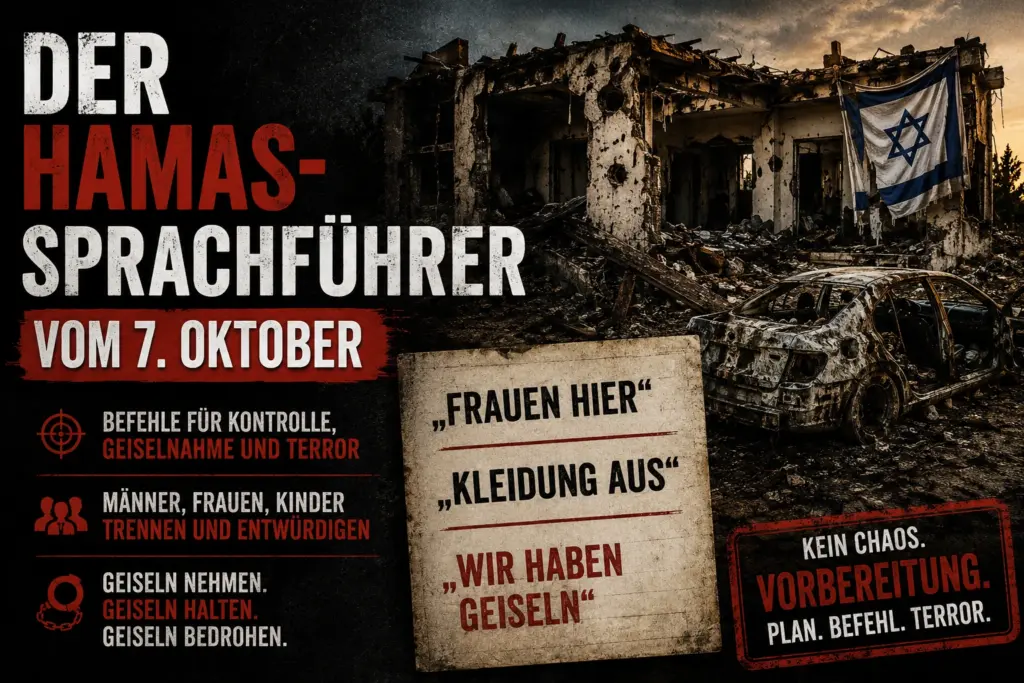

The Hamas phrasebook from October 7 begins with commands and statements such as “Women here,” “Take off your clothes” and “We have hostages.” These sentences did not happen to appear on just any piece of paper. They belong to a phrasebook, which, according to Israeli reports, was intended to prepare Hamas terrorists for situations during the attack on October 7, 2023. 45 sentences, explained in Arabic and rendered in such a way that the attackers could pronounce them in Hebrew.
The document shows quite plainly what its users were supposed to be prepared for: Israeli communities, civilians, weapons, vehicles, hostages, men, women and children. This is not an ordinary language course. This is practical communication for terrorists on Israeli territory.
45 sentences for an attack on Israeli communities
The phrasebook documented by Palestinian Media Watch consists of 45 commands, questions and short statements. Alongside the Arabic meaning is a Hebrew formulation written in Arabic phonetic transcription. Anyone who could read Arabic could use it to pronounce a Hebrew command without being able to read Hebrew.
Some of it initially sounds banal: “Stop,” “Don’t move,” “Come,” “Lie down,” “Don’t speak.” But the list quickly goes far beyond that.
The attackers could ask: “Where is the weapon?”, “Where are your friends?”, “Where are the car keys?” and “How do you operate the tank?” Other formulations lead straight into Israeli civilian locations: “Where is the person in charge of the kibbutz?” and “What is the name of the kibbutz?”
And then come the sentences that finally make every claim about supposedly improvised chaos look untenable: “You are a prisoner,” “We have hostages,” “We will kill the prisoners,” “Men here,” “Women here” and “Children here.”

Passende X-Beiträge
Aus dem SCHLAGSEITE X-Archiv


“Women here,” “Take off your clothes” and a striking combination
Several formulations carry even greater weight when they are not viewed individually. Among other things, the phrasebook contains “Women here,” “Take off your clothes,” “Take off your pants,” as well as the command to raise one’s hands and spread one’s legs.
A single command to undress could still be explained in isolation as part of a search or detention. But this list does not stand in isolation. It combines women, prisoners, hostages, the separation of people and calls to undress in one prepared phrasebook.
In the context of what was later documented about sexual violence on October 7 and against abducted hostages, this combination is not incidental. It is part of understanding what the attackers had been prepared for.
The UN Special Representative on Sexual Violence in Conflict investigated the corresponding allegations in Israel in early 2024. Her team concluded that there were reasonable grounds to believe that sexual violence was committed in several locations on October 7. According to the UN, there was also clear and convincing information of sexual violence during captivity in the case of hostages.

The phrasebook does not need to be artificially dramatized. Its 45 sentences are already clear enough. It combines commands for controlling Israeli civilians with hostage-taking, separation by men, women and children, and calls to undress. In the context of the cases of sexual violence documented later, this combination is not accidental and is therefore relevant.

The problem with the narrative of spontaneous chaos
To this day, October 7 is sometimes portrayed as though a largely unplanned dynamic emerged after the breach of the Israeli border. As though terrorists and other attackers simply set out, and the crimes subsequently arose out of the chaos.
The phrasebook does not fit that account.
Anyone who has people learn in advance how to ask in Hebrew for the person in charge of a kibbutz, how to gather people, separate men, women and children from one another, demand car keys and tell prisoners that they have hostages is preparing for concrete situations.
That does not mean that every act on October 7 was laid out in a central script with a time and page number. It did not have to be. Planning means that specific objectives and situations were anticipated and prepared for. That is precisely what this phrasebook documents.
Hostage-taking was not a side effect
The preparation is particularly difficult to explain away in the case of the hostages. The list contains not only the word “hostage.” It contains several sentences intended directly for dealing with prisoners.
“You are a prisoner.” “We have hostages.” “We will kill the prisoners.”
Added to this are commands to gather people, hand over vehicle keys and separate men, women and children.
On October 7, a total of 251 people from Israel were abducted. What had been prepared on paper became a horrific reality just hours after the attack began.
The phrasebook derives its significance not from a single spectacular sentence. It is the pattern. Kibbutz. Civilians. Men. Women. Children. Vehicles. Prisoners. Hostages. These are not randomly assembled vocabulary items.

A phrasebook as part of a larger preparation
The list is revealing even on its own. It becomes even clearer in the context of other documents analyzed after the attack. As early as December 2023, the Guardian reported on material analyzed by the Israeli military unit Amshat, including maps, documents relating to hostage-taking and Arabic-Hebrew phrasebooks.
It fits together: Anyone who wants to attack Israeli communities needs information about access routes and targets. Anyone who wants to abduct people needs control over them. And anyone who does not speak sufficient Hebrew gets a phrasebook.
That is how banal organized terror can look on paper. No grand speech, no martial manifesto. A list of short sentences intended to work at the decisive moment. That is precisely what makes the document so revealing.
Why this document still matters in 2026
The phrasebook is now several years old. Its significance is not. The nature of October 7 is still being disputed, as are planning, hostage-taking and sexual violence, as though every uncomfortable detail could be turned back into fog through sufficient political volume.
Documents are extremely inconvenient in this regard. They do not argue back.
This phrasebook does not answer every question about October 7. But it answers a fairly important one: Hamas terrorists were prepared to deal directly with Israelis, and not merely for a confrontation with soldiers.
They were supposed to be able to stop, control and gather people. They were supposed to be able to ask about kibbutzim and the people in charge of them. They were supposed to be able to separate men, women and children. And they were supposed to be able to deal with prisoners and hostages.
This is not the language of a spontaneous uprising. This is the language of prepared rule over defenseless people.
Anyone who wants to discuss October 7 should therefore not look only at the images from that day. They should also look at the paper that some perpetrators apparently brought with them.
Because this phrasebook shows what was prepared: controlling, separating, capturing people and abducting them as hostages.
The phrasebook does not depict a spontaneous encounter with Israelis, but preparation for control, capture and hostage-taking. Together with the further findings about October 7, it is another document showing that the perpetrators did not merely want to fight. They were prepared to dominate, humiliate and abduct people as hostages.
ℹ️ Factual basis and primary sources for the article 📑
▶️ Palestinian Media Watch:
From Hamas translation guide for October 7
In July 2024, PMW published the phrasebook shown at an Israeli military briefing and documented the formulations it contains.
▶️ United Nations, Special Representative on Sexual Violence in Conflict:
Mission Report of March 4, 2024
Official report by the UN Special Representative on the investigation into sexual violence in connection with the Hamas-led attack of October 7 and the treatment of Israeli hostages.
▶️ United Nations:
Reasonable Grounds to Believe Conflict-Related Sexual Violence Occurred during 7 October Attacks
Summary of the findings of the UN mission and its assessment of the available information on sexual violence.
▶️ Israel Defense Forces:
The October 7 Massacre: Explained
The IDF documents the number of 251 people who were abducted to the Gaza Strip as hostages on October 7, 2023.
▶️ The Guardian:
Hamas drew detailed attack plans for years with help of spies, IDF says
The report documents maps, documents relating to hostage-taking and Arabic-Hebrew phrasebooks analyzed by the Israeli military unit Amshat.
🔎 Spotted an error, criticism or addition?
SCHLAGSEITE.eu stands for careful research and transparent corrections. Have you discovered a factual error, unclear wording or a broken link? Then send me your tip. If possible, please provide a verifiable source.