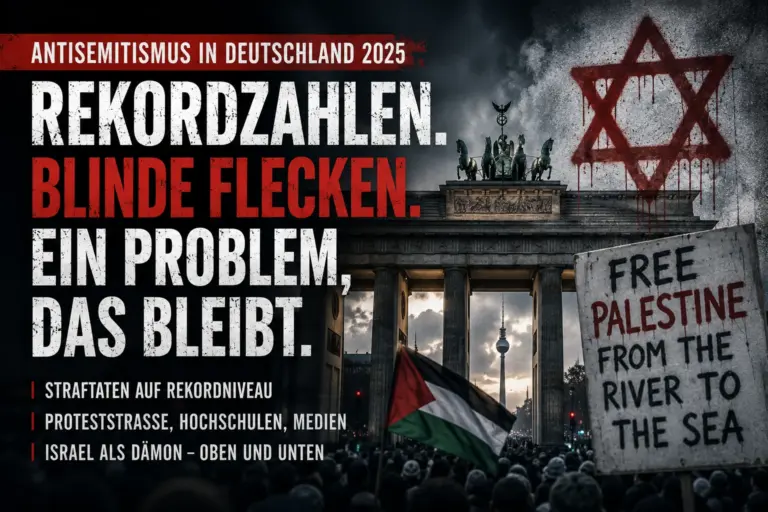

Jew-hatred in Germany reached a frightening scale in 2025: a total of 8,725 antisemitic incidents were documented. Within the seven J7 countries, Germany ranked first both in absolute numbers and relative to its Jewish population. The headline about a global record nevertheless goes beyond what the underlying data actually establish.
Germany was “world champion of Jew-hatred”, BILD declared on July 30, 2026. The claim was even more drastic: nowhere in the world were there as many antisemitic incidents as in Germany.
The general direction is unfortunately correct: Germany has a massive antisemitism problem. The current figures leave no reasonable doubt about that. The global claim, however, is not supported by the report used. The comparison covers seven countries with particularly large Jewish communities. It is significant, but it is not a complete global statistic.
The figures really are shocking
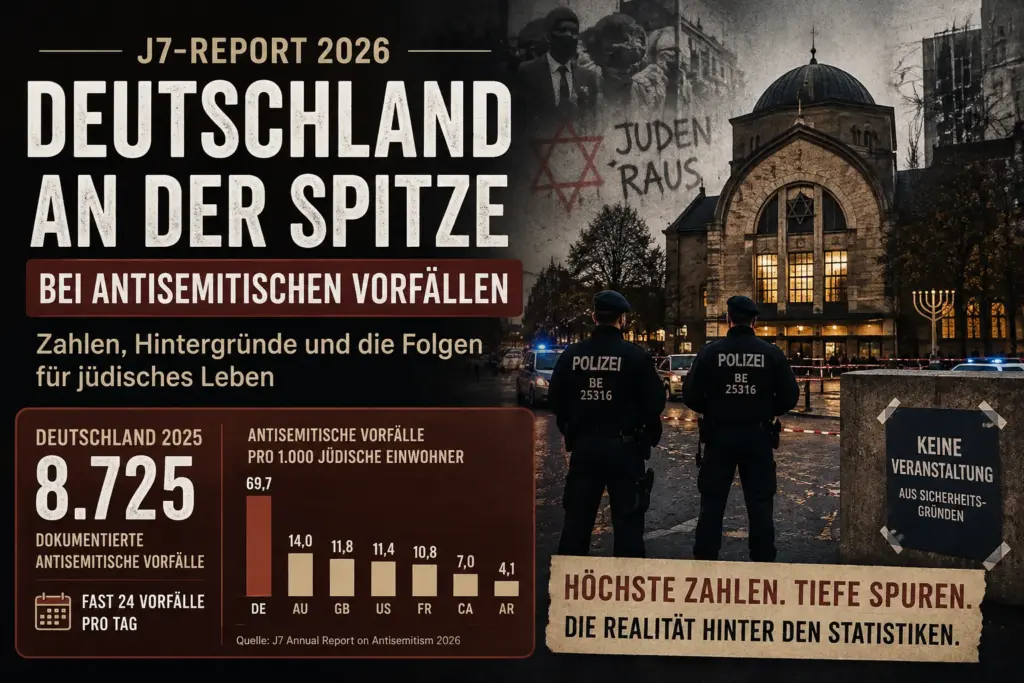
The Federal Association RIAS documented a total of 8,725 antisemitic incidents in Germany for 2025. That corresponds to an average of nearly 24 incidents every single day.
Among them were four cases of extreme violence, 178 attacks, 257 threats, and 413 targeted cases of property damage. In addition, there were 103 mass mailings and 7,770 cases of abusive behavior, including antisemitic rallies, graffiti, insults, and targeted intimidation.
RIAS classified 68 percent of all documented incidents as manifestations of Israel-related antisemitism. This is more precise than the mere formulation that the cases somehow had a “connection to Israel.” It refers to antisemitic statements or actions in which Israel serves as a projection screen.
Compared with 2024, the total rose only from 8,713 to 8,725 incidents. Twelve additional cases are statistically hardly a change. Nevertheless, drawing the all-clear from this would require considerable imagination. The level had already reached a historic high the previous year and remained practically unchanged at a very high level in 2025.

Passende X-Beiträge
Aus dem SCHLAGSEITE X-Archiv
Top among seven countries
The international comparative figure comes from the J7 Annual Report on Antisemitism 2026. The J7 comprises Germany, the United States, the United Kingdom, France, Canada, Australia, and Argentina. These are seven countries with particularly large Jewish communities outside Israel.
Within this comparison, the German finding is clear. With 8,725 incidents Germany reported not only the highest absolute number. At nearly 70 incidents per 1,000 Jewish residents Germany was also clearly ahead of the other countries examined proportionally. Australia followed with about 14, and the United Kingdom with just under twelve incidents per 1,000 Jewish residents.
The correct statement is therefore: in 2025, Germany led the J7 statistics for documented antisemitic incidents.
What is not established, however, is that more antisemitic incidents took place in Germany than in any other country on Earth. Numerous countries are not examined at all in the J7 report. In some countries, there are also no independent reporting centers, reliable statistics, or sufficiently safe ways for those affected to report incidents.
⚠️ Common misunderstanding
The J7 comprises seven countries with particularly large Jewish communities. The report is therefore an important international comparison, but not a complete global survey. “The highest figure within the J7” does not automatically become “nowhere in the world” in journalism. Reality is bad enough. It does not need statistical exaggeration.
The 215 percent also require a point of comparison
The J7 report records an increase in documented incidents in Germany of around 215 percent between 2021 and 2025. However, describing this figure directly as a development “since the Hamas terror attack of October 7, 2023” conflates the comparison period with the political turning point.
The calculation begins with 2,773 incidents in 2021 and ends with 8,725 incidents in 2025. In between, RIAS documented 2,610 incidents in 2022, 4,886 in 2023, and 8,713 in 2024.
October 7, 2023 nevertheless marks a clear turning point. Following the massacres by Hamas and other terrorist groups, the number of antisemitic incidents in Germany rose to a significantly higher level than in previous years. The specific increase of 215 percent, however, compares 2025 with 2021 and does not exclusively measure the period after the terrorist attack.
That sounds like statistical pedantry. But it is not. Anyone who uses figures as evidence must also say what they refer to. Otherwise, a solid finding becomes a headline that is loud but appears precise in the wrong place.
Incidents and offenses are not the same thing
The 8,725 RIAS cases must also not be equated with 8,725 criminal offenses recorded by the police. RIAS also documents antisemitic acts that may not meet the elements of a criminal offense or may not have been reported to the police. These can include insults, exclusion, antisemitic mailings, incidents at rallies, or other forms of abusive behavior.
The German government reported 6,548 antisemitic criminal offenses for 2025. In 3,163 offenses, or 48.3 percent, a connection to Israel was recorded. This police figure, too, is at a frightening level.
The two statistics do not contradict each other. They examine different areas. RIAS documents the social manifestation of antisemitism more broadly, while police statistics reflect offenses recorded under criminal law.

ℹ️ Two statistics, two areas of measurement
RIAS documents antisemitic incidents; the police register criminal offenses. A reported incident is not automatically a criminal offense. Conversely, reporting behavior also influences how many cases appear in police statistics. The figures complement each other, but they must not be confused.
Antisemitism does not come from just one camp
The RIAS analysis presents a politically inconvenient picture. In 1,970 incidents RIAS identified a background rooted in anti-Israel activism. 807 incidents were assigned to a far-right background based on the available indications, 501 to a left-wing anti-imperialist background, 190 to a conspiratorial-ideological background, and 166 to an Islamic or Islamist background.
This classification does not automatically mean that, in every individual case, an unequivocally identified perpetrator from the respective political milieu was established. RIAS assesses, among other things, the language and symbols used, the context of the act, and known backgrounds. In 4,935 incidents, or 57 percent, the available information was insufficient for a clear political or ideological classification.
There, antisemitic criminal offenses without indications to the contrary were often assigned for a long time to the PMK-right category. This could create the impression that every offense classified as “right-wing” had demonstrably been committed by a known far-right extremist. A statistical classification, however, is no substitute for an identified perpetrator or a political background established beyond doubt.
It is also important to distinguish between the form in which an incident manifests itself and its political background. The 68 percent of Israel-related antisemitism describe the content of an incident. Categories such as far-right, left-wing anti-imperialist, or Islamist, by contrast, describe the political and ideological background. An incident can therefore, for example, be both far-right and Israel-related antisemitic.
At the same time, the statistics disprove any convenient narrative that antisemitism is exclusively the problem of the other side. Far-right Jew-hatred is increasing. Left-wing anti-imperialist and anti-Israel antisemitism remain influential. Islamist ideology continues to be a relevant part of the threat.
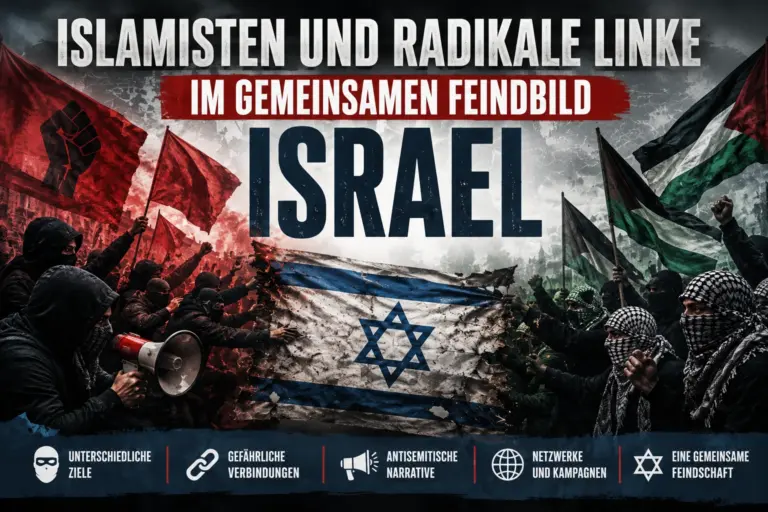
How different political extremes converge around Israel as their common enemy is examined in greater detail in the SCHLAGSEITE article “Israel as the Enemy Image: Why Extremes Converge” .
The political response nevertheless often remains predictably selective. The right points the finger at the left, the left at the right, and when it comes to Islamist antisemitism, some suddenly discover their sensitivity to language. For Jews, this partisan division of labor is largely meaningless. The hatred remains the same, even when its slogans change.
Why Jew-hatred escalated after October 7
The antisemitic hatred that has openly emerged since October 7, 2023, did not suddenly arise out of nowhere. The Hamas terrorist attack instead acted as a catalyst for long-existing anti-Jewish prejudices. What had often previously been packaged as anti-Zionism, anti-imperialism, or radical “criticism of Israel” now emerged more openly. Israel was no longer merely criticized for specific political decisions but was portrayed wholesale as a colonialist, racist, or fundamentally illegitimate state.
In parts of the left-wing anti-imperialist spectrum, this thinking follows a highly simplified worldview. On one side are supposedly exclusively the oppressed; on the other, exclusively the oppressors. Within this framework, Israel is declared a Western colonial power, while Palestinian or Islamist actors almost automatically appear as liberation movements. The Hamas massacres are thereby relativized, reinterpreted as “resistance,” or completely excluded from consideration. Jewish history, the millennia-old connection to the land of Israel, and the threat to Jewish life do not fit this rigid perpetrator-victim framework and are therefore frequently omitted.

How antisemitism in parts of the German left is trivialized or excluded through linguistic and political redefinitions is examined in the article “Germany’s Left and Israel: Antisemitism Is Defined Away Too Often”.
In Islamist circles, antisemitism has different ideological roots but converges on the same enemy image. Islamist organizations combine religiously charged Jew-hatred, conspiracy narratives, and rejection of Israel’s right to exist. The Middle East conflict is deliberately used to mobilize emotions, portray Muslims as a unified community of victims, and declare Jews, Israel, and Western democracies to be the common enemy. Criticism of this propaganda, in turn, is reframed as alleged oppression of Muslims or as a ban on legitimate solidarity with Palestine.
Since October 7, both currents have mutually reinforced each other. Islamist slogans appear at demonstrations from the left-wing spectrum, while terms from postcolonial and anti-imperialist debates serve to justify Islamist violence. This creates a political hybrid scene in which different ideologies converge around the shared enemy image of Israel.
Social networks accelerate this development further. Images, false reports, shortened videos, and emotionalizing propaganda spread faster than verifiable facts and increasingly turn political outrage into overt hatred of Jews. How framing, disinformation, and propagandistic images distort the Middle East conflict is shown by the SCHLAGSEITE fact check “Media Manipulation in the Middle East Conflict: How Manipulation Turns Israel into the Perpetrator”.
The crucial boundary remains: Criticism of an Israeli government is legitimate. The demonization of Israel, denial of its right to exist, justification of terrorism, or attribution of Israeli policies to all Jews is not. Anyone who blurs this boundary is not fighting a government. They are promoting an antisemitic worldview.
When Jewish Life Disappears from the Public Sphere
Behind the 8,725 documented incidents are not just statistics, but concrete consequences for Jewish life. The 2026 Situation Report on Jewish Communities by the Central Council of Jews is based on a survey of leaders from 102 Jewish communities and state associations.
According to it, 68 percent of the Jewish community perceive life in Germany as less safe than before October 7, 2023. Jewish people are increasingly withdrawing from public spaces, concealing their identity, or refraining from openly wearing a kippah and Star of David. Children and young people are particularly affected.
Within one year, 21 percent of communities also had to cancel events for security reasons. Only 13 percent view the future of Jewish life in Germany positively. Thus, the abstract number of antisemitic incidents becomes a concrete restriction of freedom, visibility, and participation in society.

A society in which Jewish people have to consider whether they can show their identity publicly does not have merely a statistical problem. It has a fundamental security and democracy problem.
Even the Best Statistics Do Not Capture Everything
RIAS itself points out that the documented figures do not provide a statistically representative overall picture of all antisemitic experiences . The number of reports depends, among other things, on whether those affected know about a reporting office, trust it, and are able or willing to report an incident at all.
There is therefore a dark figure. The actual number of antisemitic experiences is likely to be higher. At the same time, well-developed reporting structures can mean that more incidents become visible in one country than in places where those affected have few opportunities to document them.
This limitation does not invalidate the statistics. It merely accurately describes what was measured: documented antisemitic incidents examined according to RIAS criteria. Serious assessment begins where figures are taken seriously without attributing to them more evidentiary value than they possess.
✔️ In Summary
In 2025, Germany ranked first among the seven J7 states both in the absolute number of documented antisemitic incidents and in relation to the Jewish population. This finding is unequivocal and shameful. What is not substantiated, however, is a worldwide top ranking, because the report does not constitute a complete global statistic. Moreover, the 215 percent increase refers to the comparison between 2021 and 2025. The headline overshoots. Germany’s antisemitism problem, unfortunately, does not.
Germany does not need an invented world-champion title. 8,725 documented incidents are entirely sufficient as an indictment.
ℹ️ Factual Basis and Primary Sources for the Article 📑
▶️ Federal Association RIAS:
Antisemitic Incidents in Germany in 2025
Official annual report with total figures, types of incidents, political backgrounds, and methodological notes.
▶️ Federal Office for the Protection of the Constitution:
October 7, 2023 and the Ongoing Consequences for the Security Situation in Germany
Analysis of the ideological overlaps between Islamist, left-wing extremist, and right-wing extremist milieus, as well as radicalization through antisemitic and anti-Israel propaganda.
▶️ Federal Agency for Civic Education:
Antisemitism in the Left-Wing Spectrum
Background on the anti-imperialist worldview, the demonization of Israel, and the attribution of Israeli policies to Jewish people.
▶️ J7 Task Force Against Antisemitism:
J7 Annual Report on Antisemitism 2026
International comparison of antisemitic incidents in seven states with large Jewish communities.
▶️ Anti-Defamation League:
J7 Report: 2025 Was Deadliest Year for Antisemitic Attacks in the Diaspora
Summary of the key international findings and comparative figures.
▶️ Central Council of Jews in Germany:
2026 Situation Report on Jewish Communities
Survey on the security situation, social visibility, and the consequences of antisemitism for Jewish communities in Germany.
▶️ German Bundestag:
6,548 Antisemitic Crimes in 2025
Figures from the German government on antisemitic crimes recorded by police and their connection to Israel.
▶️ BILD:
Nowhere in the World Are There as Many Incidents of Hatred of Jews as in Germany
The media starting point of the fact check and source of the examined global exaggeration.
🔎 Found an Error, Criticism, or Addition?
SCHLAGSEITE.eu stands for careful research and transparent corrections. Have you discovered a factual error, unclear wording, or a broken link? Then send me your note. If possible, please provide a verifiable source.