

00:00 / –:–
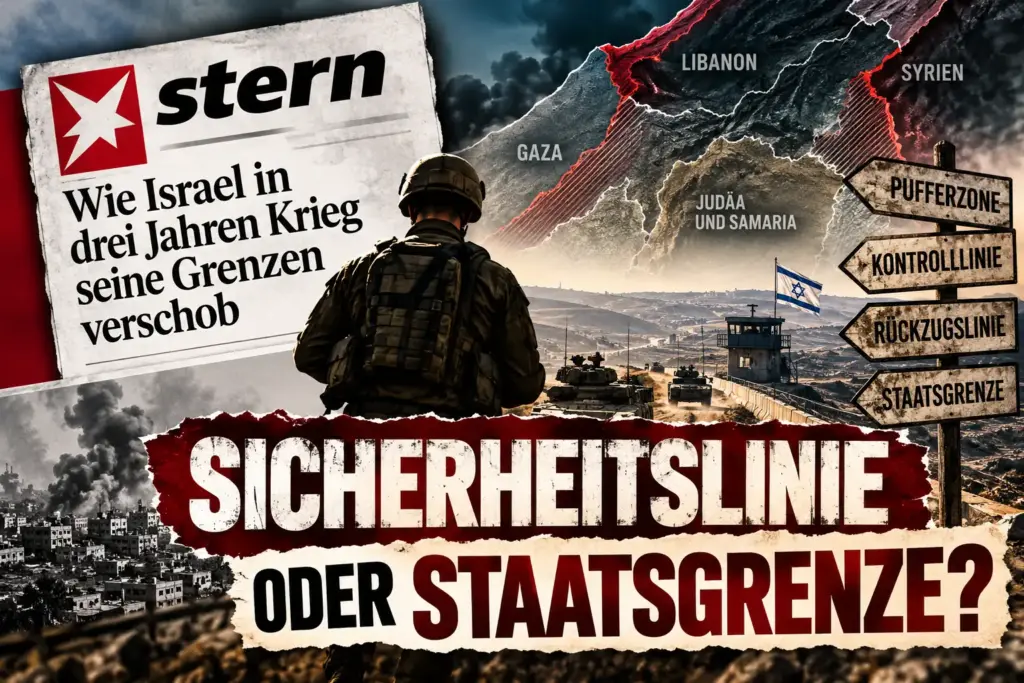
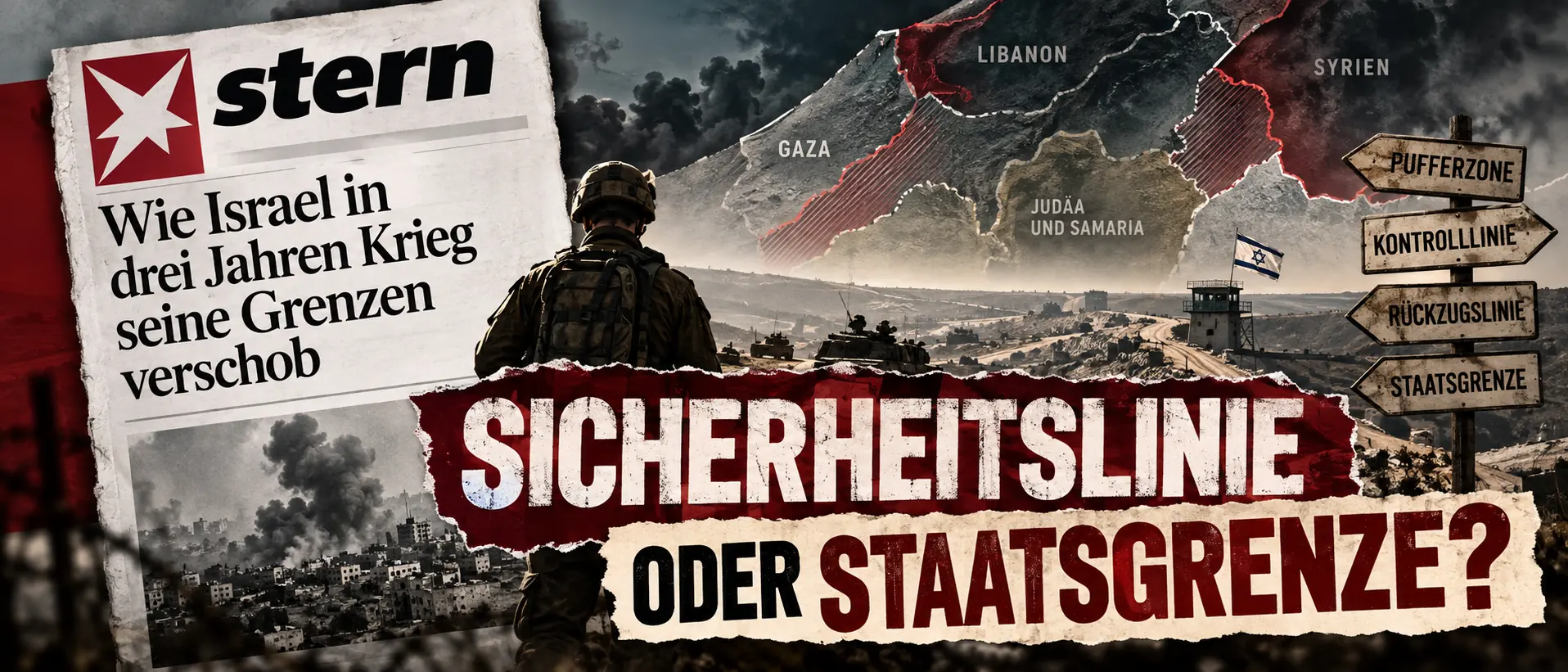
“How Israel shifted its borders in three years of war”, reads the stern headline. This sounds like an expansion of Israel’s state borders. In fact, various processes lie behind the developments since October 7, 2023: military control lines in the Gaza Strip, a security zone in southern Lebanon, Israeli positions in Syria, and a settlement policy in Judea and Samaria that must be distinguished from these. Anyone who summarizes all of this as “border shifting” is already imposing a political framework with the headline.
This is not a matter of semantic nitpicking. A state border, a military withdrawal line, a buffer zone and a political demand for annexation are four different things. They have different causes and legal consequences. A journalistic report should make precisely these differences visible instead of obscuring them with a single formulation.
Four locations, different military control lines
Gaza, Lebanon, Syria, and Judea and Samaria cannot be described as a single territorial development. In Gaza, the issue is a military system of control and withdrawal that emerged after the Hamas attack. In Lebanon, the focus is the threat posed by Hezbollah to Israel’s northern border. In Syria, the fall of the Assad regime altered the security situation along an existing area of troop disengagement. Settlement expansion in Judea and Samaria, by contrast, follows a longer-term political and administrative logic.
Those who combine these developments into a story about Israel’s allegedly redrawn borders strip them of their respective contexts. It is documented that Israel exercises additional military control in several areas. But that is a different statement from the claim that the state has accordingly changed its recognized borders.
October 7 is not a footnote
On October 7, 2023 Hamas and other armed groups attacked Israel. More than 1,200 people were murdered, and 251 were abducted to Gaza as hostages. UN Secretary-General António Guterres recalled this in his statement on the third anniversary. As early as October 8, UNIFIL documented rocket fire from Lebanon and Israeli counterfire.
Israel therefore had to respond not only to the Hamas attack, but also take into account another armed front in the north. The threat posed by rockets, armed positions and infrastructure near the border is crucial to Israel’s security strategy. Anyone reporting on the security zones established later need not adopt this history as a justification. They must explain it as a cause and subject of scrutiny.
Passende X-Beiträge
Aus dem SCHLAGSEITE X-ArchivGaza: Military control lines are not new state borders
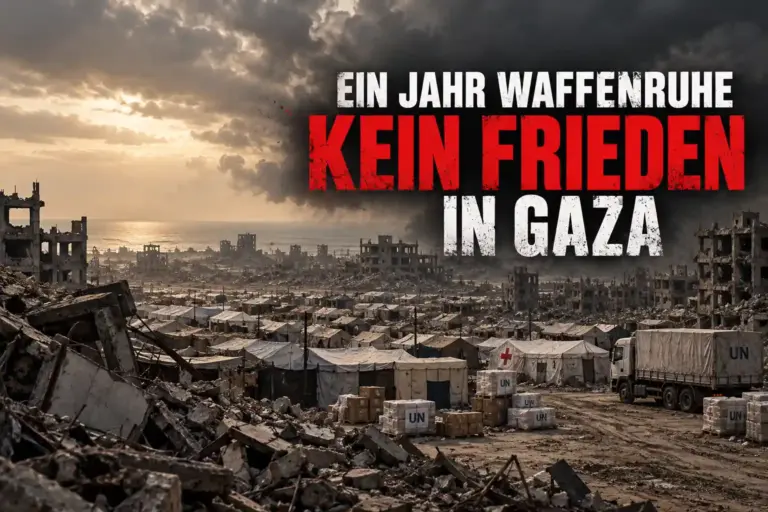
After the October 2025 ceasefire, the so-called Yellow Line initially marked the area where Israeli troops were temporarily supposed to remain. According to the OCHA report of June 26, 2026 the original deployment zone corresponded to around 53 percent of the Gaza Strip. In June 2026, access restrictions already affected around 65 percent. The UN also distinguished a more far-reaching Orange Line.
These figures describe different circumstances and different points in time: initially the designated deployment area, later the areas subject to access restrictions. The markings and restrictions were shifted several times over the course of the months. An OCHA report of October 15, 2026 documented reported shifts. The percentages are therefore snapshots in time, not immutable boundary figures.
The impact on the civilian population’s freedom of movement is considerable and belongs in reporting. But a militarily controlled area must not quietly become newly acquired state territory. The conceptual and legal prerequisites for such a step are lacking.
The Resolution 2803 of 17 November 2025 supported by the UN Security Council provides for a phased withdrawal of Israeli troops, linked to the demilitarization of Gaza and security conditions. The accompanying plan expressly does not provide for an Israeli annexation of Gaza. The question, then, is how the current control fits with these agreements and whether the security conditions are being met. This is more concrete journalistically than “Israel shifted its borders”.
Lebanon: Separate protection of the northern border from territorial claims
In southern Lebanon, the Israeli government justifies the military security zone by citing the threat posed by Hezbollah. Prime Minister Benjamin Netanyahu said on June 22, 2026, that Israeli troops should remain there for as long as necessary to protect the population in the north. In a joint statement with Defense Minister Israel Katz a few days later, the government referred to the destruction of Hezbollah infrastructure.
Finance Minister Bezalel Smotrich, by contrast, called on March 23, 2026, for extending Israel’s border to the Litani River. This demand was documented by Reuters. It is explicitly territorial and must be identified as such. However, it should not be equated with the government’s stated security strategy, nor does it constitute an already completed change to the state border.
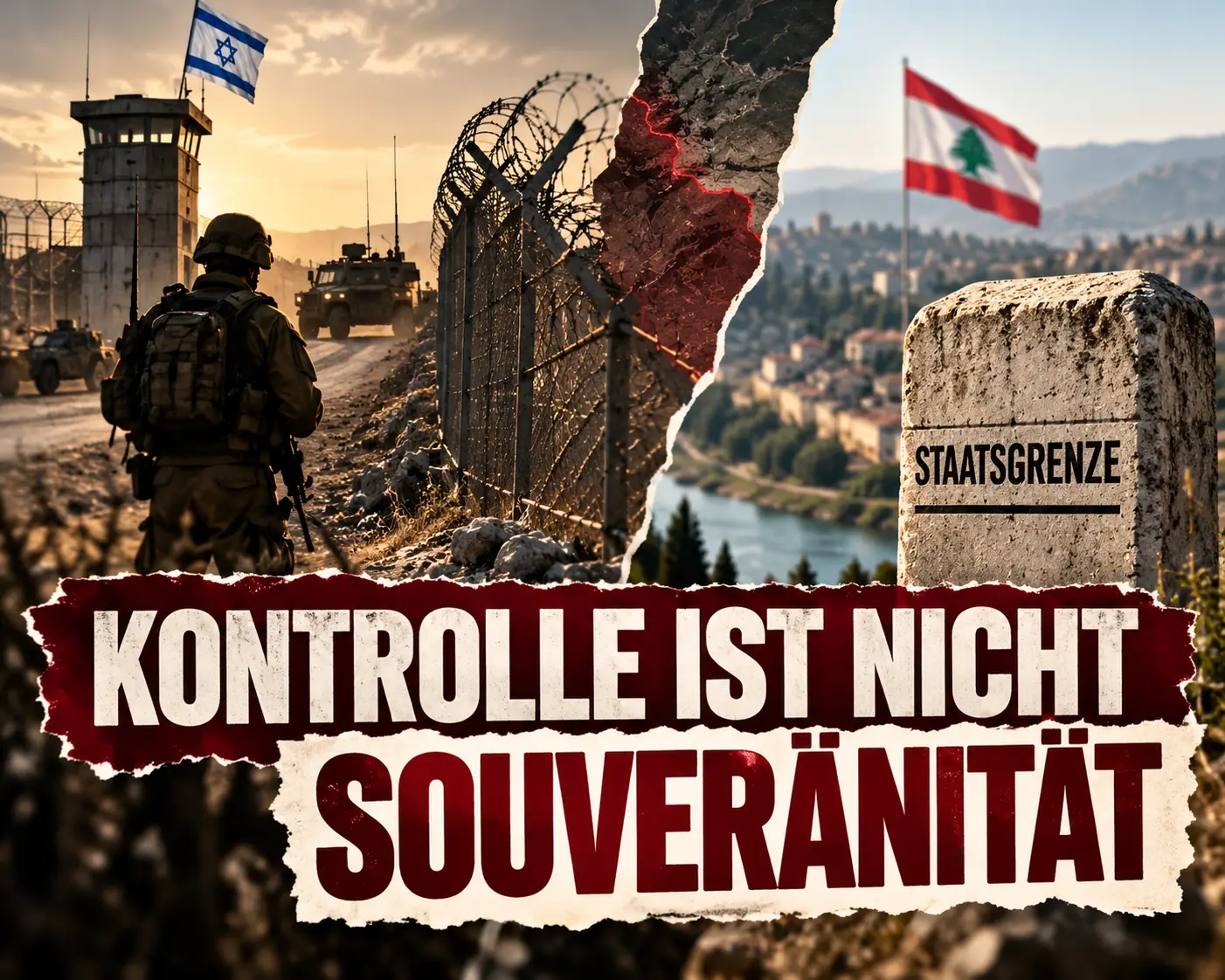
The UN mission UNIFIL also makes clear: The Blue Line is a withdrawal line, not an agreed international state border. UNIFIL considers crossings of the Blue Line to be violations of Resolution 1701. A security justification therefore does not replace an examination of the respective measure. It is the starting point for that examination, not its result.
Syria: Advances after the fall of Assad have a different background
After the fall of the Assad regime in December 2024, Israeli soldiers advanced into and beyond the Syrian troop separation zone. Israel justified this on the grounds of a changed security situation. The Security Council Report of October 2026 simultaneously documents that the United Nations considers the continuing Israeli presence in the separation zone to be a violation of the 1974 Agreement. UNDOF monitors compliance with it.
This is a concrete dispute over military presence and existing agreements. Treating it as a formal change to Israel’s state borders would obscure precisely the legal conflict that a careful analysis would need to explain.
Judea and Samaria: Settlement policy is not a buffer zone
A different category is the expansion of Israeli settlements in Judea and Samaria. According to the UN briefing of September 28, 2026During the reporting period from June to September, plans for thousands of additional housing units were advanced or approved. This is an independent state settlement and planning policy involving significant legal and political conflicts.
Anyone who places it, together with Gaza, Lebanon and Syria, within a single narrative about the response to October 7 also misrepresents this process. The settlement issue predates the current war and is driven forward by decisions different from those concerning a military line of withdrawal. Critical reporting in particular should not obscure this distinction.
How headlines turn military lines of control into borders
stern is allowed to critically examine Israeli military actions, their consequences for civilians, and the intentions of individual politicians. However, it should distinguish between documented consequences and attributed motives. For example, documented destruction does not in itself constitute proof of a plan to deliberately destroy livelihoods. Such a claim requires its own evidence.
The problem with the headline lies in its compression. It turns several developments, each based on different grounds and assessed differently, into a story about the shifting of Israel’s borders. This directs attention to territorial expansion before any distinction has been made between a security measure, occupation, withdrawal line, settlement expansion, and a demand for annexation.
A more precise headline would be: “How three years of war changed Israel’s military control lines.” It sounds less dramatic. In return, it would be immediately clear what the issue is and which questions still need to be clarified.
The central media criticism is simple: Anyone describing Israel’s military control should not phrase it as though state borders had already been redrawn. Anyone seeking to substantiate territorial ambitions must distinguish between political demands and state decisions. And anyone wishing to assess the security zones must not push the attacks by Hamas and Hezbollah to the margins of the story. A precise map requires precise terms. Especially when it comes to Israel.
ℹ️ Factual basis and primary sources for the article 📑
▶️ Starting point of the media criticism:
stern: How Israel shifted its borders during three years of war
▶️ United Nations and UNIFIL:
UN Secretary-General on October 7, 2023 and UNIFIL on the shelling of October 8, 2023
Initial situation and chronology.
▶️ OCHA:
Report of June 26, 2026 and Report of October 15, 2026
Yellow and Orange Line, access restrictions, and reported shifts.
▶️ UN Security Council:
Resolution 2803 (2025) with Gaza plan
Step-by-step withdrawal and no annexation under the attached plan.
▶️ Israeli government:
Netanyahu’s statement of June 22, 2026 and joint statement of June 28, 2026
Stated security objective and military infrastructure in southern Lebanon.
▶️ Reuters:
Smotrich calls for a border at the Litani, March 23, 2026
A minister’s territorial demand.
▶️ UNIFIL, UNDOF and Security Council Report:
UNIFIL on the Blue Line, UNDOF on the 1974 Agreement and Security Council Report, October 2026
Status and conflicts involving the troop separation lines.
▶️ United Nations:
UN briefing of September 28, 2026, on settlement expansion
A distinct area of Israeli settlement policy.
🔎 Spotted an error, criticism or addition?
SCHLAGSEITE.eu stands for careful research and transparent corrections. Have you spotted a factual error, unclear wording or broken link? Then send me your note. If possible, please provide a verifiable source.