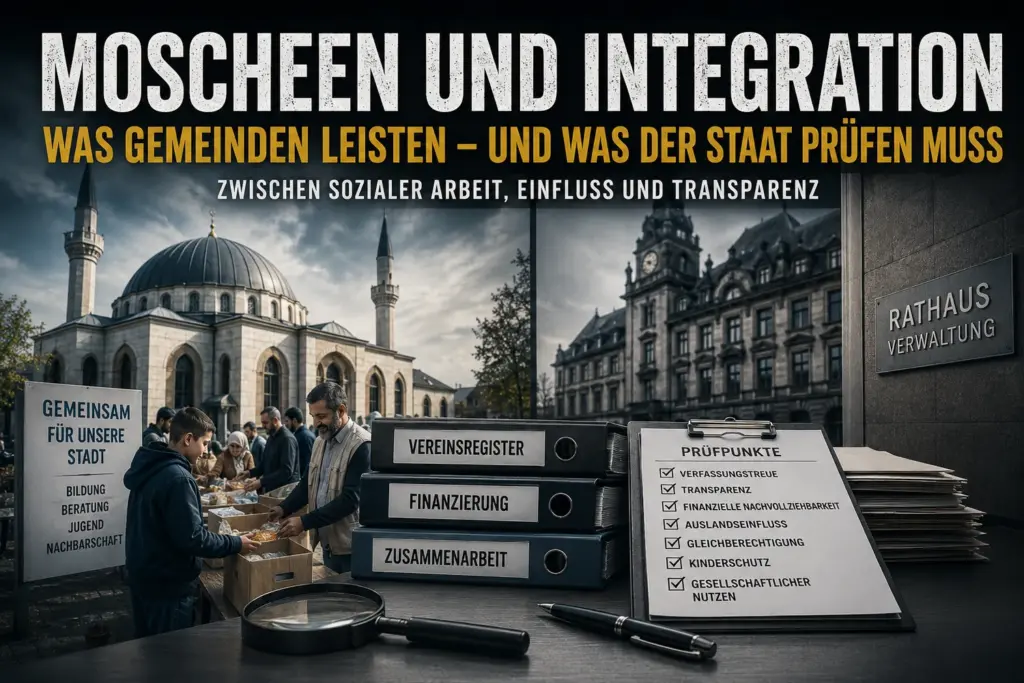

Mosque communities in Germany have long provided more than just religious services. They organize homework help, advise families, accompany people to public authorities and offer leisure activities for young people. Much of this work is carried out on a voluntary basis and is of very concrete help in many people’s daily lives.
But this is precisely where the real debate begins: Social work within a religious community is not automatically social integration. The decisive question is therefore not only whether mosques provide services, but what form of coexistence they promote – openness to wider society or, above all, attachment to their own milieu.
In Germany, this distinction has too rarely been made clearly for years. The debate often swings between two convenient extremes: Some treat mosques as a problem across the board. Others already regard every neighborhood project and every dialogue event as proof of successful integration. Both approaches fall short.
That is precisely why it is worth taking a closer look: at the actual work of the communities, at state funding programs, at the question of transparency, at foreign influence and at the standards that a credible integration partnership would have to meet.

Passende X-Beiträge
Aus dem SCHLAGSEITE X-ArchivAn old accusation that remains unresolved to this day
The starting point of this debate is not new. Back in 2018, Islamist extremism observer Sigrid Herrmann-Marschall criticized in an interview with the Frankfurter Neue Presse, that politicians and administrators too often glossed over problematic structures or shied away from clear consequences.
The specific context at the time has since become outdated. Individual names, connections and local constellations must not be transferred uncritically to the present. However, the interview’s central question is more relevant than ever: By what standards does the state declare a mosque association an integration partner?
Anyone who participates in official programs, is visibly involved in municipal events or is regarded as a contact for schools and initiatives effectively receives a public seal of approval. This creates trust – among citizens, authorities, other associations and, last but not least, the media.
All the more important, then, that this trust is not based on mere symbolic politics. Scrutiny must therefore not end with the association register, bylaws and a project description written in friendly terms. It is equally decisive what content is conveyed, which preachers appear, and what stance toward democracy, equality, antisemitism and openness to society is actually practiced.
Mosques are social points of contact in many places

According to the current findings of the Research Services of the German Bundestag there are around 2,600 Muslim communities and Alevi cemevis in Germany. Mosques have therefore long been part of the country’s social infrastructure. For many visitors, they are not only places of prayer, but also meeting places, advice centers, educational spaces and social homes.
The study of community services and structures in Islamic communities presented by the German Islam Conference shows that considerable voluntary engagement takes place in many communities. Young people receive sports and leisure activities, and in some cases tutoring or homework help as well. Adults find social counseling, guidance in everyday life and support with practical problems. For refugees, communities often organize translations, assistance with visits to public authorities or donations in kind.
These services are real and deserve recognition. Anyone who helps a family with a visit to a public authority, lends a young person a hand with studying or helps a newcomer find their bearings is providing concrete assistance. It would be unserious to deny or downplay this work across the board.
At the same time, it is necessary to state clearly what this assistance means and what it does not. Effective community work initially proves that a community supports and organizes its members. That is important, but it does not yet answer the question of whether this also leads to lasting openness to German society.
This is particularly decisive for young people. If sports, leisure activities, social recognition and key contacts take place almost exclusively within the same religious or ethnic milieu, this does not automatically create integration; it initially creates attachment to one’s own community. That can be a bridge – but it can just as easily remain a dead end.
Mosque communities can be an important first source of support for newcomers or socially disadvantaged families. From an integration-policy perspective, however, the decisive question is whether this leads to linguistic, social and institutional participation beyond the community itself or whether life is primarily consolidated within a closed milieu.
Community work is not automatically integration
This is precisely where the debate in Germany regularly becomes blurred. The mere fact that a mosque offers youth work, counseling or a neighborhood project is often regarded as evidence of successful integration work. That is too simplistic.
Integration is more than support services. Integration does not only mean managing within a group; it also means gaining access to wider society – linguistically, socially, professionally, culturally and politically. A community can give its members security while also preventing them from opening up permanently beyond their own community.
The services documented in the community study make this tension visible. While sports, outings and homework help are relatively widespread, German courses and official integration courses are significantly less common. Services for refugees, too, often focus on practical assistance rather than measurable openness to society.
Anyone who wants to seriously assess the impact of mosque communities must therefore ask different questions: Are German-language skills improving? Are contacts being established beyond one’s own milieu? Are young people being supported in joining associations, entering training, the world of work and neighborhood life? Do women have a real say? Can community members remain free even if they do not share conservative expectations?
Such questions are more uncomfortable than a friendly group photo at an iftar. But that is precisely where it is decided whether community work opens up society or primarily stabilizes internal structures.
The state promotes openness – and thereby grants trust
The state works with mosque communities not only through dialogue, but also through funding programs. The former program “Mosques for Integration” and the current project ProAktiMO are intended to professionalize and network communities and strengthen their social work.
This is understandable in principle. Many communities have little full-time staff, limited administrative experience and depend heavily on volunteers. Support can be useful here, especially when it is aimed at municipal networking, qualification and transparent project work.
But public funding brings more than money. It brings visibility, political recognition and a form of institutional advance trust. Anyone appearing as a funded partner is quickly perceived externally as vetted, responsible and unproblematic for society. That is precisely why the bar must be set high.

Professionalization is not the same as integration. An association can learn to submit funding applications professionally, prepare project reports neatly and make a convincing appearance at public events. That does not yet answer the question of which values, dependencies and social concepts lie behind this façade.
Precisely because public cooperation creates trust, scrutiny must not end with finances and event lists. The executive board, umbrella organizations, invited speakers, preaching environment, youth work, women’s participation, the handling of criticism and political conduct during crises are equally relevant.
Who actually represents “Muslims”?
Another problem lies in political representation. Organized Islamic associations have structures, contacts and spokespersons. This makes them tangible contacts for the state. That is pragmatic, but it creates a considerable imbalance.
Not every Muslim belongs to a mosque community, and not every community speaks for the breadth of Muslim life in Germany. There are secular Muslims, liberal Muslims, people with little religious affiliation, former Muslims and many who regard religion as a private matter. Institutionally, these voices are often far less organized than large associations.
Politics needs contacts. But it must not pretend that the best-organized officials are automatically representative of millions of people. Anyone who speaks with well-connected associations is initially speaking with associations – not with a homogeneous Muslim population.
Funding, DITIB and foreign influence
The debate becomes particularly sensitive where financial, personnel or political dependencies from abroad play a role. The Research Services of the Bundestag explicitly point out that the available data on foreign funding of German mosques remains insufficient. That is precisely a problem, because a lack of transparency creates room for influence.
Foreign support in itself does not prove extremism. It becomes politically relevant where donors, religious authorities or state bodies gain influence over personnel, sermons, educational content or public positions.
The best-known example is DITIB, the largest Islamic umbrella association in Germany. Its connection to Turkey’s religious authority, Diyanet, has been the subject of political debates for years. As the Federal Ministry of the Interior announced in December 2023, it was agreed to gradually end the deployment of Turkish imams and to train religious personnel more extensively in Germany. Nevertheless, the question remains how far structural and political lines of influence have actually been pushed back.
The Islamic Center Hamburg as a warning signal

One particularly clear case was the Islamic Center Hamburg. The Federal Ministry of the Interior banned the association and its affiliated organizations on July 24, 2024. According to the Federal Office for the Protection of the Constitution, the center acted as a direct representative of Iran’s revolutionary leader, propagated an authoritarian-theocratic system of rule, spread aggressive antisemitism and supported Hizb Allah, the terrorist organization banned from operating in Germany.The ban is not evidence against mosques as a whole. However, it shows that a religious institution can simultaneously be a place of worship, a center of political influence, and part of a network controlled from abroad. That is precisely why authorities must examine not only visible community work, but also lines of leadership, ideological ties, and actual political functions.
This is central to the integration debate. A community that is organizationally or personally closely linked to a foreign state will hardly be regarded as a fully independent actor in social integration. It can provide social services without therefore being free of external political control.
That is precisely why clear disclosure requirements are needed. Anyone receiving public funding or acting as an integration partner must be able to disclose who provides the funding, who makes the decisions, and who shapes religious content. Trust is not created by looking the other way, but by verifiable transparency.
The call for transparency does not mean making a blanket suspicion of mosques or Muslims. Unproblematic communities in particular have a vested interest in providing comprehensible evidence of their independence and their clear distance from extremist or state-controlled structures.
Islamism is real—but not every mosque is a security problem
This distinction is indispensable. The Islamist potential of individuals documented by the Federal Office for the Protection of the Constitution is real, as is the danger of radicalization, terrorist propaganda, and antisemitic mobilization. But it does not follow that every mosque or every conservative religious practice is automatically relevant to national security.
Anyone who lumps everything together understands neither integration nor Islamism. The great majority of Muslim communities are not the focus of the Federal Office for the Protection of the Constitution. At the same time, it would be negligent to refrain from any serious examination of problematic structures out of fear of being accused of discrimination.
This applies particularly where Islamist attitudes do not appear as open propaganda for violence, but as legalistic influence-building, religiously charged demarcation, or the cultivation of antisemitic enemy images. It is often in the way Jews, Israel, Hamas, or Hizb Allah are treated that the true resilience of dialogue and democratic loyalty becomes apparent.
It is precisely here that examining the ideological function of the enemy image of Israel is revealing. Antisemitism often functions not merely as a marginal phenomenon, but as a link between religious fanaticism, political extremism, and social isolation.
Radicalization between the pulpit and the smartphone
For 2024, the Federal Office for the Protection of the Constitution puts the Islamist potential of individuals at 28,280. At around 11,000 people Salafism remains the numerically most significant Islamist current. Political Salafism does not inevitably lead to terrorism, but in numerous cases it has laid the ideological groundwork for jihadist radicalization.
Salafist preachers and influencers use podcasts, video streams, online seminars, and social networks to reach young people in particular. This also includes actors who disparage people of other faiths, incite hatred, or portray the democratic order as illegitimate. The Federal Office for the Protection of the Constitution describes Salafism as a particularly dynamic Islamist movement and points to the growing importance of digital propaganda.

A mosque can promote radicalization, tolerate it, or resolutely oppose it. A community is responsible for invited preachers, its own teaching materials, youth programs, official social media channels, and known cooperation partners. However, it cannot automatically be held responsible for every visitor who becomes radicalized alone or in closed digital spaces.
Credible mosque communities can also be important partners in prevention. Trustworthy points of contact, qualified youth work, German-language educational programs, and clear engagement with Islamist propaganda can help identify radicalization processes at an early stage. However, this requires that problematic developments not be concealed out of fear of reputational damage, but addressed openly and, where appropriate, passed on to counseling centers or security authorities.
The Federal Office for the Protection of the Constitution is observing an increasing number of very young people who radicalize online within a short period of time. The so-called Islamic State uses international conflicts, and the conflict in the Middle East in particular, to deploy emotional images, narratives of victimhood, and enemy images in its propaganda. Such lone perpetrators do not always have long-standing contacts within an established Islamist scene.
The danger nevertheless remains concrete. According to the indictment by the Federal Public Prosecutor General, the perpetrator in Mannheim in May 2024 is said to have shared the ideology of the Islamic State and carried out the knife attack on people he considered infidels out of Islamist motives. One police officer was killed, and five other people are said to have become victims of attempted homicide.
In the knife attack in Solingen in August 2024 three people were killed. In February 2025, the Federal Public Prosecutor General brought charges including three counts of murder, ten counts of attempted murder, and alleged membership in the Islamic State.
Further serious acts followed in February 2025. In the alleged attack on a Ver.di event in Munich two people were killed and 44 others injured. The Federal Public Prosecutor General assumes an excessive religious motivation. In the knife attack at the Memorial to the Murdered Jews of Europe in Berlin the accused is said to have acted out of radical Islamist and antisemitic conviction.
These acts demonstrate a real Islamist threat, but not automatically radicalization in mosques. That is precisely why a more careful distinction must be made: between a community that invites dangerous preachers or downplays extremism, and a perpetrator whose radicalization occurred predominantly via smartphone, messenger services, and propaganda channels.
Caliphate instead of the Basic Law: When integration remains merely a façade
Islamism does not begin only with plans for terrorism or violence. The Federal Office for the Protection of the Constitution uses the term to describe a political ideology, which, invoking Islam, seeks to abolish the free democratic basic order in part or in full. What is problematic, therefore, is not the personal observance of religious rules, but the claim that a supposedly divine order should be placed above popular sovereignty, equality, and democratically enacted law.
On 5 November 2025 the Federal Ministry of the Interior banned the organization “Muslim Interaktiv”. According to the ministry, the organization’s purpose and activities were directed against the constitutional order and the idea of international understanding. At the same time, premises of the organizations “Generation Islam” and “Realität Islam” were searched because there was suspicion of similar anti-constitutional objectives. This does not prejudge a final legal assessment of either organization.

The ban makes visible a boundary that is often suppressed. Anyone who propagates a caliphate as a political countermodel to the democratic state, relativizes the rights of women and minorities, or seeks to place religious law above the Basic Law is not conducting particularly conservative integration work. They are working toward a different social order.
Such actors often do not rely on immediate violence. They use social media, public rallies, identity-political narratives of victimhood, and the claim that the majority society is fundamentally hostile. The aim is long-term separation, in which democratic institutions appear foreign, unjust, or morally inferior.
For cooperation with the state, it is therefore not only decisive whether an organization itself endorses violence. It is equally important whether it recognizes the liberal order as a binding framework or merely uses its funding opportunities while conveying a religious countermodel to its followers.
Women, young people, and dissent are the real stress tests
Whether a community works in a socially open manner is revealed not first in press releases, but in how it treats its own members. Can women participate in decision-making, or are they confined to side rooms and decorative roles? Is there genuine participation for young people? How are doubts, criticism, and different ways of life handled?
A mosque can present itself as integration-friendly externally while still maintaining strongly hierarchical, insular, or authoritarian patterns internally. That is precisely why work with women, youth work, and the handling of dissent are so revealing.
Integration is demonstrated not only by how friendly a community appears to the outside world, but also by how much freedom it can tolerate within. Anyone who recognizes young people only when they comply smoothly with the expectations of their milieu is not promoting social openness, but above all social discipline.
What credible integration work would actually have to deliver
If mosque communities want to be regarded as genuine integration partners, they need more than symbolic gestures of dialogue. Clear standards are needed—standards that are not directed against Muslims, but should apply to every cooperation relevant to the public.
- Transparent organizational structures – Boards, umbrella organizations, and decision-making processes must be comprehensible.
- Open financing – larger donations, foreign contributions, and personal ties must be disclosed.
- Traceable content – sermons, educational programs, and youth work must not be a closed-off space with no transparency whatsoever.
- Responsibility for preachers and digital channels – invited speakers, official social media offerings, and widely distributed teaching content must comply with the liberal order.
- Primacy of democratic law – religious rules must not be elevated into a political order above the Basic Law, equality, and popular sovereignty.
- Clear distance from extremism and antisemitism – not only in statements, but in actual conduct.
- Genuine participation by women and young people – not merely symbolic presence, but participation in decision-making.
- Measurable openness to society – that is, linguistic, educational, social, and institutional connectivity beyond the community itself.

These criteria would not be harassment. On the contrary: They would make visible the difference between communities that actually assume responsibility and those that use the word integration primarily as a politically useful self-description.
Mosque communities provide valuable social services in many places. But help within one’s own community is not automatically social integration. What matters is transparency, independence, genuine openness, responsibility for preachers and digital channels, a clear distance from extremism and antisemitism, and measurable participation beyond one’s own milieu. The state must neither treat mosques as objects of blanket suspicion nor endorse them uncritically.
The real question is not “whether,” but “how”
The question of whether mosques belong to Germany is misleading. Many congregations and their members have long been part of this country. The real question is a different one: What form of social coexistence is being promoted there, and how carefully is the state really looking into it?
Responsible integration policy therefore needs both: fairness and sobriety. No blanket suspicion of Muslims, but also no blindness to problematic structures. Cooperation is right—as long as it is based on transparency, verifiable standards and clear democratic reliability.
ℹ️ Factual basis and primary sources for the article 📑
▶️ Frankfurter Neue Presse – “Islamist terror threat: Politicians duck away”
Interview from 2018 that provides the starting point for the debate about mosques, political blind spots and integration policy
▶️ German Bundestag Research Services – Mosques in Germany
Current overview of the number, structure, financing, personnel and social role of mosque congregations
▶️ German Islam Conference – Services and structures of Islamic congregations
Summary of the congregation study on social services, volunteering and cooperation with local authorities
▶️ German Islam Conference – Mosques for integration
Documentation on the funding approach for the social opening and professionalization of Muslim congregations
▶️ ProAktiMO – Project description
Information on the current funding project for Muslim organizations and municipal networking
▶️ Federal Ministry of the Interior – Agreement on imam training in Germany
Background on the gradual end of imam deployment and the relationship between DITIB and Diyanet
▶️ Federal Office for the Protection of the Constitution – Islamism and Islamist terrorism
Current assessment of Islamist developments, security-relevant structures and radicalization tendencies
▶️ Federal Office for the Protection of the Constitution – Figures and facts on Islamism
Official figures on the Islamist potential, Salafism and the persistently high threat situation
▶️ Federal Office for the Protection of the Constitution – Definition and manifestations of Islamism
Distinction between personal religious practice and a political ideology that seeks to replace the free democratic basic order
▶️ Federal Office for the Protection of the Constitution – Ban on the Islamic Centre Hamburg
Official justification for the ban on the grounds of anti-constitutional objectives, Iranian influence, antisemitism and support for Hizb Allah
▶️ Federal Office for the Protection of the Constitution – Ban on “Muslim Interaktiv”
Official information on the ban on the association and the searches at “Generation Islam” and “Realität Islam”
▶️ Federal Public Prosecutor General – Indictment over the stabbing attack in Mannheim
Charges concerning one murder, five attempted murders and a motivation oriented towards the Islamic State
▶️ Federal Public Prosecutor General – Indictment over the stabbing attack in Solingen
Charges of three counts of murder, ten counts of attempted murder and suspected membership in the Islamic State
▶️ Federal Public Prosecutor General – Indictment over the attack on a Ver.di event in Munich
Charges concerning two deaths, 44 injuries and an excessive religious motivation for the act
▶️ Federal Public Prosecutor General – Indictment over the attack at the Holocaust Memorial
Official information on the accused’s alleged radical Islamist and antisemitic motivation
▶️ Federal Office for the Protection of the Constitution – Online radicalization of young people
Official assessment of rapid radicalization in the digital sphere and the role of the Islamic State