
New alliances in the Middle East are changing the region’s security order. Saudi Arabia, Turkey and Pakistan have created a new security reality with the Mecca defence agreement. An attack on one of the three states is to be regarded as an attack on all of them. Speaking of a fully fledged “Muslim NATO” would nevertheless be premature. For Israel, however, what matters less is what label the new pact receives than what shift in power it could trigger.
Because something else has long been emerging on the other side—something that sounds less spectacular but may be strategically more important: a network of Israeli partnerships stretching from the eastern Mediterranean through the United Arab Emirates to India. It would be neither a classic counter-alliance nor, certainly, a copy of NATO. That may be precisely where its strength lies.

Passende X-Beiträge
Aus dem SCHLAGSEITE X-Archiv
The Mecca Pact changes the starting position
On 7 August 2026, Saudi Arabia, Turkey and Pakistan signed the so-called Mecca Joint Defence Agreement. According to reports by Reuters the agreement obliges the three states to regard an attack on one treaty partner as an attack on all of them.
The following day, Turkish Foreign Minister Hakan Fidan went further, explicitly comparing the mutual-assistance clause with Article 5 of the NATO Treaty. At the same time, he said that the pact was directed neither against Iran nor against any other specific state. Pakistan also described the agreement as defensive. Other states could join later. Egypt is already being discussed as a possible additional participant. The three states could therefore eventually become a larger regional security framework. That is not yet certain, but it is a development Jerusalem can hardly ignore.
The truth also includes this: A mutual-assistance clause does not make a NATO. So far, there is no publicly known integrated command structure, no joint military leadership modelled on NATO, and no guarantee as to what concrete support would actually be provided in an emergency. Nor has the frequently discussed Pakistani nuclear umbrella for Saudi Arabia or Turkey been substantiated by the new agreement so far.

The term “Muslim NATO” is a political and media shorthand, not the pact’s official designation. The comparison is understandable because of the collective mutual-assistance clause. But it must not obscure the fact that NATO’s institutional and military structures have developed over decades and go far beyond a mutual assistance commitment.
Three partners, three very different interests
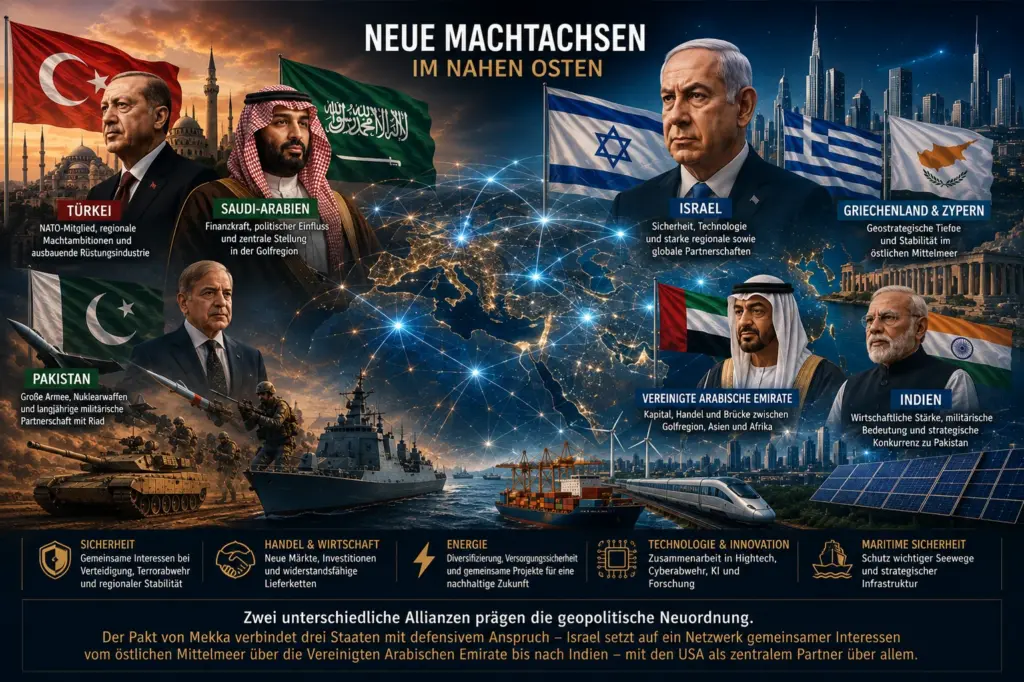
It is precisely the composition of the new alliance that makes it interesting. Saudi Arabia brings money, political influence and its central position in the Gulf. Pakistan has a large army, nuclear weapons and decades of military ties with Riyadh. Turkey combines a significant defence industry with its status as a NATO member and its growing regional power ambitions.
On paper, that makes for an impressive combination. But political alliances do not work like construction kits in which three capabilities are assembled and a cohesive power centre emerges as a result. The interests of the participating states are not identical.
Saudi Arabia is pursuing its own strategic interests, which do not fully coincide with those of Turkey or Pakistan. Pakistan, in turn, must view every strategic alignment against the backdrop of its conflict with India. And under President Recep Tayyip Erdoğan, Turkey is increasingly pursuing its own claim to regional leadership.
That is precisely why it would be too simplistic to immediately turn the Mecca Pact into a cohesive anti-Israeli bloc. The three states do not need to have the same adversaries for their cooperation to be strategically relevant to Israel.
For Saudi Arabia, the step is quite understandable. Following the regional upheavals of recent years, Riyadh is seeking additional security safeguards and does not want to make its defence dependent exclusively on Washington. The pact combines Saudi financial power with Pakistani military capabilities and Turkish defence technology. From the Saudi perspective, that makes it an instrument of strategic reassurance, without automatically creating an alliance directed against Israel.
Turkey is the decisive factor for Israel

Israel is therefore likely to watch Ankara particularly closely. Turkey differs fundamentally from Iran. It is not a Shiite revolutionary theocracy, has different regional interests and remains a member of NATO. But precisely for that reason, Turkish power projection presents Israel with a different kind of strategic challenge.
Ankara has a large conventional military, is expanding its own defence industry and has for years sought to exert political and military influence far beyond its immediate borders. At the same time, relations with Israel have repeatedly deteriorated severely under Erdoğan.
The analysis in Israel Hayom goes so far as to classify Turkey by now as a threat on a par with Iran. That is a strategic assessment by author Dr Oshrit Birvadker, not an official finding by the Israeli government.
A somewhat different question is therefore more interesting: What happens if Turkish regional ambition becomes permanently institutionally linked with Pakistani security interests and Saudi financial power? That is precisely what Israeli strategy must prepare for, without already construing a newly concluded treaty as an inevitable hostile military bloc.
Israel’s response began before the Mecca Pact
This is where the development becomes particularly interesting. The idea of an Israeli counter-movement did not emerge only after Erdoğan, Mohammed bin Salman and Shehbaz Sharif signed their agreement.
As early as 30 June 2026 Amir Baram, the director-general of Israel’s Ministry of Defence and a reserve major general, Amir Baram, outlined a new regional architecture at the Herzliya Conference. According to the official statement by the Israeli Ministry of Defence Baram explicitly spoke of a broader alliance that could extend from India through the United Arab Emirates to Greece and Cyprus .
That significantly changes the classification. Israel is not reacting hastily to a new pact. The strategic reordering was already part of the Israeli debate beforehand. The Mecca agreement merely increases the pressure to develop more robust structures from existing relationships.
Baram’s thinking is also based on an important principle: Such a regional architecture should not replace the partnership with the United States. It should expand Israel’s room for manoeuvre. Washington remains Israel’s most important strategic partner, but Israel is simultaneously seeking to broaden its foreign-policy and security-policy foundation.
Greece and Cyprus are already more than friendly neighbours
In the western part of this possible axis, Israel does not have to start from scratch. Cooperation with Greece and Cyprus has long been institutionalised. In December 2025, the three states signed a joint action plan for military cooperation in 2026. Greece and Israel also agreed on a bilateral military cooperation programme.
The Greek Ministry of Defence officially confirmed the agreements. The military action plan includes joint operational activities, training and consultations. Added to this is broader trilateral cooperation in areas such as maritime security, energy and the protection of critical infrastructure.
At the trilateral summit in December 2025, Israel, Greece and Cyprus also agreed to further deepen their cooperation, including on the security of sea routes and critical infrastructure. The eastern Mediterranean is therefore already the most developed part of a possible new Israeli security architecture. The interests of the three states are not identical, but they overlap at crucial points, particularly against the backdrop of Turkish power projection.
India turns a regional axis into a broader strategy

The picture becomes even more interesting when India is added. New Delhi is not a peripheral addition but could become the eastern anchor of such a structure.
India and Israel have significantly expanded their strategic relations in recent years. During his visit to Israel in February 2026, Indian Prime Minister Narendra Modi explicitly described defence and security as an important pillar of the partnership. The two countries had already concluded a memorandum on defence cooperation.
At the same time, Modi referred to two formats that are crucial to the broader strategic architecture: the India-Middle East-Europe Economic Corridor, IMEC, and I2U2, namely cooperation between India, Israel, the United Arab Emirates and the United States. The Indian Ministry of External Affairs explicitly documents this orientation.
This links security with the economy, infrastructure and technology. And that may be the most important difference from the Mecca Pact: Israel’s possible counter-structure does not have to be a classic military alliance to be strategically effective.
The Emirates are the hinge between the regions
The United Arab Emirates occupy a key role in this model. They have maintained diplomatic relations with Israel since the Abraham Accords, possess enormous economic capabilities and at the same time have particularly close relations with India.
India, Israel, the Emirates and the United States already cooperate in the I2U2 format. Its original focus is primarily on investment, water, energy, transport, space, health and food.
But strategic power does not arise solely from defence treaties. It also arises from ports, trade routes, energy links, technology, capital, intelligence sharing, political coordination and mutual economic dependencies.
A connection between Israel, the Emirates and India could therefore achieve far more than a symbolic response to Saudi Arabia, Pakistan and Turkey. Together with Greece and Cyprus, it would create a space that links South Asia, the Gulf, Israel and the eastern Mediterranean.
So far, this is not a formal five-country alliance. But the individual lines of connection already exist, and Israel’s Ministry of Defence has now explicitly formulated their possible consolidation as a strategic prospect.
Saudi Arabia does not fit neatly into the image of an adversary
The most complicated factor remains Saudi Arabia. Riyadh is now a member of the new pact. At the same time, Saudi interests differ significantly from those of Ankara and Islamabad in important areas.
Israel Hayom argues that the agreement makes normalization between Israel and Saudi Arabia more difficult and pushes it further into the distance. This is understandable, but not yet a definitive political fact. The Mecca Pact does not automatically mean that Saudi Arabia has declared Israel a military adversary.
Reuters reports instead that the participating states present the agreement as a defensive instrument and do not name any specific adversary. Saudi Arabia continues to have its own interests vis-à-vis Iran, the United States, China, Israel and its Arab neighbors. These interests cannot be fully reduced to Turkey’s or Pakistan’s strategic objectives.
This is precisely where an Israeli policy that hastily divides the new world into two neatly separate camps would be ill-advised. Israel must organize countervailing power without unnecessarily driving potential partners permanently into the opposing camp.

Not a counter-NATO, but a network of shared interests
This means that Israel’s real strategic response may lie precisely in not attempting simply to copy the Mecca Pact.
Israel does not need a treaty that looks as much as possible on paper like the agreement between Saudi Arabia, Pakistan and Turkey. Israel needs partners whose interests coincide with its own on crucial issues and whose cooperation has a practical impact.
Greece and Cyprus offer geostrategic depth in the eastern Mediterranean. The United Arab Emirates connect capital, the Gulf region and the Abraham Accords. India brings economic weight, military importance and its own strategic rivalry with Pakistan. The United States remains the central overarching partner.
Amir Baram formulated precisely this logic even before the Mecca agreement. Israel should expand its strategic partnerships in order to increase its room for maneuver and provide broader support for its international position.
This is not a departure from Washington. It is the recognition that an increasingly confusing region requires more than a single strategic connection .
New alliances in the Middle East redraw the map of power
The Middle East is thus increasingly moving away from an order in which almost every security-policy issue ran through Washington. Regional powers are seeking their own safeguards, building new connections and attempting to protect themselves against several conceivable risks at the same time.
The Mecca Pact is a visible result of this development. Whether it will actually become a permanently operational military bloc remains open today. Israel should neither underestimate it nor artificially inflate its importance beyond what it currently is.
For Jerusalem, the more sensible response lies not in grand labels, but in dependable relationships. Much of this already exists. Greece and Cyprus cooperate militarily with Israel. India and Israel are deepening their strategic ties. India, Israel, the Emirates and the United States already have a joint framework in I2U2. And Israel’s Ministry of Defense is publicly considering connecting these spheres.
The decisive race therefore does not begin only with the construction of a new alliance. It began long ago. The question is which side will succeed more quickly in turning political common ground into permanently reliable structures.
The Mecca Pact is real and strategically relevant. But it is not yet a finished military bloc. Israel’s response lies not in a mirror-image counter-alliance, but in the systematic consolidation of existing partnerships. That is precisely what Jerusalem began doing before August 7.
Israel does not need a copy of the Mecca Pact. The strategically stronger response could be a flexible network that more closely links existing partnerships with Greece, Cyprus, the United Arab Emirates and India while preserving the central partnership with the United States. The difference sounds technical. In a region of shifting interests, precisely this flexibility can be decisive.
ℹ️ Factual basis and primary sources for the article 📑
▶️ Reuters:
Saudi Arabia, Turkey, Pakistan pledge mutual defence as Middle East turmoil escalates
Report on the signing, content and political classification of the Mecca Joint Defence Agreement of August 7, 2026.
▶️ Reuters:
Turkey says defence pact technically same as NATO’s Article 5
Documents statements by Turkish Foreign Minister Hakan Fidan on the mutual-assistance clause and possible expansion of the pact.
▶️ Associated Press:
Turkey says defense pact is not aimed at Iran or any other country
Additional reporting on Turkey’s official classification of the agreement as a defensive alliance.
▶️ Israel Ministry of Defense:
Israel MOD Director General Baram: Israel Must Prepare for a New Regional Architecture
Official statement on Amir Baram’s speech of June 30, 2026, and his strategic perspective on a connection stretching from India through the UAE to Greece and Cyprus.
▶️ Greek General Staff:
Joint Action Plan Greece-Cyprus-Israel for 2026
Official documentation of the military cooperation agreements between Greece, Cyprus and Israel.
▶️ Greek Government:
Joint Declaration – 10th Trilateral Summit of Israel, Greece and Cyprus
Joint declaration on deepening trilateral cooperation, maritime security and the protection of critical infrastructure.
▶️ Indian Ministry of External Affairs:
Press statement during the visit of Prime Minister Modi to Israel
Official Indian account of India-Israel relations, IMEC, I2U2 and strategic cooperation.
▶️ Indian Ministry of External Affairs:
Joint Statement of the Leaders of India, Israel, UAE and the United States
Basis of the I2U2 framework between India, Israel, the United Arab Emirates and the United States.
▶️ Israel Hayom:
Israel’s answer to the ‚Muslim NATO‘
Analysis by Dr. Oshrit Birvadker as a starting point for the question of Israel’s strategic response to the Mecca Pact.
🔎 Found an error, criticism or addition?
SCHLAGSEITE.eu stands for careful research and transparent corrections. Have you discovered a factual error, unclear wording or a broken link? Then send me your tip. If possible, please provide a verifiable source.