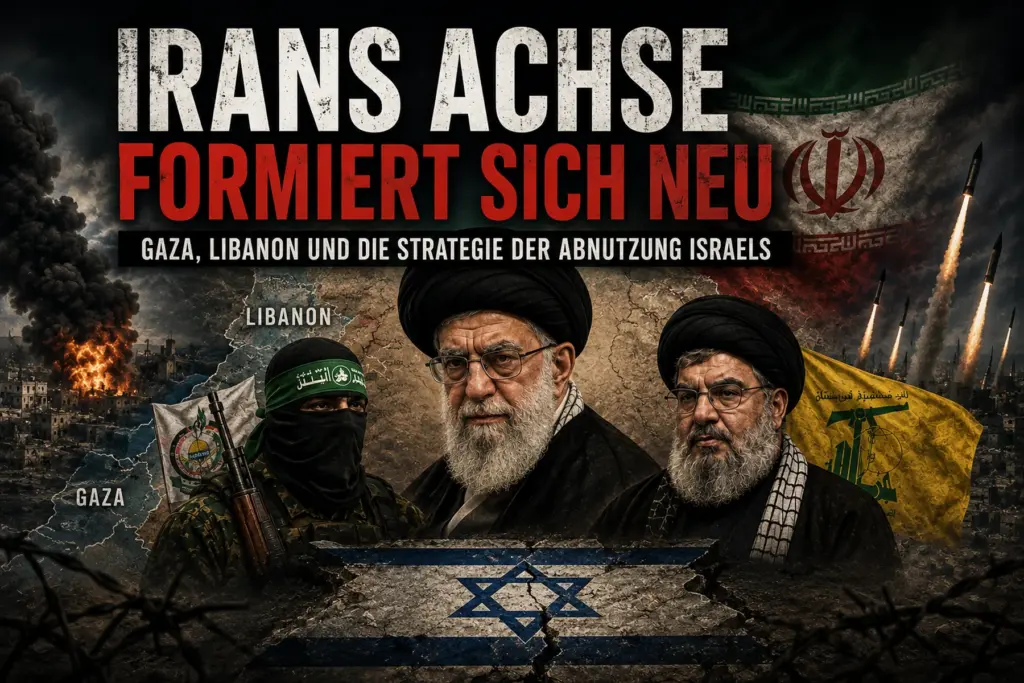

Tehran’s terror axis is apparently attempting to re-form. According to the assessment of the Israeli military, Hamas and Hezbollah are coordinating their increasing activities with Iranian support.
At the same time, military pressure is growing on Israel’s northern and southern fronts. Precisely in this situation, Washington is limiting Israel’s room for maneuver against Hamas and Hezbollah.
This creates a dangerous contradiction for Israel: Its enemies are using the military lull to rebuild, while the Jewish state is being politically restrained from combating precisely this rebuilding. Diplomacy can end fighting. But it does not replace verifiable disarmament of terrorist organizations that continue to maintain military structures and are supported by Iran.
Tehran’s Terror Axis: IDF Warns of Renewed Coordination
The starting point is a current assessment by the Israeli military. According to information from the Jerusalem Post the IDF believes that Hamas and Hezbollah have been coordinating their increased activity in recent weeks with Iranian support. At the same time, the Israeli military is registering increasing friction both in the north along the Lebanon front and in the Gaza Strip.
The IDF views the development as an attempt to rebuild Iran’s severely battered proxy axis and once again place Israel under pressure from several sides at the same time.
This is initially a military assessment and must be described precisely as such. Yet it fits into a well-documented strategic context. For years, Iran has financed, armed, trained and incorporated Hamas and Hezbollah into its regional strategy. The Quds Force units of the Revolutionary Guards formed a key organizational link between Tehran and its proxies.
What is new, therefore, is not the Iranian connection. What is new is the attempt to make a network severely weakened by several wars operational again.

Passende X-Beiträge
Aus dem SCHLAGSEITE X-Archiv

The axis lives on, but it is significantly weakened
Iran’s proxy axis in 2026 is no longer the power structure Tehran possessed just a few years ago.
Israel has eliminated numerous leaders, fighters and military capabilities of Hamas and Hezbollah. The fall of the Assad regime in Syria severed an important Iranian supply route toward Lebanon. This was compounded by the war against Iran itself, as well as massive American and Israeli attacks on Iranian military capabilities.
Reuters reported in June, citing American military information, that Iran’s ability to build up and stockpile missiles and long-range drones had been set back by years. Large parts of Iran’s air defenses and navy were destroyed. Another US military assessment is particularly relevant to the proxies: Iran is reportedly no longer able to reliably supply allied groups with modern weapons.
The regional network itself is also considered, according to American and independent assessments, to be considerably less effective than before.
That does not make it harmless. A weakened structure can attempt to reestablish connections with limited resources, regenerate forces and tie Israel down across several theaters at once.
Tehran is not attempting to deploy an intact axis. It is apparently trying to reassemble a damaged one.
The Conflict Becomes Very Concrete at the Ali-Taher Ridge
How far this development is from being theoretical is shown by the situation in southern Lebanon.
According to information from the Jerusalem Post an ongoing contest of reconnaissance and countermeasures is taking place around the strategically important Ali-Taher Ridge between the Israeli Northern Command and Hezbollah. According to the report, the terrorist organization is attempting to detect Israeli troop movements and exploit favorable moments to launch attacks.
Early Saturday morning, it did exactly that. A fiber-optic-guided drone detected Israeli forces and attacked them. Three soldiers from the Yahalom special forces unit of the Combat Engineering Corps were wounded. The soldiers were operating as part of the Commando Brigade combat formation.
According to reports reproduced by the Jerusalem Post, Hezbollah is also attempting to supply fighters who remain in underground infrastructure in the area of the Ali-Taher Ridge. The Israeli Northern Command is therefore searching for hidden supply routes, drone activity and remaining terrorist structures.
The IDF responded with strikes in the Nabatieh area and within its current area of operations. According to the Jerusalem Post, attacks on Beirut and senior Hezbollah officials believed to be there are currently ruled out, however, because of American demands.
What matters is not only this individual attack. Hezbollah has been severely hit militarily, but it still possesses fighters, weapons, underground infrastructure and the ability to attack Israeli troops.
That is precisely why Israel insists on actual disarmament.
Disarmament Sounds Simple; Enforcing It Does Not
However, the demand for verifiable disarmament must not remain an abstract formula. Lebanon already demonstrates how difficult its practical implementation is.
The framework brokered by the United States envisions a phased Israeli withdrawal in exchange for the verified disarmament of Hezbollah . In so-called pilot zones, Israel is to withdraw; the Lebanese army then takes control and removes weapons and military infrastructure there.
The first attempt already revealed the problems. According to Reuters reports , weeks of diplomatic negotiations and several days of military work were necessary to establish a single pilot zone. Hezbollah itself is not a party to the agreement and continues to refuse to surrender its weapons.
A crucial verification problem is added to this. Reuters reported on August 13, that disarmament is to be independently verified, but a final verification mechanism and the third party responsible for it have not yet been conclusively determined.
This leaves Israel facing considerable risk. A withdrawal is quickly visible. Whether underground weapons depots, tunnels, supply systems and hidden stockpiles have actually disappeared is much harder to establish.
Credible disarmament therefore requires not only political commitments, but also access, oversight, verification and consequences for violations.
UNIFIL may still play a role, but the UN Security Council has extended the mission’s mandate for the last time, until December 31, 2026. A coordinated withdrawal is then to begin, and is to be completed within one year. This will place an even greater responsibility on the Lebanese army.
Israel’s demand for verifiable disarmament is therefore not an excuse for a permanent presence. It is the security condition needed to ensure that a withdrawal does not simply enable Hezbollah’s next rebuilding effort.
Friction Is Also Increasing Again in Gaza
A similar problem is emerging in the Gaza Strip.
According to information from the Jerusalem Post an Israeli tank drove over an explosive device in the southern Gaza Strip. The IDF believes that the explosive device had been planted only recently. The Southern Command therefore views the incident as a sign of increasing friction along the so-called Yellow Line.
According to the report, a broader Israeli response in central Gaza City was not authorized, however. The reason was said to be American demands to largely halt attacks in Gaza City and targeted attacks on Hamas officials unless there is an immediate threat.
Reuters confirms the fundamental conflict. Israel has reduced its military activities in Gaza under American pressure. At the same time, Israel’s leadership is expressing concern about Washington’s demand to end targeted attacks, precisely because Hamas is rebuilding its forces.
When a terrorist organization restores military structures and reorganizes its forces, time is not a neutral variable for it. Time can mean operational recovery.
At least one Israeli strike in recent days targeted a Hamas commander who, according to the IDF, was allegedly preparing an attack on Israeli soldiers.
One cannot declare Hamas’s disarmament a goal while simultaneously ignoring the organization’s restoration of its military capability during the political process.

Washington Wants to Save Its Gaza Plan
Washington has invested considerable political and diplomatic capital in President Donald Trump’s Gaza plan. The 15-point roadmap links Hamas’s disarmament with a phased Israeli withdrawal, a new Palestinian civilian administration, internationally supported reconstruction and the establishment of an International Stabilization Force.
Trump’s advisers and mediators are holding talks on this with Israel, Egypt, Qatar, Turkey and other parties. A renewed large-scale flare-up of fighting could jeopardize this process and further delay its implementation.
Washington therefore has a real interest in de-escalation. That is neither irrational nor fundamentally directed against Israel. The conflict begins where this diplomatic interest collides with Israel’s security situation.
For Washington, a period of military calm represents an opportunity to advance a political process. For Israel, that same period may give an armed Hamas the opportunity to restore forces, weapons and command structures.
The Gaza Plan Also Needs Verifiable Disarmament
According to the published roadmap , heavy weapons, production facilities, weapons depots and tunnels are to be decommissioned or secured. An international stabilization force is to take over areas from which Israeli forces withdraw and help build new Palestinian police forces.
Area by area, it is to be checked whether the area is actually free of weapons. Only then is Israel to withdraw from the area concerned.
The decisive conflict lies in the sequence. Israel demands complete disarmament before taking on the security risk of a comprehensive withdrawal. Hamas, by contrast, says it is bound only by the original text of the roadmap and demands that Israel first fulfill its own obligations.
Thus, in Gaza too, everything revolves around the same question as in Lebanon: Who verifies the disarmament, how reliably does this oversight work, and what happens if weapons or military infrastructure remain hidden?
Tehran’s Strategy Does Not Need a Major War on Every Front
Iran did not build its regional power over decades solely with its own armed forces. Tehran’s strength lay in building, financing and linking armed organisations in different countries.
The Quds Force units of Iran’s Revolutionary Guards played a central role in this. According to the IDF the so-called Lebanon Corps of the Quds Force in particular served as a link between the Iranian regime and Hezbollah and supported it, among other things, with financing, weapons production, intelligence gathering and military reconstruction.
This structure is significantly weaker today. However, Hamas in the south and Hezbollah in the north do not have to drag Israel into a full-scale war at the same time in order to have a strategic impact. Repeated attacks, reconnaissance attempts, explosive devices, drone operations and the monitoring of multiple fronts tie up Israeli forces and political room for manoeuvre.
Iran does not have to fully restore its former strength to impose costs on Israel again.

The current direct coordination between Hamas, Hezbollah and Iran is an IDF assessment. The Iranian proxy structure itself, by contrast, has been documented for years. It is likewise established that this network has been significantly weakened by Israeli and American operations, the loss of key leaders, the collapse of the Assad regime and the damage caused by the Iran war. The danger therefore lies not in an intact terrorist axis, but in its gradual regeneration.
Israel must also weigh the risk of escalation
A tougher Israeli response is, of course, not without risk. Larger attacks on Hamas, Hezbollah or Iranian-backed structures could trigger counterattacks, further undermine the ceasefire and make another major war more likely.
That is precisely why American pressure for de-escalation is not entirely unfounded. But it does not follow that Israel must simply tolerate military regeneration.
Security policy is precisely about weighing two risks against each other: the risk of escalation today and the risk of a far more dangerous adversary tomorrow.
Since 7 October 2023, this calculation has been of particular importance for Israel. The assumption that a terrorist organisation could be permanently controlled through deterrence and limited responses has already proved catastrophically wrong once.

Military calm is not yet strategic security
Washington wants a political settlement. Israel needs a political settlement that will also hold from a security-policy perspective.
That is where the real conflict lies.
A weakened Hamas remains dangerous if it remains armed. A heavily battered Hezbollah remains dangerous if it retains underground infrastructure, attacks Israeli troops and rebuilds its structures. And a weakened Iran remains strategically relevant as long as it continues to support its remaining networks.
Israel therefore does not have to choose between diplomacy and security. Diplomacy must create conditions under which security becomes verifiable.
In Lebanon, this means robust oversight of Hezbollah’s disarmament. In Gaza, it means the verifiable decommissioning of military infrastructure and weapons stocks. And regarding Iran, it means not overlooking the rebuilding of its proxy networks out of political convenience.
The IDF’s warning therefore concerns more than individual incidents on the Ali-Taher Ridge or along the Yellow Line. It concerns whether the military successes against Iran’s proxies will be translated into a lasting security order, or whether Hamas, Hezbollah and Tehran will once again be given time to prepare for the next conflict.
Israel has good reason not to rely once again on hope rather than verifiable security on this question.
ℹ️ Factual basis and primary sources for the article 📑
▶️ Israel Defense Forces, 8 March 2026:
Iran-Israel War 2026: March 8 live updates
Primary source on the role of the Quds Force and its Lebanon Corps in linking the Iranian regime and Hezbollah, as well as in financing, weapons production, intelligence gathering and military support.
▶️ United Nations, Resolution 2790:
Security Council extends UNIFIL mandate
Official UN source on the most recent extension of the UNIFIL mandate until 31 December 2026 and the subsequent orderly withdrawal within one year.
▶️ Reuters, 17 June 2026:
Has Trump achieved his goals in the war with Iran?
Assessment of the damage to Iran’s missile, drone and conventional capabilities, as well as the significantly weakened Iranian proxy structure.
▶️ Reuters, 29 July 2026:
First test of US-backed pilot zones in south Lebanon lays bare difficulties
Details on the pilot-zone model, the role of the Lebanese army, Hezbollah’s refusal to disarm and the questions regarding independent verification that remain open.
▶️ Reuters, 13 August 2026:
Lebanon has not agreed shortlist of countries that could verify Hezbollah’s disarmament
Current status of the questions that remain open regarding third countries, inspectors and the mechanism for independently verifying Hezbollah’s disarmament.
▶️ Reuters, 13 August 2026:
Israel ties Lebanon withdrawal to Hezbollah disarmament
Current status of Israel’s demand for verifiable disarmament as a prerequisite for further withdrawals.
▶️ Reuters, 10 August 2026:
Trump’s Gaza plan hinges on Hamas disarmament, Israeli withdrawals
Details on the 15-point roadmap, sector-by-sector disarmament, the International Stabilization Force and the dispute between Israel and Hamas over the sequence and scope of disarmament.
▶️ Reuters, 16 August 2026:
Trump’s envoys in Middle East to push for Gaza peace plan
Current status of American mediation efforts, as well as Israeli concerns about Hamas rebuilding while Washington simultaneously calls for restrictions on targeted attacks.
▶️ Jerusalem Post, 16 August 2026:
Hamas, Hezbollah coordinate attacks with Iran, IDF warns of rebuilt axis
Basis for the current IDF assessment of coordination between Hamas, Hezbollah and Iran, the drone attack on Yahalom soldiers at the Ali-Taher Ridge, Hezbollah supply attempts and the Gaza explosive device.
🔎 Spotted an error, criticism or addition?
SCHLAGSEITE.eu stands for careful research and transparent corrections. Have you discovered a factual error, unclear wording or a broken link? Then send me your information. If possible, please provide a verifiable source.