

00:00 / –:–
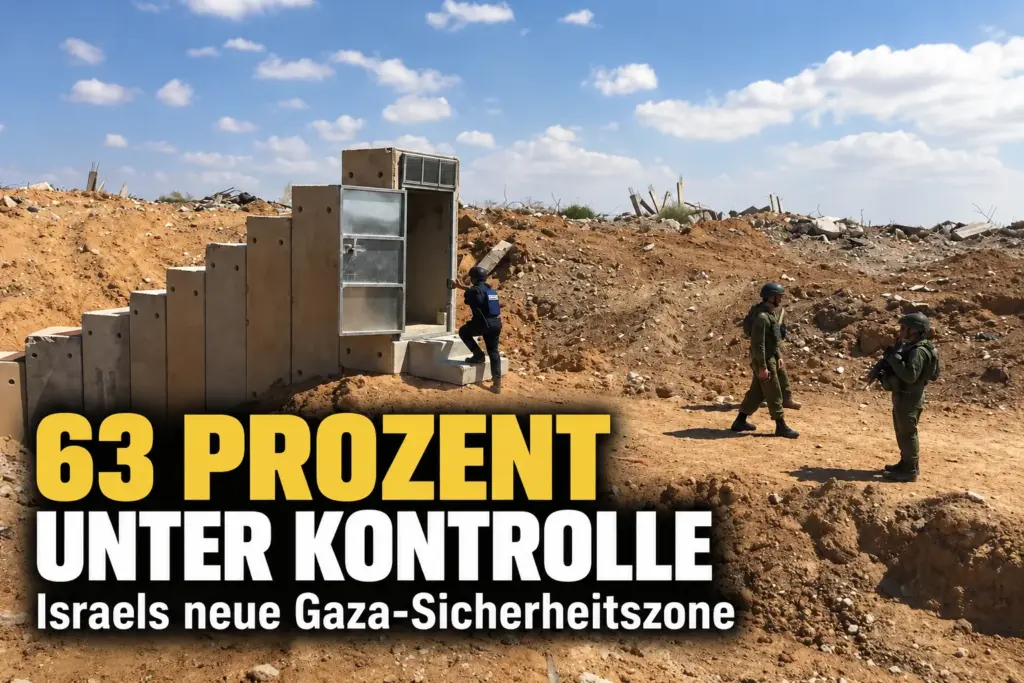
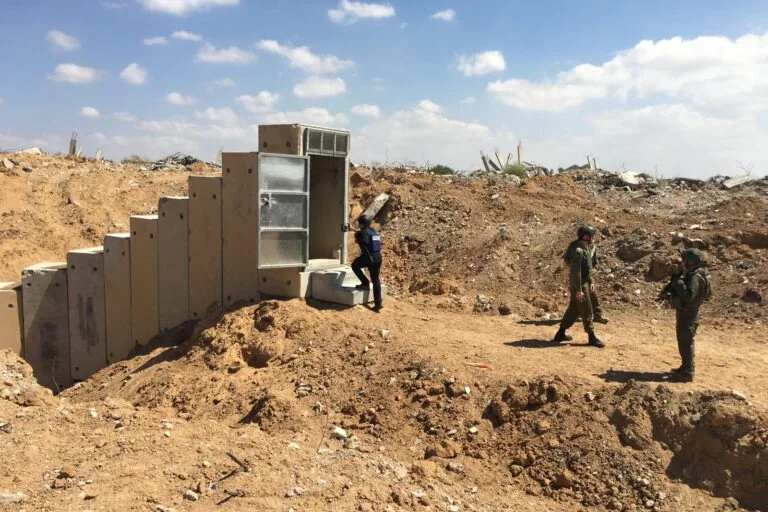
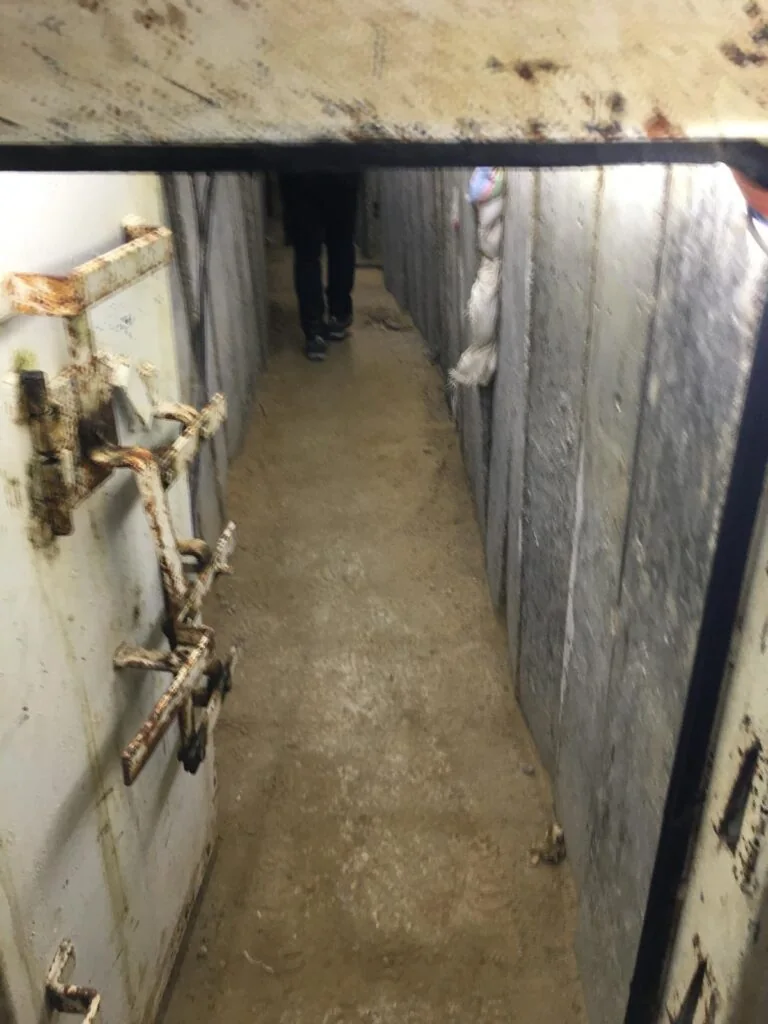
Just 750 meters from Nahal Oz, the IDF takes journalists into a Hamas tunnel more than 500 meters long. Sleeping quarters, sanitary facilities, air conditioning and water supply show that this system was built for extended stays. The discovery confronts an uncomfortable reality: A total of 18 people were abducted to Gaza on October 7 from Kibbutz Nahal Oz and the immediately adjacent military base. Almost three years later, Hamas continues to recruit fighters, build new explosives and still possesses an extensive tunnel system.
The original article and photographs for this on-site report are by journalist Benjamin Weinthal. On September 23, 2026, he accompanied Israeli troops in the Gaza Strip together with a small group of journalists. In his original report for C14 News Weinthal documents the newly uncovered tunnel near Shuja’iyya, as well as Israeli commanders’ statements on the military situation nearly three years after October 7.
The picture that emerges is contradictory only at first glance: Israel militarily controls large parts of the Gaza Strip and has destroyed extensive parts of Hamas’s infrastructure. At the same time, the terrorist organization has not disappeared. It continues to recruit, build explosives and attempt to restore its remaining structures.
Today: IDF reveals 500M-long terror tunnel in Gaza – Benjamin Weinthal @BenWeinthal reports for C14 from Gaza – watch 👇 pic.twitter.com/6kwbO6KtDE
— C14 News | EN (@c14english) September 23, 2026
18 people were abducted from Nahal Oz and the base
The tunnel is 750 meters from Nahal Oz and is therefore more than just another discovery beneath Gaza. Nahal Oz is one of the places where, on October 7, 2023, it became particularly clear how devastating just a few minutes without defensive readiness can be.
From Kibbutz Nahal Oz, eight civilians were abducted. From the IDF base just a few hundred meters away, the terrorists abducted another ten soldiers. Together, these are the 18 soldiers and civilians to whom the commander of the Southern Command referred during the briefing for journalists.
The Israeli military considers it possible that hostages were transported through or temporarily held in the tunnel complex now shown. It has not yet been publicly confirmed that this particular section was used for that purpose. The geographical connection nevertheless remains remarkable: An extensive underground system lay directly in front of one of the places where Hamas murdered people and abducted them to Gaza on October 7.
Passende X-Beiträge
Aus dem SCHLAGSEITE X-ArchivInfrastructure for months underground
According to the Southern Command, the newly uncovered tunnel is more than 500 meters long. It contains sleeping facilities, sanitary installations, air conditioning and a water supply. An Israeli commander described the underground system as part of a “city beneath a city.”
The facilities show what these installations are intended for. They are not merely used to move between two points at short notice. Parts of the network are designed to conceal people and materiel underground for extended periods and to protect military structures from Israeli surveillance and airstrikes.
The commander estimated the tunnel sections destroyed since the beginning of the war at around 60 kilometers. At the same time, he made clear that eliminating the remaining system could take years. This figure is an estimate by the Israeli military, not an independent survey of the entire network.

ℹ️ Gaza underground
The Hamas tunnel system consists of more than simple connecting passages. The IDF has repeatedly found command facilities, sleeping quarters, weapons depots and supply installations underground. Even before the war, Israeli, international and Hamas sources estimated the underground network at hundreds of kilometers; figures of more than 500 kilometers were frequently cited. The exact total length still usable today cannot be independently determined from public information.
Up to 63 percent of the Gaza Strip under Israeli control
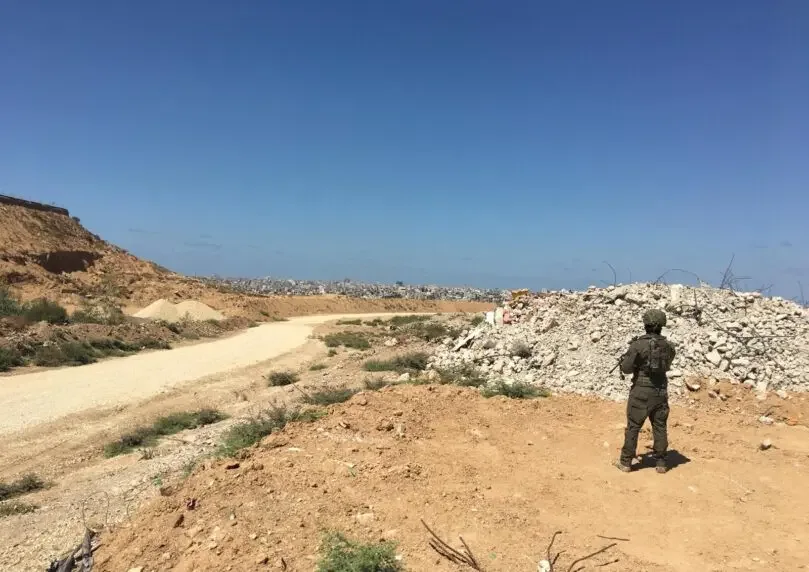
The second important figure from the journalists’ briefing concerns not the tunnel but the surface. According to a commander of the Southern Command, dozens of Israeli bases within and along the edge of the Gaza Strip now enable the IDF to exercise military control over up to 63 percent of the area.
The figure is less surprising than it initially sounds. Israel had already stated in recent months that it militarily controlled more than 60 percent of the Gaza Strip. What is particularly new is the view of how this control is organized: through numerous fortified posts and the so-called Yellow Line.
This line currently separates areas controlled by Hamas from areas under Israeli military control. It is an operational security line, not automatically a political border resulting from it.
Hamas continues to build explosives and recruit
For the Israeli leadership, this military depth is particularly relevant because Hamas continues trying to regain combat capability. The commander of the Southern Command spoke of thousands of remaining Hamas terrorists. The organization continues to recruit from the population and has abandoned neither its weapons nor its goal of fighting Israel.
There is also the improvised reconstruction of military capabilities. According to the IDF, Hamas uses unexploded ordnance from the war to manufacture new explosives.
How concrete this threat is became clear on September 21. An unmanned Israeli engineering vehicle was struck by an explosive device on the Israeli side of the Yellow Line in northern Gaza. There were no injuries. The IDF described the attack as a blatant violation of the ceasefire and subsequently struck Hamas infrastructure.
The ceasefire has changed the form of the conflict. It has not automatically eliminated Hamas’s military capabilities.

Hostages were and remain a strategic instrument
Another point raised during the journalists’ briefing concerns the significance of abductions for Hamas. An Israeli officer recalled the case of Gilad Shalit. In 2011, Israel released more than 1,000 Palestinian prisoners to secure the return of the abducted soldier.
Yahya Sinwar was among those released. Twelve years later, he was one of the key figures responsible for Hamas’s October 7 attack.
The strategic logic behind this is obvious: An Israeli hostage generates far more political and social pressure than an ordinary military loss. October 7 showed that Hamas used this instrument on a scale previously unknown. A total of 251 people were abducted to Gaza.
Qatar’s billions and the years of Hamas’s buildup
At the same time, the question arises of how such extensive military infrastructure could develop over the years. C14 puts Qatari payments to the Gaza Strip in the decade before October 7 at at least two billion dollars.
The transfers took place over years with Israel’s knowledge and, in some cases, explicit support, and were intended, among other things, to finance fuel, salaries, needy families and the stabilization of the Gaza Strip. At the same time, Hamas was able to massively expand its military tunnel system during precisely those years.
Documents reported on by international media in 2026 add further significance to the connection. According to them, a Hamas official described the Qatari payments to Doha as a central financial lifeline of the organization as early as 2019. Qatar rejects the accusation that its aid financed Hamas’s military buildup.
No direct attribution of individual Qatari payments to a specific tunnel can be derived from this. The broader finding remains: While billions flowed into Gaza, Hamas simultaneously developed an underground military infrastructure of exceptional scale.
Israel is targeting more than just tunnels and fighters
Israel’s strategy is therefore directed not exclusively against armed fighters or tunnel facilities. On September 23, Prime Minister Benjamin Netanyahu and Defense Minister Israel Katz announced the killing of Muhammad Abu Alwan in the Khan Yunis area.
Israel describes Abu Alwan as head of Hamas’s finance department. The IDF and Shin Bet conducted the strike jointly. EFE confirmed the strike and Abu Alwan’s death.
The episode shows that, alongside military infrastructure, Israel is also targeting the organizational and financial structures through which Hamas can maintain or rebuild its combat capability.
750 Meters from Nahal Oz: The Military Consequence
The report therefore ultimately leads back to Nahal Oz. The figure of 63 percent is not the strongest detail from this journalists’ briefing. It is the distance.
750 meters between an Israeli kibbutz and an extensively developed Hamas tunnel system. Eight civilians abducted from the kibbutz. Ten soldiers abducted from the neighboring base. An underground network that, even almost three years later, has not been completely destroyed.
An Israeli officer told the journalists during the briefing that his grandfather had survived the Shoah. The morning of October 7 showed him what could happen if Israel’s defenses failed even for a short time. There is no need to make more of this personal statement. The military consequence Israel has drawn from it is visible on the ground anyway.
The 63 percent explains the framework. The tunnel near Nahal Oz explains the reason behind it. According to the IDF, Israel now maintains military depth in the Gaza Strip while Hamas continues to recruit fighters, build explosives and use parts of its tunnel system. The old security order of October 6, 2023, therefore no longer exists.
Israel’s new security approach can be traced back to a simple finding: Hamas has been severely hit, but has not disappeared. As long as its armed structures, tunnels and recruitment capacity remain, Israel regards territorial military control as protection against the development of a comparable attack structure directly in front of communities such as Nahal Oz.
ℹ️ Factual basis and primary sources for the article 📑
▶️ Original article / Benjamin Weinthal, C14 News:
IDF Reveals Dozens of Bases Controlling Over 60% of Gaza Strip
Original article by Benjamin Weinthal dated September 23, 2026, about the tunnel near Nahal Oz, the Israeli military posts, the 63-percent figure, remaining Hamas forces and the destruction of tunnels.
▶️ Times of Israel:
Civilians, police stopped 1st wave of terrorists at Nahal Oz
Analysis of the IDF investigation into the attack on Kibbutz Nahal Oz. Eight civilians were abducted from there as hostages.
▶️ Times of Israel:
Systemic failure: How Nahal Oz base fell to Hamas
Assessment of the military investigation into the attack on the Nahal Oz base. Ten soldiers were abducted from there.
▶️ Times of Israel:
IDF strikes Hamas targets after engineering vehicle hit by bomb
Report dated September 21, 2026, on the explosive attack on the Israeli side of the Yellow Line and the subsequent Israeli strikes.
▶️ The New Yorker / Ruth Margalit:
Israel’s Qatargate Scandal
Report dated September 19, 2026, on Qatar’s years of payments to Gaza, Hamas documents seized by Israel, and the question of the extent to which these financial flows benefited Hamas’s military buildup.
▶️ Times of Israel:
Qatar rejects allegations over Gaza funding
Current assessment of Qatari money transfers, the Hamas documents, and Qatar’s statement.
▶️ EFE:
Israel reports killing Muhammad Abu Alwan
Report dated September 23, 2026, on the Israeli operation in Khan Yunis and Israel’s characterization of Abu Alwan as head of Hamas’s finance department.
🔎 Spotted an error, criticism, or addition?
SCHLAGSEITE.eu stands for careful research and transparent corrections. Have you discovered a factual error, unclear wording, or a broken link? Then send me your tip. If possible, please provide a verifiable source.