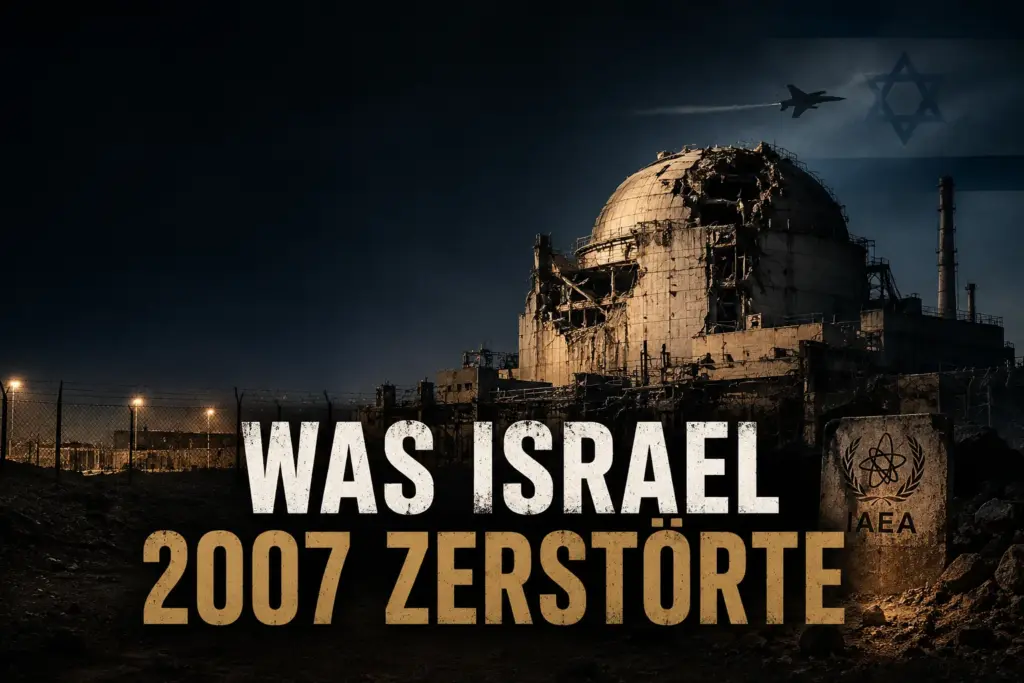


Almost two decades after the Israeli attack on a secret facility in eastern Syria, the new investigations present a substantiated picture. The Al-Kibar reactor near Deir ez-Zor was part of an undeclared nuclear programme run by the Assad regime, as the International Atomic Energy Agency has now confirmed.
Israel destroyed the facility during the night of 6 September 2007. Damascus subsequently claimed that it had been an ordinary military installation. The International Atomic Energy Agency, or IAEA for short, already considered this account implausible in 2011 and classified the destroyed building as very likely a nuclear reactor.
The new investigations go considerably further. Following the end of the Assad regime, Syrian authorities enabled the IAEA to access sites and material that had remained hidden for decades. A confidential agency report dated 1 September 2026 describes a reactor under construction, a fuel-production facility, storage sites and large quantities of previously undeclared uranium. Reuters reported on the findings of the IAEA report and the safeguards questions that have now been clarified.

Passende X-Beiträge
Aus dem SCHLAGSEITE X-ArchivExcavations reinforce the reactor finding
IAEA inspectors revisited the site of the Al-Kibar reactor near Deir ez-Zor in August 2026. There, Syria’s new authorities are carrying out excavations at the remains of the facility destroyed in 2007.
Infrastructure for cooling was uncovered in the process. The agency’s wording is deliberately precise: the cooling infrastructure now visible is compatible with that of a nuclear reactor. The IAEA has thus been able to independently verify key parts of the facility and further substantiate its earlier assessment. The excavations themselves are still ongoing.
The existence of the reactor had already been far more than a mere suspicion. In 2011, the IAEA Board of Governors found that Syria had violated its obligations under the safeguards agreement to the Treaty on the Non-Proliferation of Nuclear Weapons by failing to declare the construction. What is new is the scale and context of the materials and facilities now verified.

ℹ️ What the IAEA can now establish
Under the Assad regime, there was an undeclared nuclear reactor under construction, a facility for producing the associated nuclear fuel, and a storage site for fuel, uranium residues and waste. The Syrian authorities at the time had not properly declared these materials, facilities and activities to the IAEA.
73 tonnes of uranium and 8,808 fuel rods
Another site is particularly revealing—one not discovered by the IAEA but reported by Syria’s new leadership itself. Damascus informed the agency on 17 July 2026 about the previously undeclared location and invited inspectors to verify it.
According to the IAEA report, around 73 tonnes of natural uranium metal were verified there. About 55 tonnes of it, the report says, were contained in a total of 8,808 clad fuel rods. A further roughly 18 tonnes consisted of uranium residues and waste. The material remains in Syrian custody, but is now subject to monitoring and safeguards measures by the atomic energy agency.

The quantity is more technically revealing than the bare figure might suggest. According to an analysis by the Institute for Science and International Security the comparable North Korean 5-MWe reactor at Yongbyon contains a core load of around 50 tonnes of uranium metal in approximately 8,000 fuel rods. The 73 tonnes verified in Syria would therefore have been sufficient for one complete comparable core load plus a substantial reserve, though not for two complete loads.
This is the point at which a secret construction project becomes a highly developed nuclear programme. There was not merely a suspicious building in the desert. The Assad regime had the associated fuel produced and stockpiled material on a scale relevant to the reactor’s actual operation.
The Al-Kibar reactor was part of an entire programme
The reactor type also fits this picture. According to the technical assessment of the IAEA report by the Institute for Science and International Security, it was a gas-cooled, graphite-moderated reactor with a thermal output of approximately 20 to 25 megawatts. Its design and power range resembled North Korea’s Yongbyon reactor. Such reactors can produce plutonium if the irradiated fuel is subsequently reprocessed.
According to the technical assessment of the IAEA report by the Institute for Science and International Security, large quantities of graphite in block form were identified at another site. In this reactor type, graphite serves as a moderator and reflector. This, too, fits technically with the construction already known.
The IAEA report also mentions planned reprocessing activities at one of the sites functionally connected to Deir ez-Zor. Associated Press quotes this passage from the report. However, the investigation does not establish a completed site where irradiated fuel had already been processed and plutonium separated. The specific location of a planned plutonium-separation operation also remains unclear.
What the report does not prove
With a subject of this magnitude, linguistic precision is particularly important. The new findings establish a secret nuclear programme that was not declared to the IAEA, involving a reactor, fuel production and substantial quantities of nuclear material.
They do not prove that Syria had already developed a specific nuclear weapon or how far possible work on a weapon had progressed. The current report provides no confirmed information about work on a warhead.
This is not a minor distinction. A reactor programme and a fully developed nuclear-weapons programme are not technically or politically the same thing. Equating the two without evidence makes the findings unnecessarily vulnerable to challenge.
The claim that the project was a harmless non-nuclear undertaking, by contrast, is even less credible in light of the new findings. According to the technical assessment, the reactor was not configured to generate electricity. The nuclear facilities and materials were systematically undeclared. Following the Israeli attack, the Assad regime altered the site, removed or covered up remains, and for years failed to answer the IAEA’s outstanding questions fully.
The IAEA is not confirming a fully developed Syrian nuclear-weapons programme. It is, however, confirming a secret nuclear programme whose scale and technical structure are incompatible with Syria’s decades-long account that it was an ordinary military facility.
Israel intervened before the reactor began operating
Israel had already decided in 2007 not to allow the facility to become operational. During the night of 6 September, the Israeli Air Force attacked Al-Kibar and destroyed the reactor. The operation became known in Israel as “Outside the Box” and is also frequently referred to as Operation Orchard.
Jerusalem then officially remained silent about its responsibility for years. It was not until March 2018 that Israel publicly confirmed that it had destroyed the Syrian reactor.

The Assad regime did not respond with transparency. The site was levelled and altered, while Damascus maintained its account that it was a non-nuclear military facility. The IAEA investigations conducted from 2008 to 2011 already contradicted this explanation. The agency found uranium particles and ultimately concluded that the destroyed building had very likely been a nuclear reactor that should have been declared.
North Korea remains an important open question
The technical proximity of the Al-Kibar reactor to North Korea’s Yongbyon system is striking. The reactor design, fuel rods and scale of the core load resemble Yongbyon’s 5-MWe reactor. For years, there have also been intelligence reports and political accounts of North Korean assistance with the Syrian project.
The current findings reinforce this connection technically, but do not fully answer which components, expertise or facilities North Korea actually supplied. The IAEA report does not conclusively clarify the entire cooperation.
The current investigation provides no substantiated new evidence of Iranian involvement. Iran and Syria were close strategic partners under Assad. That does not, however, prove Tehran’s involvement in this specific nuclear project.
Syria’s new leadership opens the facilities
The fact that the IAEA has made substantially more progress today is directly linked to the political upheaval in Damascus. Following the overthrow of Bashar al-Assad at the end of 2024, Syria’s new leadership under President Ahmed al-Sharaa began cooperating with the atomic energy agency.
During his visit to Syria on 17 and 18 August 2026, IAEA Director General Rafael Grossi described the development as significant progress. In a joint statement by the IAEA and the Syrian government the new cooperation was documented. The authorities granted access, reported the additional site and provided documents.
The IAEA now says that it has been able to clarify and resolve the outstanding safeguards questions previously reported to its Board of Governors. This is precisely where two levels must be distinguished: formally, these questions are now considered resolved. That does not automatically mean that every historical and technical question concerning the programme as a whole has been answered.
The excavations in Deir ez-Zor are continuing. The exact design of the planned reprocessing, the full extent of North Korean involvement and possible weapons work remain outside what the report conclusively establishes. This is an editorial assessment of the state of knowledge today, not a finding contrary to the IAEA’s conclusions.
The uranium found remains in Syrian custody but is under IAEA monitoring. Whether all former stocks, equipment and related activities have already been fully accounted for remains subject to further technical analysis.
What the finding says about the 2007 decision
The attack on Al-Kibar remains an example of the fundamental dilemma of preventive security policy. Those who act early make a decision at a point when some of the evidence is still secret, incomplete or internationally disputed. Those who wait for conclusive proof may be too late when facing certain threats.
The IAEA is not granting Israel post hoc political or international-law absolution today. That is neither the agency’s task nor its statement.
For the historical assessment, something else is decisive: The Assad regime secretly built a nuclear reactor, produced fuel for it, stockpiled large quantities of nuclear material and concealed these activities from the international nuclear watchdog. Israel intervened before the reactor began operating.
The 2026 finding does not change what Israel did on September 6, 2007. But it significantly changes how confidently we can judge today what was destroyed then: not an ordinary military facility, but the center of a secret Syrian nuclear program.
Almost 19 years after the attack, a central part of Israel’s assessment at the time has thus been independently confirmed. What remains open is how far Assad wanted to go beyond that. The fact that his regime concealed a secret reactor, including a fuel cycle, from international nuclear inspectors is no longer merely an Israeli claim.
ℹ️ Factual basis and primary sources for the article 📑
▶️ International Atomic Energy Agency:
Joint statement by the IAEA and Syria of August 18, 2026
Documents access, cooperation, verification measures, and the investigation into Syria’s former nuclear activities.
▶️ Reuters:
IAEA reports progress in Syria investigation, none in Iran
Reports on the confidential IAEA report, the safeguards issues that have been resolved, the reactor, fuel production, and approximately 73 tonnes of uranium metal.
▶️ Associated Press:
Syria was building a nuclear reactor in Deir el-Zour under Assad, UN reports
Documents the uncovered cooling infrastructure, the functionally connected sites, planned reprocessing activities, and the verification of the uranium.
▶️ Institute for Science and International Security:
IAEA Report Presents Major New Developments on Syria’s Past, Secret Nuclear Program
Technical analysis of the reactor type, graphite, fuel rods, core loading, reprocessing, and the questions that remain open regarding a possible weapons connection.
▶️ Times of Israel:
Report on nuclear material and IAEA controls in Syria
Additional reporting on the cooperation of Syria’s new leadership and the monitoring of the material.
▶️ Ynet:
Report on Syria’s nuclear program and the IAEA’s new findings
Israeli assessment of the current investigation and the 2007 attack.
▶️ Al Jazeera:
IAEA says Syria built a nuclear reactor in Deir Az Zor under al-Assad
Additional reporting on the IAEA’s findings and the verified nuclear material.
🔎 Found an error, criticism, or addition?
SCHLAGSEITE.eu stands for careful research and transparent corrections. Have you discovered a factual error, unclear wording, or a broken link? Then send me your note. If possible, please provide a verifiable source.