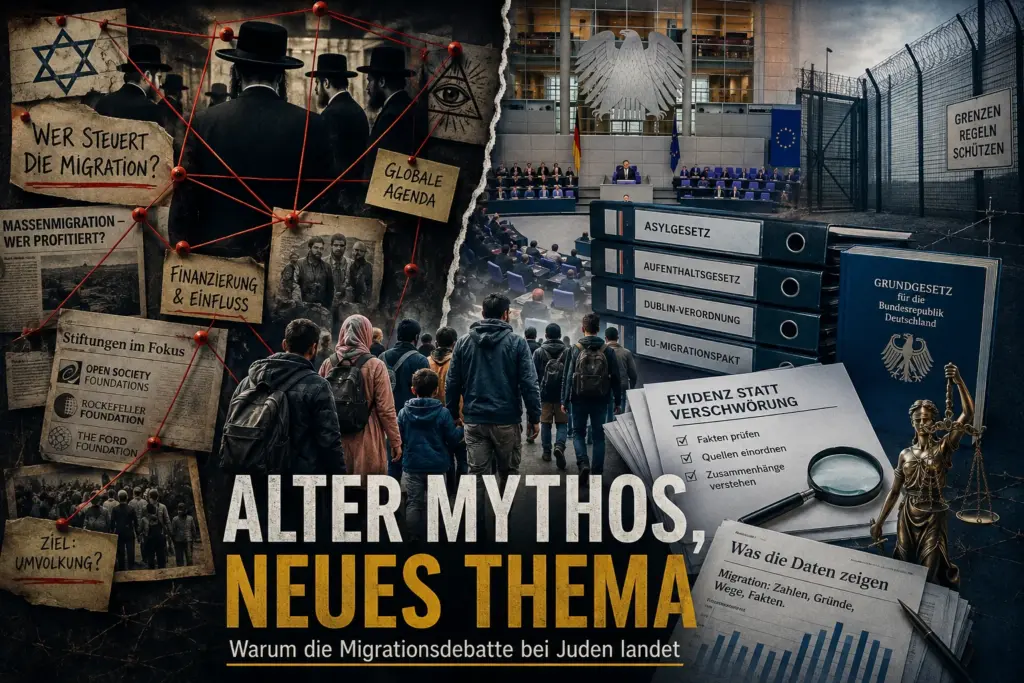

At present, familiar Telegram groups are once again circulating wild conspiracy narratives about Jews and migration to Europe. At the center is the claim of an alleged Jewish migration agenda, supposedly intended to encourage, promote or even deliberately organize immigration to Europe. Excerpts from lectures by Orthodox rabbis, religious end-times interpretations, references to George Soros and Jewish refugee organizations are circulated as evidence.
At first glance, the material appears impressive, precisely because not everything in it is fabricated. Some rabbis really do express disturbing religious ideas about Europe, Islam and messianic developments. George Soros has financed pro-migration projects. Jewish organizations really are involved in refugee aid. But none of these facts proves the derived claim of a joint Jewish strategy.
The narrative usually follows the same pattern: individual rabbis make positive comments about Muslim migration or interpret it in religious terms. George Soros and Jewish organizations support refugee aid or pro-migration projects. It is then concluded that all these actors are part of a joint Jewish plan to transform Europe. It is precisely this decisive final step for which there is no evidence.

Passende X-Beiträge
Aus dem SCHLAGSEITE X-ArchivHow real statements become a conspiracy
What makes such narratives particularly effective is that they do not necessarily have to rely on forged material. The excerpts currently being circulated do in fact feature rabbis who view political and social developments through a religious, partly messianic framework. Traditional terms such as “Edom” and “Ishmael” appear in this context. In the circulating excerpts, they interpret the growing Muslim presence in Europe, among other things, as the religiously significant decline of the Christian-influenced “Edom” and as part of a messianic process.
In religious interpretations, such designations can be transferred symbolically beyond the original biblical figures to later peoples, empires or religious spheres of power. Political developments thereby appear as part of a religious conception of history, redemption and a messianic future.
Some of these statements may seem quite disturbing to Europeans or Christians. If a rabbi interprets the growing Muslim presence in Europe positively because it allegedly signifies the decline of the Christian-influenced “Edom”, this may be sharply criticized. A rabbi has no free pass to talk nonsense simply because he wears a kippah. But between a religious interpretation and the claim that Jews politically organized this development lies an entire chain of evidence.
Among the speakers frequently mentioned in this context are, among others, Yom Tov Glaser, David Touitou and Daniel Yaakov Glatstein. Glaser is described by Aish as a rabbi whose focus is on Kabbalah and spirituality. David Touitou is a French-speaking Orthodox rabbi from Ashdod whose organization Torat Haim describes him as a rabbi, lecturer and head of a kollel and synagogue. Daniel Glatstein, in turn, is described by TorahAnytime as an American Orthodox rabbi, author and lecturer.
For now, this establishes something fairly unremarkable: They really are rabbis from Orthodox religious milieus. What does not follow is that they speak for “the Jews”. Judaism has no worldwide central religious leadership and no officeholder who could speak bindingly for all Jews. Even within Orthodoxy, there are different movements, schools, communities and religious authorities.
Large studies by the Pew Research Center already show considerable religious diversity in the United States among Orthodox, Conservative, Reform and Jews who do not identify with any particular movement. Israel, in turn, has a completely different religious and social structure. “The Jews believe …” or “the Jews want …” is about as meaningful on political and religious questions as saying “Christians want …”.
Even if a rabbi believes that a particular social development is part of a messianic process, this initially proves only that this rabbi interprets the development in religious terms. It does not prove that he organized it, that Jewish organizations organized it, that European governments are acting on Jewish instructions or that Jews around the world share this view at all.
A Christian end-times preacher may regard a war as the fulfillment of a biblical prophecy. Even if he welcomes that war, this would still not prove that Christians had secretly prepared it. A prophecy is not an operational plan.

From the individual Jew to the supposed “world Jewry”
The decisive rhetorical trick begins when the specific people disappear. Yom Tov Glaser is no longer Yom Tov Glaser, but “a rabbi”. Several rabbis become “Jewish rabbis”, then “Judaism” and finally “the Jews”. An individual statement is thus transformed into a collective intention.
Of course, individual Jews can hold pro-migration political positions. Jewish organizations can provide refugee aid. Jewish politicians can vote for liberal immigration rules. And rabbis can welcome social developments in religious terms. Each of these actors may be criticized for their specific position. But several individual Jews do not yet constitute a common will shared by millions of Jews.
This precise distinction is erased in the conspiracy narrative. The religious or ethnic affiliation of the people involved takes on the function of the missing evidence: Instead of demonstrating that the actors are actually acting together, the mere fact that they are Jewish suddenly suffices. Origin replaces coordination. This is not a minor error in reasoning, but the central mechanism of the narrative.
This is also why such posts can appear so convincing. One finds a real rabbi making a disturbing statement, along with a Jewish billionaire, a Jewish aid organization and perhaps a Jewish politician. Lines are then drawn between these real individual pieces of information until the impression of a common network emerges. But several real pieces of individual information still do not prove the alleged connection.
Soros, HIAS and actual political influence
At this point, no serious fact check can avoid George Soros. It would be equally wrong simply to deny existing migration-policy activities by Jewish actors. The Open Society Foundations founded by Soros themselves explain that, since 2015, they have supported organizations in Europe that help migrants and refugees and work on integration, asylum and human rights.
HIAS Europe also makes no secret of its position. The organization supports refugees and works with Jewish communities in Europe to promote admission and integration. Anyone who considers such a policy wrong or too pro-migration may criticize it. It is likewise legitimate to examine the political influence of large foundations, which projects they finance and which legislative changes they support.
All of that is legitimate political criticism. Open Society is not therefore “Judaism”. HIAS is not “the Jews”. George Soros does not represent millions of Jews. “Soros finances pro-migration projects” and “HIAS supports refugees” do not imply “the Jews are organizing migration to Europe”. The alleged migration agenda would instead require evidence of joint coordination.
Of course, foundations, churches, trade unions, companies, associations and NGOs all try to influence political decisions. They finance studies, organize campaigns, approach politicians and formulate political demands. Influence and control, however, are not the same thing. Anyone seeking to examine actual influence should ask who finances which organization, what demand is being made, which contacts exist with political decision-makers and which law was subsequently passed by which parliament.
Migration-policy lobbying is by no means a Jewish phenomenon. Churches, welfare organizations, trade unions, companies, political parties, human-rights organizations and international institutions likewise take positions on migration and asylum. The fact that political engagement by Jewish actors is singled out to construct an ethnic-religious overarching strategy reveals the selective logic of the conspiracy narrative.
These are verifiable questions. The question “What are the Jews planning?” is not.
The alleged migration agenda and who actually makes the decisions
If “the Jews” were supposed to control migration in Europe, a corresponding control structure would have to be found somewhere. Instead, one finds governments, parliaments, authorities, courts and European institutions. Since 12 June 2026 the new rules of the European Migration and Asylum Pact have been in force. The package consists of ten legal acts and regulates, among other things, registration, border procedures, asylum procedures, responsibilities and cooperation between the EU member states.
One may consider this policy right or wrong. One may accuse the EU of failing to protect its external borders, criticize national governments for creating the wrong incentives or demand stricter returns. But in that case, one should criticize those who adopted and implemented these rules. The decision-making processes are largely public, the responsible institutions are known and the political majorities can be traced.
Even statistically, the image of a single large migration flow quickly falls apart. According to Eurostat the EU states issued around 3.5 million first residence permits to non-EU citizens in 2024. Of these, 31.9 percent were for employment, 27.1 percent for family reasons, 15.7 percent for study and training, and 25.3 percent for other reasons including international protection.
Alongside this are asylum procedures, temporary protection arrangements and irregular border crossings. In 2025, according to Eurostat 669,365 first-time asylum applications were submitted, around 26.6 percent fewer than in the previous year. Frontex likewise reported a significant decline in detected irregular border crossings in the first half of 2026.
Migration responds to wars, labor markets, laws, border controls, political decisions, smuggling networks and developments in countries of origin and transit.Routes change, figures rise and fall, and states tighten or relax their policies. This is less spectacular than a secret master plan, but it has the small advantage of being verifiable.
Ceuta is currently showing how migration actually works
The extent to which conspiracy narratives and political reality diverge is demonstrated particularly starkly by the situation in Ceuta. The Spanish exclave on the North African coast forms an immediate external border of the European Union. At the end of July, it experienced an extraordinary mass rush. Reuters later reported that more than 72,000 people reached Ceuta within a short period. Numerous people died in attempts to cross. As of mid-August 2026, Reuters cited 94 to 96 confirmed deaths, depending on the underlying official figures.
For a city of around 80,000 inhabitants, this represented an extreme strain. On 16 August Reuters estimated that around 5,000 to 8,000 migrants were still in Ceuta. Many were living in precarious conditions on El Trampolín beach or on the outskirts of the city. Hundreds demonstrated on Sunday for asylum and against being returned to Morocco. On 17 August El País reported that more than one hundred migrants had begun a hunger strike on the beach. Madrid simultaneously announced additional provisional accommodation capacity for 1,500 people. The dispute between the government of Ceuta and the Spanish central government over responsibility and crisis management continued.

The background is particularly revealing. On 29 June 2026 a Spanish court ruling was published stating that people could be immediately prevented from entering and turned back only if they had overcome a physical border barrier. For people who reached Ceuta by swimming, this immediate rejection did not apply in the same way under the ruling. Reuters reconstructed how news of the ruling and videos of successful crossings spread on social networks and encouraged further attempts.
Spanish border unions had already warned of an escalation weeks earlier. Reuters was able to review six corresponding submissions and warnings. Border representatives pointed out that smugglers and other criminal networks monitor legal changes and adapt their methods accordingly. The Spanish government later also blamed misinformation about the significance of the court ruling for the rush.
Morocco’s role was another factor. Spain and the EU depend considerably on cooperation with the Moroccan authorities to protect this external border. When Morocco strengthens its controls, pressure on Ceuta decreases. If controls weaken or the authorities respond too late, it can rise quickly.
There was indeed a new attempt at a rush on the weekend of 15 and 16 August, announced via social networks. Moroccan security forces, however, stopped numerous people before they reached the border. Reuters reported at least 111 arrests on Saturday. The Associated Press later reported, citing Moroccan state television, 294 detained migrants from countries south of the Sahara as well as 61 Moroccans, who were accused of supporting the crossing attempts. The figures come from different reporting updates and therefore cannot readily be equated.
On the Spanish side, more than 1,600 security personnel were also deployed, including more than 500 officers sent in from the mainland. Following the July rush, Spain had also installed a maritime barrier. The renewed attempt at a rush therefore took place. However, a second successful mass entry like the one at the end of July did not occur.

Ceuta is not evidence of the circulating Jewish conspiracy narrative, but rather a reality check. The specific case shows which factors actually influence migration movements: the legal situation, border protection, government cooperation, social networks, smugglers, economic motives and political decisions. The incident provides no indication of a Jewish control structure—and instead contradicts it.
Ceuta thus demonstrates almost textbook-style how absurd the search for a secret ethnic-religious puppet master becomes as soon as one actually examines a specific migration event. The causes do not disappear into the fog; on the contrary, they become quite visible.
Why does the narrative nevertheless lead back to Jews?
That leaves the truly interesting question: Why does a debate about migration lead to Jews at all? Why not solely to governments, parties, courts, European institutions, transit states or smuggling networks? The answer lies in a very old antisemitic pattern of explanation. The International Holocaust Remembrance Alliance explicitly describes as antisemitic the notion that Jews as a collective are responsible for actual or alleged social ills, or that a secret Jewish power controls social and political institutions.
One of the best-known historical examples is the so-called “Protocols of the Elders of Zion”. The forgery purports to document a secret Jewish plan to rule the world. In fact, it is a long-exposed fabrication. The United States Holocaust Memorial Museum documents in detail how the “Protocols” became the archetypal example of an antisemitic world conspiracy.
The content changes, but the basic principle remains remarkably stable. Historically, Jews were blamed for revolutions, capitalism, communism, financial crises and alleged secret world governments. Today, migration, globalization or the so-called population replacement are forced into the same template. A secret Jewish coordination is alleged, after which individuals and organizations are sought who can be made to fit the narrative.
The fact that certain Jewish organizations are strongly involved in refugee assistance also has an understandable historical dimension. For centuries, Jews themselves were affected by expulsion, pogroms and flight. During the Shoah Jewish refugees faced closed borders and restrictive immigration rules. It is understandable that such historical experiences shape the present-day refugee work of some Jewish organizations. Historical motivation, however, makes a present-day political demand neither automatically right nor a secret plan to Islamize Europe.
The claim of a common Jewish interest in the most extensive possible Islamization of Europe contains a striking internal contradiction. The EU Agency for Fundamental Rights (FRA) documents the extent to which antisemitism burdens security and openly lived Jewish life in Europe. The 2025 Report of the Federal Office for the Protection of the Constitution documents antisemitic ideas and hostility toward Israel as central elements of Islamist ideology. Synagogues, Jewish schools and other facilities in many places require extensive security measures.
This does not prove that Jews must therefore support a particular migration policy. But it does show how implausible the notion of a unified Jewish interest in the Islamization of Europe is. Precisely because Jewish positions differ, no common agenda can be constructed from them.

Criticism of migration needs no antisemitic myth
Refuting this conspiracy narrative does not mean defending European migration policy . One can sharply criticize German and European policy since 2015 and still stick to the facts. One can discuss inadequate border protection, too few returns, perverse incentives, family reunification, social benefits, integration problems, Islamist parallel milieus and the resilience of European societies.
Anyone who concludes that governments have made serious political mistakes should hold those governments responsible. There are specific politicians, parties, votes, laws, court rulings, budgets and international agreements. Democratic politics leaves records. Conspiracy narratives leave arrows between photographs.
That is precisely where a rather absurd side effect of the myth lies. Anyone who claims that a secret Jewish power directed Europe’s migration policy makes the political actors actually responsible seem smaller. Governments become puppets, parliaments become stage scenery and political decisions become mere acts of execution by an invisible power. A narrative that supposedly exposes those responsible thus exonerates the real decision-makers of all people.
In the end, remarkably little remains of the great revelation. Yes, there are rabbis with religious views that one may find problematic. Yes, Jewish organizations are involved in refugee assistance. Yes, George Soros has financed migration-friendly projects. None of this needs to be denied.
What is still missing is the decisive proof: There is no reliable evidence of a common Jewish plan, and certainly none of a Jewish control structure behind European migration. The currently circulating excerpts of rabbis do not provide this proof. Refugee assistance does not provide it. Foundation funding does not provide it. And the shared Jewish background of individual actors is no substitute for a chain of evidence.
Thus, all that remains of the alleged migration agenda is precisely what was missing at the outset: proof of a common control structure. One need not like George Soros. One need not shield rabbis from criticism. One need not advocate a liberal migration policy.
Anyone who claims a conspiracy must substantiate it. Nothing more.
Migration to Europe is real. Political mistakes and migration-friendly lobbying are real. Individual Jewish people and organizations also advocate such positions. This implies neither a common Jewish plan nor a Jewish control structure. Between “individual Jews support a particular policy” and “the Jews organize this policy” lies precisely the chain of evidence that the conspiracy narrative cannot provide.
Anyone who replaces this gap with the shared Jewish background of individual actors is not analyzing causes. They are holding a collective responsible for the actions of individuals—and at the same time ignoring that the same development demonstrably endangers Jewish life in Europe.
ℹ️ Factual basis and primary sources for the article 📑
▶️ European Commission:
New migration and asylum rules enter into application
Official overview of the entry into force and components of the EU Migration and Asylum Pact on 12 June 2026.
▶️ Eurostat:
3.5 million first residence permits in 2024
Statistical data on first residence permits and their reasons.
▶️ Eurostat:
Asylum applications – annual statistics
Data on first-time asylum applications in the European Union.
▶️ Frontex:
Irregular border crossings into the EU down 37% in the first half of 2026
Data on detected irregular border crossings in the first half of 2026.
▶️ Reuters:
Spain disregarded Ceuta warnings before migrant rush, say border workers‘ unions
Reconstruction of the mass rush on Ceuta, the warnings that preceded it, the role of social networks and Spanish-Moroccan border policy.
▶️ Reuters:
Morocco arrests 111 migrants headed for Spain’s Ceuta in security crackdown
Current report on the renewed crossing attempt on August 15, the arrests, and the strengthened Spanish and Moroccan border security.
▶️ Associated Press:
Moroccan security forces arrest nearly 300 migrants trying to reach Spain’s Ceuta
Report on 294 migrants from countries south of the Sahara who were arrested and 61 Moroccans accused of supporting the crossing attempts.
▶️ Reuters:
In Spain’s Ceuta, hundreds of migrants stage protest and demand asylum
Status as of August 16 on the migrants still remaining in Ceuta, the living conditions, and the asylum protests.
▶️ El País:
Current situation in Ceuta on August 17, 2026
Current status regarding additional accommodation capacity and the hunger strike by more than one hundred migrants at El Trampolín beach.
▶️ Aish:
Yom Tov Glaser
Biographical information on Rabbi Yom Tov Glaser.
▶️ Torat Haim:
Rav David Touitou
Biographical information on Rabbi David Touitou and his religious work.
▶️ TorahAnytime:
Rabbi Daniel Glatstein
Biographical information on Rabbi Daniel Yaakov Glatstein.
▶️ Open Society Foundations:
Europe and Central Asia
The organization’s own account of its support for organizations assisting migrants and refugees in Europe.
▶️ HIAS Europe:
Supporting Refugees in Europe
The organization’s own account of HIAS’s refugee work and cooperation with Jewish communities in Europe.
▶️ EU Agency for Fundamental Rights (FRA):
Jewish People’s Experiences and Perceptions of Antisemitism
EU-wide study on experiences of antisemitism, security concerns, and restrictions on openly lived Jewish life.
▶️ Federal Ministry of the Interior:
2025 Report on the Protection of the Constitution
Official report on extremist activities in Germany, including manifestations of antisemitism across different extremist milieus.
▶️ United States Holocaust Memorial Museum:
Refugees
Historical context on the flight of persecuted Jews from Nazi Germany and the considerable obstacles they faced in finding countries willing to receive them safely.
▶️ International Holocaust Remembrance Alliance:
Working Definition of Antisemitism
Contextualization of antisemitic conspiracy beliefs and the attribution of collective guilt to Jews.
▶️ United States Holocaust Memorial Museum:
An Antisemitic Conspiracy: The Protocols of the Elders of Zion
Historical context on the forged “Protocols of the Elders of Zion” and antisemitic conspiracy myths.
🔎 Spotted an error, criticism, or addition?
SCHLAGSEITE.eu stands for careful research and transparent corrections. Have you discovered a factual error, unclear wording, or a broken link? Then send me your note. If possible, please provide a verifiable source.