
Double standards against Israel are particularly evident at the UN Human Rights Council: Israel is the only state in the world singled out there through its own permanent agenda item. No other country is treated in this way. An analysis compiled according to its own methodology by UN Watch for the period from 2006 to the end of 2025 also shows a massive quantitative imbalance. The special standard applied to Israel is therefore not merely a perception. It is built into the institution and can be measured in figures.
A recent commentary by Benedict Neff in the Neue Zürcher Zeitung leads from this finding to a more uncomfortable question: Why is the pressure for moral justification on Israel growing precisely when Jews are no longer remaining victims but defending themselves?
This question reaches far beyond an Israeli government or a single war. It touches on the West’s relationship with Jewish power, Jewish self-determination and a Jewish state that no longer makes its security dependent on the goodwill of others.

Passende X-Beiträge
Aus dem SCHLAGSEITE X-Archiv
Double Standards Against Israel: The Special Standard Is Built into the Institution
Anyone discussing double standards toward Israel need not rely on abstract perceptions. One can start with the United Nations Human Rights Council.
There, Agenda Item 7 is a permanent agenda item officially entitled “Human rights situation in Palestine and other occupied Arab territories”. Israel is the only state singled out in this form through its own permanent agenda item of the Council.
On 31 March 2026 even the British government stated this finding unambiguously. In its statement on Agenda Item 7 it noted that this agenda item unfairly and uniquely singled out Israel compared with other countries, represented a disproportionate focus, and that no other country was treated in this way by the Human Rights Council.
The political context is noteworthy: Britain had already formally recognized the State of Palestine on 21 September 2025 and abstained on all three resolutions submitted under Item 7 on 31 March 2026. London nevertheless did not change its fundamental rejection of this institutional special status.
That is precisely what makes the statement so clear: Even a British government that has recognized Palestine and changed its voting policy considers Israel’s institutional special status unfair and disproportionate.
Germany: Staatsräson Meets the Reality of the UN
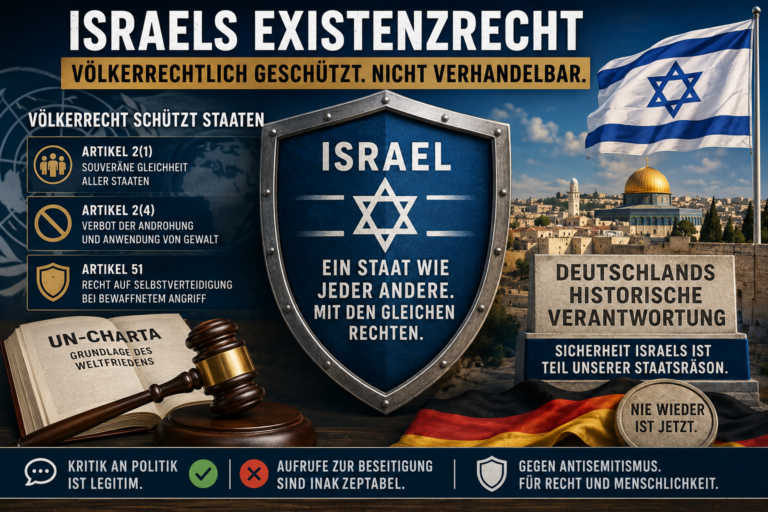
For Germany, this issue has a particular political dimension. On 24 June 2025, Chancellor Friedrich Merz stated in the German Bundestag: “Our Staatsräson is the defense of the State of Israel in its existence.”
If defending Israel is Germany’s Staatsräson, this responsibility concerns not only rocket attacks, terrorism or the military threat posed by Iran. It also concerns international structures in which Israel of all countries is permanently treated according to different rules.
Germany was a member of 2023 to the end of 2025 of the UN Human Rights Council. On 2 April 2025, Berlin voted against the resolution addressed under Agenda Item 2 A/HRC/RES/58/2. In the resolution adopted under Agenda Item 7 A/HRC/RES/58/28 on Israeli settlements on 4 April 2025, Germany abstained.
Berlin was therefore quite prepared to withhold its support from texts directed against Israel. However, this does not amount to an equally clear fundamental rejection of Agenda Item 7, such as Britain has now formulated.
Since 1 January 2026 Germany has no longer been among the Council’s 47 voting members. At the same time, the German government continues to uphold its line on Israeli security. According to its own account, Israel has “the right and indeed the duty”, to defend its citizens and its existence.
This makes Germany’s Staatsräson a test case: If protecting Israel’s existence is indeed one of Germany’s political principles, a clear rejection of the institutional special status represented by Agenda Item 7 would be only logical.
UN Watch Counts 112 Resolutions Against Israel by the End of 2025
The extent of the imbalance is shown by an analysis by UN Watch for the completed period through the end of 2025. The Geneva-based nongovernmental organization records country-specific UN resolutions and classifies them according to an own published methodology including, among other things, whether they condemn a state.
For the period from 2006 to the end of 2025, UN Watch counts 112 corresponding Human Rights Council resolutions against Israel. In the same comparison, there were 45 against Syria, 16 against Iran and 11 against Russia.
The figures are not an independent official UN category, but are based on UN Watch’s analysis and classification of official resolutions. The organization explicitly distinguishes between condemnatory and non-condemnatory country-specific resolutions.
According to this UN Watch analysis, by the end of 2025 Israel therefore accounted for more than twice as many corresponding resolutions as Syria and seven times as many as Iran.
Syria, Iran and Russia nevertheless have no permanent country-specific agenda item comparable to Agenda Item 7. Israel does.
The figures and Agenda Item 7 thus show two sides of the same problem: Israel is addressed exceptionally frequently through country-specific resolutions and is additionally singled out through a unique permanent agenda item.

⚠️ The Special Case of Israel
By the end of 2025, UN Watch counted 112 corresponding UN Human Rights Council resolutions against Israel, compared with 45 against Syria, 16 against Iran and 11 against Russia. The figures are based on the nongovernmental organization’s own classification of official resolutions and are not an official UN category. At the same time, Israel remains the only state singled out in this form through its own permanent agenda item, Agenda Item 7.
Ban Ki-moon Criticized the Imbalance
The criticism is by no means new. In December 2016, at the end of his term, then UN Secretary-General Ban Ki-moon drew a remarkable conclusion.
In a speech before the UN Security Council he explained that during his tenure he had consistently spoken out against bias toward Israel in UN bodies. Decades of political maneuvering had led to a disproportionate number of resolutions, reports and conferences criticizing Israel.
The then Secretary-General of the United Nations thus himself confirmed a finding that Israel has been complaining about for years: Within the UN system, the Jewish state is made the subject of international attention to a disproportionate extent.

Why Israel of All Countries?
Israel is not the only country that wages war. It is not the only country facing serious human rights allegations. Syria experienced a devastating civil war, Iran suppresses opposition and protest movements, and Russia has been waging war against Ukraine for years.
None of these states has a permanent country-specific agenda item at the Human Rights Council comparable to Agenda Item 7.
That is precisely why the comparison is decisive. A special standard does not begin only where a specific allegation is false. It begins where a particular state is permanently assessed differently, treated differently institutionally and subjected to its own review logic.
This principle is also found in the working definition of the International Holocaust Remembrance Alliance. Among the possible manifestations of antisemitism, it lists, taking the respective context into account, applying double standards by requiring of Israel behavior not expected or demanded of any other democratic nation. At the same time, the IHRA explicitly clarifies that criticism of Israel comparable to criticism of any other country cannot be regarded as antisemitic.
The decisive test is therefore: Would the same rule also apply if the state in question were not called Israel?
The Jewish State Under the Moral Magnifying Glass
Double standards against Israel do not end with agenda items and resolutions. They have long shaped the political and public perception of the Jewish state.
Military decisions are not judged only in their specific context, but are repeatedly elevated into a fundamental moral question about the Jewish state as a whole. Statements by individual politicians are transferred to Israel as a whole, misconduct by individual soldiers becomes an indictment of a society, and specific allegations quickly give rise to sweeping moral judgments.
The sharpest expression of this permanent moral scrutiny is the genocide allegation. Israel’s war against Hamas following the 7 October massacre developed into a global accusation of the gravest crime under international law. I have already examined how well-founded this accusation actually is in detail in the article “The Genocide Allegation Against Israel – Facts, Contradictions and Uncomfortable Questions” .
This is no longer merely about assessing individual Israeli decisions. Again and again, the moral legitimacy of the Jewish state itself is made into a fundamental question.
Israel Becomes the Jews
How quickly this fixation on Israel affects Jews outside Israel is shown by data from the EU Agency for Fundamental Rights.
For its study published in 2024, the FRA surveyed 7,992 Jewish people in 13 European Union member states. The survey ran from January to June 2023 and had therefore already been completed before 7 October.
Seventy-five percent of respondents reported that people in their country held them responsible for the actions of the Israeli government because they were Jewish. A further 76 percent said they hid their Jewish identity at least occasionally.
The FRA conducted the study as an open online survey. It was not a representative random sample of all Jews in the EU, but according to the FRA it constitutes the largest collection of empirical data of this kind on antisemitism against Jews in Europe.
A person of Iranian heritage is not responsible for the mullahs, a Russian in Berlin is not responsible for Putin’s decisions, and a student of Turkish descent is not responsible for Erdoğan. Yet Jews are repeatedly treated as though they personally had to justify the decisions of a government in Jerusalem.
Foreign policy thus becomes something else. Israel is linked to Jews worldwide, and Jews worldwide are linked to Israel whenever responsibility is to be assigned.
ℹ️ FRA Survey
Among 7,992 Jewish respondents in 13 EU states, 75 percent reported being held responsible for the actions of the Israeli government. 76 percent hid their Jewish identity at least occasionally. The survey was conducted before the Hamas terrorist attack of 7 October 2023.
Europe finds it easier to cope with the remembered victim
Here, the institutional findings lead to the more uncomfortable cultural question that Benedict Neff also raises in the NZZ.
In Europe’s public memory, Jews are known above all as the persecuted. Synagogues are guarded, Stolpersteine are laid, commemorative speeches are delivered, and politicians regularly promise to protect Jewish life.
This culture of remembrance is part of Europe’s historical self-understanding. At the same time, it shapes an image of the Jew that is strongly defined by persecution, vulnerability and the experience of victimhood.
Israel breaks through this historical role model. The Jewish state stands for self-determination, state power and the ability to ensure Jewish security itself.
Part of public morality apparently finds it easier to cope with the defenceless, remembered Jew than with the sovereign and self-defending Jew. One is the object of remembrance. The other makes his own decisions, defends borders, pursues terrorists and uses power when the security of his country is threatened.
Jewish self-determination precisely means that Jews do not have to remain victims permanently.

Jewish self-defence needs no permission
Europe copes with the dead Jew astonishingly well. One can mourn him, commemorate him, lay wreaths and promise every year that such a thing must never happen again.
Far more uncomfortable is the Jew who does not wait for the next commemoration. The one who possesses a sovereign state, protects its citizens and makes clear to its enemies that Jewish life is defended today.
Israel needs no moral authorisation from Berlin, London, Brussels or New York for this. The very purpose of Jewish sovereignty is that Jewish security should no longer depend on the goodwill of others.
I’m just saying…
October 7 made the contradiction visible
On October 7, 2023 Hamas and other Palestinian terrorists killed around 1,200 people and abducted 251 people to Gaza. For Israel, the consequence was clear: Such an attack must not happen again.
The state had to fight Hamas militarily, destroy terrorist structures and restore the security of its population. That is precisely why a sovereign state exists.
Yet the more forcefully Israel acted militarily, the more the international debate shifted from Israel under attack to Israel as the accused. The right to self-defence was repeatedly acknowledged, but its practical exercise was increasingly subjected to exceptional pressure to justify itself.
A right to exist that applies only as long as one does not defend oneself effectively is not a seriously intended right to exist.
Israel is not a moral laboratory
Israel is not outside the law. But neither may the Jewish state become a laboratory for rules applied exclusively to it.
Double standards against Israel become apparent precisely where more is demanded of the Jewish state than of other democratic states. Israel does not have to prove that it is more moral than every other nation in order to be allowed to protect its citizens. Nor does it have to return to a role in which Jewish suffering appears more acceptable than Jewish strength.
The demand is considerably simpler: equal rights, equal duties, equal standards.
Anyone who condemns Israel for its actions should therefore be able to answer a simple question: Would I apply exactly the same standard to the United Kingdom, France, the United States or another democratic state if its population had been attacked by a terrorist organisation?
If the answer is no, the standard is not universal. Then it is a special standard for the Jewish state.
Jews do not have to remain victims
Perhaps that is the real challenge Jewish sovereignty poses for Europe.
The consequence of Jewish history is not to view Jews as vulnerable victims for all time. It is to accept that Jews today determine their own security.
Israel is not a monument to European guilt and not a protected territory whose inhabitants may act only when others have first declared their response appropriate.
Israel is the sovereign state of the Jewish people.
Sovereignty means bearing responsibility, making decisions, representing interests and defending oneself against enemies. Jews need no pity for this; nor do they need special rights, and they are no more required to accept special rules.
The standard is simple: What applies to other democratic states must also apply to Israel. Anyone who treats the Jewish state separately on a permanent basis, assigns it its own UN agenda item and subjects Jewish self-defence to special pressure to justify itself is not defending a universal standard. They are creating a special standard.
ℹ️ Factual basis and primary sources for the article 📑
▶️ Federal Government:
Government statement by Federal Chancellor Friedrich Merz of June 24, 2025
Merz reaffirms Israel’s right to defend its existence and security and describes the defence of Israel’s existence as Germany’s raison d’état.
▶️ Federal Government:
Germany stands with Israel
Current presentation by the Federal Government on Germany’s responsibility towards Israel and Israel’s right and duty to defend its citizens and its existence.
▶️ UN Human Rights Council:
Membership of the UN Human Rights Council from 2023 to 2025
Germany was a voting member of the Council until December 31, 2025.
▶️ UN Human Rights Council:
Current members of the Human Rights Council in 2026
Germany is not among the 47 voting member states in 2026.
▶️ UN Human Rights Council:
Resolution A/HRC/RES/58/2, adopted on April 2, 2025
Germany voted against the resolution considered under Agenda Item 2. The vote was 27 in favour, 4 against and 16 abstentions.
▶️ UN Human Rights Council:
Resolution A/HRC/RES/58/28 of April 4, 2025
Voting record on the settlement resolution under Agenda Item 7. Germany was among the ten states that abstained.
▶️ Government of the United Kingdom:
UN Human Rights Council 61: Explanation of Vote for Item 7
Statement of March 31, 2026, on Israel’s unique and disproportionate special treatment through Agenda Item 7 and on the UK’s abstention on all three resolutions submitted under this agenda item.
▶️ Government of the United Kingdom:
PM statement on the recognition of Palestine
Official statement by the British Prime Minister on the formal recognition of the State of Palestine on September 21, 2025.
▶️ United Nations:
Briefing by UN Secretary-General Ban Ki-moon before the Security Council
Ban Ki-moon’s criticism of bias against Israel within UN bodies and of the disproportionate volume of resolutions, reports and conferences targeting Israel.
▶️ Israeli Ministry of Foreign Affairs:
Two years since October 7, 2023
Official Israeli figures on around 1,200 people killed and 251 people abducted to Gaza on October 7, 2023.
▶️ International Holocaust Remembrance Alliance:
Working Definition of Antisemitism
Working definition of antisemitism, including the example of a double standard and the explicit note that criticism of Israel comparable to criticism of other countries cannot be regarded as antisemitic.
▶️ European Union Agency for Fundamental Rights:
Jewish People’s Experiences and Perceptions of Antisemitism
EU-wide open online survey of 7,992 Jewish respondents in 13 Member States. 75 percent reported being held responsible for the actions of the Israeli government because they are Jewish.
▶️ UN Watch:
2025 UNGA Resolutions on Israel vs. Rest of the World
Historical comparison through the end of 2025: 112 corresponding Human Rights Council resolutions against Israel, 45 against Syria, 16 against Iran and 11 against Russia.
▶️ UN Watch:
Methodology of the UN Watch resolution database
Explanation of the organisation’s internal classification of country-specific resolutions, including the distinction between condemnatory and non-condemnatory texts. The comparative figures are therefore not an independent official UN category.
▶️ Neue Zürcher Zeitung:
Israel is always held to increasingly stringent standards. Behind this lies the distorted idea that Jews must remain victims
Commentary by Benedict Neff and the starting point for the independent analysis of special standards applied to Israel and Jewish self-defence.
🔎 Found an error, criticism or addition?
SCHLAGSEITE.eu stands for careful research and transparent corrections. Have you found a factual error, unclear wording or a broken link? Then send me your note. If possible, please provide a verifiable source.