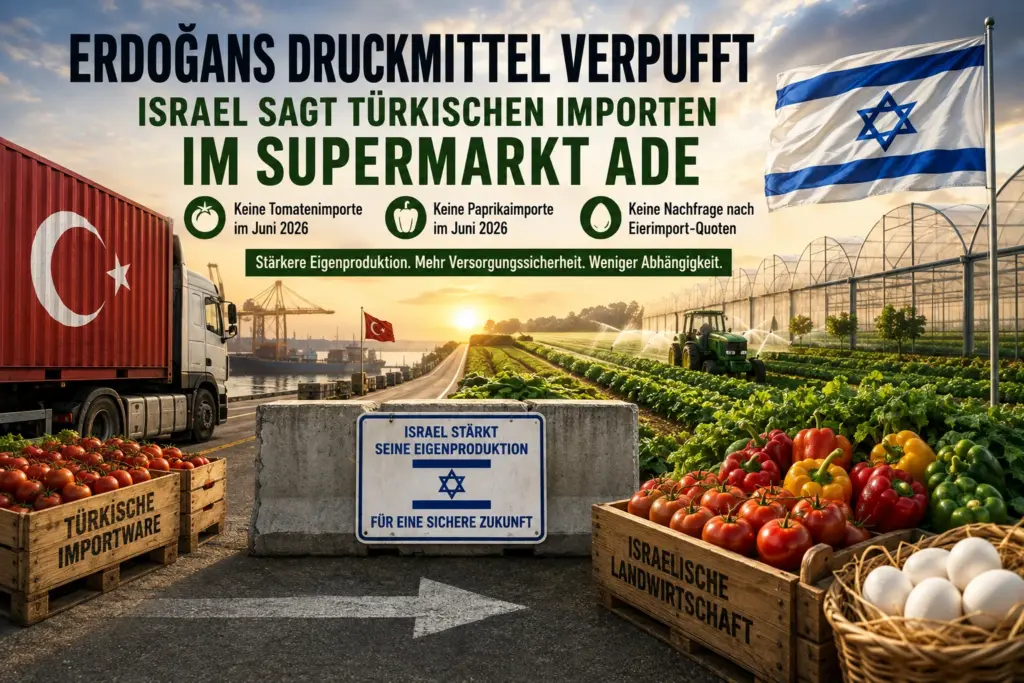

Erdoğan’s leverage against Israel is losing its effect. Turkey wanted to put economic pressure on Israel. Today, supermarket shelves of all places show that this lever is becoming increasingly blunt. In June 2026, for the first time since the start of the war, neither tomatoes nor peppers were imported into Israel. At the same time, no demand for import quotas was recorded for table eggs. The change is particularly remarkable in the case of tomatoes: Before the war, a significant share of Israel’s demand came from abroad, especially from Turkey. Today, Israeli farmers fully cover the demand for tomatoes themselves.
What initially sounds like a side note from the agricultural sector tells a larger story. Israel has responded to political pressure, disrupted supply chains and the Turkish trade halt not only with new suppliers, but also by significantly expanding its own production. This is turning an economic weakness into an increasingly important part of national supply security.
Why Erdoğan’s Leverage Is Losing Its Effect
The economic decoupling did not begin with tomatoes. On April 9, 2024 Turkey stopped exporting 54 product groups, comprising a total of 1,019 tariff lines, to Israel, according to the Turkish Presidency . A few weeks later, Ankara went considerably further: Since May 2, 2024 , all direct import and export transactions with Israel have been halted, according to the official Turkish account.
The Turkish government justified the move by citing the war in the Gaza Strip and made a resumption of trade conditional on political requirements. For Israel, the decision was by no means economically insignificant. The U.S. Department of Agriculture described Turkey in 2024 as Israel’s third-largest foreign supplier of agricultural and related products. Important Turkish deliveries included tomatoes, cucumbers, onions, eggplants and olive oil.
Overall goods trade also reached considerable dimensions. In 2023, bilateral trade volume stood at around 6.8 billion U.S. dollars, according to Turkish figures. Ankara was thus deliberately targeting an area in which considerable economic interconnections had developed between the two countries over many years. The political dimension of this relationship is also evident in Turkey’s power politics toward Israel, which extends far beyond trade.

Passende X-Beiträge
Aus dem SCHLAGSEITE X-Archiv
The Tomato Shows How Dramatically Things Have Changed
Hardly any product makes the former dependence as tangible as the tomato. According to data published by ynet from Israel’s Ministry of Agriculture and Food Security , Israel imported around 40,000 tons of tomatoes annually before the war. The majority came from Turkey. With Israeli annual consumption at around 180,000 tons, this corresponded to roughly 22 percent of total demand.
The comparison with 2026 could hardly be clearer. In June 2025, around 709 tons of tomatoes and 97 tons of peppers were still imported into Israel. In June 2024, the figures were around 16 tons of tomatoes and 422 tons of peppers. In June 2026, imports of both products stood at zero. According to the available data, domestic producers now fully supply the Israeli market with tomatoes.
This means that Erdoğan’s leverage is visibly losing its effect precisely with a food product that was previously heavily dependent on imports. That does not mean, however, that Israel no longer needs agricultural imports in general. A single month is not yet a declaration of self-sufficiency, and agriculture remains dependent on weather, harvests, labor and prices. But the development shows that a previously considerable import dependence on an important everyday product has been significantly reduced.

Before the war, around 40,000 tons of tomatoes came from abroad each year, predominantly from Turkey. This corresponded to approximately 22 percent of Israeli consumption. In June 2025, around 709 tons were still imported. In June 2026, no tomatoes were imported.
Import Dependence Is Also Declining for Peppers and Eggs
The development is not limited to tomatoes. In June 2026, according to the Israeli Ministry of Agriculture, no peppers were imported either for the first time since the start of the war. A similarly clear change was seen in the egg sector: While around 30 million table eggs were still imported in June 2025, the authorities recorded in June 2026 no demand whatsoever from importers for import quotas.
The report cites a significant increase in domestic egg production following an expansion of production quotas for Israeli producers as the reason. Other factors contributed in the case of fruit and vegetables. Cultivated areas were expanded, while the number of foreign workers in agriculture increased, according to figures published by the ministry, from around 20,000 to around 70,000. Favorable weather conditions and correspondingly high yields also played a role.
The labor issue had become one of the biggest problems facing Israeli agriculture after October 7, 2023. The Israeli Ministry of Agriculture therefore significantly expanded the possible employment quotas in order to replace absent workers and stabilize agricultural production.
This is precisely where an important difference between political narrative and economic reality lies: The Turkish trade halt alone did not cause additional tomatoes to grow. However, it increased the pressure to review existing dependencies. Expanded production, additional workers, larger cultivated areas and good harvests turned this into a measurable effect.

The War Turned Agriculture into a Security Issue
The strategic value of domestic agriculture became particularly visible after October 7, 2023. Numerous agricultural businesses are located in border regions in southern and northern Israel. Evacuations, security restrictions and the temporary massive loss of foreign workers therefore affected not just any economic sector, but the food supply directly.
Dependence on imports initially seemed like an obvious answer. But it also comes at a price. Supply chains can be disrupted, transport costs can rise, and trading partners can drop out for political reasons. Particularly in the case of fresh food, a failed delivery cannot simply be replaced by inventory for an indefinite period.
An analysis of Israeli food security by Leket Israel points out that Israel imported around 227,000 tons of fresh plant products in 2024, about 13 percent more than in the previous year. Important imported products included apples, onions, pineapples, tomatoes and garlic. At the same time, the analysis points to risks from international supply chains, price fluctuations and possible export restrictions.
More domestic production therefore does not mean abolishing international trade. That would be neither realistic nor economically sensible. What matters instead is not being dependent on individual states or a small number of supply routes for strategically important foods.
Supply Security Is Part of National Resilience
For decades, Israeli agriculture has been shaped by a particular contradiction. The country has limited water resources, difficult climatic conditions and comparatively little land suitable for agriculture. At the same time, Israel is among the technologically advanced countries in irrigation, water treatment, greenhouse technology and agricultural research.
The war has made the importance of these capabilities even clearer. Under normal conditions, what appears primarily as economic efficiency becomes a question of strategic resilience in a crisis. For Israel, agriculture is therefore not only an economic sector, but also a component of supply security.
This changes the perspective. The question is no longer merely: Where can consumers get a product at the lowest price? Increasingly, it is also: How much domestic production does a country need to ensure that a political conflict does not turn into a supply crisis?
This question is by no means limited to Israel. The past few years have shown worldwide how quickly pandemics, wars, blocked transport routes and political sanctions can change supposedly stable supply chains. Global trade remains important. But a functioning world market does not replace strategic preparedness.

Erdoğan’s Leverage Works Less Well Today
The Turkish trade halt was intended to put economic pressure on Israel. There is no question that this pressure had real short-term consequences. Companies had to reorganize supply chains, look for other countries of origin or switch to domestic products. Precisely for that reason, it would be too simplistic to dismiss the development in hindsight as politically empty thunder.
But leverage depends on lasting dependence. The better Israel can replace Turkish deliveries, the smaller Ankara’s economic lever becomes. This mechanism is now particularly visible in the case of tomatoes: A product for which Israel imported about one-fifth of its demand before the war and was heavily dependent on Turkey has, at least for now, become a food product supplied entirely by domestic production.
That this mechanism also works beyond food was already shown by an analysis by the Bank of Israel dated March 19, 2025. According to it, goods of Turkish origin accounted for around 5.3 billion U.S. dollars, or approximately 6.3 percent of all Israeli goods imports in 2023. Nevertheless, the effects of the Turkish embargo on Israel’s imports and import prices overall remained limited.
From the central bank’s perspective, the reason was primarily the market’s response: Israel found alternative sources of supply for numerous Turkish products. Even for goods on which dependence on Turkey had previously been particularly high, other suppliers were able to step in. The Bank of Israel explicitly interpreted this as an example of how open markets and diverse sources of supply can cushion the impact of limited trade sanctions.
This adds an important point to the development in agriculture. Israel’s response does not consist exclusively of more domestic production. Where domestic production is sensible and possible, it can increase supply security. Where international markets function more efficiently, a broader distribution of suppliers reduces dependence on individual states.
Erdoğan’s leverage is therefore losing its effect on two levels:Israel can produce certain goods more extensively itself and source others from alternative suppliers. It is precisely this combination that reduces vulnerability to politically motivated trade restrictions.
This is politically noteworthy. Sanctions and trade restrictions can impose costs on a country. But at the same time, they can create an incentive to dismantle precisely those dependencies on which their impact is based. One successfully replaced import is one less instrument of pressure.
However, this does not mean that Israel is now economically independent of the world. The country continues to import numerous foodstuffs, raw materials and intermediate goods. Domestic agriculture also remains vulnerable to drought, extreme weather, war and labour shortages. The current development is therefore not a story of complete autarky, but of greater resilience.
Success has several fathers
It would be equally wrong to portray the entire increase in production solely as a reaction to Recep Tayyip Erdoğan. The data for 2026 are also so positive because several factors have come together at the same time. More workers, larger cultivated areas, high yields and government measures have strengthened production. Favourable weather also played a role, particularly in the case of vegetables.
This does not diminish the political significance of Turkey’s trade halt. It merely puts it into proper perspective. Ankara eliminated an important direct supply channel. Israel responded with alternative suppliers, a broader spread of sources and, where possible, a stronger expansion of domestic production.
The result can now be seen not only in statistics. It is literally on the vegetable shelf.
Turkey wanted to exert economic pressure on Israel with its trade halt. In the short term, new costs and supply problems arose. Israel responded, however, with alternative sources and stronger domestic production. In June 2026, no tomatoes or peppers were imported, while there was no demand for import quotas for table eggs. In the case of tomatoes, Israeli farmers now fully cover domestic demand.
What grows in Israeli fields cannot be stopped by Ankara
The perhaps most important lesson from this development is therefore neither culinary nor agricultural. It is strategic. A country that can produce more vital goods itself or distribute its supply chains among several partners is harder to put under political pressure.
Erdoğan was able to stop direct trade with Israel. He was able to remove Turkish goods from regular Israeli-Turkish supply chains. What Ankara cannot control, however, is Israel’s ability to respond to this pressure.
In the case of tomatoes and peppers, this response can now be measured directly. In the case of eggs, the increase in domestic production is so large that no demand for import quotas was recorded in June 2026. At the macroeconomic level, the Bank of Israel also documents that many Turkish goods could be replaced by products from other origins.
Erdoğan’s instrument of pressure has therefore not disappeared completely. But it is losing its edge. Because economic pressure works durably above all where the other side has no practicable alternative.
And sometimes that alternative really does grow in one’s own field.
ℹ️ Factual basis and primary sources for the article 📑
▶️ Israel Ministry of Agriculture and Food Security / ynet:
Shakshuka is Israeli again: June passed without imports of tomatoes, peppers and eggs
Current data on tomato and pepper imports in June 2024, 2025 and 2026, egg production, labour, cultivated areas and the complete coverage of Israel’s tomato demand by domestic producers.
▶️ Bank of Israel:
The Impact of the Turkish Embargo on Israel’s Economy
Analysis dated 19 March 2025 on the limited macroeconomic effects of the Turkish embargo, the share of Turkish goods in Israel’s imports and the successful development of alternative sources.
▶️ Turkish Presidency, Directorate of Communications:
Statement concerning misleading claims about Türkiye-Israel trade
Official Turkish account of the suspension of all import and export transactions with Israel since 2 May 2024.
▶️ Turkish Presidency, Directorate of Communications:
Statement concerning the claim that products covered by the restrictions continue to be exported to Israel
Official information on the export ban covering 54 product groups and 1,019 customs tariff items from 9 April 2024.
▶️ U.S. Department of Agriculture, Foreign Agricultural Service:
Israel May Seek New Sources for Agricultural Imports Due to Turkish Trade Ban
Report from May 2024 on Turkey’s importance as an agricultural supplier to Israel and the main agricultural products previously imported from Turkey.
▶️ Leket Israel:
Distinctive Traits of Food Production and Consumption in Israel
Overview of Israeli food security, agricultural imports in 2024 and the risks posed by international supply chains, price changes and export restrictions.
▶️ Reuters:
Turkey says it is not easing Israel export ban
Report on the Turkish trade halt and bilateral trade volume of around 6.8 billion U.S. dollars in 2023, according to Turkish figures.
🔎 Found an error, criticism or addition?
SCHLAGSEITE.eu stands for careful research and transparent corrections. Have you discovered a factual error, unclear wording or a broken link? Then send me your notice. If possible, please provide a verifiable source.