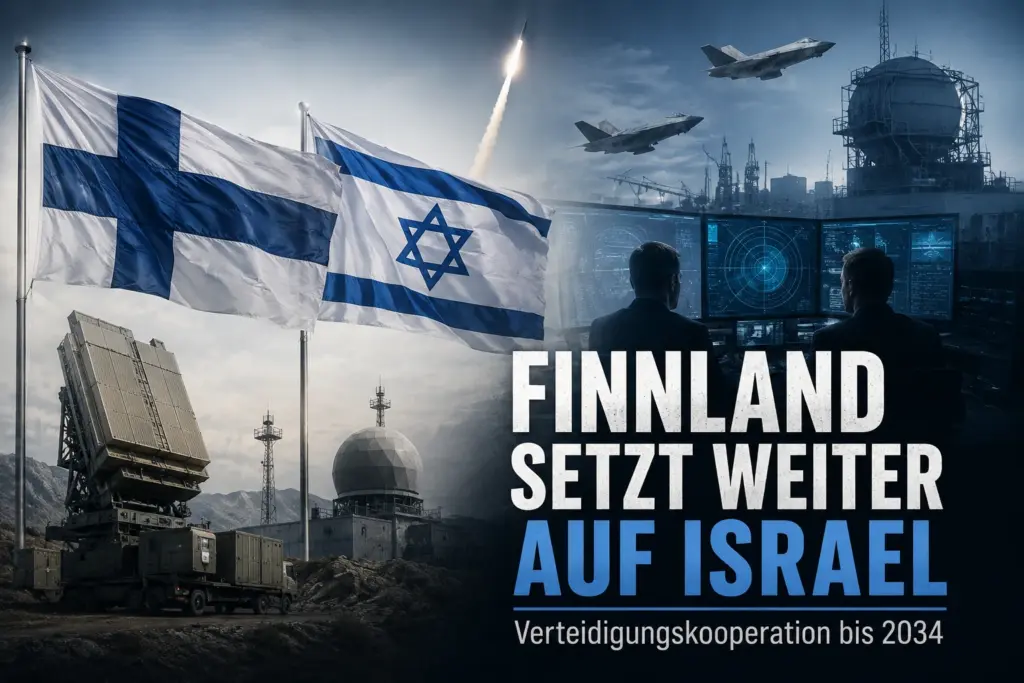


Finland’s defense cooperation with Israel is being given a long-term framework. A memorandum that has existed since 2013 has been extended until 2034 and covers cooperation in research, development and procurement. Particularly noteworthy politically are the timing and the initiative: In early 2024, in the midst of the Gaza war, Finland itself proposed extending the cooperation—previously renewed for five years at a time—for an entire decade this time. Helsinki is thus continuing to regard Israel as an important security-policy partner despite considerable political pressure.
The decision fits a development that is often obscured in Europe by political debates about Israel. While calls for sanctions, boycotts or restrictions on cooperation are growing louder, states facing concrete security-policy challenges view Israeli defense technology much more soberly.
Finland is one of these states. The country has been a member of NATO since April 4, 2023. Russia’s attack on Ukraine ended Finland’s decades-long military non-alignment and fundamentally changed the country’s security planning.

Passende X-Beiträge
Aus dem SCHLAGSEITE X-ArchivFinland’s defense cooperation with Israel until 2034
The memorandum is not a new agreement. According to research by Finnish public broadcaster Yle , the original agreement was concluded as early as 2013 and subsequently continued for five years at a time.
The decisive difference this time lies in the term. In early 2024, it was Finland that proposed a ten-year extension. The joint framework now therefore extends until 2034.
According to Yle, Israel described the relationship in its response as a “unique partnership” based on shared values and interests. This is diplomatic language, but it shows that both sides attach more importance to the cooperation than to an occasional procurement deal.
The memorandum is intended to safeguard cooperation between the two countries in the research, development and procurement of defense materiel. It also provides for a joint coordination group that is to meet at least once a year.
Finland’s Defense Minister Antti Häkkänen does not attach any exceptional significance to the matter. According to him, Finland has comparable cooperation documents with around 40 countries. Israel has been one of these partners for years. What is new, therefore, is less the existence of the memorandum than the decision to replace the previous five-year cycle with an entire decade-long horizon.

ℹ️ What the memorandum means
The document is not a mutual military assistance pact. It establishes a long-term framework for cooperation in the field of defense materiel, particularly in research, development and procurement. Individual projects and procurement decisions must still be approved separately.
Not publicly announced
What is politically interesting, however, is not only the term. Finland’s Ministry of Defense did not publicly announce the extension in 2024. According to information from Yle, Finland’s Foreign Ministry was also not informed about the continuation of the memorandum at the time.
That does not make it a secret military pact. But it raises a legitimate political question: How far does the foreign-policy significance of long-term defense cooperation extend, and who within the government should be involved in such a decision?
This is precisely what has now sparked domestic political criticism. Sofia Virta, chair of the Greens, and Minja Koskela, chair of the Left Alliance, sharply criticized the continuation of the cooperation. Koskela described Finland’s policy as shameful and explicitly linked her criticism to the accusation of genocide in Gaza. This is the political assessment of the Left Alliance, not a legal finding adopted by the Finnish government. The Left Alliance also announced a parliamentary inquiry into who knew about the agreement and how the decision came about.
Today’s debate, however, has a history that makes the picture more complicated. The fundamental decision on the major Israeli air defense project David’s Sling was made as early as April 5, 2023, under Sanna Marin’s government. Defense Minister Antti Kaikkonen granted procurement approval at the time. The Greens were part of the governing coalition then. The final contract was signed in November 2023 under the government of Petteri Orpo, which was already in office.
The Left Alliance, by contrast, had already taken a different position in autumn 2023 and called for the procurement to be halted. Today’s criticism therefore does not come from entirely identical political starting positions.
The ties have long extended beyond a single deal
Israel is now, after the United States, Finland’s second-largest foreign supplier of defense technology. David’s Sling is only the most visible example.
The Finnish government put the value of the procurement at around €316 million in 2023. Options worth around €213 million are added to this, with their use to be decided separately. Finland is the system’s first foreign customer.
The connection to Israel’s defense industry is broader, however. Over the years, Finland has procured additional Israeli systems for various areas of its armed forces, including Spike, Gabriel and Israeli protective technology for Finnish vehicles. Finnish companies are also involved in integrating Israeli systems.
What matters here is less the list of individual products than the structure that emerges from it. Anyone using complex systems over many years needs training, maintenance, spare parts, software support, technical integration and security of supply. A major procurement contract therefore does not end with delivery.
This is precisely why the ten-year extension of the memorandum fits the development of the Finnish armed forces. The major procurement programs extend far into the coming years. A cooperation framework until 2034 thus covers a period in which these systems will first be fully integrated into Finland’s defense structure and then operated for years.
ℹ️ Why the ten years matter
Previous extensions were each for five years. In 2024, Finland proposed a ten-year term for the first time. Defense Minister Antti Häkkänen does not justify this with a new political doctrine, but primarily with existing procurements and long-term cooperation in air defense. The longer period therefore fits the service life and integration of the projects already approved.

23 ongoing projects
The breadth the connection has now acquired is shown by a figure from the Israeli side of the cooperation. Citing the Israeli newspaper Ynet, Yle refers to 23 ongoing projects between the Finnish armed forces and Israel’s defense industry.
The relationship can therefore hardly be reduced to David’s Sling or a single major contract. It encompasses a network of ongoing projects, industrial cooperation and military exchanges.
This also became visible in May 2026. The second Finnish-Israeli defense industry seminar was held in Helsinki. Dozens of companies from both countries took part. A similar meeting had already taken place in 2022.
For Israel, Finland is additionally important as a NATO member and European market. According to Yle, a representative of Israel’s Ministry of Defense even described Finland to the Jerusalem Post as a gateway to the NATO and European markets.
From Finland’s perspective, however, the calculation is likely to be considerably more sober. Helsinki is not procuring systems to promote Israeli export interests, but because the armed forces attribute concrete value to them for Finland’s own defense.
The Finnish General Staff identifies the decisive point
That the cooperation consists of more than contracts was also demonstrated by the visit of Finland’s Commander-in-Chief, General Janne Jaakkola, to Israel in August 2026. Among others, he met Israel’s Chief of the General Staff, Eyal Zamir. The topics discussed included the security situation, modern warfare and air defense.
Even more revealing was Jaakkola’s subsequent explanation on Finnish television. In procurement, he said, the matter is not only the equipment itself. Training, spare parts, security of supply and experience from practical operation are also provided.
These operational experiences were “extremely valuable information” for Finland, Jaakkola explained with regard to cooperation with Israel. The Finnish General Staff is thus itself articulating the point that can easily be overlooked in the political debate: Finland is not simply buying hardware. It is incorporating knowledge, support and many years of experience into its own defense planning.
This also explains why a complete separation would be considerably more complicated than canceling a future order. Systems already introduced or ordered create relationships that must function over many years.
The opposition is vocal, but not the parliamentary majority
The criticism from the Greens and the Left Alliance is politically relevant. But it is not equivalent to the Finnish parliament’s policy to date.
A citizens’ initiative calling for stronger statutory regulation of defense procurement gained more than 50,000 supporters and was considered by parliament in 2026. It sought to give human-rights and humanitarian-law criteria greater weight in procurement and was directed in the political debate particularly against purchases from Israel.
The Defense Committee recommended that the initiative not be pursued further. Following parliamentary consideration in April 2026, it was rejected. The demand for a corresponding restriction of procurement policy therefore did not prevail in parliament.
This is important for classification. The long-term cooperation agreed in 2024 does not face an already decided parliamentary break with Israel. Rather, it is at the center of a political conflict in which part of the opposition is calling for a significantly more restrictive policy but has so far been unable to secure a majority for it.
Political distance and military reality
Since the beginning of the Gaza war, there has been intensive discussion in Europe about restricting economic and military relations with Israel. Some parties and governments view such measures as a way to exert political pressure on Jerusalem.
Finland shows where the limits of this policy can lie.
Those who have already integrated Israeli systems into their armed forces require more than the original procurement. Long-term support, training, technical integration and security of supply become part of their own defence planning. Relationships of this kind cannot be switched on and off like a diplomatic reception depending on the political weather.
For Finland, another factor makes the debate less abstract than in many other European states. The country borders Russia directly and must align its defence planning with a possible military conflict in its own region.
This does not explain every political decision, nor does it place such decisions beyond criticism. But it does explain why Helsinki weighs defence cooperation differently from parties that primarily want to send a political signal to Israel.

A decision with signalling impact
The extension of the memorandum does not mean that Finland supports every political decision of the Israeli government. Rather, it shows that Helsinki does not automatically equate political disagreements with the question of its own defence capability.
The initiative for the ten-year term makes this particularly clear. Finland did not merely respond to an Israeli request for continuation. At the beginning of 2024, Helsinki itself proposed securing the existing cooperation this time until 2034.
Even under considerable political pressure, Finland continues to treat Israel as an important security partner. The decisive point is not only that the cooperation was continued. In 2024, Helsinki itself proposed replacing the previous five-year cycle with a ten-year agreement running until 2034. Together with 23 ongoing projects, long-term procurements and the exchange of military experience, this demonstrates a relationship that goes far beyond political symbolism.
Finland’s decision can therefore most plausibly be understood as a matter of pursuing its interests. Helsinki does not have to support the Israeli government on every issue to conclude that Israeli technology, support and experience have concrete value for its own security. When security is no longer merely the subject of political resolutions but begins at one’s own border, the debate about Israel quickly becomes a question of tangible state interests.
ℹ️ Factual basis and primary sources for the article 📑
▶️ Yle:
Finland and Israel extend defence cooperation until 2034
Research into the 2013 memorandum, Finland’s proposal for a ten-year extension, the areas of cooperation, the ongoing projects and the political context.
▶️ Yle:
Reactions from the Greens and the Left Alliance to cooperation with Israel
Report on Sofia Virta, Minja Koskela and the announced parliamentary question.
▶️ Yle:
Janne Jaakkola on Finnish-Israeli defence cooperation
Interview and analysis of the significance of training, security of supply and operational experience.
▶️ Yle:
Israel as an important foreign defence supplier to Finland
Analysis of Finnish procurements and Israel’s role.
▶️ Finnish Ministry of Defence:
New Long-Range Air Defence System for the Finnish Defence Forces
Statement dated 5 April 2023 on the decision to select David’s Sling, the procurement volume and the approval at the time by Defence Minister Antti Kaikkonen.
▶️ Finnish Parliament:
Parliamentary debate on the citizens’ initiative to regulate defence procurements of 21 April 2026
Documentation of the parliamentary consideration of citizens’ initiative KAA 4/2025 vp.
▶️ Finnish Parliament:
Plenary session of 24 April 2026
Further parliamentary consideration of the initiative to regulate defence procurements.
▶️ NATO:
Finland joins NATO as 31st Ally
Official documentation of Finland’s accession to NATO on 4 April 2023.
🔎 Found an error, criticism or addition?
SCHLAGSEITE.eu stands for careful research and transparent corrections. Have you discovered a factual error, unclear wording or a broken link? Then send me your information. If possible, please provide a verifiable source.