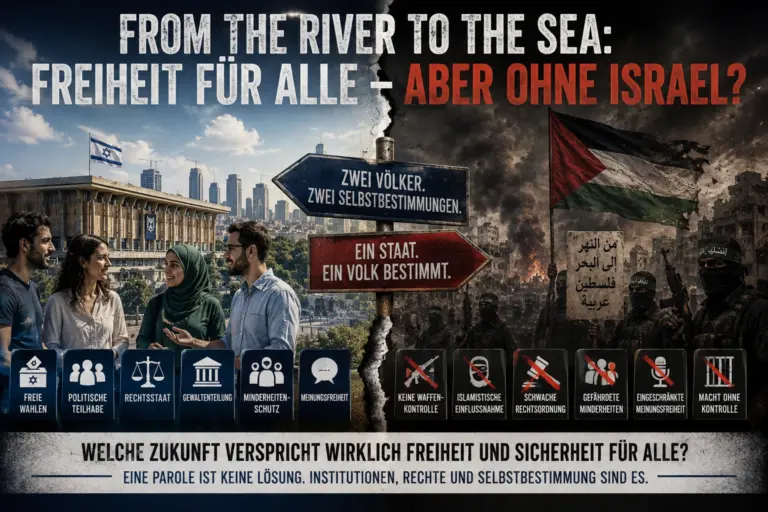

The convenient perpetrator-victim fairy tale shapes many Western debates about Gaza, Hamas and Israel: here the victims, there the perpetrator—political certainty achieved. But anyone who takes peace, human rights and truth seriously must look more closely. The civilian suffering in Gaza is real. But so are Hamas terrorism, the refusal to recognize Israel, authoritarian structures, tunnels, weapons depots, booby traps and a political culture in which Jewish self-determination is still rejected by many.

Passende X-Beiträge
Aus dem SCHLAGSEITE X-Archiv
The Convenient Template
Many voices in the progressive West like to explain their affinity with the Palestinian cause using four arguments: They invoke the two-state solution, progressive values, an allegedly clear perpetrator-victim scheme and the civilian suffering in Gaza.
At first glance, this sounds morally unassailable. At second glance, it becomes more complicated. And at third glance, one realizes: This is often less analysis than emotion.

The two-state solution is the best example of this. Of course, there are Palestinian representatives who speak internationally of two states. The PLO recognized Israel’s right to exist in peace and security in 1993, and Mahmoud Abbas has repeatedly called for Palestinian statehood alongside Israel since then. Anyone who claims this never happened is making things too easy for themselves.
But it would be equally wrong to infer from this that genuine Palestinian readiness for peace can be taken for granted. For decades, there has been an enormous gulf between diplomatic language and political reality. Hamas openly rejects Israel’s existence. Within the Palestinian Authority, there are still serious problems involving incitement, glorification of terrorism, corruption and a lack of democratic legitimacy.
Current opinion polls also show this tension. The Palestinian Center for Policy and Survey Research wrote in its Poll No. 96 that Palestinian public opinion was divided over the so-called Trump Plan, while at the same time drawing a clear red line against disarming Hamas. Accordingly, 69 percent rejected Hamas’s disarmament even if it were a condition for ensuring that the war would not return.
That is precisely where the problem lies: An abstract formula for peace sounds good. But as soon as the issue involves recognizing Israel, disarmament, security guarantees and normalization, things become considerably more difficult.
The Historical Record Is Uncomfortable
The historical record is uncomfortable as well. In 1937, the Peel Plan met with broad Arab rejection. The specific shape of the plan was also disputed within the Zionist movement, while parts of it accepted partition as a basis for negotiations. In 1947, the Jewish leadership accepted the UN partition plan despite considerable reservations, while the Arab leadership rejected it. The historical overview by PalQuest on the UN partition plan shows the opposing reactions to the 1947 proposal.

In 1948, armies from several Arab states attacked the newly founded State of Israel. The Office of the Historian at the U.S. Department of State describes the 1948 war in connection with Israel’s founding and the subsequent Arab-Israeli war. Camp David in 2000, Taba in 2001 and the talks over the 2008 Olmert offer also failed to produce a final agreement, albeit for different reasons and not as identical cases.
Not every one of these events can be reduced to a simple sentence. One recurring problem, however, remained the question of whether Jewish self-determination and a sovereign State of Israel would be permanently recognized.
Progressive Values End Where Hamas Begins
This is precisely where the great idealization begins in the progressive West. The Palestinian cause fits perfectly into the modern progressive framework: here the oppressed, there the oppressors. Here the weak, there the powerful. Here the victims, there the state with an army, high-tech capabilities and borders. This creates a morally convenient but politically distorted picture in which reality is reduced to a simple perpetrator-victim scheme.
The only problem is that reality does not play along.
Anyone who takes progressive values seriously would also have to talk about conditions under Hamas and the Palestinian Authority. About the lack of freedom of expression. About allegations of torture. About repression of political opponents. About the situation of women. About the situation of LGBTQ people. About antisemitic incitement that does not exist only on the fringes, but is deeply rooted in education, the media, religious language and political culture.

Human Rights Watch documented arbitrary arrests, allegations of torture and abuse by Palestinian security forces even before the current war, both in areas controlled by the Palestinian Authority and under Hamas in Gaza. The ADL-Global-100 survey from 2014 recorded an index value of 93 percent for the West Bank and Gaza. According to the ADL methodology, this means that respondents agreed with a majority of the eleven antisemitic stereotypes surveyed.
This does not mean condemning every Palestinian indiscriminately. That would be wrong. But it does mean not pretending that Palestinian society is automatically a progressive freedom project simply because it is often presented that way in Western lecture halls.
The Term Occupation Requires Precision

The term “occupation” also warrants precision. Israel withdrew all settlements and its permanent military presence from inside the Gaza Strip in 2005. Following the intra-Palestinian power struggle, Hamas took sole control of Gaza in 2007. Anyone claiming that Gaza was thereafter still administered directly by Israel like a classically occupied territory is oversimplifying reality.
At the same time, it is equally inaccurate to simply dismiss the international debate over occupation as a “lie.” The UN and the International Court of Justice treat the West Bank, East Jerusalem and the Gaza Strip as parts of the occupied Palestinian territory. The International Court of Justice ruled in 2024, that Israel’s withdrawal from Gaza did not fully end its obligations under the law of occupation. Their scope would depend on the degree of effective control still exercised. Israel rejects this legal classification and refers, among other things, to the 2005 withdrawal, security concerns and Hamas’s rule.
That is precisely why this question should be properly classified: as a matter of international law and politics in which the international legal position, Israel’s counter-position and the actual conditions of control must be clearly distinguished from one another.
Serious analysis here does not mean concealing Israel’s position. But neither does it mean simply brushing aside international legal positions. In Gaza especially, the matter is more complicated than the slogans: no Israeli settlement or civilian administrative apparatus since 2005, but still disputed questions concerning control, borders, security, the blockade, responsibility and war.
Hamas Prepared Gaza as a Battlefield
Yes, the civilian suffering in Gaza is real. But anyone who automatically turns that into a one-sided indictment of Israel overlooks a decisive point: Hamas did not merely govern Gaza; it also prepared it militarily over many years. According to Israeli sources, military analyses and documented individual cases, tunnel entrances, weapons depots, command facilities and military positions were established in or beneath densely built-up and partly civilian areas. Not every individual allegation can be independently verified. However, the strategic significance of the underground network and its integration into urban spaces are well documented.

The Modern War Institute at the U.S. Military Academy West Point described the Hamas tunnel system as a fundamental basis of the organization’s politico-military strategy. Another analysis by the Modern War Institute on combating Israeli tunnels shows how closely underground infrastructure, urban warfare and the civilian environment are intertwined.
The destruction of Gaza therefore cannot be explained solely by “Israeli harshness.” A substantial part of the military dynamics also stems from Hamas’s method of warfare. In documented cases, fighters operated from densely built-up areas, weapons were stored in or near buildings used by civilians, tunnels ran beneath residential areas, and roads or buildings were prepared with booby traps.
Anyone who turns a city into a fortress should not be surprised when, in the end, not only the fortress burns but the city suffers as well. It is tragic nonetheless. Just not as simple as the usual Israel accusers would like it to be.
October 7 Remains the Beginning of This War
The current Gaza war did not begin with an Israeli attack out of nowhere, but with the Hamas massacre of October 7, 2023. Hamas killed, abducted and abused civilians, then withdrew into densely built-up Gaza and continued the war precisely where its own population is maximally endangered. That is not a side issue but the core of moral responsibility.
Nor do current political developments change this. At the end of July 2026, reports once again discussed a Gaza roadmap and the disarmament of Hamas. Reuters reported on July 31, 2026, that Israel is demanding genuine disarmament, while Hamas initially wants Israeli commitments under the ceasefire agreement to be fulfilled. Associated Press documented the roadmap text, which refers to “One Authority, One Law, One Weapon” as well as to a process for decommissioning heavy weapons, production facilities, weapons depots and tunnels.
That is precisely what this shows: The core conflict is not only humanitarian. It is also military and political. Anyone who does not disarm Hamas leaves intact the system that turned Gaza into a terrorist base over many years.
Figures Require Care, Not Slogans
At the same time, one must be precise when discussing casualty figures. The Gaza Health Ministry publishes total figures but does not distinguish between civilians and combatants.
Associated Press reported in June 2026 citing the ministry, more than 73,000 deaths since the beginning of the war. The total therefore cannot be equated with an independently confirmed civilian death toll. But it is also not automatically worthless simply because it comes from the Hamas-led administration.
Israeli figures on Hamas fighters killed are likewise figures provided by a party to the conflict and have not been fully independently verified. That is precisely why casualty figures should be presented accurately, with a clear distinction between reported totals, confirmed civilians, fighters killed, and political conclusions.
Hunger, aid and the reality of a war zone
The issue of hunger and aid deliveries also requires closer scrutiny. The IPC classifications for Gaza have been widely cited internationally, but they are not undisputed. In 2025, Israel and COGAT accused the IPC, of failing to adequately consider Israeli data on aid deliveries, markets and the supply situation, and of using a methodologically questionable approach. The IPC rejected the accusation and stated that its criteria had not been changed. The 15-percent MUAC threshold is a method provided for emergency situations for years, when complete measurements of weight and height are not possible.
For 2026, one point is important: The IPC continues to describe the situation as serious and fragile, while at the same time referring to improvements through large-scale aid after the October 2025 ceasefire. For the period from mid-April to the end of June 2026, the IPC classified the entire Gaza Strip as Phase 3, Crisis. For July to December 2026, the IPC expected a deterioration, with more than 1.4 million people in Phase 3 or worse.
That is serious enough. But it is not the same as the blanket claim that Israel is deliberately starving Gaza. Anyone who wants to write seriously must take the humanitarian situation seriously, but must not turn a complex supply situation into a simple political indictment.

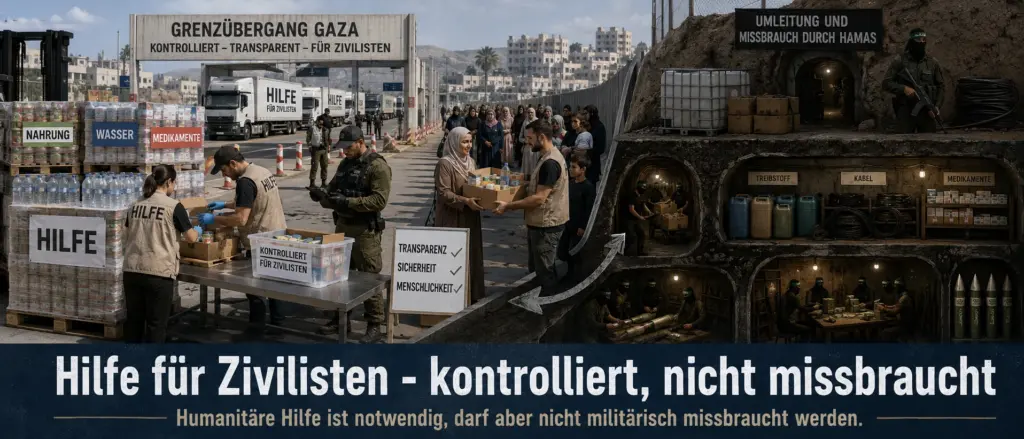
Another point is decisive: International humanitarian law obliges parties to a conflict, to enable aid deliveries for civilians in need to proceed rapidly and unhindered. At the same time, there is a right to control: deliveries may be inspected, searched and directed along designated routes and during specified times. Security checks are therefore fundamentally permissible. However, humanitarian aid may not be arbitrarily denied or unnecessarily delayed.
The demand for completely uncontrolled deliveries ignores real risks. Weapons, explosives, communications equipment, fuel, construction materials and other dual-use goods can be misused by Hamas for tunnels, rockets, IEDs and other military infrastructure. Control is therefore legitimate as long as it serves protection and does not arbitrarily block necessary aid.
At the same time, humanitarian aid for civilians must remain possible. The clear point is therefore not: no aid. The point is: aid yes, but controlled, inspected and organized in such a way that it reaches civilians as much as possible and does not disappear into the hands of Hamas, armed groups or black-market structures. This precise distinction is missing from many debates: aid for civilians is necessary, but it must not become a logistical back door for Hamas.
The Hamas responsibility that is being ignored
The point, then, is not that Israel is faultless. The point is: Anyone who describes Gaza solely as the result of Israeli violence erases Hamas’s responsibility. And that is the great moral distortion. Hamas began this war with the massacre of October 7, 2023, militarized civilian spaces, used tunnels beneath residential areas and anticipated that the images of destruction would subsequently be used against Israel.
This is not merely a tragic consequence of the war, but part of a strategy of warfare in which Hamas factors in the suffering of its own population politically and propagandistically.
Many voices in the progressive West view this conflict through a moral template in which Israel must always be the perpetrator and Palestinians may only ever be victims. This is precisely how everything that does not fit the picture disappears: Hamas terrorism, the history of Palestinian rejectionism, antisemitic incitement, failed peace offers, authoritarian structures and the fact that Jewish self-determination in the Middle East is still not accepted as legitimate by many.
Peace requires more than moral self-affirmation
Anyone who genuinely wants peace must see both: the suffering of the Palestinians and the responsibility of Palestinian leadership. Israel’s military power and Israel’s security situation. The humanitarian catastrophe in Gaza and the terrorism that caused it, exacerbated it and exploited it propagandistically.
Anyone who ignores these connections is not showing serious solidarity, but replacing analysis with moral self-affirmation.
This conflict has truly had more than enough of that.
✔️ In summary
The suffering in Gaza is real. But anyone who ignores Hamas, tunnels, weapons depots, booby traps, failed peace offers, antisemitic incitement and authoritarian Palestinian structures does not explain the conflict, but simplifies it morally. A serious analysis must see humanitarian responsibility and security realities at the same time.
ℹ️ Factual basis and primary sources for the article 📑
▶️ PLO – Recognition of Israel in the 1993 exchange of letters
Documentation of the exchange of letters between Yasser Arafat and Yitzhak Rabin on mutual recognition and the Oslo process
▶️ PCPSR – Public Opinion Poll No. 96
Survey data on the two-state solution, Hamas disarmament and Palestinian attitudes toward political solution models
▶️ IPC – Gaza Strip: Acute Food Insecurity Situation, April to December 2026
Current IPC classification of the food situation in Gaza, including the Phase 3 assessment and projection through December 2026
▶️ IPC – Humanitarian assistance drives food security and nutrition gains
IPC assessment of improvements through humanitarian aid and the still fragile supply situation
▶️ Israel and COGAT – Criticism of the IPC Gaza report
Israeli rebuttal concerning the IPC methodology, data selection and assessment of the humanitarian situation in Gaza
▶️ International Committee of the Red Cross – Humanitarian access and the right to control
Legal assessment of the rapid and unhindered passage of humanitarian aid and the right of parties to a conflict to control deliveries
▶️ Associated Press – Palestinian death toll in Gaza tops 73,000
Report on the death figures reported by Gaza and the lack of separation between civilians and fighters in the published total
▶️ Associated Press – Text of the Gaza roadmap
Documentation of the roadmap concerning weapons, tunnel structures, Gaza governance, international control and Israeli withdrawal
▶️ Reuters – Positions on the Gaza roadmap
Overview of the positions of Israel, Hamas and the mediators on the sequence of disarmament and withdrawal
▶️ International Court of Justice – Advisory Opinion of July 19, 2024
Official advisory opinion on the Israeli presence in the occupied Palestinian territory and the functional application of the law of occupation to Gaza
▶️ Modern War Institute – Gaza’s Underground
Analysis of the strategic significance of Hamas’s tunnel system for military and political warfare
▶️ Modern War Institute – Israel’s New Approach to Tunnels
Expert analysis of tunnel warfare, underground structures, booby traps and urban warfare in Gaza
▶️ Human Rights Watch – Palestine: Arbitrary Arrests and Torture
Report on repression, arbitrary arrests and allegations of torture under the Palestinian Authority and Hamas
▶️ ADL – Global 100 Survey of 2014
Survey on the prevalence of antisemitic attitudes, including the index value for the West Bank and Gaza
▶️ PalQuest – UN Partition Plan of 1947
Historical overview of the UN Partition Plan and the reactions of the Jewish and Arab leadership
▶️ U.S. Office of the Historian – Arab-Israeli War 1948
Historical background to the 1948 war following the establishment of Israel