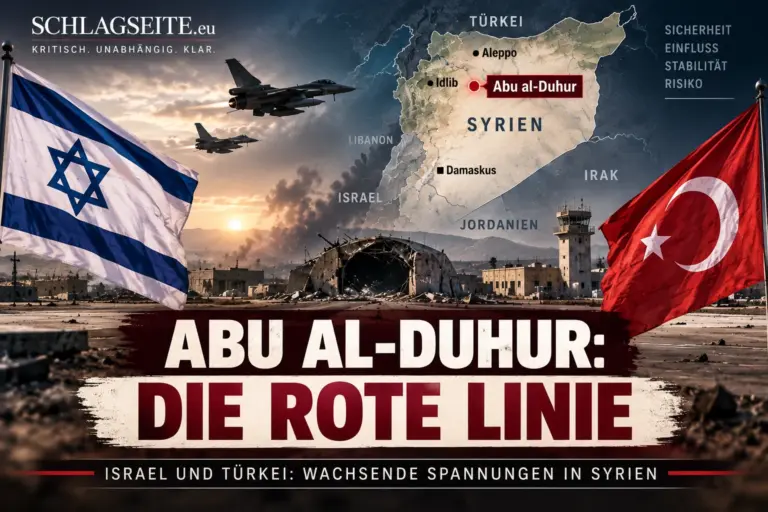
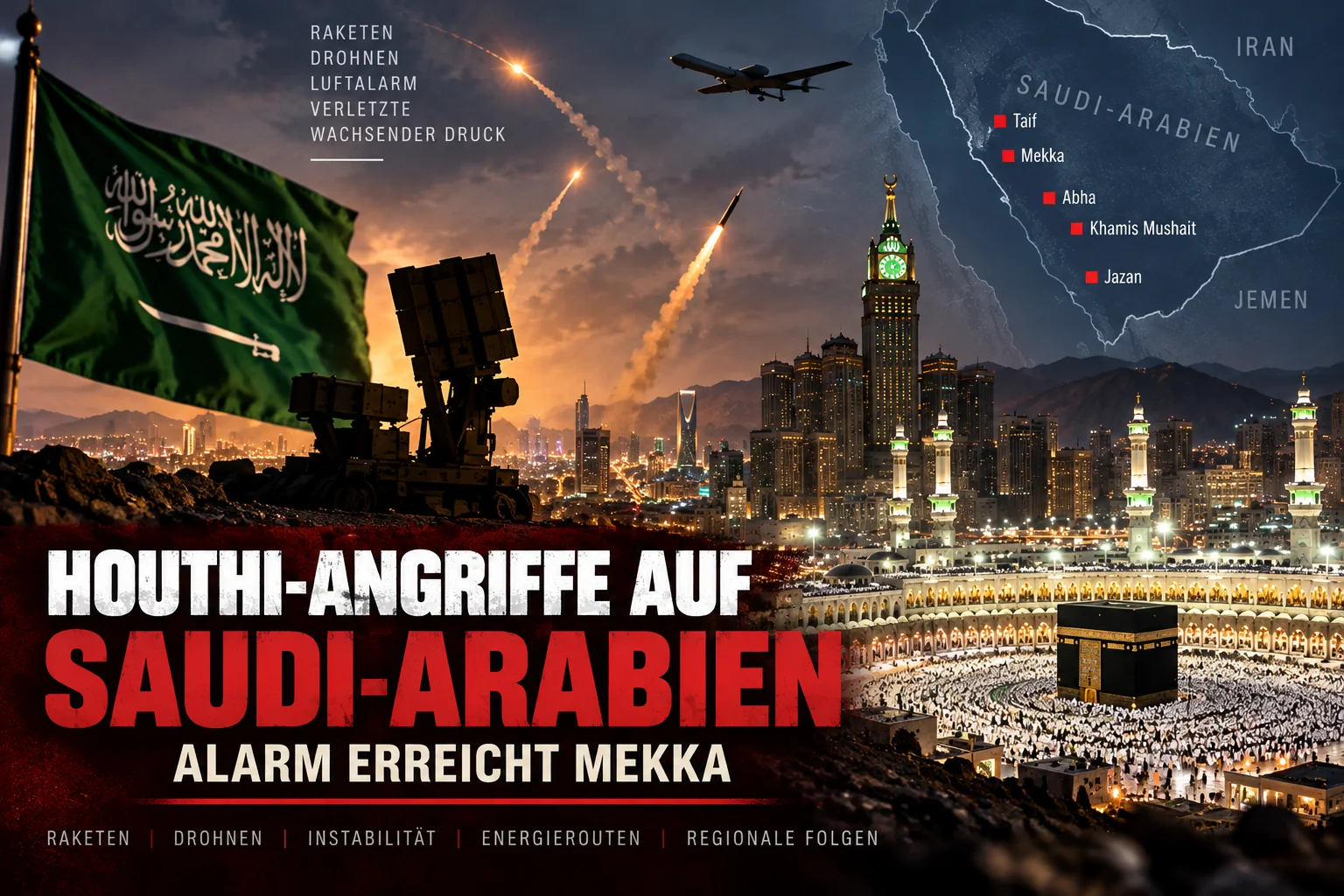
Houthi attacks on Saudi Arabia have once again brought the current escalation in Yemen directly onto Saudi territory. Missile and drone attacks injured civilians in the south and west of the kingdom within a few days, while warnings have now reached as far as Mecca. At the same time, the Houthis have massively expanded their position along the Red Sea coast and at the strategically important Bab al-Mandab. This is creating a multi-front situation in which Saudi Arabia is coming under pressure not only from Yemen, but also from attacks carried out by Iran-backed militias in Iraq.
The attacks on September 14 were not an isolated incident. As early as September 13, according to the Saudi Civil Defense, two people were injured when a Houthi projectile struck the Al-Tuwal district in the Jazan region. A mosque, as well as other buildings and vehicles, were also damaged. Al Jazeera documented the Saudi account of this attack. The Houthis had previously attacked Saudi cities, energy facilities and military installations on several occasions.
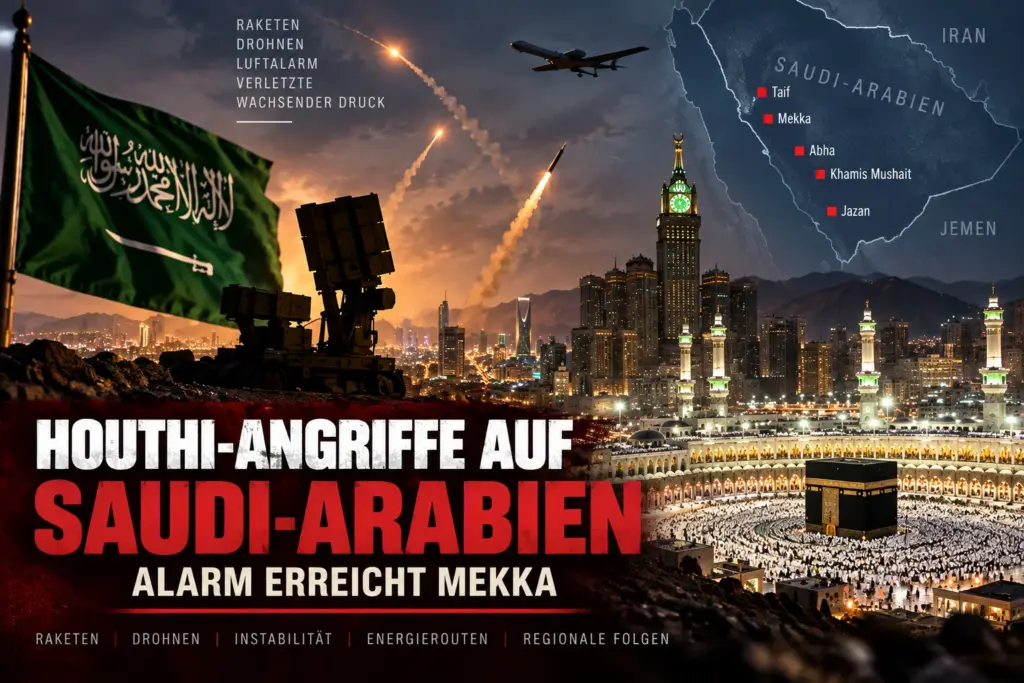
On September 14, the next wave of attacks struck targets in southern and western Saudi Arabia. According to the Saudi-led coalition, the Iran-backed Houthis attacked Khamis Mushait, Abha and Taif with ballistic missiles and drones. Thirteen civilians were lightly to moderately injured. Seven residential buildings and two vehicles were damaged. The Houthis themselves said that, as part of a large-scale operation, they had also attacked King Khalid Air Base near Khamis Mushait.
What exactly was hit on military property has not yet been independently confirmed. A distinction must be made here between the confirmed attack and the claimed military impact. The Saudi-led coalition confirms that missiles and drones reached Saudi territory and caused damage and injuries there. Further claims about hits on military installations, however, come from the Houthis.
Passende X-Beiträge
Aus dem SCHLAGSEITE X-Archiv
Houthi Attacks on Saudi Arabia: Air Raid Alert Reaches Mecca
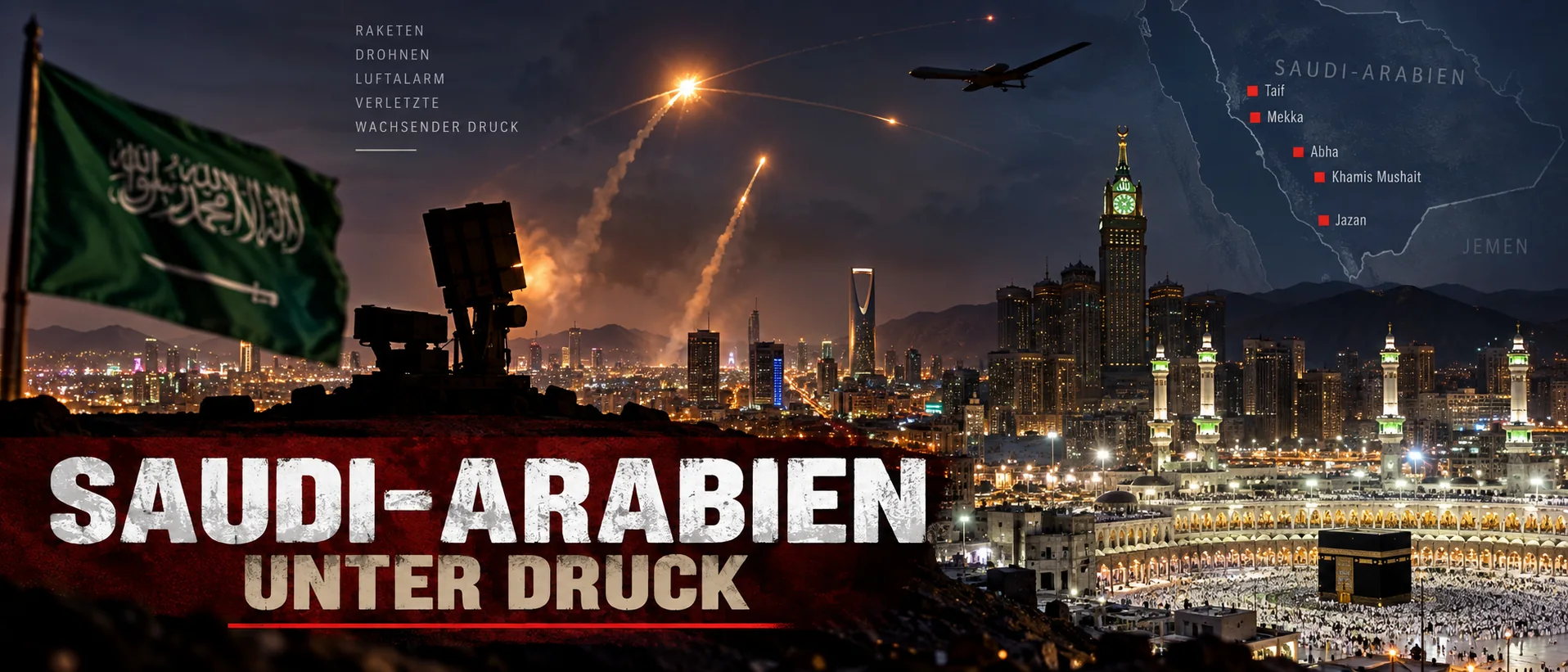
The escalation was not limited to southern Saudi Arabia. On September 15, Saudi Civil Defense temporarily issued warnings for several regions. Those affected included Jeddah, Taif, Abha, Jazan, Al-Ula and Yanbu. AFP also reported a warning for Mecca, the first there since the start of the current Middle East war. The warnings were lifted again in each case, without impacts being confirmed at all locations.
On Tuesday evening, September 15, the Saudi-led coalition reported another incident. According to its account, Saudi air defenses intercepted a Houthi drone south of Mecca at 6:50 p.m. local time, before it could enter the restricted airspace over the city. Coalition spokesman Turki al-Maliki described Mecca’s security as a red line and announced measures to deter further attacks. Reuters documented both the Saudi account and the Houthi denial.
Al-Maliki classified the incident as a second attempt to attack Mecca and referred to a ballistic missile attack reported by Saudi Arabia on July 27, 2017. The Houthis expressly deny having selected Mecca or other Islamic holy sites as targets. Thus, two contradictory accounts face each other regarding this part of the events. The Saudi report of a drone interception south of Mecca is documented. Whether its actual target was the holy city cannot currently be independently determined.

An air warning for Mecca is not the same as a confirmed impact in Mecca. Saudi Arabia says a Houthi drone was intercepted south of the city before it could enter the restricted airspace. The Houthis deny having selected Mecca as a target. This contradiction has not yet been independently resolved.
Mocha, Dhubab and Perim: The Advance to the Strait
The Houthi attacks on Saudi Arabia are only part of the broader development. Within a few days, the Houthis seized several strategically important positions along Yemen’s Red Sea coast. The port city of Mocha fell on September 10. As early as the following day, according to two Yemeni government sources, Houthi forces reached Dhubab directly on Bab al-Mandab.
The Houthis then reached the strategically located island of Perim, also known as Mayyun, which lies directly in the strait and divides Bab al-Mandab into two shipping routes. According to a representative of Yemen’s internationally recognized government speaking to AFP, the Houthis subsequently also seized Greater Hanish and Lesser Hanish. A government official said that everything government forces had previously controlled on the western coast had fallen.
This creates a geographic line: Mocha on the coast, Dhubab directly at the strait, Perim in the middle of Bab al-Mandab, and further strategic islands in the Red Sea. Reuters described the rapid advance as a serious strategic setback for Saudi Arabia and its Yemeni allies. The Houthis now have significantly greater opportunities to put pressure on shipping through one of the world’s most important trade and energy routes.
Bab al-Mandab connects the Red Sea with the Gulf of Aden and, through it, the Suez Canal with the Indian Ocean. Important trade and energy routes between Europe and Asia pass through this comparatively narrow passage. What happens there therefore does not remain confined to Yemen.

Hormuz Restricted, the Alternative Route Under Pressure
For Saudi Arabia, the Houthi advance comes at a particularly difficult time. Shipping through the Strait of Hormuz is already severely restricted as a result of the Iran war. As a result, Saudi Arabia’s East-West Pipeline has become a strategic reserve turned into the most important alternative route, through which crude oil can be transported from the eastern production areas to the Red Sea.
However, this pipeline came under pressure not because of a confirmed Houthi attack. The 1,200-kilometer connection was attacked by drones on September 10. Saudi Arabia and Iraq said, according to Reuters, that the drones had been launched from Iraqi territory. Iran-backed militias operate there. However, no group initially claimed responsibility for this specific attack, and direct Iranian command has not yet been independently established.
Saudi Arabia shut down the East-West Pipeline as a precaution. According to Reuters data, it transported around four to five million barrels of crude oil per day in recent months. That roughly corresponds to four to five percent of the world’s daily oil supply. Precisely because Hormuz is severely restricted, this volume was no longer merely a technical reserve, but a crucial part of Saudi Arabia’s alternative strategy.
Riyadh is therefore under pressure from two directions within Iran’s sphere of influence at the same time. From Yemen, the Iran-backed Houthis are attacking Saudi territory and have greatly expanded their position at Bab al-Mandab. In Iraq, Iran-backed militias operate in the environment from which, according to Saudi Arabia and Iraq, the drones targeting the East-West Pipeline came. However, it has not yet been established that both lines of attack are controlled by a single operational commander.
ℹ️ Background
Saudi Arabia’s East-West Pipeline connects the production regions on the Persian Gulf with the Red Sea. Most recently, it transported around four to five million barrels of crude oil per day. Its importance has increased particularly sharply since traffic through the Strait of Hormuz was restricted. At the same time, the Houthi advance at Bab al-Mandab is now putting the western alternative route under pressure as well.
Riyadh Announces a Tough Response
Riyadh has announced a determined response to the Houthi attacks on Saudi Arabia. The coalition said it would protect Saudi sovereignty and take all necessary measures to deter further attacks. AFP reported on the Saudi announcement that it would respond decisively to the attacks.
The Houthis, in turn, accuse Saudi Arabia of carrying out massive airstrikes on targets in Yemen. Their claims about the exact number of Saudi airstrikes cannot be independently confirmed. Reuters, however, now reports a significant expansion of Saudi air operations and continuing reciprocal shelling. The conflict, which had appeared at least partly frozen for years, is thus once again developing into a direct military confrontation between Saudi Arabia and the Houthis.
Saudi Arabia Seeks Support
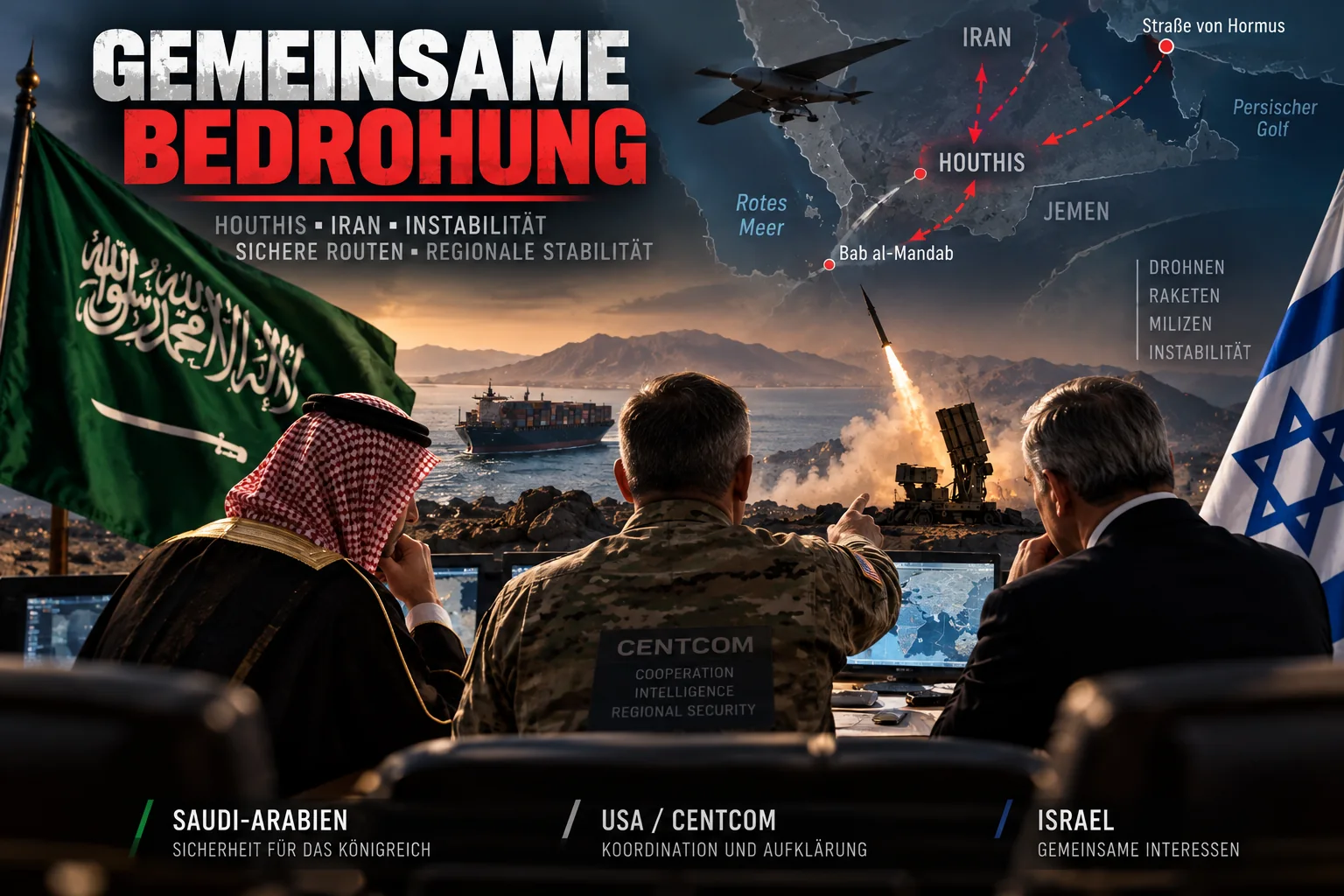
The growing pressure is also changing the regional security architecture. Saudi state media confirmed on September 14 a meeting between Crown Prince Mohammed bin Salman and CENTCOM commander Admiral Brad Cooper. Reuters had previously reported that the Saudi crown prince had asked Washington for military support against the Houthis. The United States has so far not directly participated in Saudi attacks, but it is supporting Riyadh with intelligence.
Israel, Saudi Arabia and the CENTCOM Channel
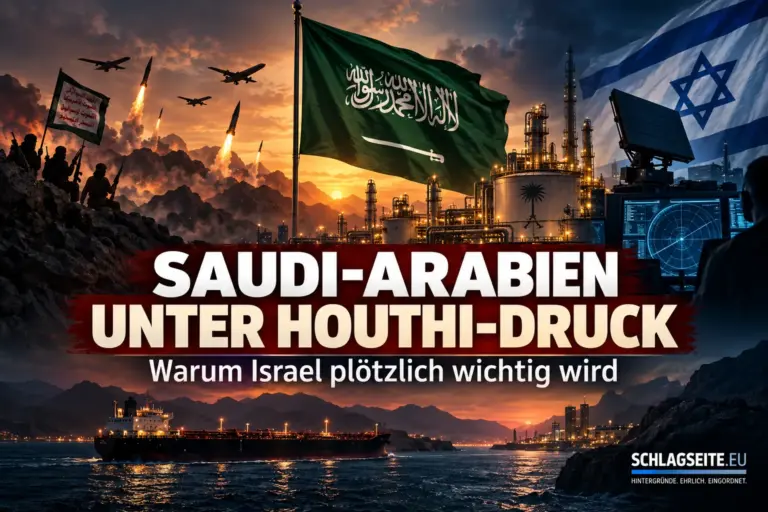
Current media reports indicate that contacts between Saudi Arabia and Israel go beyond a mere general overlap of interests. The Jerusalem Post reported, citing a regional diplomat, that Saudi Arabia and Israel were holding talks, mediated by the U.S. Central Command, about Israeli intelligence assistance to counter the Houthis.
Israel Hayom reported on September 16, citing diplomatic and security sources from the region, that the possible support currently focused primarily on intelligence and early warning to protect Saudi infrastructure and strategic targets. According to the newspaper, this concerns not only Houthi attacks from Yemen, but also threats from pro-Iranian militias in Iraq. An Israeli government official told Israel Hayom that Saudi Arabia was very familiar with Israel’s capabilities in defending against missiles and drones.
There is also an institutional framework that goes beyond the bilateral reports. CENTCOM confirmed to the Jerusalem Post a closed meeting of senior military officials in Germany. According to consistent media reports, representatives of the United States, Israel, Saudi Arabia and other Arab states took part. CENTCOM said the conference discussed ways to strengthen security cooperation in the Middle East. The security of the Strait of Hormuz was also addressed.
The meeting and the reports about intelligence contacts do not prove a formal Saudi-Israeli alliance or a joint military operation against the Houthis. But they do show that CENTCOM has long served as an institutional channel of communication between Israel and several Arab states. Against this backdrop, possible Israeli support for Saudi Arabia is not merely a theoretical overlap of shared interests, but part of an already existing regional security structure.
The Yemen war is once again a regional conflict
The new escalation shows why the Houthis’ advance is far more than another shift in the front line in Yemen’s years-long war. The group can put Saudi territory under pressure with missiles and drones, controls strategic positions along the Red Sea, and has massively expanded its access to Bab al-Mandab. Reuters assesses the recent territorial gains as a significant strategic setback for Riyadh and as strengthening Iranian influence.
For Saudi Arabia, this exacerbates a problem that was actually supposed to be contained politically. In recent years, Riyadh had sought to calm the war in Yemen and stabilize relations with the Houthis. Now air-raid warnings are again being issued over Saudi cities, while the Houthis, just a few hundred kilometers farther south, have taken Mocha, Dhubab, and strategic islands at the entrance to the Red Sea. At the same time, the most important Saudi alternative route for oil shipments was hit by an attack from the direction of Iraq.
The decisive development in the Houthi attacks on Saudi Arabia therefore lies not solely in the renewed shelling of the kingdom. What is new is the combination of territorial advances at Bab al-Mandab, attacks deep inside Saudi territory, and additional pressure on energy infrastructure from the direction of Iraq. Saudi Arabia thus faces a multi-front situation that links the war in Yemen with the conflict with Iran, Iraqi militias, and the region’s strategic energy routes as a whole.
ℹ️ Factual basis and primary sources for the article 📑
▶️ Reuters:
Houthis strike Saudi targets anew as talks over Strait of Hormuz stall
Documents the wave of attacks on Khamis Mushait, Abha, and Taif, as well as the further escalation between Saudi Arabia and the Houthis.
▶️ Al Jazeera:
Houthi projectile wounds two, damages mosque in Jazan region, Saudi says
Documents Saudi reports on the attack in Jazan on September 13, which left two people injured and caused damage to a mosque, buildings, and vehicles.
▶️ AFP:
Saudi civil defence issues brief alerts over attack threats in Mecca, Jeddah, Taif
Documents the air-raid warnings issued on September 15, including the first warning for Mecca since the beginning of the current Middle East war.
▶️ Reuters:
Saudi-led coalition says it destroys Houthi drone south of Mecca
Documents Saudi Arabia’s reported interception of a drone south of Mecca, the reference to 2017, and the Houthis’ denial.
▶️ Reuters:
Iran-backed Houthis reach Yemen’s Dhubab on Bab el-Mandeb Strait
Evidence of the Houthis’ rapid advance from the coast to the immediate vicinity of Bab al-Mandab.
▶️ AFP:
Houthis seize last two Bab al-Mandab islands: Yemen military official
Documents reports by Yemen’s internationally recognized government on the capture of Greater Hanish and Lesser Hanish.
▶️ Reuters:
Houthi blitz leaves Saudi Arabia exposed, Iran emboldened
Puts the Houthis’ territorial gains, the strategic islands, and the consequences for Saudi Arabia into context.
▶️ Saudi Press Agency:
East-West Pipeline Shut Down as a Precaution Following Multiple Attacks
Primary source from Saudi Arabia’s Energy Ministry on the temporary shutdown of the East-West Pipeline following the attacks.
▶️ Reuters:
Saudis shut down oil pipeline as Houthis tighten grip on Red Sea shipping
Documents the drone attack originating from Iraq, according to Saudi and Iraqi accounts, as well as the four to five million barrels of crude oil per day transported through the pipeline most recently.
▶️ The Jerusalem Post:
Israel and Saudi Arabia discuss intelligence aid amid growing Houthi attacks
Reports, citing a regional diplomat, on CENTCOM-mediated talks between Israel and Saudi Arabia about intelligence support.
▶️ Israel Hayom:
Saudi Arabia’s Israel appeal: New details emerge on dramatic contacts
Reports, citing diplomatic and security sources, on intelligence and early-warning assistance to protect Saudi infrastructure.
▶️ The Jerusalem Post / CENTCOM:
CENTCOM, IDF, Arab militaries held military summit on Middle East, Iran
Documents CENTCOM’s confirmation of a meeting of senior military representatives from the United States, Israel, Saudi Arabia, and other Arab states in Germany.
🔎 Error discovered, criticism, or addition?
SCHLAGSEITE.eu stands for careful research and transparent corrections. Have you discovered a factual error, unclear wording, or a broken link? Then send me your note. If possible, please provide a verifiable source.