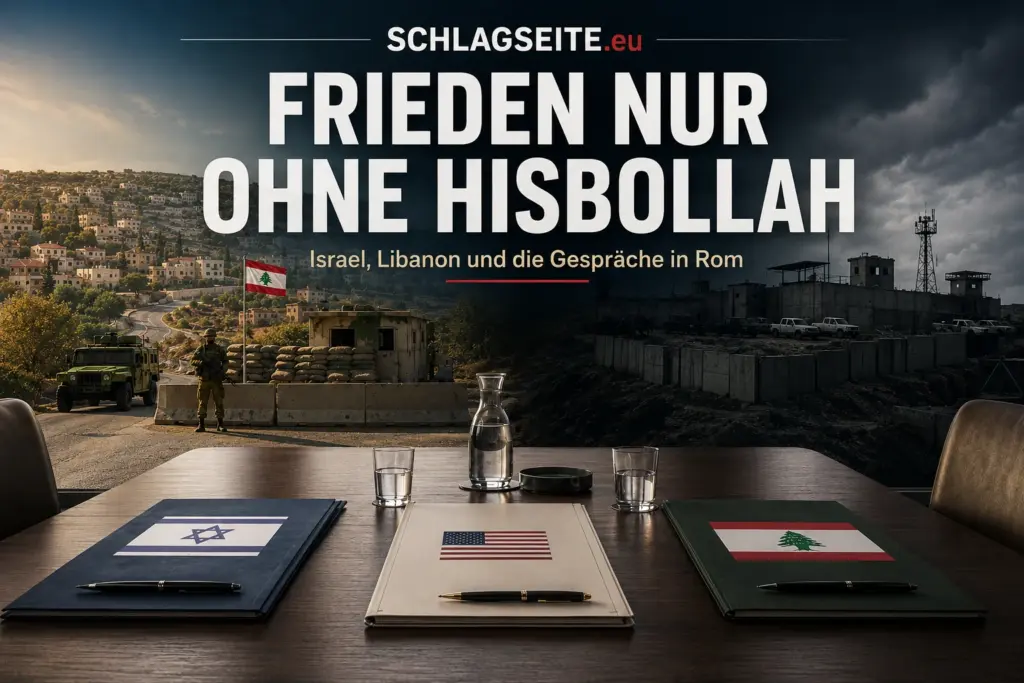

Israel and Lebanon are once again negotiating directly with each other. But the path to lasting peace will not be decided by diplomatic wording in Rome, but by a far more uncomfortable question: Is Beirut truly willing and able to disarm Hezbollah?
On August 4, 2026, a new round of talks between Israeli and Lebanese representatives, mediated by the United States, began in Rome. The talks are scheduled to last until Thursday, August 6. According to Reuters the US State Department spokesperson, Tommy Pigott, said the aim was to create lasting security for both countries, eliminate security threats to Israel and restore the authority of the Lebanese state in the south.
Israel and Lebanon: An Agreement on Paper Is Not Enough
The US ambassador to Lebanon, Michel Issa, warned against rushed steps. There was a significant difference between a political agreement and its responsible implementation. The safety of the civilian population in particular had to be ensured.
This caution is understandable. However, it must not lead to the core of the conflict once again disappearing behind technical details. For decades, Lebanon has not had full control over war and peace in its own country. Hezbollah has its own weapons, its own command structures and close political and military ties to the Iranian regime.

Passende X-Beiträge
Aus dem SCHLAGSEITE X-Archiv

The Test Is Disarmament
The basis for the talks is a framework agreement reached on June 26. It initially provides for two so-called pilot zones in southern Lebanon. There, the Lebanese army is to take control and disarm armed groups. In return, Israeli troops are to gradually withdraw from the areas concerned.

ℹ️ The Agreed Process
The Lebanese armed forces are to assume state control in selected areas of southern Lebanon and disarm non-state armed groups. The Israeli withdrawal is to take place gradually. Further security, control and verification mechanisms are to be defined in a security annex still to be drafted.
Israel is right to insist that a withdrawal must not take place merely in exchange for political promises. UN Security Council Resolution 1701 from 2006 had already called for the disarmament of all armed groups in Lebanon. South of the Litani, there were to be no armed forces, weapons or military installations other than those of the Lebanese armed forces and UNIFIL.
Twenty years later, Hezbollah nevertheless remained armed and continued to reject its disarmament. Following its renewed rocket and drone attacks on Israel on March 2, 2026, the conflict escalated again. Hezbollah thus played a major role in drawing Lebanon back into a war with Israel.
The extent to which Iranian influence goes beyond an ordinary political alliance is also shown by the analysis “Iran’s Shadow Empire: How Tehran Is Corroding the Middle East”. A parallel order emerged in Lebanon in which a militia supported from abroad was able to make decisions about war and peace without being democratically accountable for them.
Peace Requires State Sovereignty
The talks between Israel and Lebanon in Rome are therefore more than another diplomatic round. They could mark the beginning of a new order in which the Lebanese government actually restores the state’s monopoly on the use of force.
That would not only be in Israel’s interest. The Lebanese population also has a right to a state that is not used by an Iranian-backed militia as a military forward position. An Israeli withdrawal can be part of a viable solution. However, it must not once again leave behind a vacuum that Hezbollah subsequently fills with weapons and new military positions.
✔️ In Summary
The negotiations can lead to lasting peace only if the Lebanese state takes control of its own territory and armed forces. The decisive test therefore remains not the Israeli withdrawal, but the actual disarmament of Hezbollah.
Peace does not begin with a signed document. It begins where an elected government, rather than a militia, once again decides whether a country goes to war.
ℹ️ Factual basis and primary sources for the article 📑
▶️ US Embassy in Lebanon:
Statement from Ambassador Michel Issa
Original statement on the technical implementation of the framework agreement and the protection of the civilian population.
▶️ United Nations:
UN Security Council Resolution 1701
International legal framework for the disarmament of armed groups and state control over southern Lebanon.
▶️ Reuters:
US-facilitated Israel-Lebanon talks have begun
Current report on the start, duration and aims of the round of talks beginning on August 4, 2026.
▶️ Reuters:
What’s in the deal between Israel and Lebanon?
Overview of the framework agreement of June 26, the disarmament, the pilot zones and the planned Israeli withdrawal.
▶️ Reuters:
Lebanon and Israel conclude talks on pilot zones
Background on the pilot zones, the technical implementation and the gradual Israeli withdrawal.
▶️ Jewish News Syndicate:
US envoy urges caution as Israel, Lebanon resume talks
Report on Michel Issa’s remarks, the round of talks in Rome and the renewed escalation in March 2026.
🔎 Spotted an error, criticism or addition?
SCHLAGSEITE.eu stands for careful research and transparent corrections. Have you discovered a factual error, unclear wording or a broken link? Then send me your note. If possible, please provide a verifiable source.