
The Gaza roadmap runs up against Benjamin Netanyahu’s red line: Israel will not vacate any further secured positions as long as Hamas has not been actually, completely and verifiably disarmed. This is neither a diplomatic quirk nor a question of personal stubbornness. It is the consequence of October 7, 2023, and of two decades in which Israel has experienced how quickly security assurances become worthless when no one is prepared to enforce them.
On August 9, Netanyahu made clear that Israel does not accept the new 15-point roadmap of the Board of Peace, led by Donald Trump, in its current form. According to Reuters he demanded of his cabinet “real disarmament, not fictitious disarmament” (author’s translation). This refers not only to heavy weapons, but to all categories of weapons. At the same time, he reaffirmed his opposition to a Palestinian state in Gaza or Judea and Samaria.
This position does not need to be softened in order to be journalistic. Hamas is not a normal political counterpart, but an Islamist terrorist organization. The European Union lists Hamas under its measures against terrorism and has most recently expanded its sanctions against the organization and its officials. October 7 was not a diplomatic misunderstanding, but a terrorist attack on Israel. Anyone discussing Gaza’s future without placing this starting point at the center is talking about a different conflict.
Donald Trump is pursuing a legitimate goal: ending the war, removing Hamas from power and transferring Gaza into a new order. But Israel bears the risk if this order fails. Washington can devise a plan. Jerusalem must live with the consequences if Hamas rebuilds military power.

Passende X-Beiträge
Aus dem SCHLAGSEITE X-Archiv

Israel’s red line is not a rejection of peace
The dispute is not about whether Gaza should be demilitarized. Trump and Netanyahu largely agree on that. The dispute begins with the question of what “demilitarized” means in reality and who guarantees that this condition will not be reversed.
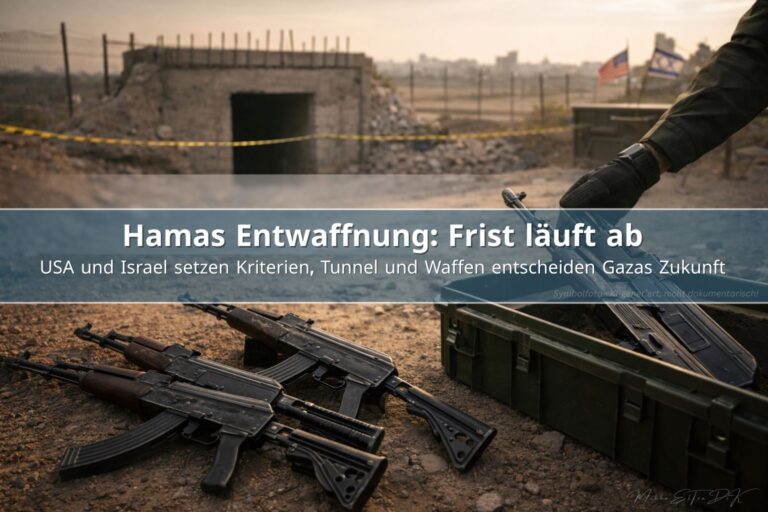
The original 20-point plan is clear on this point. Military and terrorist infrastructure, including tunnels and weapons-production facilities, is to be destroyed and not rebuilt. Weapons are to be rendered permanently unusable. Published on July 30, the 15-point Gaza roadmap describes the concrete implementation mechanism.
And that is precisely where things become problematic for Israel.

ℹ️ 20 points and 15 points
The 20-point plan sets out the political end goal: Hamas out of government, terrorist infrastructure destroyed, weapons rendered permanently unusable and Gaza demilitarized. The 15-point roadmap regulates the path there. Weapons are to be taken out of service gradually and stored under Palestinian NCAG control, while the Israeli withdrawal is linked in parallel to the verification process.
The sticking point: The weapons do not simply disappear
The 15-point roadmap provides for Hamas and other armed groups to transfer their civilian and security-related governing functions to the National Committee for the Administration of Gaza, NCAG,. Hamas is ultimately not to be allowed either to govern or to possess or store weapons itself.
At first glance, this sounds like complete disempowerment. From Israel’s perspective, however, what happens to the weapons themselves is decisive.
The roadmap expressly stipulates that heavy weapons, weapons depots, military production facilities and tunnels are to be taken out of service gradually. Militia weapons are likewise to be taken out of service and stored under NCAG responsibility. None of these weapons is to be handed over to Israel or to any other non-Palestinian actor. Ultimately, only the NCAG is to be permitted to possess, store or control weapons in Gaza.
That is more than a technical detail. A stockpile in storage is not an eliminated stockpile. A weapon that physically remains in Gaza can become a security problem again in the event of political collapse, infiltration, corruption or violence. Israel is therefore supposed to relinquish real military control while part of the weapons stock remains in the territory and is entrusted to a new Palestinian system that has yet to prove its resilience.
According to the Associated Press this is precisely why Israel is demanding that surrendered Hamas weapons not merely be stored, but permanently eliminated.
Netanyahu’s position at this point is not complicated: Israel should not give up an irreversible security position as long as disarmament itself remains reversible.

Hamas is not a partner Israel can trust blindly
In many Western portrayals, it sounds as though two governments are facing each other, merely arguing about the sequence of individual treaty steps. This obscures the core of the problem.
Hamas is an Islamist terrorist organization that ruled Gaza for nearly two decades and led the terrorist attack of October 7, 2023. It did not secure its rule through a functioning democratic process of alternation, but through armed power, security apparatuses and terrorist structures.
Reuters reports that Hamas itself avoids the term “disarmament” . The organization speaks of handing weapons over to the Palestinian technocratic administration and having them stored there. At the same time, it ties implementation to Israeli prior steps, including further withdrawals.
This is not an unconditional surrender. It is agreement to a process whose design can give Hamas time and political room for maneuver. Israel would be negligent if it equated a statement by Hamas with disarmament that had actually taken place.
In early August, an Israeli prime minister’s spokesperson told AP that Israel’s assessment was that Hamas continued to recruit, rebuild its military capabilities and rearm. Precisely for this reason, Netanyahu’s demand for verifiable facts is not rhetorical severity, but elementary security policy.
⚠️ No artificial equivalence
Israel and Hamas are not two similar political actors with symmetrical security interests. Israel is a state that must prevent the terrorist organization Hamas from organizing militarily again. Hamas, in turn, is trying to preserve its influence and capacity to act. This asymmetry is part of the facts and must not be linguistically moderated away.
Israel has already paid the bill for failed security assumptions
Anyone who considers Netanyahu’s position excessive must explain why Israel should ignore the experiences of the past two decades.
In 2005, Israel withdrew its stationed troops and settlements from the Gaza Strip. Two years later, Hamas took control of the territory by force. In the years that followed, extensive military structures, tunnels, rocket arsenals and an organized terrorist army emerged. The political hope that withdrawal could create long-term security did not prove to be an adequate security strategy.
Lebanon also shows how little an international mandate alone guarantees. Following the 2006 war, UN Security Council Resolution 1701 required that no armed forces or weapons outside state control be present south of the Litani. Nevertheless, later reports by the UN secretary-general continued to document weapons belonging to non-state groups, including Hezbollah.
The lesson is not that every international mission inevitably fails. The lesson is that an international presence and the international capacity to enforce are two different things.
An observer can identify a violation. A committee can record it. A resolution can condemn it. But for an Israeli in Sderot, Kfar Aza or on the Lebanese border, what matters is whether someone actually ends the violation.
International oversight sounds better than it has been secured so far
The Gaza roadmap relies on an International Verification Committee, IVC, which is to monitor implementation and confirm individual steps. This body is only now being established for the new mechanism. It therefore has no practical track record of its own in permanently suppressing Hamas structures.
There is also the International Stabilization Force, ISF. It is to monitor the ceasefire, train Palestinian police forces, secure humanitarian aid and support the NCAG. But the roadmap sets it a clear limit: The ISF is not to assume police functions within Palestinian society. Internal security incidents fall under the NCAG.
This is precisely where the question arises that Israel must answer before its soldiers vacate further positions: What happens if Hamas intimidates or infiltrates the NCAG, or practically sabotages its disarmament?
The Board of Peace has published troop commitments from, among others, Indonesia, Morocco, Kazakhstan, Kosovo and Albania. Egypt and Jordan are to help build Palestinian police forces. This international participation is politically significant. But it does not yet answer the decisive question of which actor would actually be prepared, in an emergency, to prevent Hamas from building up an armed force again.
A control mechanism becomes a security guarantee only when it is clear what happens in the event of a violation. Anyone who merely establishes that Hamas is violating the plan is not yet protecting an Israeli civilian.
Trump is Israel’s partner, but not Israel’s security guarantor
Donald Trump does not need to be turned into Israel’s adversary in this dispute. That would be factually wrong and politically absurd. His administration has itself made Hamas’s disempowerment and demilitarization the core of the Gaza concept.
Trump and Netanyahu differ less on the goal than on the question of when the goal may be considered achieved.
Washington needs a political mechanism that ends a war, enables reconstruction and produces an international success. Israel needs an order that continues to function even if Hamas cheats, an international body fails or a new Palestinian authority comes under pressure.
This is not a minor matter. The United States can broker guarantees. Israel must fend off the rockets, terrorist cells and border violations if the guarantees do not hold.
That is why an Israeli no to an American detail is not a betrayal of the partnership. Sovereign allies are allowed to disagree. An Israeli government that accepted a recognizable security risk for Washington’s sake would fail in its own mandate.
Earlier, SCHLAGSEITE.eu had already pointed to the decisive sequence in the article “Netanyahu on Gaza: No withdrawal without complete Hamas disarmament” . Netanyahu’s new statement makes the line even clearer: Disarmament first, further withdrawals afterward.
The Palestinian state cannot be separated from Israel’s security
The 15-point roadmap explicitly speaks of a possible path toward Palestinian self-determination and statehood. Netanyahu rejects a Palestinian state in Gaza or Judea and Samaria.
From a European distance, statehood can easily be described as the logical endpoint of a peace process. For Israel, the question is different: What security structure will emerge there the day after statehood is established?
A state has authorities, security forces, territorial control and foreign-policy capabilities. If Islamist terrorist structures survive socially or militarily at the same time, statehood is no guarantee of peace. It can give a threat additional institutional capabilities.
After October 7, it is entirely legitimate for Israel to treat a Palestinian state not as a moral obligation, but as a security issue. Anyone demanding that Israel accept state sovereignty directly on its border must provide a credible explanation of how this can be prevented from becoming a new base for terrorism.

Netanyahu is under pressure, but that does not mean the security problem is fabricated
Of course, Netanyahu is also acting for domestic political reasons. Israel votes on October 27, 2026, and the prime minister is caught between American pressure, his coalition partners and an Israeli public that did not experience October 7 as an abstract foreign-policy event.
Finance Minister Bezalel Smotrich welcomed Netanyahu’s tough line and is demanding the complete destruction and demilitarization of Hamas before further withdrawals and before Gaza is rebuilt. At the same time, political opponents continue to accuse Netanyahu of having failed to prevent October 7.
This political situation can be acknowledged. It should simply not be made the convenient explanation for everything. The question of whether Hamas has actually been disarmed does not disappear because Netanyahu is campaigning. Another Israeli government would also have to explain to its citizens why it is giving up secured positions before a new security system has demonstrated its effectiveness.
Israel’s security is not a bargaining chip
The Gaza roadmap contains reasonable goals. Hamas is to disappear from government. Armed militias are to lose their monopoly on weapons. Gaza is to receive a new civilian administration and be rebuilt. Israel has no interest in ruling Gaza forever. Israel has an interest in ensuring that Gaza can never again be turned into a terrorist army directed against its citizens.
That is precisely what every peace plan must be measured against.
Israel is supposed to relinquish real military control. Some weapons are to remain in Gaza under Palestinian control. A newly created international body is to verify implementation. An international force is to stabilize the situation, but not take over internal policing. At the same time, according to Israel’s assessment, Hamas is attempting to restore its military capabilities.
Under these conditions, blind trust would not be peace policy. It would be a security risk.
Donald Trump deserves recognition for seeking a political path. But a peace plan is not an end in itself. It must also work if Hamas deceives, breaks agreements or attempts to build new structures.
Netanyahu’s demand is therefore neither extreme nor puzzling: The terrorist threat must first actually and permanently disappear. Only then can Israel make irreversible concessions.
After October 7, Israel has no obligation to once again play the guinea pig for untested security mechanisms. Peace is a goal. Security is the prerequisite. And Israel’s security is not a bargaining chip.
A viable Gaza roadmap must do more than promise that Hamas will be disarmed. It must ensure that the Islamist terrorist organization actually, verifiably and permanently loses its military power. Israel must not first give up its security position and then hope that a new system holds. Peace requires trust. Security requires proof.
ℹ️ Factual basis and primary sources for the article 📑
▶️ Board of Peace:
15-Point Roadmap for Gaza of July 30, 2026
Official wording of the current roadmap on transitional administration, disarmament, international control, Israeli withdrawal and possible Palestinian statehood.
▶️ Board of Peace:
President Donald J. Trump’s Comprehensive Plan to End the Gaza Conflict
The original 20-point plan containing the political principles for demilitarization, the destruction of terrorist infrastructure, transitional administration and Israeli withdrawal.
▶️ European Council / Council of the European Union:
Sanctions against terrorism
Official overview by the Council of the European Union of the terrorism sanctions framework, including Hamas and Palestinian Islamic Jihad.
▶️ Reuters:
Netanyahu says Israel won’t pull out of Gaza before Hamas disarms
Current report on Netanyahu’s rejection of the 15-point roadmap, his demand for complete disarmament, Hamas’s position and the Israeli election campaign.
▶️ Associated Press:
Israel says it has serious concerns with Hamas disarmament deal
Background on Israel’s security concerns, the proposed disarmament mechanism, Israeli control in Gaza and objections to the storage of surrendered weapons.
▶️ Board of Peace:
Board of Peace Convenes Inaugural Meeting
Official information on international participation in the Board of Peace and the planned stabilization of Gaza.
▶️ Associated Press:
20 years after its landmark withdrawal from Gaza, Israel is mired there
Historical context on Israel’s withdrawal from Gaza in 2005, Hamas’s takeover of power in 2007 and the terrorist organization’s subsequent military development.
▶️ United Nations / UNIFIL:
Implementation of Security Council resolution 1701 (2006), Report S/2024/548
UN report on the implementation of Resolution 1701 and the continued presence of weapons held by non-state groups, including Hezbollah.
🔎 Found an error, criticism or addition?
SCHLAGSEITE.eu stands for careful research and transparent corrections. Have you found a factual error, unclear wording or a broken link? Then send me your note. If possible, please provide a verifiable source.