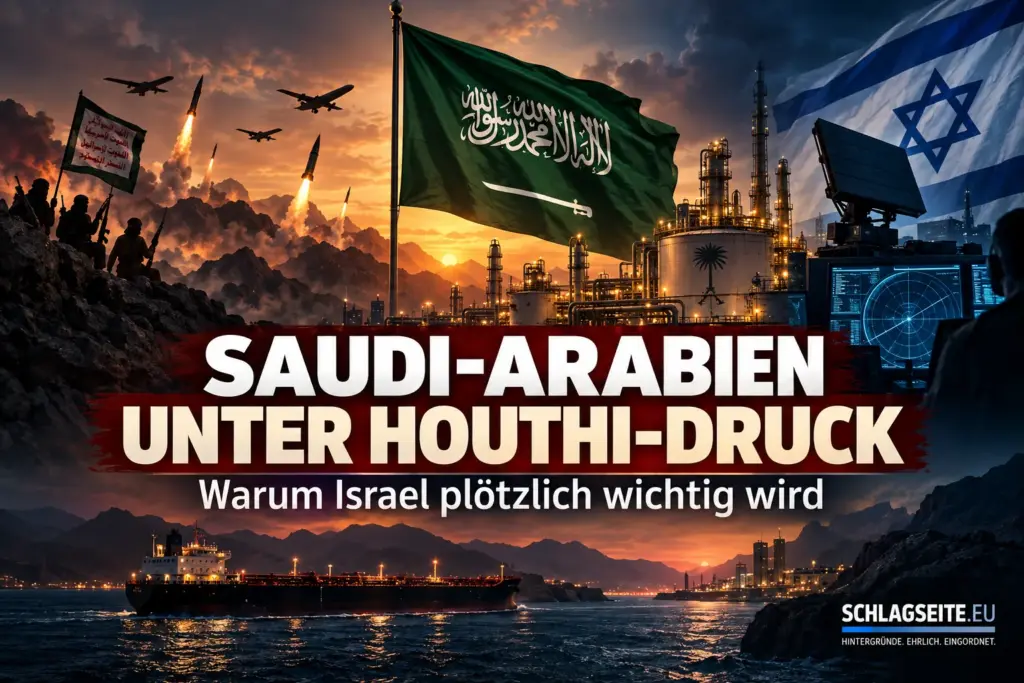
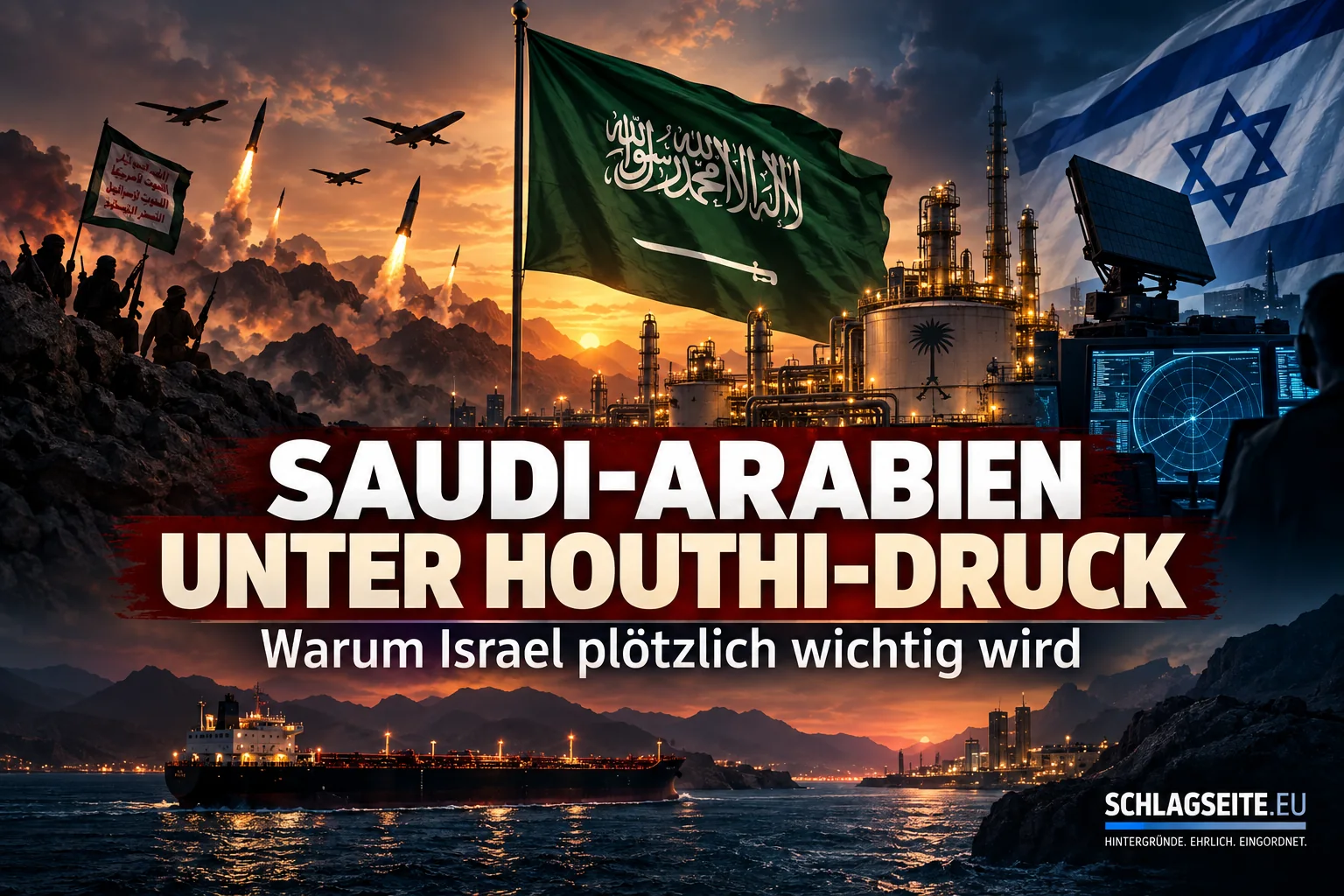
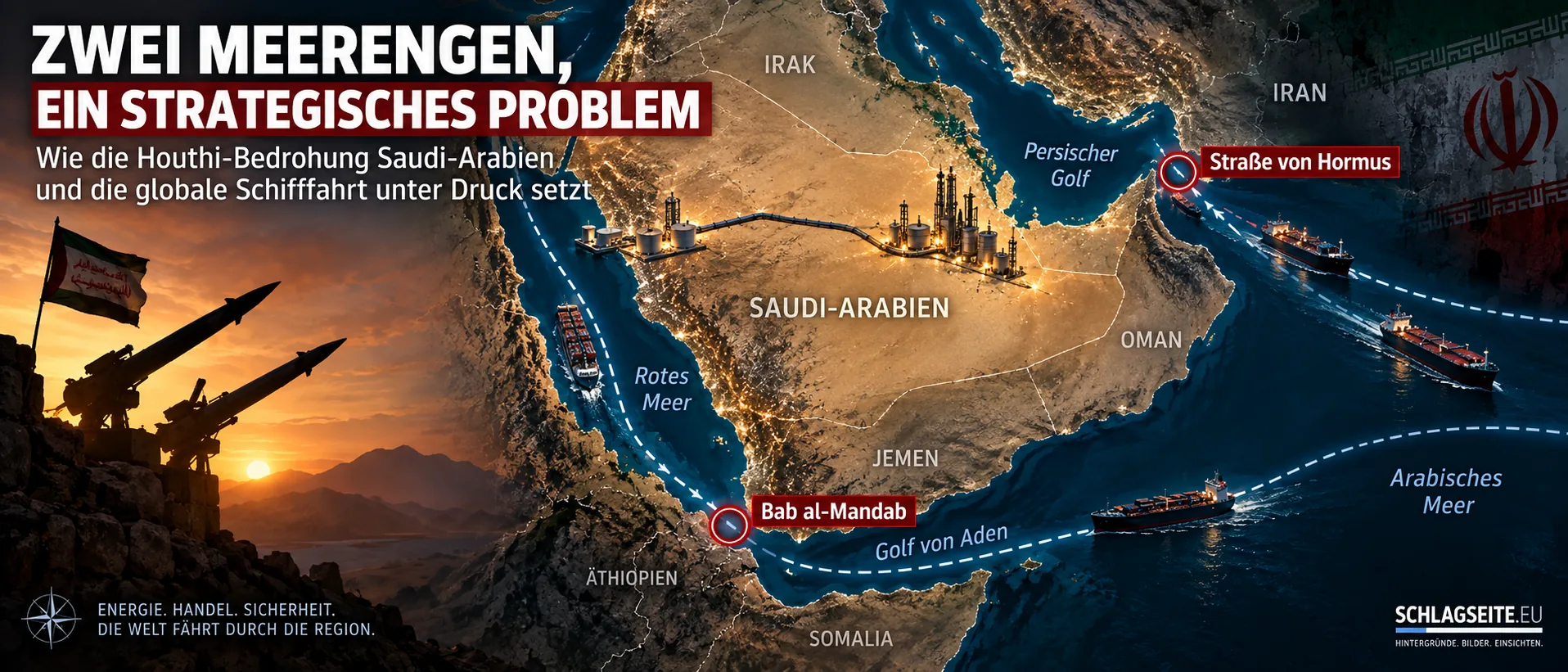
Saudi Arabia under Houthi pressure: The war with Iran has already severely restricted the Strait of Hormuz, while the Houthis have captured strategic coastal locations and islands at Bab al-Mandab. Riyadh asked Washington for military support, while Israeli media have reported on CENTCOM-mediated talks with Israel about intelligence and early warning. Open Israeli-Saudi military cooperation has not been confirmed.
Saudi Arabia is thus caught between two strategic chokepoints. Before the war, around one-fifth of the world’s oil supply passed through the Strait of Hormuz. Since the war with Iran began at the end of February, traffic there has plunged. Reuters put the latest oil flows through Hormuz at only around six to nine million barrels per day. Saudi Arabia’s alternative route via the East-West Pipeline to Yanbu and onward through the Red Sea is therefore no longer merely a technical detail, but a central part of the energy supply.
Reuters reported on September 16 on a further escalation in Yemen. Saudi Arabia carried out strikes against Houthi positions, while the militia continued its own operations against Saudi targets. Reuters had previously reported that Crown Prince Mohammed bin Salman had asked Washington for military support against the Houthis.
Passende X-Beiträge
Aus dem SCHLAGSEITE X-Archiv

Saudi Arabia under Houthi pressure: Two strategic chokepoints
The first chokepoint is Hormuz. Because this route has already been significantly restricted by the war with Iran, Saudi Arabia has increasingly transported oil via the approximately 1,200-kilometer East-West Pipeline from the east of the country to the Red Sea port of Yanbu. The second chokepoint lies exactly where this alternative route reaches the global market: at Bab al-Mandab between Yemen and the Horn of Africa.
The Houthi advance is therefore more concrete than the formulation that the militia has merely gained ground “along the coast.” Reuters initially reported, citing Yemeni government sources, that the port city of Mocha had been captured and that the Houthi advance had reached the Hanish Islands. One day later, government officials said their forces had withdrawn from the strategic island of Perim, also known as Mayun, and that the Houthis had also captured Dhubab opposite the island. Reuters described both points as key positions for access to the strait.
The front nevertheless remains fluid. The internationally recognized government announced counterattacks to recapture lost territory along the Red Sea coast. It would therefore go too far to speak already of definitive control of the entire Bab al-Mandab. Something else is decisive: The Houthis now occupy several strategic points directly at or in the strait. A Yemeni front line has thus become a problem for international shipping and energy supplies.
The East-West Pipeline figures also show the pressure. According to Reuters, it most recently transported around four million barrels of oil per day, roughly four percent of global supply. After the drone attack on the pipeline, export-ready stocks in Yanbu were sufficient for only five to seven days, according to three industry sources familiar with Saudi exports. Without a rapid resumption of pipeline operations, a further significant decline in Saudi deliveries was therefore looming.

ℹ️ Why Bab al-Mandab Is Now Even More Important
The strait connects the Red Sea with the Gulf of Aden. Because traffic through the Strait of Hormuz has already been severely restricted as a result of the war with Iran, the western Saudi export route via Yanbu has gained considerably in importance. This route then passes through Bab al-Mandab.
The Pressure Is Not Coming Only From Yemen
The attack on the East-West Pipeline broadens the threat picture once again. According to Saudi and Iraqi statements, the drones came from Iraqi territory, not Yemen. It was initially unclear who had carried out the attack. Reuters reported on the attack in the context of the broader escalation by Iran-aligned actors in the region.
This makes Saudi Arabia’s problem larger than the Houthi front alone. Riyadh is being put under pressure at different points in its energy and security architecture. Reuters also reported, citing Yemeni, Iranian and regional sources, that the latest Houthi offensive along the Red Sea coast had taken place with direct advice from Iran’s Islamic Revolutionary Guard Corps. Iran denies directly controlling the Houthis. The distinction is important: Iranian support and advice are extensively documented, but that does not automatically prove operational control of every individual attack.
Mohammed bin Salman Seeks Support From Washington
That Riyadh has recognized the seriousness of the situation is evident in its direct contacts with the United States. The Saudi Press Agency confirmed on September 14 a meeting between Crown Prince Mohammed bin Salman and the commander of US Central Command, Admiral Brad Cooper, in Jeddah. According to the official Saudi account, the discussion concerned bilateral relations and the latest developments in the region.
Reuters placed the meeting in a more specific context. Three sources familiar with the matter had previously told the news agency that Mohammed bin Salman had asked US President Donald Trump for military support against the Houthis. Reuters reported, that Trump initially rejected direct American strikes, while Washington promised intelligence and targeting support.
Riyadh is therefore seeking American backing, but so far it has not received a commitment to an open US war against the Houthis. This is precisely where CENTCOM becomes important. The American regional commander is not only Saudi Arabia’s interlocutor, but is now at the center of a broader security architecture in which Israel is also involved.
CENTCOM Has Long Been More Than a Mediator
How far this framework already extends was shown by a meeting in Germany last week. Axios reported, citing two Israeli government officials, that Admiral Brad Cooper brought together the military chiefs of eight countries there: Israel, Saudi Arabia, the United Arab Emirates, Bahrain, Kuwait, Qatar, Jordan and Egypt. CENTCOM confirmed the meeting to Axios and said that the planned conference had discussed options for stronger security cooperation in the Middle East.
According to the Axios report, Cooper assured participants that the United States would not withdraw its forces from the region despite Iranian attacks on American bases. Israel’s Chief of Staff Eyal Zamir reportedly briefed participants on Israeli operations on various fronts. Israeli and Saudi military leaders were therefore not merely theoretically part of the same American security framework, but actually sat at the same table.
The meeting was not a suddenly improvised emergency format. CENTCOM had already organized a regional security dialogue with twelve countries in July and referred to a coordination center for air defense established in January, through which information and threat warnings were to be exchanged. The American command framework therefore already exists. The Houthi offensive is now increasing the pressure to use it in practice.
The Route to Israel Runs Through CENTCOM
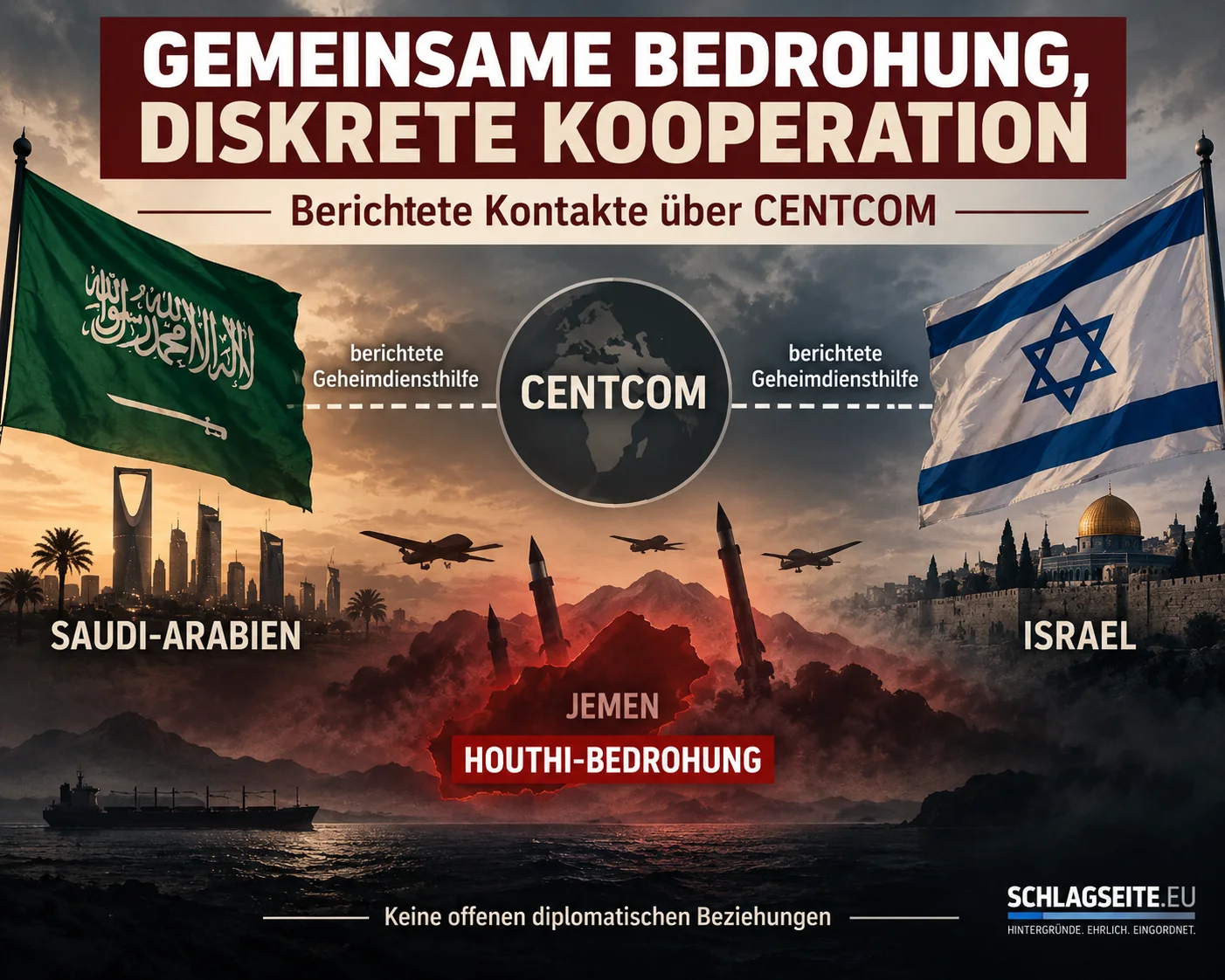
Against this backdrop, reports of Israeli-Saudi contacts appear less like an isolated call. The Jerusalem Post reported on September 15 , citing a regional diplomat and other sources familiar with the talks, that Saudi Arabia and Israel had held talks via CENTCOM about Israeli intelligence support. The focus was reportedly on improving the tracking of Houthi positions and possible future operations.
One day later, Israel Hayom published further details. According to the report, diplomatic and security sources from the region confirmed contacts between Saudi Arabia and Israel through US Central Command. For now, the support is said to focus primarily on intelligence, early warning and the protection of critical infrastructure against missile and drone attacks.
When it comes to how far this cooperation has already progressed, the distinction remains decisive. The Jerusalem Post describes talks about support. Israel Hayom goes further and reports that assistance in intelligence and early warning is already being implemented through CENTCOM. There is still no public joint confirmation from the governments in Jerusalem and Riyadh regarding the scope and concrete form of this cooperation.
The fact that several media outlets are reporting Israeli-Saudi security contacts makes the development more credible than a single report. But it does not replace an official joint statement by both countries. Talks, intelligence support and an open military alliance are three different levels and should not be conflated.
What Israel Can Offer That Saudi Arabia Needs Now
The strategic logic behind these contacts is easy to see. Israel has been dealing for years with Iranian missiles, drones and armed organizations supported by Tehran. These include not only the Houthis in Yemen, but a broader network of Iranian allies and partners in the region.
For Saudi Arabia, Israeli capabilities in situational awareness, intelligence and early warning are therefore of particular interest: the early detection of attack preparations, the analysis of military movements and the linking of different sensors into as complete a picture as possible of missile and drone activity. Especially in the case of distant launch areas and mobile systems, early warning can be decisive in determining whether critical infrastructure can be protected in time.
This does not mean that Israel could protect Saudi Arabia from the entire Yemen war with a single system. Modern air defense requires intelligence, early warning, command systems, integrated sensors and suitable defensive means. The potential Israeli added value therefore lies not in a miracle weapon, but in linking these capabilities.
In this context, Israel Hayom quotes former Mossad official and current researcher Oded Ailam. His analysis goes significantly beyond the contacts confirmed so far: Israel could offer Saudi Arabia a security package consisting of real-time intelligence, air defense and protection of critical infrastructure. This is a strategic assessment, not a confirmed agreement between the two countries.
Why the Detour Through CENTCOM Matters Politically
Saudi Arabia and Israel still do not maintain normal diplomatic relations. Riyadh publicly continues to insist on linking normalization with Israel to the establishment of a Palestinian state. At the same time, the domestic and regional symbolism is particularly sensitive for Saudi Arabia: The kingdom administers Islam’s two holiest sites, Mecca and Medina, and must weigh overt security-policy steps toward Israel differently from discreet technical cooperation.
Domestic politics also play a role on the Israeli side. Saudi Arabia researcher Brandon Friedman told The Jerusalem Post, potential Israeli support would have to be provided “quietly” because of the respective domestic political needs. At the same time, Israeli foreign policy is currently being strongly shaped by the upcoming election. Friedman therefore considers rapid political normalization unlikely despite shared security interests.
This provides a sober explanation for the CENTCOM detour: Shared threats can force practical contacts without automatically creating public recognition or diplomatic relations. For Riyadh, the American framework permits cooperation without immediately having to turn it into a political normalization process.
Iran is creating the very basis for new security contacts
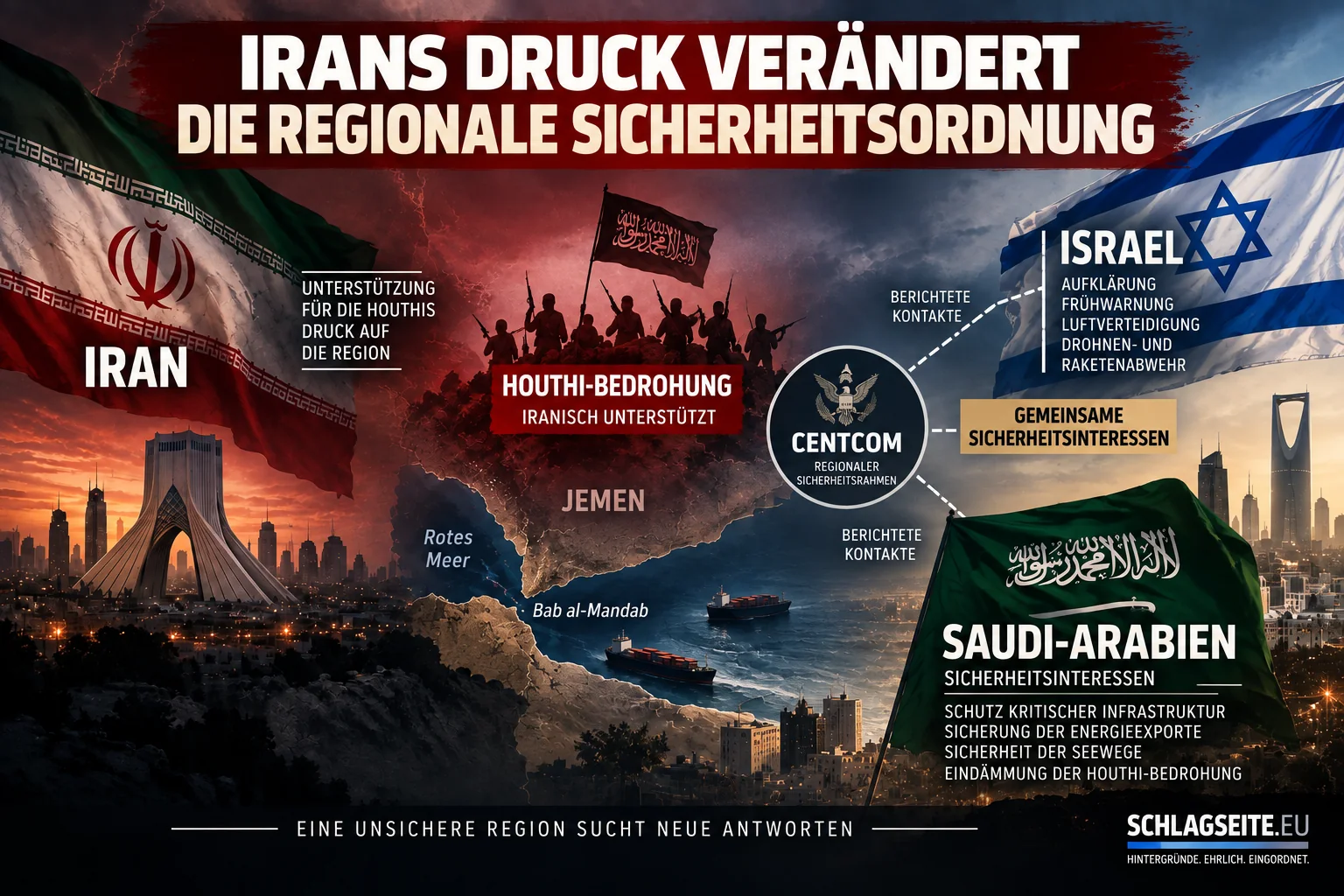
The strategic irony is that Iran has spent years building a network of armed partners capable of putting opponents under pressure and threatening regional transport routes. The stronger this pressure now becomes on Arab states as well, the greater their interest in intelligence, early warning, and joint air defense.
The attack on the Saudi East-West Pipeline underscores this point. The drones came from Iraq, while the Iran-backed Houthis were simultaneously putting Saudi territory and the Red Sea route under pressure from Yemen. Even though responsibility for the pipeline attack was not conclusively attributed to a specific actor, the combination of fronts shows why Riyadh can no longer view the threat merely as a Yemeni problem.
This development is also relevant for Israel. A stronger Houthi presence at Mocha, Dhubab, Perim, and the Hanish Islands directly affects access to the Red Sea and therefore a route of strategic importance to Israel, Saudi Arabia, and international trade. Both states consequently have a concrete shared security interest in early warning, freedom of navigation, and containing Iranian-backed military structures.
Can Israel protect Saudi Arabia from the Houthis?
The pointed question is also raised by an article published on September 16 by Tikvah Ideas. It argues that Israel could offer Saudi Arabia a more comprehensive protection concept than other partners. The basis is likewise an analysis by Oded Ailam.
As a political thesis, this is interesting. As a description of facts, it goes too far. Israel possesses capabilities that are particularly relevant to Saudi Arabia in intelligence, early warning, sensor integration, and air defense. Whether these capabilities would be sufficient to permanently contain the Houthi threat depends on much more: the development of the war in Yemen, Iranian support, American decisions, and how far Riyadh and Jerusalem are willing to politically sustain cooperation that has so far remained discreet.
The real news, therefore, is not that Israel is suddenly “saving” Saudi Arabia. More significant is that the strategic situation is apparently prompting Riyadh to take Israeli capabilities into account that, just a few years ago, would scarcely have been discussed openly for political reasons.
The Houthi pressure makes visible just how much the security order in the Middle East is shifting. Hormuz is already restricted, the Houthis hold strategic points at Bab al-Mandab, and Saudi Arabia’s most important alternative pipeline has been attacked. In this situation, CENTCOM becomes the framework in which shared security interests can be put into practice without automatically creating an Israeli-Saudi alliance.
Saudi Arabia is therefore facing more than just another round of the Yemen war. The kingdom must simultaneously deal with two maritime chokepoints, vulnerable energy infrastructure, and pressure from a broader Iranian-shaped security environment. The fact that Israeli capabilities in intelligence and early warning are also entering the picture through CENTCOM shows how strongly the regional threat environment is putting old political dividing lines under pressure.
ℹ️ Factual basis and primary sources for the article 📑
▶️ Saudi Press Agency:
HRH the Crown Prince, US CENTCOM Commander Review Bilateral Relations and Regional Developments
Official Saudi confirmation of the meeting between Crown Prince Mohammed bin Salman and CENTCOM Commander Admiral Brad Cooper on September 14, 2026.
▶️ U.S. Central Command:
CENTCOM Leads Regional Security Dialogue with 12 Nations in Bahrain
Official account of regional security cooperation under CENTCOM and the coordination center for air defense and threat warnings.
▶️ Axios:
U.S., Israeli and Arab military chiefs held secret meeting on Iran
Report on the meeting confirmed by CENTCOM in Germany with military chiefs from Israel, Saudi Arabia, the United Arab Emirates, Bahrain, Kuwait, Qatar, Jordan, and Egypt.
▶️ Reuters:
Yemen’s Houthis close in on Bab el-Mandeb Strait in new threat to shipping
Report on the capture of Mocha, the advance toward the Hanish Islands, and the strategic importance of Bab al-Mandab.
▶️ Reuters:
Yemen’s Houthis reach strategic island at mouth of vital shipping lane
Report on Perim, also known as Mayun, Dhubab, and the counterattacks announced by Yemen’s internationally recognized government.
▶️ Reuters:
Saudi pipeline outage threatens loss of 4% of global oil supply
Data on the East-West Pipeline, approximately four million barrels per day, export stocks in Yanbu, and the war-related severe restrictions on the Strait of Hormuz route.
▶️ Reuters:
Saudis shut down oil pipeline as Houthis tighten grip on Red Sea shipping
Report on the drone attack on Saudi Arabia’s East-West Pipeline originating from Iraqi territory and the parallel escalation along the Red Sea route.
▶️ Reuters:
Iranian arms and advice helped Yemen’s Houthis seize key Red Sea city, sources say
Report on Iranian weapons and advice, and the support for the Houthi offensive on the Red Sea coast that was provided, according to several sources.
▶️ Reuters:
Saudi crown prince sought US military help from Trump with Houthis, sources say
Report on the Saudi request for American military assistance and the U.S. aid, which so far has been limited to intelligence and targeting support.
▶️ The Jerusalem Post:
Israel and Saudi Arabia discuss intelligence aid amid growing Houthi attacks
Report on CENTCOM-mediated talks between Saudi Arabia and Israel about intelligence support.
▶️ Israel Hayom:
Saudi Arabia’s Israel appeal: New details emerge on dramatic contacts
Report on Israeli-Saudi contacts, intelligence, early warning, and the protection of strategic infrastructure.
▶️ The Jerusalem Post:
Israel unlikely to improve Saudi ties despite Houthi threat, expert tells Post
Interview with Brandon Friedman about the political limits of discreet Israeli-Saudi security cooperation and the continued low prospects for short-term normalization.
▶️ Tikvah Ideas:
Israel Can Save Saudi Arabia from the Houthis
Analytical starting point for the thesis that Israel could offer Saudi Arabia a broader security package against the Houthi threat.
🔎 Found an error, criticism, or addition?
SCHLAGSEITE.eu stands for careful research and transparent corrections. Have you found a factual error, unclear wording, or a broken link? Then send me your tip. If possible, please provide a verifiable source.