
Settler violence and terror shape the situation in Judea and Samaria. Israeli extremists’ violence against Palestinians is real, unlawful and a growing problem. Yet anyone who reports exclusively on “settler violence” and cuts Palestinian terror against Israelis out of the picture does not show the full reality. This creates a distortion in which one side almost automatically appears as perpetrators and the other almost automatically as victims.
In Judea and Samaria, history, religion, terror, military security, settlement policy and unresolved legal questions converge in a very confined space. An individual incident can therefore rarely be understood if the account begins only where the preferred political interpretation takes over.
The fatal incident of July 24, 2026 shows how quickly a complicated and partly unresolved situation can become a simple narrative.

ℹ️ Facts as of
This article reflects the publicly known information as of August 3, 2026. The investigation into the fatal incident near Tell has not yet been completed. Unresolved sequences of events are therefore explicitly identified as open.
A fatal incident and two incomplete stories
On July 24, a larger group of Israeli civilians entered areas near the Palestinian village of Tell, southwest of Nablus, without coordinating with the army. According to a preliminary IDF investigation members of the group entered Areas A and B, which, according to preliminary military findings, had not been authorized for this group. The exact reason, the size of the group and the first minutes of the confrontation remain the subject of differing accounts.
According to the Israeli army, a violent confrontation with Palestinian residents developed. During it, a Palestinian wrested an assault rifle from an armed Israeli security official and opened fire. Killed were 32-year-old reservist Benayahu Mellet and 27-year-old IDF officer Major Yuval Ezra. Four Palestinians also died.
According to the IDF account, the armed shooter was killed by an Israeli officer. How the three other Palestinians died initially remained unclear. The army stated that this part of the events was still being investigated. This is precisely where restraint is necessary. Where the sequence of events has not been established, neither the Israeli nor the Palestinian account may simply be declared the complete truth.
The Israeli group should not have entered the area without coordination. This does not, however, create a right to wrest a weapon from a security official and shoot at Israelis. Unlawful conduct on one side does not turn deadly violence on the other into legitimate vigilante justice.
Nor did the two Israelis who were killed justify subsequent acts of revenge against Palestinian civilians or their property. That same day, the IDF warned of a charged “atmosphere of revenge”. In the following days, mosques, homes, vehicles and agricultural land were among the targets of attacks.
The Israeli police later arrested two Israelis on suspicion of involvement in the revenge attacks. At the same time, Palestinian suspects were arrested in connection with the fatal confrontation. Arrests are not convictions, but they show that the investigation must encompass both spheres of violence.
The situation remained tense afterward as well. Reuters reported on July 31 on nearly daily raids and arrests in Tell, blocked access roads and a march by more than 100 Israeli settlers toward the village. A Reuters reporter observed individual participants removing objects from a Palestinian building; residents also reported damaged gravestones. The IDF stated that its forces had been present to disperse the group and remove it from the area, and rejected the accusation that it supported settler violence. This later course of events in particular shows that credible enforcement of the law must be visible and consistent on both sides.
Both things must be said at the same time: Entering an area that had not been authorized was wrong. That did not justify wresting away the weapon and firing the fatal shots at Israelis. Revenge attacks on uninvolved Palestinians were criminal as well.

Passende X-Beiträge
Aus dem SCHLAGSEITE X-Archiv

The headline often starts too late

Many reports begin where Israeli extremists attack Palestinian homes, vehicles, fields or residents. That is journalistically legitimate, because these acts are real, relevant and must be documented.
It becomes problematic when the broader security context almost completely disappears. Then the reader sees burning olive groves, damaged homes and injured Palestinians. What they barely see are Israeli families on dangerous roads, armored school buses, attacks at bus stops, shots fired at vehicles, Molotov cocktails, knife attacks and roadside explosive devices.
Palestinian terror often becomes major news only when people are killed. The thousands of foiled attack plans, stone-throwing incidents, incendiary devices and smaller attacks, by contrast, remain largely invisible.
This does not necessarily create an invented story. It creates something subtler: a true but incomplete story.
A burning barn is visible and easy to photograph. A foiled attack, by contrast, has no dramatic crime-scene image. Intelligence work is about as photogenic as a tax return. Yet it remains decisive for the actual security situation.
What the security data for 2025 show
For 2025, Israel’s domestic intelligence service Shin Bet reported 1,374 foiled significant attack plots in Judea and Samaria. According to the published figures, these consisted predominantly of planned shooting attacks and attacks involving explosives.
This figure must not be misunderstood. It does not mean that 1,374 attacks were actually carried out. It includes plans and preparations halted through arrests, intelligence information, weapons discoveries or other security measures.
For 2025, Shin Bet also reported 25 people killed and 197 injured in terror attacks. At the same time, the IDF Central Command recorded a sharp decline in actually carried-out major attacks. According to a uniformly published IDF assessment, their number fell from 847 in 2023 via 258 in 2024 to 57 in 2025. The narrower Shin Bet category records 54 carried-out significant attacks. Different geographical and methodological definitions explain at least part of this discrepancy.
⚠️ Numbers without definitions mislead
“Foiled attacks,” “carried-out major attacks,” “stone-throwing incidents” and “settler-related incidents” are not interchangeable categories. Anyone who calculates them directly against one another produces not context, but statistical fog.
This is compounded by attacks not included in the narrower category of significant attacks. The IDF Central Command reported a roughly 17 percent decline in stone-throwing and Molotov incidents in 2025. The decline does not change the fact that these attacks pose a lasting security threat to residents and road users.
The scale of Israel’s countermeasures shows how broadly the threat is structured. According to the 2025 IDF annual review 7,400 people classified as terrorists were arrested in the Central Command area, 1,340 weapons were seized and terror funds amounting to 16.48 million shekels were confiscated.
The threat also does not consist solely of spontaneous lone actors. In March 2025, Shin Bet reported the dismantling of a cell from Nablus that, according to the agency, was directed and financed by the Hamas leadership in Turkey . The IDF also described an Iranian-backed smuggling route for weapons into Judea and Samaria. At least from the perspective of Israeli security officials, this demonstrates that organized and cross-border structures stand behind some of the attack planning.
The crucial point requires no statistical acrobatics: Palestinian violence against Israelis does not consist of just a few spectacular attacks. It ranges from organized shooting and explosives cells to everyday attacks on vehicles, roads and security forces.
A stone thrown at a moving windshield is not symbolic protest. A Molotov cocktail is not a form of political expression. An explosive device by the roadside does not become less dangerous because it was found in time.

The success of counterterrorism can make the threat invisible
The figures contain an apparent contradiction. On the one hand, the number of foiled significant attacks rose from 1,040 in 2024 to 1,374 in 2025. On the other hand, the IDF Central Command reported a roughly 78 percent decline in actually carried-out major terror incidents.
This is not a contradiction, but an indication of intensive security work. The more successfully security authorities prevent attacks, the calmer the situation appears from the outside. This can lead to the absurd conclusion that the threat is exaggerated precisely because it was often stopped in time.
The production of explosives, the acquisition of weapons and the planning of an attack do not disappear from reality simply because the perpetrator is arrested before carrying it out. A foiled attempted murder is not a peaceful intention.
What a Moata compilation records as “resistance”
An additional view of the scale comes from an editorial compilation that cites the Palestinian media portal Moata . It lists a total of 8,392 events from January 1, 2018, to August 1, 2026 that are categorized there as forms of “resistance.” According to the source, these include 4,607 shooting attacks, 2,184 explosive devices, 148 ramming attacks, 273 stabbing attacks and 295 arson attacks.
The wording is crucial: What appears as “resistance” in Palestinian sources frequently includes acts directed against Israeli civilians and security forces and classified from an Israeli perspective as terror attacks or serious acts of violence.
The underlying original publication is not currently directly linked in the article, and the figures have not been fully independently verified. In addition, the sum of the visible individual figures in the first block is 8,386, six cases below the stated total. The graphic therefore primarily documents the scale and forms of violence recorded by the portal itself, not a conclusively verified Israeli security statistic.

Settler violence is real and increasing

The existence of Palestinian terrorism does not relativize any violence by Jewish extremists.
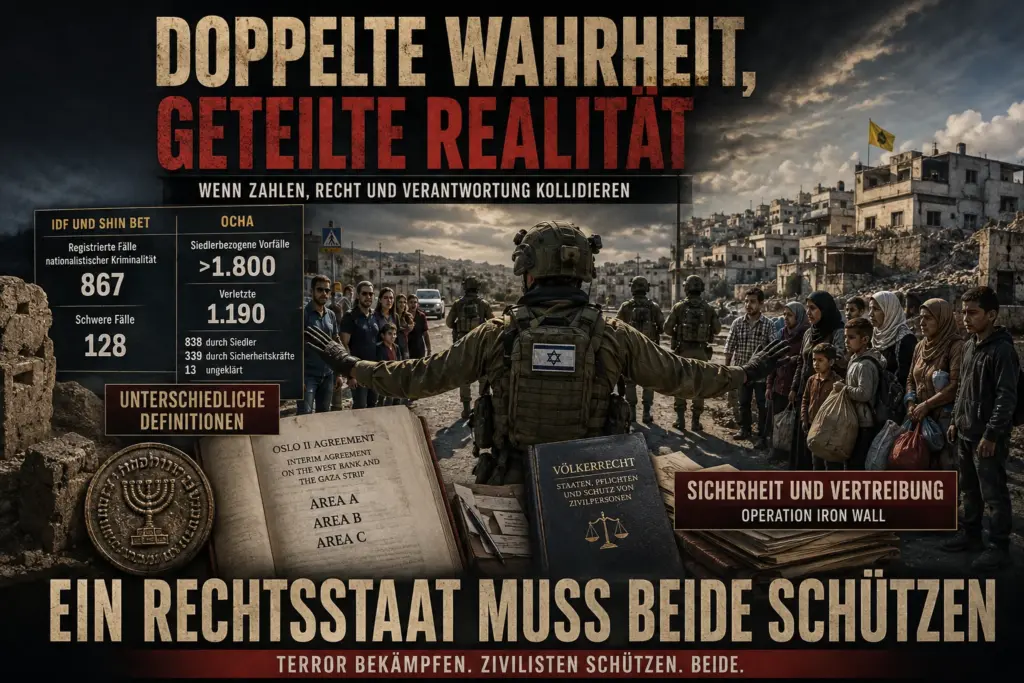
According to the IDF and Shin Bet, in 2025 867 cases of nationalist crime committed by Israeli extremists were recorded. In 2024, there were 682. The number of serious incidents, including the use of firearms, arson and other significant acts of violence, rose from 83 to 128 cases.
This is not a marginal problem that can be dismissed by pointing to hostile propaganda. Representatives of the IDF Central Command themselves stated that they had not curbed the trend effectively enough. In March 2026, the commander of the Central Command described the violence in a public letter as dangerous, serious and incompatible with Israeli law, Jewish values and the foundations of Zionism.
The perpetrators attack Palestinians, damage homes and vehicles, destroy agricultural land and put soldiers in a position where they must simultaneously combat terrorism and restrain Israeli perpetrators of violence.
This violence harms innocent people and damages Israel on several levels. It violates Israeli law. It contradicts Jewish values. It ties up security forces. It intensifies the conflict. And it provides material to all those who do not condemn individual perpetrators but instead seek to demonize Jews in Judea and Samaria—or Israel as a whole.
The perpetrators are nevertheless not “the settlers.” Hundreds of thousands of Jewish citizens live in Judea and Samaria. Most are families, workers, teachers, farmers, students and retirees. Holding them collectively responsible for the actions of a radical minority would be just as unserious as equating Palestinian civilians collectively with terrorist organizations.
Collective guilt is not analysis. It is the intellectual shortcut taken by people for whom reality has become too demanding.
Why Israeli and international figures do not measure the same thing
In addition to Israeli security data, the UN humanitarian affairs office OCHA regularly publishes figures on violence connected with Israeli settlers.
For 2025, OCHA documented more than 1,800 settler attacks, which resulted in injuries, property damage or both. The organization recorded 1,190 injured Palestinians. According to OCHA, 838 of them were injured by Israeli settlers, 339 by Israeli security forces and 13 by actors whose affiliation could not be clearly determined.
This statistic is important, but it measures something different from the Israeli category of “nationalist crime.”
OCHA records a broad range of incidents, including physical attacks, the use of firearms, property damage, arson, the destruction of agricultural land and incidents in which Israeli security forces intervene during a confrontation.
More than 1,800 documented incidents therefore do not mean 1,800 shootings or 1,800 serious bodily injuries. But they equally do not mean that the problem consists merely of a few toppled fences.
The figures show different aspects. The Israeli statistic primarily asks which offenses by Israeli extremists were recorded by security authorities as nationally motivated crime. OCHA asks in which settler-related incidents Palestinians were injured or property was damaged.
Both datasets may contain relevant information. They must not, however, be treated as though they had the same categories, the same sources and the same evidentiary standards.

The escalation continued in 2026
The development did not end with the change of year. According to the OCHA situation report of July 23, 2026 more than 1,330 settler-related incidents had already been recorded in around 250 Palestinian communities by July 20.
In this context, OCHA recorded approximately 880 injured Palestinians, including 720 injured by Israeli settlers and the remainder by Israeli security forces. In addition, 18 Palestinian fatalities in settler-related incidents were reported. OCHA attributed twelve of them to Israeli settlers, three to Israeli security forces and three to unidentified perpetrators.
Here too, the definition is decisive. OCHA counts injuries and deaths caused by soldiers when they occur during a settler attack or a related confrontation. Anyone who later cites only the total and presents it as exclusively direct settler violence changes the content of the statistic.
Nevertheless, the finding remains serious: The frequency, intensity and geographical spread of extremist violence have increased significantly.
On this issue, Israel must not content itself with the correct observation that international organizations sometimes use broad or politically shaped categories. Criticism of methodology is no substitute for law enforcement.
Judea and Samaria are not a space without history
The political debate often begins in 1967, as though this land had previously existed in a historical vacuum.
Judea and Samaria are central areas of Jewish history. Hebron, Shiloh, Bethel and numerous other places are deeply rooted in Jewish sources, memory and archaeology. This connection is not a modern invention of the settlement movement.
At the same time, historical ties do not automatically resolve every present-day legal question.
From 1948 to 1967, the territory was under Jordanian control. Jordan annexed it in 1950, but this annexation was recognized internationally only to a very limited extent. Under the agreements of the time, the 1949 armistice line was expressly not a final state border. After the 1967 war, the territory came under Israeli control.
Israel therefore did not take over, in 1967, the generally recognized sovereign territory of an existing Palestinian state. That does not automatically determine its present legal status, but it does refute the popular simplification that Israel simply invaded a recognized Palestinian state at the time and stole its land. Nevertheless, the prevailing international position regards the territory as occupied and Israel as the occupying power.
Under the Oslo II Accord of 1995 Israel and the Palestine Liberation Organization divided the territory for a transitional period into Areas A, B and C. In Areas A and B, substantial civil responsibilities were transferred to the Palestinian Authority. In Area C, Israel retained extensive security, administrative, planning and construction powers. Questions such as borders, Jerusalem and settlements were to be resolved in subsequent negotiations.
The Oslo Accords therefore did not finally decide the question of sovereignty. They created a transitional arrangement that has continued for decades, even though it was never intended as a permanent solution.
The legal situation is disputed, but not arbitrary
The international position is clear.
In 2016, the UN Security Council stated in Resolution 2334, that Israeli settlements in the territories controlled since 1967 had no legal validity and constituted a serious violation of international law.
The International Court of Justice went further in its advisory opinion of July 19, 2024 It deemed Israel’s continued presence, settlement policy and measures aimed at permanently integrating larger parts of the territory unlawful. At the same time, it called for an end to new settlement activity.
The opinion is not binding in the same way as a judgment in contentious proceedings between states, but carries considerable legal weight. Within the Court, there were dissenting and limiting views, including regarding the significance of the Oslo Accords, Israel’s security interests and whether the opinion adequately took the historical and political context into account.
Israel rejects the international majority position. The Israeli legal view points out that final sovereignty was never established by treaty, that the Palestinian Authority does not possess comprehensive territorial authority in Area C and that the Oslo Accords expressly left the settlement issue to final-status negotiations.
A serious assessment must therefore state both: Internationally, the settlements are predominantly regarded as contrary to international law. Israel rejects this assessment and invokes the unresolved final status, the Oslo framework, and historical and legal claims.
Anyone who claims that there is no legal controversy at all is being just as simplistic as someone who alleges that Israel conquered and colonized the clearly recognized sovereign territory of an existing Palestinian state.
ℹ️ The legal dispute does not suspend the protection of civilians
The disputed status of the settlements does not change the fact that Israeli residents are protected as civilians under the basic rules of international humanitarian law against direct attacks as long as they do not directly participate in hostilities. A place of residence does not become a legitimate target merely because its legal or political classification is disputed. The dispute under international law over the settlements can therefore never justify terrorism against their residents.

Operation “Iron Wall” and the security reality in the north

In January 2025, Israel began Operation “Iron Wall” in northern Samaria. The security forces acted particularly in Jenin and Tulkarm against armed cells, weapons depots, explosives workshops and prepared explosive devices.
Jenin lies in Area A and, under the Oslo framework, is therefore formally under Palestinian security responsibility. From Israel’s perspective, however, its duty to protect does not end where the Palestinian Authority fails to effectively disarm armed cells or prevent attack planning. That is not a license for limitless military operations, but it is an indispensable part of the security assessment.
In the first days alone, the IDF and Shin Bet reported the killing of armed terrorists, arrests, weapons discoveries and the destruction of numerous explosive devices. Within 48 hours, more than 150 explosive devices had reportedly been found or destroyed in Jenin and Tulkarm. The IDF also reported weapons workshops, weapons depots and explosive devices laid beneath roads.
According to the Israeli account, the operation contributed significantly to the decline in completed serious attacks in 2025. At the same time, the figures on prevented attacks and confiscated infrastructure show that the locations concerned were not merely civilian residential areas without armed structures.
But the humanitarian consequences are also undeniable. The Federal Foreign Office stated at the end of February 2025 that around 40,000 people had been forced to leave their accommodations in and around Jenin, Tulkarm and Tubas.
In April 2026, OCHA still reported 33,362 displaced people from Jenin, Tulkarm and Nur Shams. Satellite analyses had identified more than 1,500 destroyed or severely damaged buildings in the three camps.
The terror infrastructure was real. So were the prolonged displacement and destruction.
An honest analysis must explain the military necessity of Israeli operations without concealing the consequences for civilians. Conversely, humanitarian criticism must not be phrased as though the camps had contained no armed groups, explosives workshops or terrorist cells.
The PA payments and the political environment surrounding terrorism
The security situation also includes the question of what political and financial incentives Palestinian society creates.
For years, the Palestinian Authority provided financial payments to prisoners, released prisoners, and the families of those killed and injured. Critics called the system “Pay for Slay” because the amount of certain payments was linked to the length of imprisonment and thus often also to the severity of the offense. The PA rejected this designation and described the payments as social assistance.
In February 2025, PA President Mahmoud Abbas formally repealed the relevant legal provisions. In future, assistance was no longer to be granted according to prisoner status or length of imprisonment, but according to social need. The payments and records were transferred to a new social structure assigned to the president’s office. Reuters reported at the time that details of the new mechanism initially remained unclear.
This was a genuine formal reform. However, whether it fully ended the previous system remained disputed. In April 2026, the Times of Israel reported on a U.S. State Department report according to which certain payments or benefits had continued.
In July 2026, the PA published the summary of an audit by the consulting firm Alvarez & Marsal. According to it, the new social program is in fact needs-based; the auditors found no indications that eligibility or the amount still depended on prisoner or “martyr” status. However, the audit also identified a round of impermissible legacy payments from November 2025 and demanded further evidence that previous mechanisms had been permanently shut down. The United States and Israel additionally argued, that the review might not fully capture possible covert payments or benefits through other institutions.
What can therefore be established with confidence is this: The PA has formally abolished the old status-based system, and the audit supports the conclusion that the new program operates according to need. However, it has not been conclusively established whether all parallel benefits, legacy claims, and possible ways of circumventing the system have been ended.
The political core remains despite the reform: A system that linked benefits for years to imprisonment duration and prisoner status could materially and symbolically elevate serious offenses. Whether the new order permanently ends this logic must be measured against transparent audits and the actual channels through which payments are made. At the same time, a reform must be acknowledged where it has in fact been implemented. Facts do not lose their value merely because they contradict one’s own expectations.
The IDF stands between two obligations

In Judea and Samaria, the Israeli security forces have a dual task.
They must protect Israeli civilians from shootings, knife attacks, vehicle attacks, explosive devices, and incendiary devices.
At the same time, they must protect Palestinian civilians from Jewish extremists.
This is not an irritating additional task, but part of the state’s responsibility. A state governed by the rule of law may not apply its laws according to the population group to which the perpetrator belongs.
When Israeli extremists attack Palestinians, destroy property, or obstruct soldiers, the state must investigate, arrest, and prosecute. Not because international organizations demand it, but because Israel’s own law and its own moral standards demand it.
Israel’s strength is shown not only in dismantling terrorist cells. It is also shown by whether the state is prepared to prosecute violence from its own ranks without political favoritism.
Precisely a pro-Israel position must not weaken this demand. Those who protect Jewish extremists out of a misguided sense of solidarity are not defending Israel. They are harming it.
Why the violence must not simply be equated
There is violence from both sides in Judea and Samaria. But this sentence alone explains almost nothing.
Palestinian terrorism encompasses organized structures of Hamas, Islamic Jihad, and local armed cells. There are also lone perpetrators, shootings, explosive devices, knife attacks, ramming attacks, and everyday stone-throwing and incendiary attacks.
Jewish extremist violence comes from a comparatively small radical scene. It targets Palestinian people, homes, vehicles, livestock, and agricultural land. It can be fatal, displace people, and intimidate entire communities.
The reverse clarification is just as important: Jewish residents of Judea and Samaria remain civilians. The dispute over settlements, borders, and sovereignty neither takes away their right to life nor their protection from attacks. Anyone who attacks a bus, a family, or a residential community is not thereby fighting an abstract legal position, but attacking people.
Both are violence. Both are criminal. Both must be fought. But neither automatically has the same organizational structure, ideological entrenchment, or societal reach.
That is precisely the difference between contextualization and equating them.
A statistic of more than 1,800 broadly defined settler-related incidents cannot be directly weighed against 1,374 thwarted serious terrorist plots. The categories are too different.
Nor may the number of thwarted Palestinian attacks be used to dismiss every attack by Israeli extremists as insignificant.
Numbers require definitions. Violence requires those responsible. And political positions replace neither one nor the other.
What responsible reporting would have to do
Fair reporting would have to do three things at the same time.
It would have to clearly name settler violence without collectivizing all Jewish residents of Judea and Samaria.
It would have to portray Palestinian terrorism as a permanent security reality, not merely as an occasional “reaction” to Israeli policy.
And it would have to clearly explain that different statistics record different events.
That would be less convenient than the familiar story of the powerful Israeli perpetrator and the exclusively passive Palestinian victim. But journalism is not there to manage political convenience.
The reality is uncomfortable: Israeli civilians live under a real threat of terrorism. Palestinian civilians suffer from real extremist violence. Israel has the right and the duty to protect its citizens. At the same time, Israel has the duty to consistently prosecute perpetrators of violence from its own ranks.
Law instead of revenge
Settler violence is not a marginal note or merely a communications problem. It harms people, destroys property, undermines Israel’s credibility, and contradicts the claim of a Jewish and democratic state governed by the rule of law.
However, it does not arise in a peaceful vacuum. It takes place in a region where Israelis have lived for years with attacks, shootings, explosive devices, stone-throwing, and incendiary attacks. Naming this context does not excuse any crime. It merely prevents context from being confused with justification.
Those who see only settler violence do not show the whole situation.
Those who see only Palestinian terrorism are not helping Israel either.
Israel must combat terrorism, protect its citizens, and at the same time prove that its law also applies to its own radical minority. That is precisely the difference between a state governed by the rule of law and the terrorist organizations that attack it.
Facts instead of one-sidedness. Law instead of revenge. Security without moral self-abandonment.
This is not a comfortable position. It is the only one that does justice to reality.
✔️ In summary
Settler violence is real, unlawful, and politically and morally damaging to Israel. Palestinian terrorism is simultaneously a permanent and structural security threat. Serious reporting must name both without artificially equating different statistics and forms of violence.
ℹ️ Factual basis and primary sources for the article 📑
▶️ IDF investigation into the incident near Tell:
IDF probe finds settlers entered off-limits area ahead of deadly clash
Preliminary reconstruction of the incursion into Areas A and B, the confrontation, and the still-unclarified circumstances of the deaths.
▶️ Reuters on developments in Tell through July 31, 2026:
Israeli military cracks down on village as settlers march
Report on raids and arrests, blocked access roads, the settlers’ march, and observed looting and cemetery damage.
▶️ Israeli army on Benayahu Mellet:
רס“ר במיל‘ בניהו מלט ז“ל
Official information on name, age, role, and date of death.
▶️ Israeli army on Yuval Ezra:
רס“ן יובל עזרא ז“ל
Official information on name, age, role, and date of death.
▶️ Shin Bet annual report for 2025:
1,374 thwarted attacks and figures on terrorism victims
Report on data published by the Shin Bet concerning thwarted attack plans, deaths, and injuries.
▶️ IDF Central Command on the security situation in 2025:
Central Command annual overview
Information on the decline in carried-out terrorist attacks and the rise in nationalist crime.
▶️ Moata analysis of “resistance” from 2018 to 2026:
Editorial infographic based on Moata figures
Editorial compilation citing Moata. The underlying original publication is not directly linked; the figures have not been fully independently verified, and the visible individual values differ by six cases from the stated total.
▶️ IDF and Shin Bet on extremist settler violence:
Settler violence rose by 27 percent in 2025
Detailed figures on 867 registered cases and 128 serious incidents.
▶️ Letter from the IDF Central Command commander:
Commander of Central Command’s Letter
Official condemnation of extremist violence against Palestinian civilians.
▶️ OCHA annual report for 2025:
Humanitarian Situation Update 352
Data on more than 1,800 settler-related incidents and 1,190 injured Palestinians.
▶️ OCHA situation report of July 23, 2026:
Humanitarian Situation Report, 23 July 2026
Current figures on settler-related incidents, injuries, and deaths in 2026.
▶️ Oslo II Accords:
Israeli-Palestinian Interim Agreement on the West Bank and the Gaza Strip
Original document on the interim arrangements and the division into Areas A, B, and C.
▶️ UN Security Council:
Resolution 2334 from 2016
International legal position on Israeli settlements in the territories controlled since 1967.
▶️ International Court of Justice:
Summary of the Advisory Opinion of 19 July 2024
Summary of the non-binding advisory opinion on Israel’s presence, settlement policy, and annexation measures.
▶️ IDF on Operation Iron Wall:
More than 150 explosives dismantled in Jenin and Tulkarm
Official information on explosive devices, weapons finds, and terrorist infrastructure.
▶️ Federal Foreign Office on Operation Iron Wall:
Federal Foreign Office on the Israeli military operation Iron Wall
Assessment of the humanitarian consequences and the approximately 40,000 people displaced in February 2025.
▶️ OCHA on ongoing displacement:
Humanitarian Situation Report, 17 April 2026
Information on 33,362 people still displaced and more than 1,500 destroyed or severely damaged buildings.
▶️ Reuters on the reform of PA payments:
Abbas revokes prisoner payment system
Report on the formal abolition of the old payment system in February 2025.
▶️ Times of Israel on implementation of the reform:
US says PA continuing to pay security prisoners
Presentation of the U.S. allegations and the open questions regarding practical implementation.
▶️ Arrests following the revenge attacks:
Police arrest two over suspected extremist violence
Information on the investigations into Israeli suspects following arson attacks and acts of vandalism.
▶️ Arrests following the deadly confrontation near Tell:
IDF apprehends two Palestinian suspects
Information on Palestinian suspects who were arrested following the confrontation and handed over to the Shin Bet.
▶️ IDF Central Command 2025 annual figures:
Central Command – 2025 Numbers
Official figures on arrests, weapons seized and terrorist funds confiscated.
▶️ Shin Bet on the Hamas cell directed from Turkey:
Cell from Nablus guided and financed by Hamas leadership in Turkey
Official information on the cross-border direction and financing of planned shooting and explosive attacks.
▶️ IDF on Iran-backed smuggling routes:
Iranian-operated cells and weapons route into Judea and Samaria
Official account of a smuggling route supported by Iran’s Quds Force.
▶️ Historical context of the Jordanian annexation:
Understanding the Settlements Debate
Expert contribution on the limited international recognition of the Jordanian annexation and the unresolved border question.
▶️ Historical status of the armistice line:
British government statement of April 27, 1950
Contemporary confirmation that the 1949 armistice line did not constitute a final state border.
▶️ ICRC on the protection of civilians:
Direct participation in hostilities: Questions and answers
The principle that civilians remain protected from direct attack as long as they are not directly participating in hostilities.
▶️ Audit of the reformed PA social welfare system:
PA releases summary of external audit
Summary of the audit findings, including legacy payments from November 2025 and evidence that is still missing.
▶️ US and Israeli objections to the scope of the audit:
US questions whether the audit covered bypass channels
Context on the concern that parallel payments or benefits through other institutions were not fully captured.
🔎 Found an error, criticism or addition?
SCHLAGSEITE.eu stands for careful research and transparent corrections. Have you discovered a factual error, unclear wording or a broken link? Then send me your information. If possible, please provide a verifiable source.