
00:00 / –:–
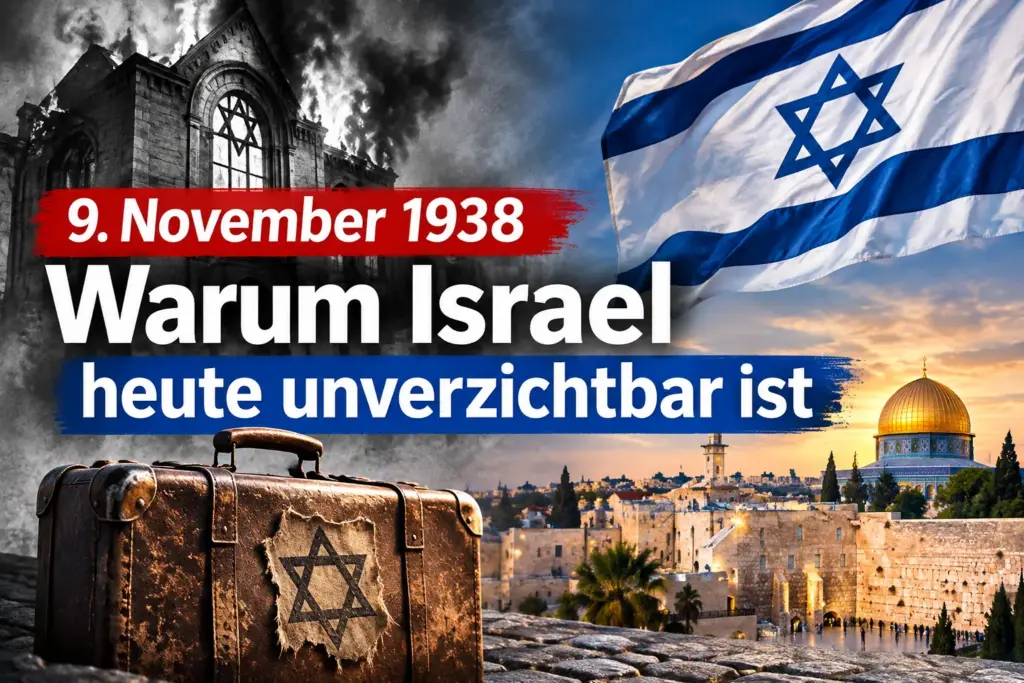
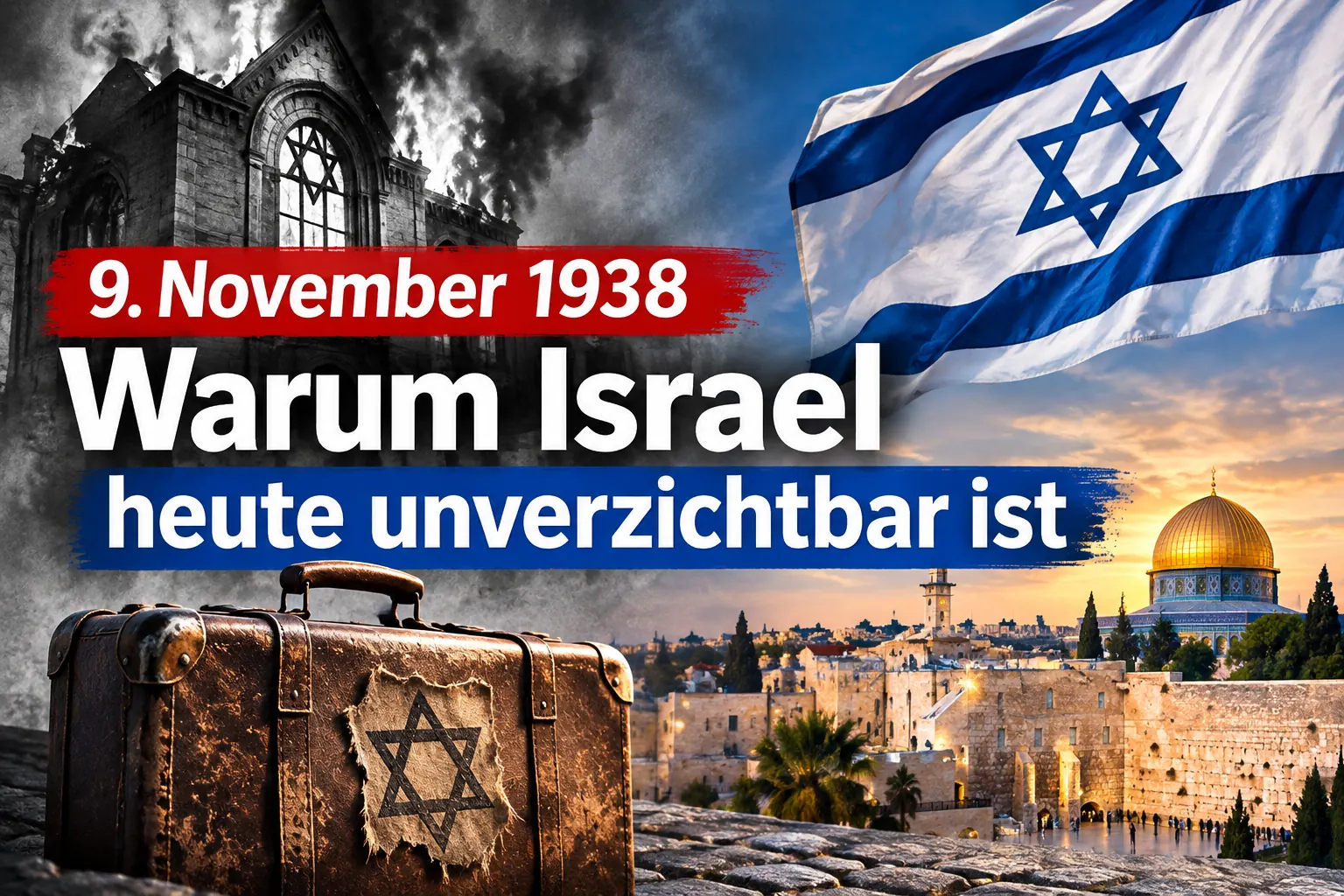
When synagogues burned in Germany on November 9, 1938, Jewish businesses were destroyed, and people were persecuted solely because of their Jewish origin, there was no Jewish state that could offer protection to those being persecuted. Anyone who wanted to leave Germany had to find a country willing to take them in. Many states were not willing to do so. Ten years later, Israel was founded, and this very historical experience explains why the existence of the Jewish state is significant for Jews worldwide in a way that extends far beyond politics and changing governments.
On November 9, 2026, we remember the Nazi November pogroms of 88 years ago. Germany will once again commemorate the victims, politicians will give speeches and emphasize that history must never repeat itself. This is right and necessary, but in view of today’s antisemitism, it is not enough to remember the past once a year.
We must also examine why Jews had so few opportunities to escape persecution at the time, and why Jewish self-determination remains so central to this day.
November 9, 1938, and the End of All Security
The November pogroms were not spontaneous riots by an enraged population, but an act of violence against Jewish people and institutions organized by the Nazi leadership.
According to the United States Holocaust Memorial Museum more than 1,400 synagogues were set on fire, thousands of Jewish businesses were damaged and homes were ransacked. Jews were abused and murdered. Around 30,000 Jewish men were arrested, approximately 26,000 of whom were taken to concentration camps.
The police did not protect the victims; they were themselves part of the state persecution apparatus. In many places, firefighters were permitted to prevent the flames from spreading to neighboring buildings, while Jewish houses of worship were destroyed.
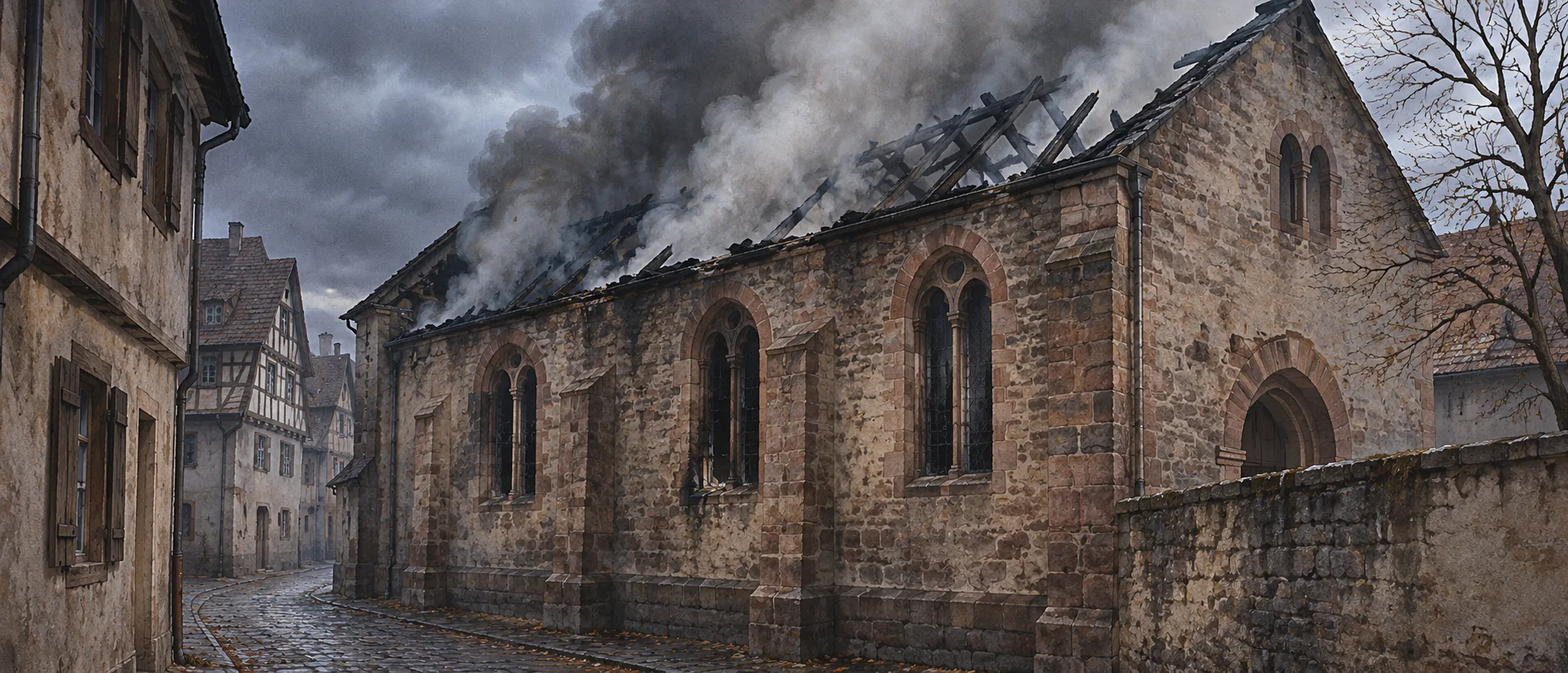
Worms, one of Germany’s most historically significant Jewish communities, was also affected: the medieval synagogue was burned down on the night of November 9–10, 1938. The remaining walls were subsequently destroyed. Reconstruction began in 1956/57, and the synagogue was reopened in December 1961, as documented by the City of Worms
Passende X-Beiträge
Aus dem SCHLAGSEITE X-ArchivFor the Jewish population, it was now impossible to overlook that the German state no longer guaranteed their safety, but itself posed the greatest danger to them.
Many Jews had regarded themselves as an unquestionable part of German society. They were Germans, had fought for Germany in the First World War, worked as doctors, craftsmen or merchants, and had belonged to social life for generations.
But this played no role for the National Socialists. Whether religious or secular, wealthy or poor, socially respected or unknown, the only decisive factor was Jewish ancestry.
The world knew about the persecution, but was scarcely willing to take in refugees
Months before the November pogroms, it had already become clear how difficult it was for Jewish refugees to find protection outside Germany.
From July 6 to 15, 1938, representatives of 32 countries met in Évian, France, to discuss admitting the people fleeing Germany and Austria.
The international conference had been initiated by U.S. President Franklin D. Roosevelt. The participants expressed their sympathy for those being persecuted, but for the most part were not prepared to relax their immigration regulations.
The United States Holocaust Memorial Museumdocuments that, with the exception of the Dominican Republic, no participating state pledged additional refugee quotas.
The National Socialists were able to derive a message from this that suited them: Other countries criticized the persecution of Jews, but were themselves largely unwilling to take in Jewish refugees.
Of course, there were people and organizations that stood up for those persecuted, organized escape routes, and saved lives. Many Jews did in fact reach safety. But the possibilities were limited, and for countless families, the search for a country willing to take them in became a race against time.

The British policy in the Mandate territory of Palestine at the time weighs particularly heavily in this regard.
Jewish communities, cities and political institutions already existed there. Jewish immigrants had built up an economic and social infrastructure over the course of decades, but admission was decided by the British Mandate administration.
In May 1939, when the persecution of European Jews had long since become obvious, the British government published its White Paper on policy in Palestine. It limited Jewish immigration over the following five years to a total of approximately 75,000 people. Further immigration was then to be made dependent in principle on the consent of the Arab population.
These restrictions are described, among other places, in the historical account of the Israeli Ministry of Foreign Affairs on the Law of Return and documented in the records of the United States Holocaust Memorial Museum.
Ironically, at a time when European Jews urgently needed refuge, this escape route was further restricted for them as well.
No one today can reliably calculate how many people could have been saved through a different refugee policy. Nevertheless, the historical responsibility of the states that kept their borders largely closed is unequivocal.
Israel did not come into being only as a result of the Shoah
To this day, one encounters the notion that Israel was founded as a consequence of the Shoah, as it were as international reparations for the murder of six million Jews.
Historically, this account falls far short.
The Jewish connection to the Land of Israel goes back thousands of years. Jerusalem had long been the religious and cultural center of the Jewish people before the emergence of modern Zionism. Even after expulsions and centuries of diaspora, Jews continued to live in their historic homeland.
The modern Zionist movement emerged as early as the 19th century. In 1897, Theodor Herzl organized the First Zionist Congress in Basel, where the creation of a legally secured Jewish homeland was declared the political objective.
Herzl had recognized that the social equality of Jewish citizens offered no lasting protection against antisemitism. Even in European states that regarded themselves as modern and enlightened, Jews could once again become the enemy.
The Nazi persecution confirmed in a cruel way how justified this concern had been.
On May 14, 1948, David Ben-Gurion declared Israel’s independence. This was preceded by decades of Jewish nation-building, the development of its own institutions, and the UN partition resolution of November 29, 1947.
The Israeli Declaration of Independence explicitly affirmed the Jewish people’s right to national self-determination and declared Israel a state that was to be open to Jewish immigration.
Israel was therefore not a gift that the world presented to the Jews out of a guilty conscience. The establishment of the state was the result of a long national movement, historical ties and political self-assertion.
For the survivors of the Shoah, a possibility now emerged that had been denied to them during the Nazi persecution.
They could immigrate to a Jewish state that decided for itself on its admission policies.
According to the United States Holocaust Memorial Museum approximately 140,000 survivors of the Shoah came to Israel in the first years after the establishment of the state.
People from whom Europe had taken their families, their property and, in many cases, every means of making a living were able to begin a new life there.

Why Israel means more to Jews than a government
Anyone who wants to understand why many Jews also feel a deep connection to the Jewish state outside Israel should distinguish between a state and the government currently in office.
Governments are elected, can be voted out of office, and make decisions that one may argue about. This happens regularly in Israel as well, often with a political passion scarcely known in Germany in this form.
Israel’s fundamental significance, however, does not depend on whether someone supports Benjamin Netanyahu or prefers another prime minister.
Israel is the state in which the Jewish people have realized their national self-determination. It has its own institutions, an army, democratically legitimized political leadership, and the ability to decide for itself on its security interests.
This claim is particularly evident in the Israeli Law of Return of 1950It generally grants Jews the right to immigrate to Israel. Subsequent regulations also extended corresponding rights to certain family members.
This represents a fundamental change compared with the situation in 1938.
At that time, Jewish refugees depended on the willingness of foreign states to accept them. Today, there is a Jewish state that regards the admission of Jewish immigrants as part of its own governmental responsibility.
This does not constitute an absolute security guarantee. Israel itself is exposed to threats, as the history of its wars and terrorist attacks demonstrates.
What is decisive, however, is that Jews there are not solely dependent on whether other governments are willing to protect or accept them.
Israel therefore has a significance that cannot be reduced either to religion or to party politics. It is an expression of Jewish self-determination and a concrete response to the historical experience of persecution and vulnerability.
October 7 once again demonstrated the importance of Jewish security
On October 7, 2023, Hamas and other Palestinian terrorist organizations carried out a coordinated attack on Israel. Civilians were deliberately murdered, people were abducted, and entire communities were attacked.
The culpability of Hamas and the groups involved is extensively documented, including by the United Nations Commission of Inquiry.
The terror struck a sovereign Jewish state that, despite its security measures, was unable to prevent thousands of attackers from crossing the border. Israel’s security authorities and political leadership must be held accountable for this failure.
For Jews outside Israel, October 7 had another consequence.
In numerous countries, the number of antisemitic incidents rose significantly. Jews were held responsible for Israeli military actions, threatened and attacked, even though they were neither involved in these decisions nor bore any personal responsibility for them.
This can also be demonstrated in Germany using specific figures.
The Federal Association of Departments for Research and Information on Antisemitism, RIAS for short, documented a total of 8,725 antisemitic incidents for 2025. That was almost as many as in 2024 and more than three times as many as in 2022.
Israel-related antisemitism was identified in 68 percent of the recorded incidents.
The report published on June 17, 2026 RIAS annual report also documents 178 attacks and 257 threats.
Behind these figures are people who are harassed in everyday life because they are Jewish or perceived as Jewish.
What does a Jewish pupil in Germany have to do with a decision by the Israeli government? Why should a rabbi in a German supermarket be held responsible for a war? And why should a Jewish community have to fear for its safety when military confrontations take place in the Middle East?
These questions are by no means theoretical. The cases documented by RIAS show how quickly alleged criticism of Israel can turn into overt anti-Jewish hostility.
Anyone who collectively holds Jewish people responsible for the actions of a state is not criticizing a government. They are resorting to an antisemitic pattern of thought.
A culture of remembrance must be measured by how it treats living Jews
Germany commemorates the crimes of National Socialism with memorials, Stolpersteine and official events. This is important because the Shoah and the long history of antisemitism must have a firm place in historical consciousness.
But how credible is this commemoration when Jewish people today are once again afraid to show their identity publicly?
When Jewish schools and synagogues require special police protection, when people are harassed because they are wearing a kippah, or when the destruction of Israel is called for at demonstrations, annual expressions of outrage on 9 November are not enough.
Historical comparison requires precision. Germany in 2026 is not Nazi Germany in 1938. That is precisely why it is important to recognize antisemitic developments at an early stage today and counter them decisively.
Combating antisemitism begins with the people who live in Germany today. They are entitled to practise their religion, preserve their cultural identity and publicly affirm their connection to Israel without being threatened for doing so.
Germany’s historical responsibility also includes taking Israel’s existence and security seriously.
The Jewish state is neither a political whim of the 20th century nor a temporary solution whose legitimacy others can decide at will.
It is the result of a long struggle for self-determination that had already begun before the National Socialists came to power.
What November 9 should tell us today
In 1938, Jewish families could not rely on a door being opened to them somewhere in the world. Anyone who wanted to flee needed visas, money, contacts and, above all, a state willing to take them in.
The founding of Israel fundamentally changed this historical starting point.
Today, the Jewish people can shape their national future in their own state and do not have to make their right to statehood dependent on the approval of others.
That is also why I do not measure Israel’s significance solely by the decisions of its government. Specific political measures can and must be discussed. For me, the Jewish state’s right to exist is not up for debate.
Anyone who commemorates the persecuted and murdered Jews on November 9 should also draw from this an obligation toward Jews living today. This includes resolutely confronting antisemitism, protecting Jewish life in Germany, and recognizing why a sovereign Jewish state is indispensable for the security and self-determination of the Jewish people.
Am Yisrael Chai. The Jewish people lives.
ℹ️ Fact base and primary sources for the article 📑
▶️ United States Holocaust Memorial Museum:
Kristallnacht
Documentation of the November pogroms of 1938, their organization and their consequences.
▶️ United States Holocaust Memorial Museum:
The Evian Conference
Historical overview of the international refugee conference in July 1938.
▶️ Israeli Ministry of Foreign Affairs:
The Law of Return, 1950
Historical account of Jewish immigration, the British White Paper of 1939 and Israel’s Law of Return.
▶️ Knesset:
Declaration of Independence
Israeli Declaration of Independence of May 14, 1948.
▶️ United States Holocaust Memorial Museum:
Refugees
Information on the flight of Jewish survivors and their immigration to Israel.
▶️ United Nations:
Report of the Independent International Commission of Inquiry on the attacks of October 7, 2023
Documentation of the attacks on Israeli civilians and the involvement of Palestinian armed groups.
▶️ Federal Association of Departments for Research and Information on Antisemitism (RIAS):
Antisemitic Incidents in Germany in 2025
Nationwide figures on antisemitic incidents, attacks, threats, and Israel-related antisemitism.
▶️ WELT, Raquel Erdtmann:
The Lifesaving Island That Did Not Exist in 1938
Opinion piece dated November 9, 2026, serving as the editorial starting point.
🔎 Spotted an error, have criticism or an addition?
SCHLAGSEITE.eu stands for careful research and transparent corrections. Have you discovered a factual error, unclear wording, or a broken link? Then send me your note. If possible, please provide a verifiable source.