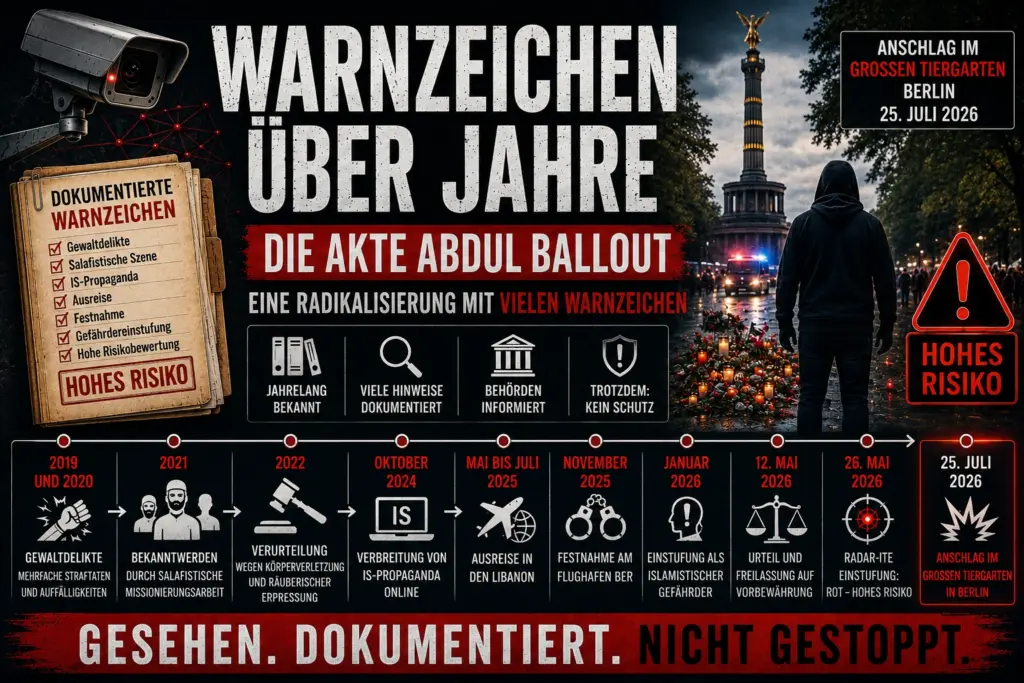

Abdul Ballout was not an unknown radical who suddenly appeared out of nowhere. Police, the domestic intelligence service, the judiciary and counterterrorism authorities had known about his history of violence, his Salafist radicalization, his IS propaganda, his plans to travel abroad and his willingness to join the terrorist organization. The analytical tool RADAR-iTE classified him as a high-risk person . Nevertheless, he was free on the evening of July 25, 2026.
Shortly afterward, the 21-year-old is alleged to have attacked people in a targeted manner with a vehicle on the edge of Christopher Street Day in the Großer Tiergarten. Further people are then alleged to have been injured with stabbing weapons. One woman died, and 31 people were injured. Investigators later found a suspected claim-of-responsibility video on Ballout’s mobile phone, featuring an oath of allegiance to the so-called “Islamic State”. According to the Federal Prosecutor General’s Office, the masked person is highly likely to be Ballout.
The case is therefore more than the story of a single perpetrator. It shows how a state governed by the rule of law can observe, assess and manage a threat for years without stopping it at the crucial moment. The warning signs were not missing. What was missing was a response commensurate with the sum of those warning signs.
An Attack That Began Years Earlier
According to the joint statement by the Berlin police and the Berlin Public Prosecutor General’s Office , on July 25, 2026, at around 10 p.m. in the Großer Tiergarten , several people were struck by a vehicle. Further people are alleged to have been injured with stabbing weapons afterward.
Ballout initially managed to flee. The following day, investigators located him in a garden colony in Berlin-Spandau. According to the information available so far, he attacked the special forces deployed there with a stabbing weapon. The officers fired, and Ballout died at the scene.
The act itself lasted only a few minutes. Its backstory, however, extended over years.
An in-depth reconstruction by WELT as well as reporting by NDR, WDR and Süddeutsche Zeitung depicts not a spontaneous radicalization, but a gradual escalation . A youth who had already attracted attention for violence became a Salafist activist, IS propagandist, would-be traveler to join the group and, ultimately, an Islamist whom the authorities assessed as highly dangerous.

From Violent Youth Offender to Islamist
Ballout had already attracted attention for violence as a teenager. According to court documents reviewed by WELT, he beat and kicked a fellow student in 2019, when he was 14 . A year later, he is alleged to have cornered a teenager together with an accomplice and forced him to hand over his headphones under threat of violence.
The Tiergarten Local Court convicted him in 2022 of intentional bodily harm and robbery-related extortion. It imposed juvenile-law educational measures: a subject-specific short course and 40 hours of community service.
The sentence was not unusual for the offenses at the time. Juvenile criminal law is intended not only to punish young offenders, but also to educate and stabilize them. In Ballout’s case, however, this approach had no lasting effect.
According to reporting by NDR, WDR and Süddeutsche Zeitung, his Islamist radicalization is alleged to have begun around 2020 . The Berlin Office for the Protection of the Constitution became aware of him in 2021, when he is alleged to have participated in Islamist missionary work in pedestrian zones. The authorities assigned him to the Salafist youth group “Siraatul Haqq” , which is alleged to have emerged around a Berlin mosque.
In 2024 , according to the court’s later findings, Ballout disseminated propaganda material from the “Islamic State” via a publicly accessible Instagram profile. He was therefore no longer merely a religiously radicalized youth. He was part of an extremist milieu and disseminated the messages of a terrorist organization.
The Myth of the Isolated Lone Perpetrator
Following terrorist attacks, people often speak of a “lone perpetrator” . The term initially describes only the fact that one person may have carried out the specific act alone. It says nothing about where that person’s ideology, motivation and justification came from.
The former interrogation chief of Israel’s domestic intelligence service Shin Bet, Michael Koubi, warns in WELT’s analysis against viewing such perpetrators as completely isolated “lone wolves.” Even without directly involved accomplices, they frequently move in an environment of preachers, acquaintances, online groups, propaganda channels and ideological role models.
A perpetrator can strike alone without having radicalized alone.
In Ballout’s case, such connections were present according to the information available so far. He is alleged to have participated in Salafist missionary activity , disseminated IS content, influenced other prisoners religiously while in custody and attempted to join IS. This does not point to a sudden spontaneous act, but to an entrenched ideological development.

ℹ️ Lone perpetrator does not mean isolated perpetrator
A person can carry out an attack without directly involved accomplices and still have been shaped by extremist networks, preachers, personal contacts or digital propaganda. The operational execution of the act and the ideological radicalization must therefore be examined separately.
The Attempt to Travel to IS Did Not Fail Because of Germany
In May 2025 , German authorities initially attempted to prevent Ballout from traveling abroad. Shortly afterward, he nevertheless managed to travel via Turkey to Lebanon. According to the findings of the subsequent investigators, he intended to travel from there to Syria, join IS, receive military training and take part in combat operations.
German security authorities informed the Lebanese authorities. On July 24, 2025 , Ballout was arrested in Lebanon. A military court there sentenced him to three months in prison for incitement to religious and sectarian conflicts.
After his release, he returned to Germany on November 17, 2025 . The Berlin State Criminal Police Office arrested him upon his arrival at BER Airport. The Public Prosecutor General’s Office investigated him for preparing a serious act of violence endangering the state . Ballout was placed in pretrial detention.
On January 12, 2026 , the State Criminal Police Office officially classified him as an Islamist threat . A threat classification is not a criminal conviction. It does, however, mean that the police believe a person is capable of committing a serious politically motivated offense.
The Court Saw the Danger and Released Him Anyway
On May 12, 2026 , the juvenile lay judges’ court of the Tiergarten Local Court sentenced Ballout to one year and ten months in juvenile detention . The court found that he wanted to join IS and knew that the organization spreads terror, murders people and declares those who think differently to be “deserving of death.”
The written reasons for the judgment, reviewed by Legal Tribune Online , contradict the idea that the court simply overlooked Ballout’s dangerousness. The judges expressly stated that it could not be expected that Ballout would refrain from committing further offenses in the future . A direct suspension of the sentence on probation was therefore initially out of the question.
And yet he was released.
The court used the possibility of so-called probation before a final decision under Section 61 of the Youth Courts Act . Under this provision, the decision on whether a juvenile sentence will ultimately be suspended on probation or enforced is deferred for a limited period. The convicted person is meant to demonstrate under strict conditions whether serving the sentence is still necessary.
From the court’s perspective, Ballout’s having already spent more than nine months in Lebanese custody and German pretrial detention spoke in his favor. His plan to enter Syria was assessed as unprofessional and not yet immediately ready for execution. He also claimed in court to have distanced himself from IS.
However, considerable doubts stood against this account. The court itself pointed out that Ballout had continued to show interest in IS media after his detention in Lebanon. According to WELT’s reporting, he also deliberately sought contact with fellow prisoners in pretrial detention, acted as a prayer leader and attempted to exert religious influence.
The legal problem was therefore not that no one recognized the danger. It was that, despite the recognized danger, juvenile criminal law once again relied on development, conditions and educational intervention.
The prosecution had requested a considerably longer juvenile sentence without probation and appealed the judgment. According to WELT, however, no separate application was made to extend pretrial detention. This is one of the questions that must be examined more closely in the political and legal review.
⚠️ The Court Did Not Consider Ballout Harmless
The reasons for the judgment expressly document doubts about his future law-abiding conduct. His release was not based on a positive assessment of the threat, but on the special structure of probation before a final decision in juvenile criminal law and the periods of detention already served.
RADAR-iTE Showed Red

Even before Ballout’s release, the Joint Counter-Terrorism Centre dealt with his case. According to reporting by NDR, WDR and Süddeutsche Zeitung , the specialists involved concluded that there was a substantial risk of renewed travel abroad or an attack .
On May 26, 2026 , his case was discussed again by the Counter-Terrorism Centre’s Risk Management Working Group. The system developed by the Federal Criminal Police Office, RADAR-iTE , was used there.
The acronym stands for “Rule-Based Analysis of Potentially Destructive Offenders for Assessing Acute Risk in Islamist Terrorism.” Among other factors, the system assesses a history of violence, criminal development, ideological entrenchment, social ties, affinity for weapons and other risk factors.
RADAR-iTE Does Not Establish Guilt and does not automatically determine which police measure must follow. The tool serves to set priorities. Authorities are meant to identify which known threats require particularly intensive attention.
In Ballout’s case, according to consistent media reporting, the result was: Category Red, high risk.
A response from the German federal government concerning RADAR-iTE’s methodology explains that, in such a high-risk classification, an individual case analysis and consideration by the Risk Management Working Group are generally предусмотр. The specific intervention then depends on the legal possibilities in the individual case.
This is precisely where the blind spot becomes apparent: A system can correctly identify a danger without this leading to a measure that actually limits it.
Surveillance Without Intervention

After his release, the Berlin State Criminal Police Office initially monitored Ballout closely. His phone and online communications were monitored, law enforcement officers surveilled him, and a camera was installed outside his home.
However, the public description that Ballout had been under “active surveillance” right up until the attack is misleading. According to research by NDR, WDR and the “Süddeutsche Zeitung,” the resource-intensive surveillance was scaled back after around ten days and later discontinued. Ballout had behaved inconspicuously in public and had provided no discernible indications of an imminent operation.
The technical measures continued. His telephone, internet activities and the entrance to his home continued to be monitored. However, the camera footage was not continuously monitored live; instead, it was evaluated every 24 hours.
At the beginning of July, Ballout attracted attention because of an object at his waistband that looked like a firearm. The police searched his apartment. The object turned out to be a toy.
On the evening of July 25, 2026, at 8:58 p.m. the camera recorded Ballout leaving his home. Around an hour later, the attack took place.
The camera had documented that he was leaving the house. However, it did not trigger an immediate alarm. This is less paradoxical than it may initially sound: A person is allowed to leave their home, even if they have been classified as a threat. Without concrete indications of an impending act, this alone does not create a legal basis for intervention.
Nevertheless, the bitter conclusion remains: The state saw Ballout leave, but it did not know where he was going.
Deradicalization without robust deradicalization
In parallel with police surveillance, Ballout was supposed to participate in a deradicalization program run by the publicly funded Violence Prevention Network organization. Two preliminary interviews took place in June and July.
The published descriptions appear different, but paint the same troubling picture. Ballout was described to “Spiegel” as friendly, compliant and uninformative . WELT reports that an adviser assessed him as elusive and inscrutable. Ballout reportedly gave no clear answer to key questions about his ideology.
The counseling center apparently did not identify any concrete indications of an imminent violent act. A decision on his final admission to the program was to be made after a third interview. That interview never took place.
This must not lead to a blanket judgment against deradicalization work. Counseling programs can reach people willing to leave extremist circles, support families and interrupt radicalization processes. But they can work only if a person cooperates at least to some extent.
Anyone who presents themselves as compliant, avoids any ideological clarification and conceals their intentions cannot be assessed reliably through social-educational discussions alone.
A counseling center is not an intelligence service. It cannot search an apartment, secretly evaluate communications or detain people. Conversely, a security architecture must not silently shift responsibility for a high-risk threat onto an educational program.
1,250 Salafists and a growing digital scene
The Ballout case must not be generalized to all Salafists. Not every Salafist is oriented toward violence, and not every Islamist inclined toward violence is planning a terrorist attack. A clear conceptual distinction is necessary.
However, it would be equally wrong to treat Ballout as a completely isolated exception. His radicalization took place in a real and growing Islamist environment.
The 2025 Berlin Office for the Protection of the Constitution report puts the Islamist potential in the capital at 2,590 people. The previous year, the figure was 2,440. The entire increase is attributed to the Salafist sector.
According to information from Berlin’s Interior Committee, the Salafist scene now numbers 1,250 people. In 2024, the figure was still 1,100. Around 350 are considered violence-oriented.
The numerical increase is only part of the problem. The Office for the Protection of the Constitution describes professionalized online activities by international terrorist organizations and Salafist preachers. Their content reaches young people through social media, video platforms, messaging services and personal digital networks.
The modern Salafist preacher no longer needs a street stall. He sits in the smartphone as a video, voice message or private chat contact. There, he provides simple answers, clear enemy images and a closed worldview. Personal disorientation becomes religious superiority, alienation becomes hatred, and hatred can become a willingness to use violence.
ℹ️ 1,250 Salafists are not 1,250 terrorists
The figure describes an ideological pool of people. Around 350 members of Berlin’s scene are considered violence-oriented. Classification as a threat is a separate police category altogether. However, the necessary distinction must not serve to downplay Salafism’s anti-democratic ideology.
The parallel with Anis Amri
The Ballout case inevitably recalls Anis Amri, the attacker at Berlin’s Breitscheidplatz. Amri was also known to the authorities, moved in Salafist circles, was classified as a threat and was surveilled for a time. Nevertheless, in December 2016 he carried out the attack on the Christmas market.
The two cases are not identical. Amri was a foreign national with a complex asylum and residency history. Ballout was born in Germany, held German citizenship and had already been convicted of preparing a serious act of violence endangering the state.
The structural parallel lies elsewhere:
- Both perpetrators had been known as Islamists for an extended period.
- Both moved in a Salafist environment.
- Both were classified as threats.
- Both were the subject of consultations between different authorities.
- In both cases, immediately before the act, the concrete indication that would have enabled intervention was missing.
- In both cases, extensive knowledge held by the authorities ended without adequate protection for the victims who were later harmed.
After the attack at Breitscheidplatz, improved intelligence, better coordination and new instruments were promised. RADAR-iTE was one response to the mistakes made at the time. In the Ballout case, this system recognized the high risk. This time, the classification did not fail. This time, the failure lay in translating the classification into effective threat prevention.

Germany lacks more than just personnel
The reflexive response to cases like these is often: more personnel, more cameras, more surveillance. That may be necessary, but it is not enough.
Hans-Jakob Schindler, director of the international Counter Extremism Project, points in his WELT analysis to the comparatively narrow legal limits placed on German security authorities. This concerns, among other things, encrypted communications, financial investigations, digital surveillance and modern analysis systems.
According to the WELT analysis, Germany repeatedly relies on information from foreign partners to thwart Islamist attacks, including security services from Israel and the United States. This cooperation is valuable. However, it must not replace the ability of German authorities to penetrate extremist networks in their own country themselves.
Former Shin Bet employee Michael Koubi places particular emphasis on human sources in Islamist milieus. Technical surveillance reveals communications, movements and contacts. But it does not automatically explain what is discussed within a closed circle, whom a perpetrator trusts or when radical conviction turns into a concrete intention to act.
More data does not automatically mean more insight. What matters is whether authorities can connect information, uncover clandestine structures and clearly assign responsibility.
What must change
The Ballout case does not justify abolishing rule-of-law safeguards. People must not be imprisoned indefinitely solely because of radical views. Police threat classifications replace neither evidence nor judicial decisions.
However, the rule of law does not mean merely documenting obvious risks. The case raises several specific questions:
- Who bears binding responsibility for a red RADAR-iTE classification?
- After the release of someone convicted of preparing a terrorist attack, must a new judicial risk assessment automatically take place?
- What consequences follow if a threat blocks every attempt at ideological clarification in a deradicalization program?
- What minimum measures must be reviewed and justified in writing after a high-risk classification?
- How can the police, the Office for the Protection of the Constitution, the justice system, probation services and counseling centers combine information lawfully and more quickly?
- Do the state security divisions have sufficient personnel for long-term surveillance?
- What additional legal powers do investigators need for the covert investigation of digital and personal Islamist networks?
An electronic ankle monitor alone would not necessarily have prevented the attack. It shows a person’s location, but does not recognize thoughts and cannot stop a vehicle. Nor is a camera a police officer who intervenes at the right moment.
What is therefore needed is not a single symbolic measure, but a security architecture in which high risk also means high priority. Anyone classified as a threat, convicted of preparing a terrorist attack and placed in the highest risk category by a nationwide analysis system must not disappear between competing jurisdictions, a lack of resources and pedagogical optimism.
The authorities knew almost everything—except the time of the attack
It would be unserious to claim that the attack could certainly have been prevented. Security authorities cannot monitor every dangerous person without gaps. Courts may restrict freedom only on a statutory basis. A state governed by the rule of law must remain governed by the rule of law even when its opponents despise these rules.
But invoking the limits of the rule of law must not become a convenient excuse.
Ballout’s history of violence was known. His radicalization was known. His Salafist contacts were known. His IS propaganda was known. His intention to travel abroad was known. His continuing ideological allegiance was known. His dangerousness was known. His high-risk classification was known.
In the end, the only unknown was when he would strike.
That is precisely the dilemma of modern counterterrorism. A democratic state cannot wait until an extremist signals before an attack. But neither may it lock up every radical without concrete evidence of an intended act.
Between these two boundaries, what is needed is better intelligence, clear responsibility, sufficient resources and laws, which do not take effect only once the perpetrator is already on the way.
The case of Abdul Ballout is therefore not proof that terrorism can always be prevented. It is proof that a recognized danger is far from being a controlled danger.
✔️ In summary
Abdul Ballout was not an unknown or spontaneously radicalized perpetrator. Security authorities, the justice system and prevention services knew numerous parts of his development. RADAR-iTE assessed him as a high-risk individual. The case therefore shows not a single mishap, but a chain of legal, personnel and institutional limitations at the end of which extensive knowledge failed to provide adequate protection.
ℹ️ Factual basis and primary sources for the article 📑
▶️ Berlin Police and Public Prosecutor General’s Office:
Attack in the vicinity of Christopher Street Day
Official information on the incident, the manhunt and the fatal police operation against the suspect.
▶️ Berlin State Office for the Protection of the Constitution:
2025 Berlin Report on the Protection of the Constitution
Official information on the Islamist potential and the increasing digital radicalization of young people.
▶️ Federal Criminal Police Office:
RADAR-iTE for Assessing Acute Risk
Description of the nationwide instrument for prioritizing Islamist threats and relevant persons.
▶️ German Bundestag:
Bundestag printed paper 19/32271 on RADAR-iTE
Official explanations of high-risk classification, individual case analysis and consideration by the Risk Management Working Group at the Joint Counter-Terrorism Centre.
▶️ Parliamentary Oversight Panel of the German Bundestag:
Statement of facts concerning the Anis Amri case
Official chronology of the threat assessment, surveillance and inter-agency handling of the man who later carried out the Breitscheidplatz attack.
▶️ Tagesschau, NDR, WDR and Süddeutsche Zeitung:
BKA classified Abdul B. as a high-risk person
Investigations into the threat assessment, GTAZ meetings, RADAR-iTE, surveillance and the technical monitoring measures.
▶️ Tagesschau:
Pledge-of-allegiance video found on the suspect’s mobile phone
Information on the alleged pledge of allegiance to IS and on the identification, with a high degree of probability, of the masked person as Abdul Ballout.
▶️ Legal Tribune Online:
How the Tiergarten District Court justified the release
Legal analysis of the written reasons for the judgment and pre-probation under juvenile criminal law.
▶️ WELT:
The Abdul Ballout file and the blind spots of counterterrorism
Extended reconstruction of the perpetrator’s biography, criminal history, deradicalization and the limits of German security powers.
▶️ WELT TV:
Berlin counts 1,250 Salafists
Information from the Berlin Interior Committee on the size and violent orientation of the Salafist scene.
🔎 Spotted an error, criticism or addition?
SCHLAGSEITE.eu stands for careful research and transparent corrections. Have you spotted a factual error, unclear wording or a broken link? Then send me your note. If possible, please provide a verifiable source.