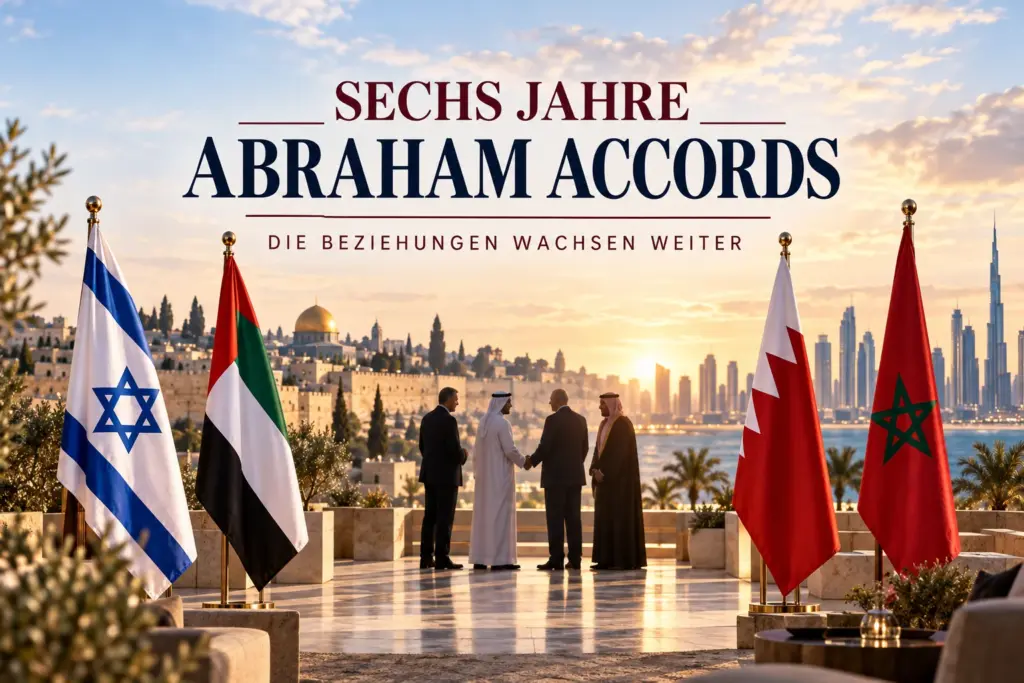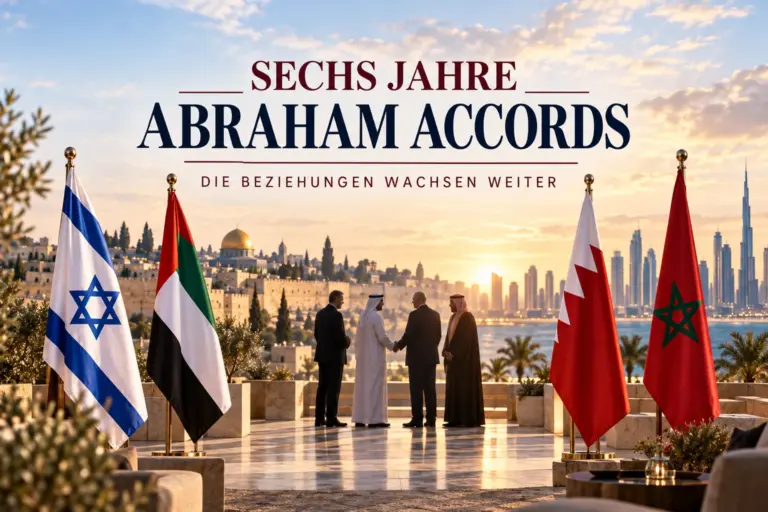
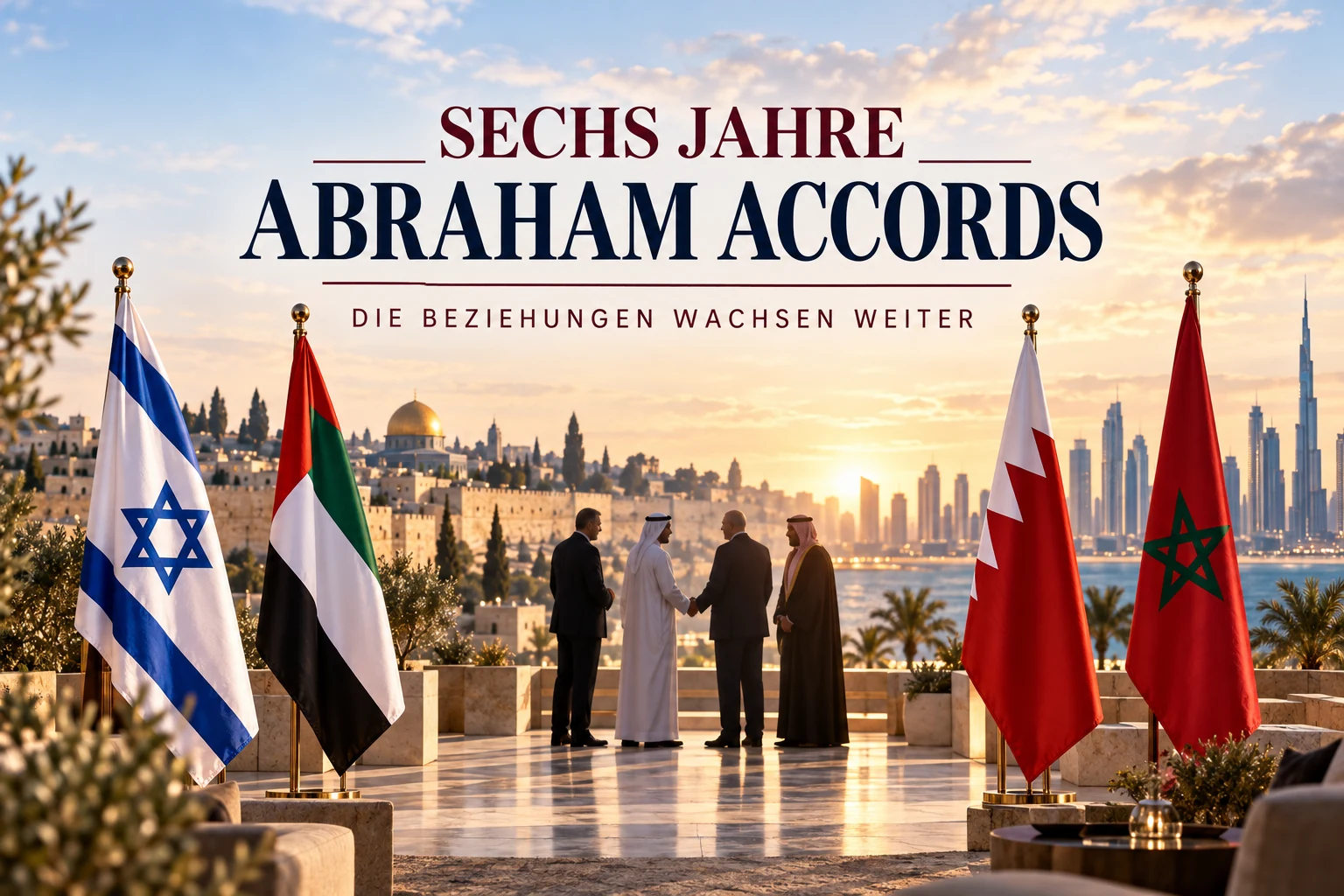
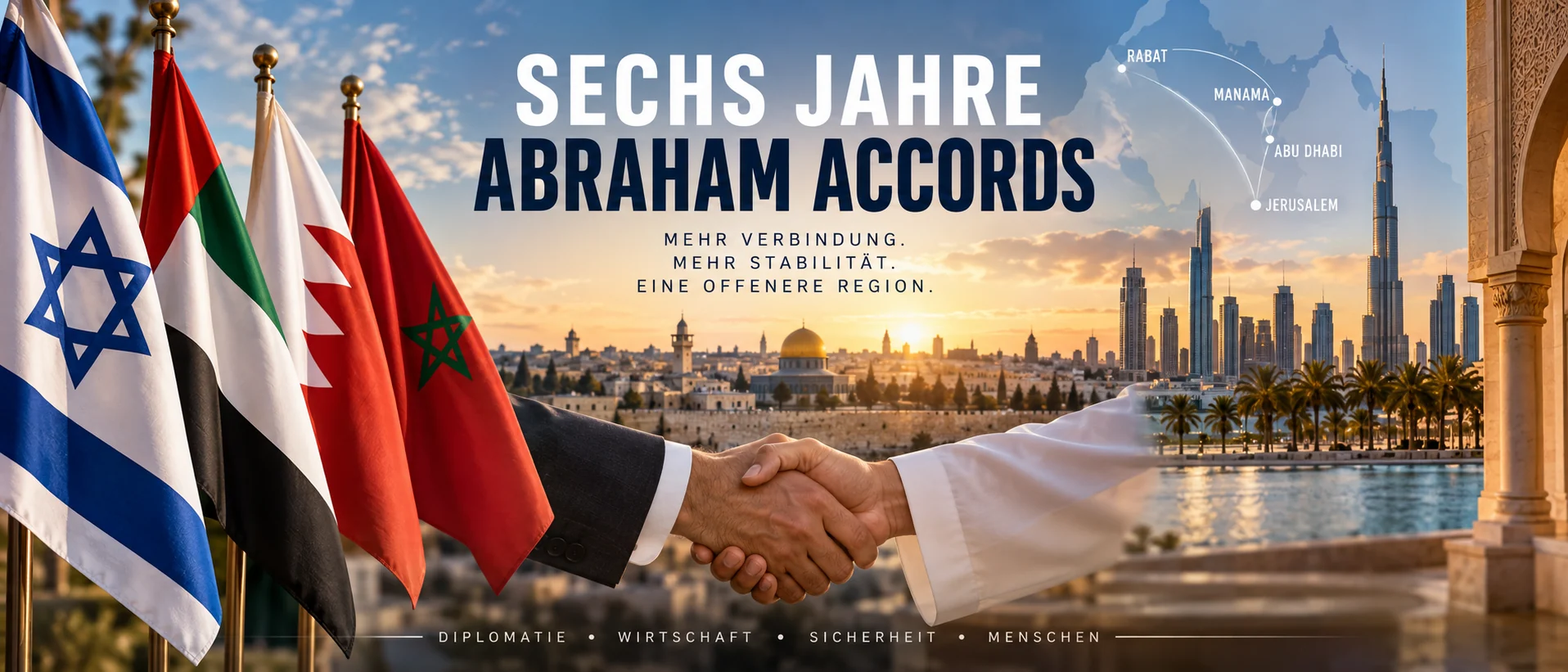
Six years ago, Israel, the United Arab Emirates and Bahrain signed the Abraham Accords in Washington. The normalization framework created at the time has since survived October 7, the Gaza war, massive regional tensions and now also the war with Iran. The relationships are not developing uniformly everywhere, but they continue: The UAE and Israel trade with each other in the billions, Bahrain has taken back an Israeli ambassador after a period of diplomatic distance, Kazakhstan has joined, and Israel and Morocco have just agreed to upgrade their relations further.
On September 15, 2020, Israel’s then Prime Minister Benjamin Netanyahu, the foreign minister of the United Arab Emirates, Abdullah bin Zayed Al Nahyan, and Bahrain’s foreign minister, Abdullatif bin Rashid Al-Zayani, stood on the White House lawn. With the mediation of the first Trump administration, Israel, the UAE and Bahrain signed the Abraham Accords. Morocco followed in December 2020 with its own normalization agreement.
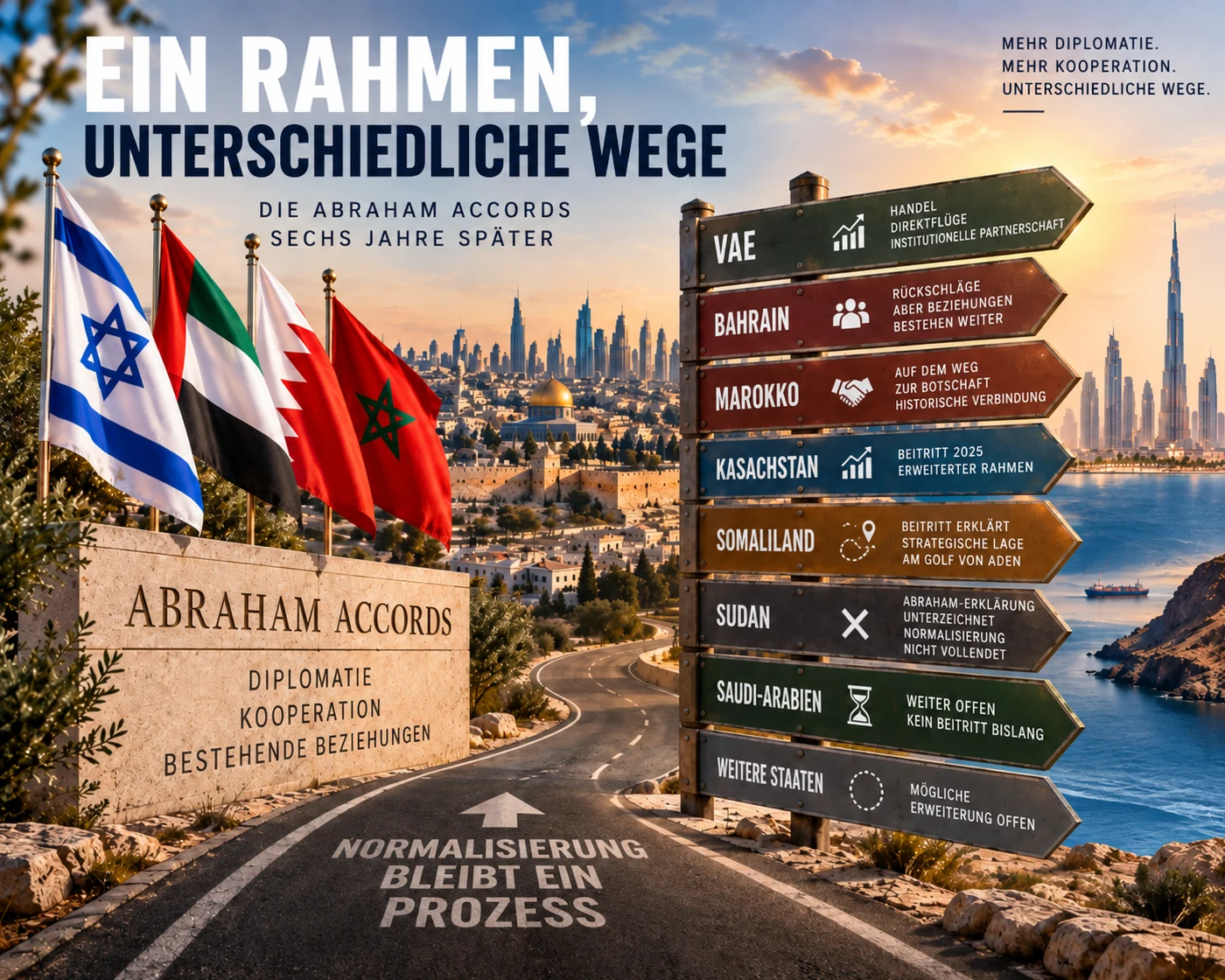
Since then, the framework has become broader and more complicated at the same time. Kazakhstan officially joined it in 2025, although the country had already maintained diplomatic relations with Israel for decades. Somaliland declared its intention to join after being recognized by Israel at the end of 2025. That is not the same thing and should not be treated as such. These differences in particular show that the Abraham Accords have long since developed beyond their original 2020 design.
Passende X-Beiträge
Aus dem SCHLAGSEITE X-Archiv
An alliance that is not really one
The term alliance is politically catchy, but legally imprecise. The Abraham Accords are neither a joint defense pact nor an international organization with fixed membership rules. They consist of a political declaration of principles and several bilateral agreements between Israel and individual states.

The Abraham Accords provide a political framework for diplomatic relations and cooperation between Israel and Arab and Muslim-majority states. Depending on the country, this involves diplomacy, trade, tourism, technology, security and societal exchange. They are not a formal military alliance.
The actual political rupture of 2020 did not lie in the number of members either. It lay in the sequence. The 2002 Arab Peace Initiative placed normal relations between Arab states and Israel in the context of a prior comprehensive peace, including the creation of a Palestinian state. In 2020, the UAE and Bahrain took a different path: They normalized their relations with Israel even though this conflict had not been resolved.
This at least partially broke the political linkage that had shaped policy for decades among individual Arab states. Bilateral interests, trade, security and regional cooperation could henceforth be developed independently of whether a final Israeli-Palestinian settlement had first been reached.
The Emirates: The signature became measurable cooperation
Six years later, it is possible to measure fairly precisely what normalization has produced in the United Arab Emirates. According to the UAE Ministry of Foreign Affairs , bilateral trade in goods with Israel reached around $3.209 billion in 2025. In 2024, it stood at $3.254 billion. The figures expressly refer to the goods trade reported by the Emirates and therefore cannot be readily compared with statistics that use other trade components or recording methods. Even after October 7 and during the Gaza war, the goods trade reported by the UAE did not collapse, but remained at almost the same level.
From September 2020 to May 2026, bilateral trade in goods totaled around $14.53 billion, according to the Emirates. From January to May 2026, it stood at $1.243 billion, approximately one percent above the same period of the previous year. This is no longer merely a political declaration of intent, but an economic structure.
Air links show a similar development. In 2025, around 1.53 million passengers traveled between the two countries, compared with approximately 892,000 the year before. That represents an increase of just over 71 percent. The number of direct flights temporarily reached 136 per week, while the Emirates refer to around 120 weekly connections during normal operating periods.
There is also an institutional dimension. Israel and the UAE opened embassies in 2021, and the Comprehensive Economic Partnership Agreement, or CEPA, provides a formal economic framework for reducing trade barriers and promoting investment. The relationship therefore no longer depends solely on individual heads of government or symbolic visits.
Bahrain: Much cooler, but not broken off
Bahrain shows that resilience does not mean that everything has proceeded smoothly since 2020. After the Gaza war began, the Bahraini ambassador returned from Israel to Manama in November 2023. The Israeli ambassador also left Bahrain. However, diplomatic relations were not formally severed.
In August 2025, Bahrain’s foreign minister, Abdullatif bin Rashid Al-Zayani, accepted the credentials of Shmuel Revel as the new Israeli ambassador . Revel continues to represent Israel in Manama six years after the signing of the Abraham Accords. The difference from the Emirates is therefore clear: While Abu Dhabi has broadly expanded relations economically and institutionally, development in Bahrain has been politically cooler and included a visible interruption at ambassadorial level. They were not severed.
The real stress test began after October 7
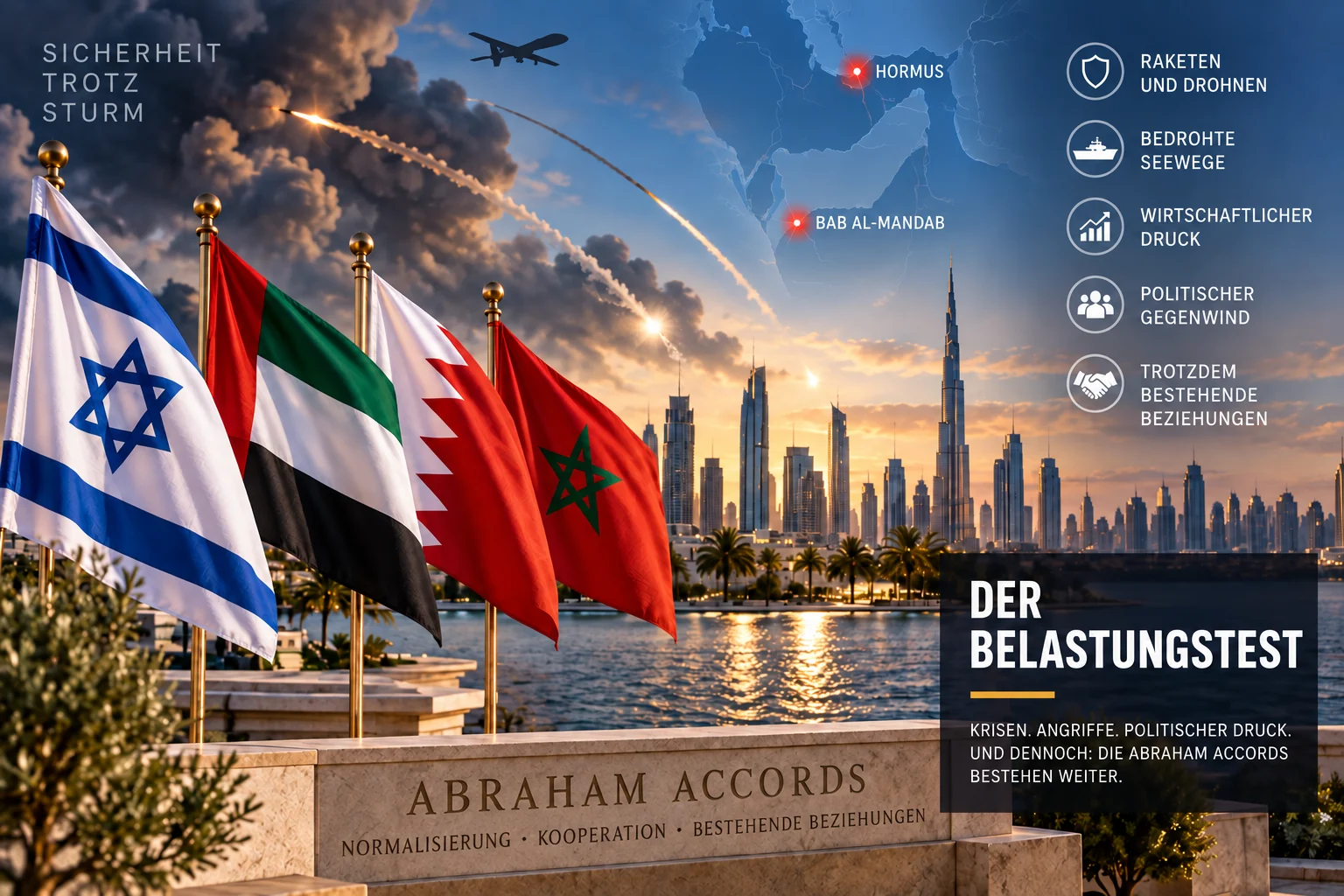
The viability of the Abraham Accords is determined not by their signing in 2020, but by what happened afterward. Hamas’s terrorist attack of October 7, 2023, and the ensuing war in Gaza greatly intensified political pressure on Arab governments. Public support for normalization with Israel declined significantly in parts of the region.
Arab Barometer found in seven countries surveyed in 2023 and 2024 that in none did more than 13 percent of respondents support normalization with Israel. In Morocco, approval fell from 31 percent in 2022 to 13 percent. However, comparable data for Bahrain and the United Arab Emirates were not available in this survey wave. The figures therefore should not simply be transferred to these two states. They do, however, show the regional headwinds among the public under which the governments continued their relations with Israel.
In 2026, the stress test became even more severe. The war between the United States and Israel on one side and Iran on the other also reached the Gulf region. Missile and drone attacks struck targets and infrastructure in several Gulf states. Reuters reported in September on Amazon Web Services’ cloud infrastructure in Bahrain and a data-center area in the UAE that had still not been fully restored after war-related attack damage.
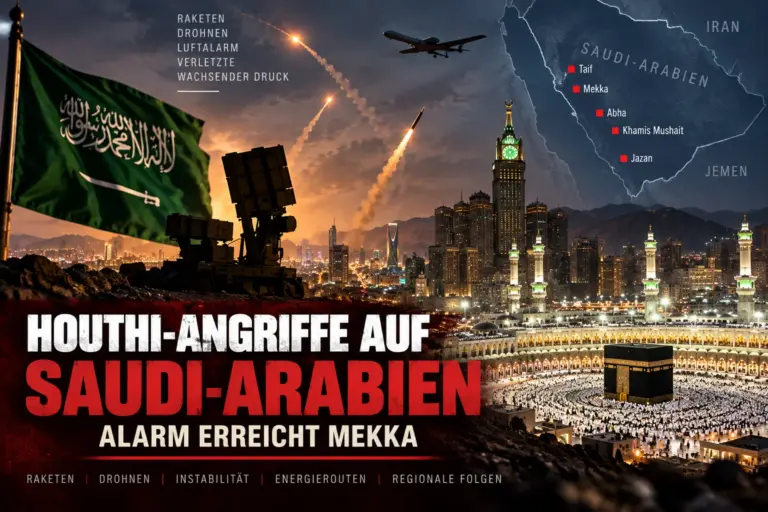
At the same time, both of the region’s major sea routes came under pressure. Iran severely restricted traffic through the Strait of Hormuz. In Yemen, the Iran-backed Houthis advanced along the Red Sea coast and increased pressure on Bab al-Mandab. Attacks on shipping and Saudi energy infrastructure turned abstract debates about regional security into an immediate economic issue.
There is also a specific security dimension between Israel and the Emirates, without this becoming a military alliance. The UAE Ministry of Foreign Affairs stated on September 8, 2026, that government bodies in both states had maintained open and direct communication channels since relations began. Relevant intelligence would be exchanged between the responsible agencies when necessary. This goes beyond mere diplomatic symbolism, but it is something different from a joint defense pact.
The fact that Abu Dhabi did not sever its relations with Israel in this environment, and that Bahrain took back an Israeli ambassador after the diplomatic cooling of 2023, is therefore a more telling finding than any anniversary speech. The relationships differ in depth and political visibility, but they have survived several regional escalations.
Morocco turns the anniversary into current news
How little the sixth anniversary was merely a look back became clear just one day later. On September 16, 2026, Israel’s foreign minister, Gideon Sa’ar, met his Moroccan counterpart, Nasser Bourita, in New York. The trilateral meeting was hosted by the American ambassador to the UN, Mike Waltz.
Israel and Morocco agreed to upgrade their diplomatic missions to full embassies and exchange ambassadors. Reuters confirmed the agreed upgrade. According to the joint statement, direct flights operated by Israeli and Moroccan airlines are also to be resumed or expanded later in 2026. Agreements on investment protection and the avoidance of double taxation are also to be concluded.
Timing remains important: The upgrade was agreed. New ambassadors had not yet been appointed when it was announced, and the liaison offices had not yet been fully transformed into embassies.
The political starting point in 2020 was also more matter-of-fact than the often-told story of cultural ties might suggest. Morocco normalized its relations with Israel as part of a larger US-mediated package. At the same time, the US administration at the time recognized Moroccan sovereignty over Western Sahara. The territory’s international status remains disputed and the subject of an unresolved conflict.
At the same time, the Israeli-Moroccan relationship has a historical and societal dimension that cannot be reduced to this political exchange. Jewish life has been part of Morocco’s history for centuries, and hundreds of thousands of Israelis have Moroccan family roots. Today’s upgrade to embassy-level relations therefore rests on two foundations: a very concrete political deal from 2020 and a much older societal connection.
Kazakhstan changes what joining means in the first place
The clearest formal expansion of recent years did not come from an Arab state. On November 7, 2025, the Kazakhstan Ministry of Foreign Affairs officially announced the country’s accession to the Abraham Accords.
This is noteworthy because Kazakhstan has maintained diplomatic relations with Israel since 1992. Its accession therefore did not constitute an initial normalization. Rather, the political framework of the Abraham Accords was expanded beyond its original function: from establishing new relations between Israel and Arab states to a broader platform for cooperation with Muslim-majority states.
Kazakhstan justified the decision by referring to its balanced foreign policy and the goal of expanding cooperation with interested states. At the same time, Astana continues to support a two-state solution. This also shows that joining the Abraham Accords does not require complete foreign-policy alignment with Israel.
Somaliland is not Kazakhstan—and yet it is strategically interesting
The situation is even more complicated in the case of Somaliland. Israel recognized Somaliland as an independent state on December 26, 2025. According to the Knesset President Abdirahman Mohamed Abdullahi subsequently stated that Somaliland would join the Abraham Accords. In June 2026, Abdullahi visited Israel; shortly beforehand, a Somaliland embassy had opened in Jerusalem.
This should not be equated with Kazakhstan’s move. Somaliland is recognized internationally as a sovereign state only to a very limited extent, and there is a difference between a political declaration of accession and a fully documented formal admission process.
Geographically, however, the case is anything but marginal. Somaliland lies on the Gulf of Aden, in the immediate vicinity of the southern approach to Bab al-Mandab. This strait is currently at the center of regional security issues because of the Houthi offensive and the threat to international shipping. Somaliland’s political significance therefore derives not only from its disputed status under international law, but also from its location on one of the most important sea routes between Asia, the Middle East and Europe.
The UAE and Bahrain established diplomatic relations with Israel in 2020. Morocco normalized its relations shortly afterward. Kazakhstan joined an existing framework in 2025, even though diplomatic relations with Israel had already existed for decades. Somaliland has declared its accession, but has only limited international recognition. Sudan, meanwhile, signed the Abraham Accords declaration, but the full normalization process with Israel was not implemented. These cases cannot meaningfully be counted as identical “memberships.”
Sudan shows the limits of a mere signature
Sudan is the counterexample to linear expansion. In 2020 and 2021, Khartoum initiated steps toward normalization with Israel and signed the Abraham Accords declaration. However, the process was not fully implemented. In 2025, the House of Commons Library noted that Sudan had not ratified the agreements.
Political instability and the civil war that has continued since 2023 brought the normalization process to a practical standstill. The case shows why a list of states alone says little. What matters is whether a declaration actually leads to embassies, transport links, trade and lasting diplomatic institutions.
Saudi Arabia: Washington is now applying a concrete lever
The most politically significant open case remains Saudi Arabia. Riyadh has not yet joined the Abraham Accords. The Trump administration is now attempting to link accession to a very specific American-Saudi project.
On July 22, 2026, US Energy Secretary Chris Wright and his Saudi counterpart, Prince Abdulaziz bin Salman, signed an agreement on civil nuclear cooperation under Section 123 of the US Atomic Energy Act. It is intended to provide the legal basis for American involvement in Saudi Arabia’s planned nuclear energy program and must undergo the prescribed US review process.
Two days later, US President Donald Trump publicly linked the matter to Israel. He said that the United States would not move forward with the nuclear agreement as long as Saudi Arabia did not join the Abraham Accords. Reuters reported in September that the agreement had meanwhile been submitted to Congress and was being reviewed there. However, according to Reuters, the normalization condition cited by Trump is not itself included in the text of the agreement.
For its part, Riyadh continues to state publicly that normalization with Israel requires credible and irreversible progress toward a Palestinian state. This is precisely where the circle closes with the original break in 2020: At that time, the Emirates and Bahrain decoupled their normalization from a prior final resolution of the Palestinian issue. Saudi Arabia has so far not abandoned this linkage.
Kuwait remains an expectation, not news
Other states are also regularly named as possible next candidates. Israel’s ambassador to the United Arab Emirates, Yossi Shelley, said on the sixth anniversary that another state might possibly join within the next four to six months, and named Kuwait.
No more can currently be made of this. It is the expectation of an Israeli diplomat. There is so far no corresponding commitment from Kuwait, no announced accession, and no reliably documented final negotiations.
Six years later, substance is what matters
The Abraham Accords are not developing like a classic international organization with a clear membership list. The individual relationships differ considerably. The UAE has built an economically and institutionally measurable partnership with Israel. Bahrain distanced itself diplomatically after October 7, but did not sever relations and later accepted an Israeli ambassador again. Morocco now wants to raise its representations to embassy level. Kazakhstan expanded the framework without previously requiring normalization. Somaliland wants to join, but has an entirely different international status. Sudan, by contrast, shows how little a signature without implementation means.
Six years after the signing, the normalization framework continues to exist, but not as a uniformly growing bloc. Its significance is shown by which bilateral relations survive political crises, become institutionally anchored and are actually expanded further.
The agreement between Israel and Morocco of September 16, 2026, provides the latest evidence of this: While some of the original processes are stagnating and new accessions have very different prerequisites, elsewhere normalization is becoming a deeper diplomatic relationship.
ℹ️ Factual basis and primary sources for the article 📑
▶️ US Department of State:
The Abraham Accords
Archived original documents and declaration of principles of the Abraham Accords concluded in 2020.
▶️ United Nations:
Arab Peace Initiative
Documentation of the 2002 Arab Peace Initiative and its linkage of comprehensive peace, Palestinian statehood and normal relations with Israel.
▶️ Ministry of Foreign Affairs of the United Arab Emirates:
UAE-Israel Economic Cooperation
Current official figures on bilateral goods trade, passenger volume, direct flights and the economic cooperation framework between Israel and the UAE.
▶️ Ministry of Foreign Affairs of the United Arab Emirates:
Statement by the UAE Ministry of Foreign Affairs in Response to Media Reporting
Official statement on the direct communication channels between Israeli and Emirati government bodies that have existed since the beginning of relations, as well as on the exchange of relevant intelligence information when necessary.
▶️ Reuters:
Bahrain receives credentials of Israel’s new ambassador
Documents the return of the Bahraini ambassador in 2023, the withdrawal of the Israeli ambassador at that time, and the acceptance of the new Israeli ambassador in 2025.
▶️ Arab Barometer:
MENA Publics and the Future of Normalization with Israel
Survey data on the decline in support for normalization after October 7, 2023. Comparable data for Bahrain and the UAE were not available in this survey wave.
▶️ Reuters:
War damage to cloud infrastructure in Bahrain and UAE
Current report on war-related damage to infrastructure in Bahrain and the United Arab Emirates during the Iran war.
▶️ Reuters:
Saudi pipeline attack and Houthi pressure on Red Sea shipping
Documents the current pressure on Saudi energy infrastructure and the strategic situation at Bab al-Mandab.
▶️ Reuters:
Israel, Morocco agree to upgrade diplomatic ties
Report dated September 16, 2026, on the agreed upgrade of Israeli-Moroccan relations to embassy level.
▶️ White House, archive:
Proclamation on Recognizing the Sovereignty of the Kingdom of Morocco Over the Western Sahara
Primary source on the American recognition of Moroccan sovereignty over Western Sahara in connection with the 2020 normalization.
▶️ Ministry of Foreign Affairs of Kazakhstan:
Statement on the Accession to the Abraham Accords
Official statement on Kazakhstan’s accession to the Abraham Accords in November 2025.
▶️ Knesset:
Somaliland President Abdullahi visits the Knesset
Official information on Israel’s recognition of Somaliland, the opening of the Somaliland embassy in Jerusalem and Somaliland’s declared intention to join the Abraham Accords.
▶️ Department of Energy:
United States and Saudi Arabia Reach Nuclear Cooperation Agreement
Primary source on the signing of the US-Saudi 123 agreement on July 22, 2026.
▶️ Reuters:
Trump conditions Saudi nuclear deal on Abraham Accords
Documents Trump’s public linkage of the civil nuclear agreement to Saudi Arabia joining the Abraham Accords.
▶️ House of Commons Library:
Israel and the Abraham Accords in 2025: Five years on
Overview of the development of the normalization agreements and the unfinished Sudanese process.
▶️ The Jerusalem Post:
Six years on, Israel, UAE, Bahrain commemorate signing of Abraham Accords
Original report on the sixth anniversary with current statements by Israeli diplomats.
🔎 Found an error, criticism or addition?
SCHLAGSEITE.eu stands for careful research and transparent corrections. Have you found a factual error, unclear wording or a broken link? Then send me your note. If possible, please provide a verifiable source.