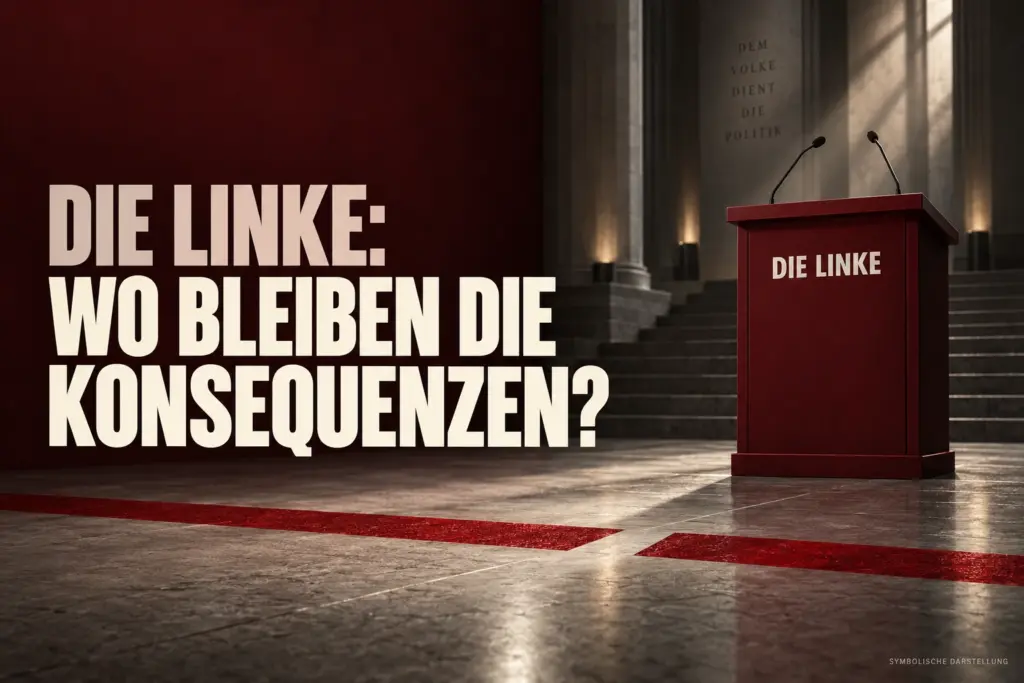


Berlin’s Left wants to govern, but must explain why the death of Israeli soldiers could be wished for on one of its campaign stages. The party leadership condemns the appearance; leading officials of the Neukölln district association defend its fundamental political direction, while a working group warns against normalising antisemitic positions. The conflict raises a question that potential coalition partners must answer before the election: What limits apply to cooperation?
A government needs majorities. But it also needs partners whose commitments are reliable. That is precisely what has sparked the debate about Berlin’s Left ahead of the election to the House of Representatives on 20 September. Anyone who promises to protect Jewish life must be able to uphold that promise within their own party. Credibility begins with the question of whom one gives a platform to and when one intervenes there.
Nelly Eliasberg, spokesperson for WerteInitiative, therefore calls in a commentary in the Jüdische Allgemeine for a firewall against the Left Party. Behind the pointed demand lies a concrete political decision: Should the desire for a governing majority outweigh the way a partner deals with antisemitism?
Passende X-Beiträge
Aus dem SCHLAGSEITE X-ArchivAn appearance lays bare the internal conflict
The trigger was a campaign event held by Neukölln’s Left at the end of August on Herrfurthplatz. The rapper Dahabflex performed a song there calling for the death of the Israeli armed forces and for an intifada. According to reports documented by rbb, visitors danced and clapped while politicians present did not intervene.
The content goes beyond an aggressive rejection of the Israeli army. The song links the intifada to the PFLP and invokes Leila Khaled as a political role model. The PFLP is on the European Union’s terrorism list. Leila Khaled was a member of the PFLP and was involved in the hijacking of a TWA aircraft in 1969 and in an attempted hijacking of an El Al aircraft in 1970. The reference therefore does not merely romanticise resistance as an abstract political concept; it invokes symbolic figures and organisations of Palestinian terrorism.
Nor is the term intifada a harmless protest slogan in this context. According to the figures from the Israeli human rights organisation B’Tselem, a total of 992 Israelis were killed between the beginning of the Second Intifada in September 2000 and the end of 2005, including 683 civilians. Suicide attacks and other targeted attacks on civilian targets shaped those years. Anyone calling for an intifada on a political stage is therefore using a term with a concrete history of deadly violence.
Lead candidate Elif Eralp condemned the appearance, called for clarification and consequences, and expressly affirmed the protection of Jewish life and opposition to antisemitism. Neukölln’s co-chair Hermann Nehls said that the song in question had not been agreed upon. Dahabflex, in turn, rejected the reporting as distorted and specifically denied having called for violence against civilians.
These reactions form part of the account of what happened. However, they do not remove the organisers’ political responsibility. A programme item that was not agreed upon may explain why a particular song was played unexpectedly. It does not answer why an appearance containing such material was allowed to continue. And distinguishing between soldiers and civilians does not turn a wish for death into a call for peace.
The alleged element of surprise has a backstory
Dahabflex was not an unknown artist to Neukölln’s Left. In September 2025, he had already been announced for the musical programme of the demonstration “Together for Gaza”, which was supported by the Left and promoted by the Neukölln district association. The LAG Shalom writes in its statement, Dahabflex performed the same song there that later became controversial. Public criticism did not lead to his being disinvited at that time either.
Of particular relevance is a public warning from within the party itself. Former deputy Left Party chair Martina Renner had already drawn attention on 24 September 2025 to the line-up circulated by Neukölln’s Left and expressly referred to the rapper’s links to the PFLP and Leila Khaled, as well as to the call for the death of the Israeli armed forces.
Dahabflex was not a spontaneous guest at the current campaign event either. The rbb reports that the rapper had been announced in advance together with other artists. The WELT documents the announcement on the campaign poster even more specifically: Dahabflex was scheduled to headline, and his name appeared at the very top of the party’s poster.
This does not disprove Hermann Nehls’s explanation that precisely this song had not been agreed upon for the evening. But it changes the classification of what happened. The artist had been deliberately invited and prominently announced, even though his lyrics and precisely this song had already been the subject of public and internal party criticism the previous year.
This does not prove that every person responsible in the district association knew in August 2026 which song Dahabflex would perform that evening. The crucial point is a different one: The artist and precisely those contents that caused outrage a year later had already been the subject of public internal party criticism. It is therefore difficult to speak of a completely unforeseeable incident.
A song that was not agreed upon can explain an organisational failure. Inviting again an artist whose lyrics had been publicly criticised by people within the party shifts the question, however, from surprise to the decision to select him. The issue is then no longer merely why nobody intervened during the appearance. It is also what kind of review took place before the invitation at all.
The sharpest criticism also comes from within the party
Particularly revealing is the statement by the intra-party LAG Shalom of 2 September. The working group welcomes Eralp’s disavowal, but describes it as part of a recurring pattern: antisemitic incidents, public distancing, demands for consequences. In its view, these appeals have so far failed to halt the development.
The LAG accuses the state association of weakening positions critical of antisemitism in favour of a stronger orientation towards a young, activist audience. It sees the state executive as sharing responsibility. This is the assessment of an intra-party current, not a neutral investigation. It is nevertheless politically significant: The accusation cannot simply be dismissed as an attack by the competition.
The conflict becomes even clearer through Jorinde Schulz. She is chair of the Left in Neukölln and also a member of Berlin’s state executive. As the Tagesspiegel reported, citing her appearance on rbb’s evening news, Schulz said that the district association stood unreservedly behind the song’s title, “Stop the Genocide”. She also told rbb that the rapper had taken a position, among other things, against the Israeli army, which, according to her account, was currently partly responsible for a “genocide”. The WELT also documents these statements, expressly referring to the rbb interview.
This matters more for the question of power within the party than the statement by a working group. Schulz is not speaking of a political fringe outside the leadership bodies. She leads the district association in question and simultaneously sits on the state executive. Thus, the contradiction to Eralp’s disavowal also runs within the leadership level of Berlin’s Left.
The distance between the positions is further demonstrated by the reaction of the LAG Palestine Solidarity. It sided with the Neukölln district association and Dahabflex and described the reporting as a “smear campaign”, as the Tagesspiegel reported on 2 September. While the lead candidate identifies a crossing of the line, parts of the party are defending those involved against public criticism.
More is therefore at stake than the wording used by a musician. Within the same party, there is a dispute over whether such an incident requires serious self-examination or is primarily a hostile campaign to be fought off. The party leadership’s pledge of support for a government must be measured against which of these positions actually proves effective in day-to-day politics.
Clarification is a beginning; its outcome remains decisive
The party leadership has now agreed on further steps. According to a report by the Berliner Morgenpost, the state leaders, together with the Neukölln spokespersons, are to investigate the incident and propose conclusions. The ombuds office will be involved. Future campaign events organised by the district association are to be coordinated with the state executive.
According to the latest publicly known information, concrete sanctions against those responsible have so far not been imposed. As the Tagesspiegel reported on 5 September, after a special meeting the acting state executive did decide to continue reviewing the matter, involve the ombuds office and coordinate future Neukölln campaign events with the party leadership. Beyond that, no further measures were initially decided.
It would therefore be wrong to deny the party any reaction whatsoever. The agreed coordination could prevent further appearances of this kind. Whether it actually does so will be shown by its implementation. Announcing an investigation is not yet an outcome, and an additional coordination procedure does not resolve the substantive conflict by itself.
Central Council of Jews President Josef Schuster had previously called for personal and political consequences. In his view, subsequent disavowals are insufficient if those responsible fail to intervene when calls for violence are made on their own stage. He expressly linked this criticism to the question of the party’s ability to govern, as the Jüdische Allgemeine reported.
A boundary must specify what conduct it excludes
A serious debate about the firewall requires concrete standards. Criticism of decisions by the Israeli government, demands for humanitarian aid, or advocacy for Palestinian rights do not in themselves constitute grounds for an accusation of antisemitism. A political boundary must apply where Jewish self-determination is fundamentally denied, antisemitic stereotypes are disseminated, or violence and terrorism are justified and romanticized.
The song’s references to the PFLP, the intifada, and Leila Khaled are therefore relevant to its classification. They show why the controversy cannot be reduced to an especially harsh form of criticism of Israel. A general reference to artistic freedom or solidarity with Palestine does not answer the question of what a specific statement actually contains. Anyone organizing an election campaign rally also assumes responsibility for which messages receive political support there.
Nor can the Neukölln incident be used to make a blanket assertion about every member and voter of the Left Party. The opposition from the LAG Shalom shows precisely that these boundaries are being contested within the party. For potential coalition partners, the question is therefore whether those who combat antisemitism can enforce binding rules.
The SPD and Greens have already raised the question of power
The potential coalition partners have since reacted to the incident. Green Party lead candidate Werner Graf demanded clarity as to whether Eralp’s announced consequences would actually be implemented. He explicitly raised the possibility of internal party disciplinary proceedings and asked what influence the Neukölln district association would have on a future parliamentary group or government. This would show whether Eralp could prevail within her party, WELT reported.
The SPD, too, has long linked the question to the ability to govern. Lead candidate Steffen Krach called for a clear response from the Left Party and made clear that a party loses credibility in the fight against antisemitism if it tolerates members who promote violence against Israel. Franziska Giffey stated that repeated antisemitic remarks and calls for violence were not accidents. Eralp’s dismay alone was insufficient; what mattered were actual consequences. The Left Party’s ability to govern would have to be measured by how the Jüdische Allgemeine summarized.
SPD and Greens therefore do not need to invent the conditions for cooperation. They have formulated standards themselves. The crucial question now is whether these statements will become actual conditions in the event of coalition negotiations: no political support for calls for violence, no trivialization or romanticization of terrorism, and comprehensible consequences in cases of antisemitic incidents.
An announced consequence is not yet an enforced consequence. Likewise, a publicly stated red line is not yet a coalition condition as long as it remains unclear what will happen if it is crossed. This is precisely where it will be decided whether the debate will have political consequences after the election or end as an election campaign reaction.
The demand for a firewall derives its meaning from such verifiable conditions. Where a party persistently fails to meet them or is unwilling to enforce them, the consequence must be foregoing a coalition. Otherwise, every act of distancing remains dependent on the moment when the votes in question are needed for a majority.
This is also about the people who would support a left-wing government because of its social and housing policies. They are entitled to a party that pursues its political goals without making the toleration of hatred of Jews the price of internal cohesion. Affordable housing and the protection of Jewish life are not competing concerns.
The Berlin Left Party therefore no longer only has to explain how a single appearance could have occurred. It must show whether a commitment by its leadership to an influential district association and its representatives on the state executive can actually be enforced. As long as this proof is absent, potential coalition partners must not replace it with a vote of confidence. Jewish security is one of the prerequisites for cooperation, not one of the open questions for later.
ℹ️ Factual basis and primary sources for the article 📑
Information as of: September 6, 2026. Article type: Commentary.
▶️ Jüdische Allgemeine:
Why a firewall against the Left Party is necessary
Commentary by Nelly Eliasberg on political cooperation with the Left Party and dealing with antisemitism.
▶️ rbb24:
Left Party lead candidate Eralp criticizes rapper’s appearance during Neukölln election campaign
Documents the rapper’s announcement, the appearance, and the reactions of Elif Eralp, Hermann Nehls, and Dahabflex.
▶️ LAG Shalom of the Berlin Left Party:
The intifada greets us every day
Internal party statement on the current incident, Dahabflex’s earlier appearance in September 2025, and the development of antisemitic and anti-Zionist positions within the state association.
▶️ Martina Renner:
Public warning of September 24, 2025
The former deputy chair of the Left Party had already drawn attention before the “Together for Gaza” demonstration to Dahabflex, his references to the PFLP and Leila Khaled, and his expressed wish for the death of the Israeli armed forces.
▶️ Jüdische Allgemeine of August 31:
Report on the background to the Dahabflex appearance
Documents the public warning from 2025 and the subsequent criticism of portraying the incident as a surprising crossing of the line.
▶️ WELT of September 3:
Stalin, Mao, intifada – This rapper is putting the Left Party under pressure
Documents the rapper’s previous appearances at Left Party events, his prominent announcement as the headliner on the current election campaign poster, and Jorinde Schulz’s statements to rbb.
▶️ Council of the European Union:
Current EU list of terrorist organizations
Continues to list the Popular Front for the Liberation of Palestine, PFLP, as a terrorist organization.
▶️ Interactive Encyclopedia of the Palestine Question:
Biography of Leila Khaled
Documents Khaled’s membership in the PFLP and her involvement in aircraft hijackings or an attempted hijacking in 1969 and 1970.
▶️ B’Tselem:
Tally of casualties since the beginning of the Second Intifada
Documents a total of 992 Israelis killed by the end of 2005, including 683 civilians.
▶️ Tagesspiegel of September 1:
“How stupid can you be?” – This is how deeply antisemitism is rooted in Berlin’s Left Party
Documents the internal party conflict and Jorinde Schulz’s defense of the song title, referring to her appearance on rbb’s evening news program.
▶️ Tagesspiegel of September 2:
Left Party group defends controversial concert in Neukölln
Reports on the support of the LAG Solidarity with Palestine for the Neukölln district association and Dahabflex.
▶️ Berliner Morgenpost:
After calls for violence in Neukölln: This is the solution presented by the Left Party leadership
Reports on the agreed review, the involvement of the ombuds office, and the closer coordination of future election campaign events.
▶️ Tagesspiegel of September 5:
Berlin Left Party initially draws no consequences
Documents the status after the special meeting of the state executive and confirms that, beyond the review, ombuds office, and coordination of events, no further measures were initially adopted.
▶️ Jüdische Allgemeine:
New antisemitism scandal puts Left Party under pressure
Documents the criticism by Josef Schuster, as well as the reactions of Steffen Krach, Franziska Giffey, and Werner Graf and their linking of the incident to the Left Party’s ability to govern.
▶️ WELT:
“The Left Party must clarify whether Eralp’s word stands”
Documents Werner Graf’s questions about internal party disciplinary proceedings, Eralp’s ability to prevail, and the potential influence of the Neukölln district association on a future government.
🔎 Spotted an error, criticism, or addition?
SCHLAGSEITE.eu stands for careful research and transparent corrections. Have you spotted a factual error, unclear wording, or broken link? Then send me your tip. If possible, please provide a verifiable source.