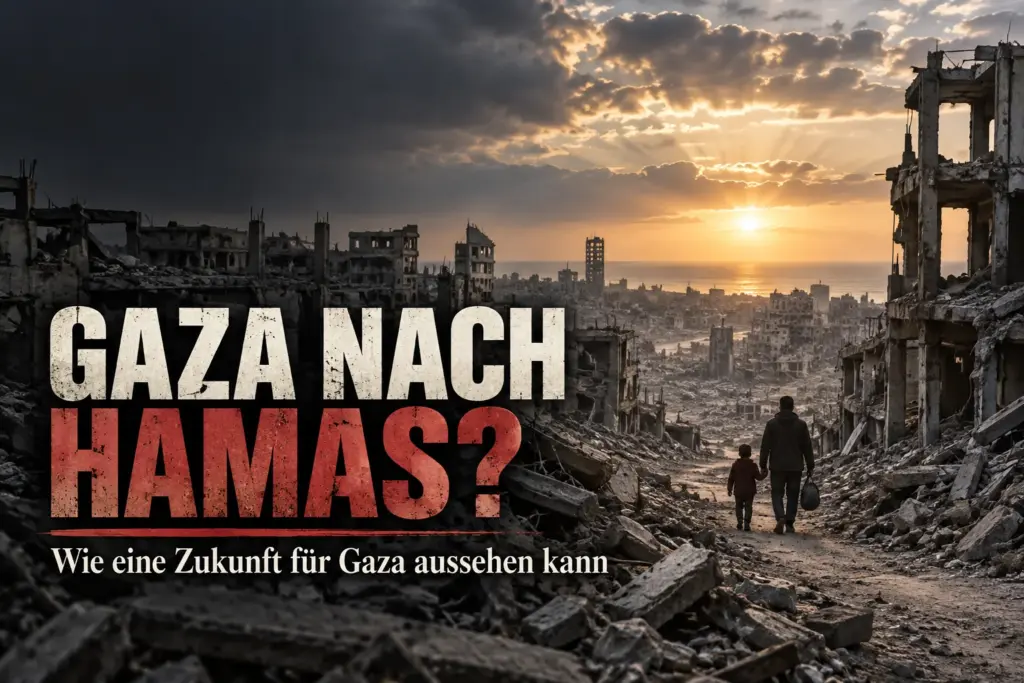

Gaza after Hamas is long since more than a theoretical question. The West is engaged in passionate debate over Gaza. Almost every political demand is directed at Israel. Far less often is the question addressed of what responsibility Hamas bears for the catastrophe and what a future for Gaza should look like as long as an Islamist terrorist organisation remains armed, politically organised and socially entrenched. Strikingly, this debate is now visibly beginning to change among Palestinians themselves.
A recent opinion piece by Gaza-born Ahmed Fouad Alkhatib in the New York Times brings this conflict into unusually sharp focus. The essay was published on 4 September 2026 under the headline “For Gaza to Recover, Hamas Must Be Expelled”. Alkhatib is not calling for less solidarity with the Palestinians. He is calling for a different kind: one that does not romanticise Hamas, does not ignore Palestinian responsibility and does not once again leave Gaza’s future to an armed Islamist movement.
It would be easy to dismiss this as an individual opinion. Yet current data from Gaza and the West Bank, that is, Judea and Samaria, show that something is indeed moving. Just not as conveniently and unambiguously as some would like.

Passende X-Beiträge
Aus dem SCHLAGSEITE X-ArchivGaza after Hamas: Alkhatib’s criticism goes deeper than the balance sheet of a lost war
Ahmed Fouad Alkhatib grew up in Gaza City and left the territory in 2005. Today, he is a Resident Senior Fellow at the Atlantic Council, where he heads the Realign For Palestine, a project advocating nonviolence, coexistence and a political realignment of the Palestinian national movement.
According to the Atlantic Council, Alkhatib has lost a total of 33 immediate and extended family members since 7 October 2023. Nevertheless, he is among Hamas’s most outspoken Palestinian critics.
His argument goes beyond the observation that Hamas strategically led Gaza into catastrophe. Alkhatib describes Hamas as an ideological project. As a teenager, he experienced how the movement used mosques for religious and political mobilisation and sought to win young Palestinians over to its Islamist vision of resistance.
This ideology did not disappear along with the organisation’s military losses. The political charter published in 2017 also continued to define Palestine as the entire territory between the Jordan River and the Mediterranean Sea. Although Hamas accepted a Palestinian state based on the 1967 lines as a possible national consensus, it did not recognise Israel. The document did not replace or suspend the 1988 Hamas Charter. Even an analysis by the then comparatively dialogue-oriented European Council on Foreign Relations therefore pointed to the contradictions between formulations that sounded more pragmatic and the fundamental position toward Israel that remained in place.
That is precisely where the real problem lies: an organisation can lose a war and still retain its ideology.
The events of 7 October 2023 were therefore neither a natural disaster nor an inevitable historical reaction. Hamas and allied groups made a political and military decision. Around 1,200 people were killed in Israel and 251 people were abducted to Gaza. Israel’s responsibility for its own actions in the subsequent war does not erase Hamas’s responsibility.
What is changing in Palestinian public opinion
The latest survey by the Palestinian Center for Policy and Survey Research is particularly revealing. Between 5 and 8 August 2026, 1,270 Palestinians were interviewed in person, including 440 in Gaza and 830 in Judea and Samaria. The stated margin of error is 3.5 percentage points.
The methodology warrants a qualification. Gaza is not a free political environment. Interviews were conducted in areas without an Israeli military presence west, south and north of the so-called “Yellow Line”. Residents of areas under Israeli control, including Rafah and parts of northern Gaza and Khan Yunis, were interviewed in shelters. The results are therefore an important snapshot, but not a mathematical revelation about every resident of Gaza.
| Political position | October 2025 | August 2026 | Change |
|---|---|---|---|
| Support for Hamas overall | 35% | 24% | -11 percentage points |
| Support for Hamas in Gaza | 41% | 33% | -8 percentage points |
| Support for Hamas in Judea and Samaria | 32% | 18% | -14 percentage points |
| Hamas should lead and represent the Palestinians | 41% | 28% | -13 percentage points |
| Armed struggle is considered the most effective path | 41% | 27% | -14 percentage points |
| Negotiations are considered the most effective path | 36% | 44% | +8 percentage points |
| Hamas is considered the winner of the Gaza war | 39% | 20% | -19 percentage points |
The trend is clear. Hamas is losing support, confidence in armed struggle is declining and support for negotiations is growing. For Gaza after Hamas, this is an important signal, but not yet a political realignment. Turning it into broad support for Israel or a new peace movement would simply be wrong.

ℹ️ More negotiations do not automatically mean greater recognition of Israel
44 percent support the broadly worded two-state solution, while 50 percent reject it. 58 percent now consider it impracticable because of settlement development. At the same time, 56 percent prefer, when presented with a selection of specific models, a Palestinian state based on the 1967 lines. The rise in willingness to negotiate therefore primarily describes a change in the preferred method, not automatically a fundamental reassessment of Israel.
Gaza takes a more critical view of violence and still supports Hamas more strongly
Another combination of findings from the survey prevents overly convenient conclusions.
In Gaza, 65 percent agree that armed resistance has neither protected the Palestinians nor ended Israeli control, but instead contributed to Gaza’s destruction. In Judea and Samaria, the figure is only 35 percent.
At the same time, 33 percent in Gaza still identify with Hamas. In Judea and Samaria, the figure is just 18 percent. The decline there was even sharper, at 14 percentage points, than in Gaza, where it was eight.
This is not a contradiction. It shows how contradictory political opinions can be after a war like this. A person can conclude that armed struggle has failed catastrophically without therefore immediately abandoning their political or ideological attachment to Hamas.
The legend of military success loses credibility especially where its consequences are visible firsthand. But that does not mean the organisation itself disappears any time soon.

A leadership vacuum is not yet a liberal alternative
Nor should Hamas’s and Fatah’s loss of significance be confused with the emergence of a nonviolent technocratic centre.
44 percent of respondents say that neither Hamas nor the Fatah led by Mahmoud Abbas deserves to represent the Palestinians. When asked, however, about a possible successor to Abbas, Marwan Barghouti is clearly ahead. 39 percent name him as the most suitable successor, well ahead of Hamas leader Khalil al-Hayya at 16 percent and Mohammed Dahlan at 15 percent.
In a hypothetical presidential election, Barghouti would even receive 54 percent among likely voters.
Barghouti is therefore currently the strongest personal expression of the Palestinian leadership vacuum. But he is not a political countermodel of the Alkhatib type. The longtime Fatah official has been imprisoned in Israel since 2004. An Israeli court sentenced him to five life terms for his involvement in acts that resulted in five deaths. Barghouti did not recognise the court’s jurisdiction.
The weakness of Hamas and Abbas therefore does not automatically produce a moderate political alternative. For now, it produces a vacuum.
Disarmament remains the real test
The ambiguity is particularly clear when it comes to weapons. Anyone discussing Gaza after Hamas therefore cannot avoid the question of disarmament.
72 percent of all respondents reject Hamas’s disarmament as long as Israel has not completely withdrawn from Gaza. In Gaza, the figure is 62 percent; in Judea and Samaria, 79 percent. An equal number assume that prior disarmament would lead not to an Israeli withdrawal but to renewed fighting.
In July 2026, Hamas declared itself in principle ready to place its weapons under the supervision of the Palestinian transitional administration NCAG as part of the agreed process. The sequence, control and question of which steps Israel must take beforehand remain disputed.
A post-war order also cannot be limited to Hamas alone. If other armed organisations such as Palestinian Islamic Jihad or independent armed groups retain their structures, the fundamental problem would only be partially resolved. A civilian government cannot govern permanently as long as competing actors can independently decide over weapons and war.
Polls can change political moods. Weapons, personnel, financial structures and security apparatuses are power. The one should not be confused with the other.
In Gaza, open opposition to Hamas was dangerous
The extent to which political opposition can be organised freely is another question altogether.
In March 2025, hundreds of people took to the streets in Beit Lahia in northern Gaza. At the protests documented by Reuters the departure of Hamas was explicitly demanded. Further protests followed in other parts of Gaza.
Amnesty International subsequently documented threats, intimidation, interrogations and mistreatment of demonstrators by Hamas security forces.
This was not a new pattern. Following the violent takeover of power in 2007, Human Rights Watch had already documented arbitrary arrests of political opponents, torture and restrictions on freedom of expression and assembly by the Hamas government.
Political support in an authoritarian system therefore cannot be read in the same way as party preferences in an open democracy.
The Western blind spot also exists in Germany
Alkhatib’s criticism is therefore directed not only against Hamas, but also against some of its Western supporters and apologists.
The blind spot is also visible in Germany. Israeli government decisions are personalized very specifically at demonstrations, in political debates and in campaigns. At the same time, Hamas’s political responsibility often comes up only when it is explicitly asked about.
In some parts of the milieu, it goes even further. On December 13, 2024, the slogan “From the river to the sea” was used at a demonstration in Berlin-Friedrichshain. In this specific case, Berlin Regional Court I classified its use on December 18, 2025, as a symbol of the banned terrorist organization Hamas and imposed a fine. The State Protection Chamber pointed out that Hamas uses the slogan as an alternative to a peaceful two-state solution and that its goal is the elimination of Israel. At the time of reporting, the judgment was not final and could be challenged by an appeal on points of law to the Federal Court of Justice.
Also, a report by ZDF “Die Spur” examined possible connections in 2025 between Hamas-affiliated networks and pro-Palestinian protest structures in Germany. The investigation documented Hamas symbolism, personal affiliations and networks, without making the blanket claim that pro-Palestinian demonstrations in Germany are generally controlled by Hamas.
This is precisely where solidarity becomes politically blind. Anyone who takes Palestinians seriously cannot hold every Israeli minister responsible for his or her decisions while simultaneously portraying Hamas as merely a reaction to external circumstances.
Hamas was a government, security apparatus, armed organization and ideological movement. It was not background noise in the conflict.
Reconstruction needs more than concrete and billions
The question of Hamas is therefore also a question of reconstruction. A viable future for Gaza after Hamas cannot consist solely of new buildings and international funding.
International donors can finance homes, roads, hospitals and infrastructure. But they cannot purchase a stable political order as long as armed organizations can decide independently of a civilian government over war and peace.
This applies not only to Hamas. A viable postwar order would have to bring armed parallel structures as a whole under state or internationally guaranteed control.
Otherwise, the fundamental risk remains: billions flow into reconstruction, civilian structures are rebuilt, and an armed organization simultaneously retains the ability to trigger the next war.
That would not be a reconstruction plan. It would be bridge financing until the next catastrophe.

Declining levels of support for Hamas indicate a real political shift. But they do not yet create a new order. What matters is whether, after the war, a civilian leadership will actually possess the monopoly on force or whether armed organizations will continue to be able to decide independently over war and peace.
Declining support for Hamas is real. It is not a new political order. Gaza after Hamas therefore needs more than falling poll numbers. As long as an armed organization can decide over war and peace, Gaza remains politically vulnerable to blackmail and any lasting reconstruction remains at risk. Western solidarity that identifies Israeli responsibility but leaves out Hamas, its ideology and its power structures therefore does not help the Palestinians. It remains politically blind.
ℹ️ Factual basis and primary sources for the article 📑
▶️ Palestinian Center for Policy and Survey Research:
Public Opinion Poll No. 97, August 12, 2026
Current survey on Hamas, political preferences, Barghouti, armed struggle, negotiations, a two-state solution and disarmament.
▶️ New York Times:
Ahmed Fouad Alkhatib: For Gaza to Recover, Hamas Must Be Expelled
Opinion piece by the author from Gaza and the starting point of the analysis.
▶️ Atlantic Council:
Ahmed F. Alkhatib
Biographical information on Alkhatib and his work.
▶️ Atlantic Council:
Realign For Palestine
Information on the project led by Alkhatib and its political orientation.
▶️ European Council on Foreign Relations:
Time to bring Hamas in from the cold
Contemporary analysis of Hamas’s 2017 foundational document, its statements on Israel and the 1967 lines, and the continued existence of the 1988 charter.
▶️ Reuters:
Hundreds stage Gaza protest against Hamas after conflict resumes
Report on anti-Hamas protests in Gaza in March 2025.
▶️ Amnesty International:
Hamas security services must respect freedom of peaceful assembly in Gaza
Documentation of threats, interrogations and mistreatment of demonstrators in Gaza.
▶️ Human Rights Watch:
Internal Fight: Palestinian Abuses in Gaza and the West Bank
Documentation of political repression and human rights violations following Hamas’s takeover of power.
▶️ Berlin Regional Court I:
Decision on the slogan “From the river to the sea” of December 18, 2025
Non-final judgment by the State Protection Chamber concerning the specific use of the slogan as a symbol of the banned terrorist organization Hamas.
▶️ ZDF:
Pro-Palestinian demonstrations: Also coordinated by Hamas?
Investigation into possible connections between Hamas-affiliated networks, actors and symbolism and pro-Palestinian protest structures in Germany.
🔎 Spotted an error, criticism or addition?
SCHLAGSEITE.eu stands for careful research and transparent corrections. Have you spotted a factual error, unclear wording or a broken link? Then send me your information. If possible, please provide a verifiable source.