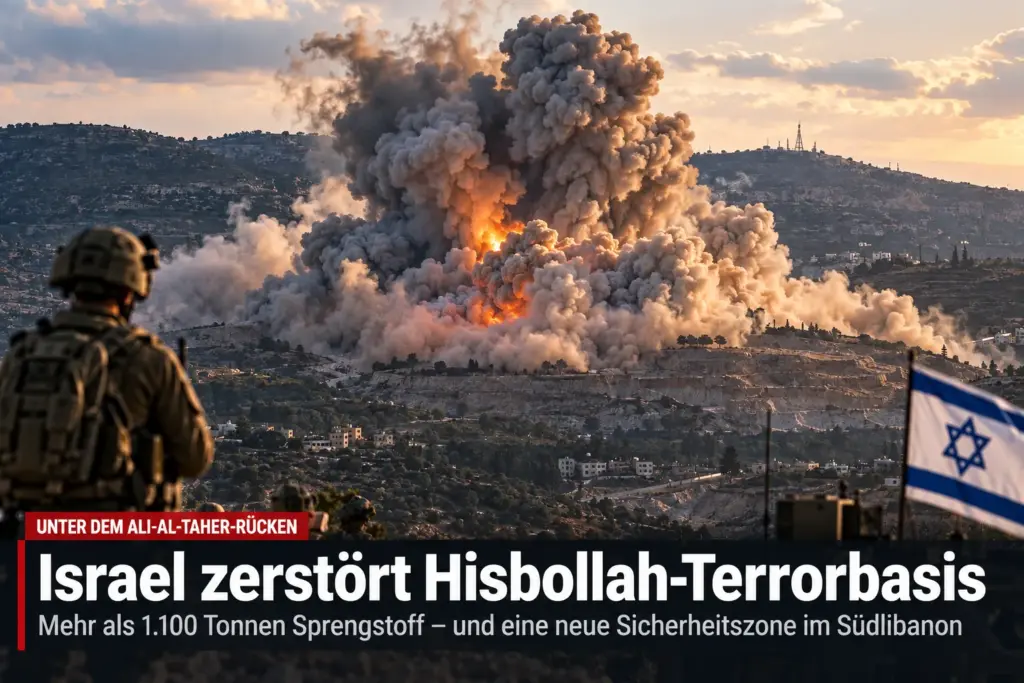


Israel has destroyed Hezbollah tunnels in southern Lebanon as well as other underground terrorist infrastructure belonging to the organization. Prime Minister Benjamin Netanyahu and Defense Minister Israel Katz view the operation as the completion of an important military step: With the destruction of the facility, the consolidation of the Israeli security zone in southern Lebanon has been completed.
The demolition of the Hezbollah tunnels on September 10, 2026, was not the beginning of the operation but its final step. In the weeks before, Israeli troops had, according to the IDF, achieved operational control over the Ali al-Taher ridge above and below ground. On September 3, the army reported that it had cleared two underground tunnel branches of Hezbollah fighters. Some were reportedly killed, while others left the area. Only afterward were the facilities prepared for their final destruction.
השמדנו הלילה את המוצב האיראני הגדול ביותר מחוץ לאיראן – מנהרות עלי טאהר בלבנון.
משלימים את המשימה. שנה טובה! pic.twitter.com/xbDGu7Fhyf
— Benjamin Netanyahu – בנימין נתניהו (@netanyahu) September 10, 2026
One week later, the demolition followed. After extensive preparations, forces from the 36th Division destroyed the underground facilities in order, according to the Israeli military to render them permanently unusable for military purposes.

Passende X-Beiträge
Aus dem SCHLAGSEITE X-ArchivHezbollah Tunnels: More Than Two Kilometers Underground
The two destroyed Hezbollah tunnels extended over a total distance of more than two kilometers, according to the IDF. Israeli soldiers reportedly found dozens of rockets, missiles and drones of Iranian manufacture inside them, as well as machine guns, anti-tank weapons, mines and other explosives.
According to the army, an important command complex of Hezbollah’s regional Badr unit was located at the center of the system. The IDF assigns this unit to the area of southern Lebanon north of the Litani. Thus, according to the Israeli account, Ali al-Taher was not merely a forward border tunnel, but a command center for a significantly larger area of operations.
According to the IDF, the complex included command rooms, weapons depots, generator rooms, living quarters, showers and a kitchen. The facilities were intended to enable fighters to remain underground for extended periods and conduct military operations from there.
The IDF describes the facility as strategic infrastructure that had been built over roughly two decades. The statement that its planning and financing were carried out by the Iranian regime also comes from the Israeli army. The sources used do not provide independent confirmation of these specific details concerning the construction period and Iranian planning at the same level of detail.
Lebanese security sources confirmed to Reuters however, that underground command facilities and Hezbollah weapons depots were located in the area. These Lebanese sources do not independently confirm the figures cited by the IDF, the classification of individual weapons as Iranian-made, or the subsequently reported quantity of explosives used.
Why Ali al-Taher Is So Important to Israel
The Ali al-Taher ridge lies in the Nabatieh area and is militarily significant because of its elevation. It overlooks towns and transport routes in the surrounding area. Put simply: Whoever controls the ridge can monitor and, in a conflict, block important routes toward Nabatieh.
But the other direction of view also matters to Israel. After the tunnel system was destroyed, Netanyahu and Katz said that, according to Israel’s assessment, the infrastructure beneath the ridge had served as a base for a possible advance into the Galilee. At the same time, it had enabled surveillance and fire against Metula and Kiryat Shmona. This characterization of its purpose is an account provided by the Israeli government.
Ali al-Taher therefore combines two strategic functions. The ridge lies deep enough inside southern Lebanon to be important for Hezbollah’s regional command and supply, while also being close enough to Israel to, according to Israel’s assessment, directly affect the security of northern communities.

More Than 1,100 Tons of Explosives
For the final destruction of the Hezbollah tunnels, the IDF used more than 1,100 tons of explosives, according to its own account. The Times of Israel published the figure, citing the army.
With the demolition of the Hezbollah tunnels beneath Ali al-Taher, the IDF also declared the destruction of a larger underground network in the Ali al-Taher and Beaufort area complete. According to Israeli figures, this network comprised a total of eight tunnels with an overall length of around 5.4 kilometers.
The force of the explosion was not merely audible. Lebanese reports described strong tremors in the Nabatieh area. According to the United States Geological Survey, a seismic event with a magnitude of 4.1 was recorded in connection with the massive explosions.
The figure says little about the military impact underground, but it illustrates the physical scale of the demolition. Israel did not eliminate a few small connecting passages there, but an underground complex expanded over many years.
From an Operation to a Security Zone
The Israeli government connects the destruction of the Hezbollah tunnels with a broader political message. Netanyahu and Katz said on September 10 that the operation completed the consolidation of the security zone in southern Lebanon.
According to their joint statement, the IDF is to take up a defensive position in the area and prevent Hezbollah from returning and rebuilding its military capabilities. On September 4, Katz had already said that Israel would not leave the security zone as long as Hezbollah had not been disarmed throughout Lebanon and the threat to the residents of the Galilee had not been eliminated.

The statement by Netanyahu and Katz does not mean that the fighting in southern Lebanon has ended or that all of Hezbollah’s military capabilities have been eliminated. It describes a military condition claimed by Israel within the security zone. The exact extent of Israeli control also cannot be fully independently verified from outside.
Strategically, Israel is therefore concerned not only with destroying facilities that already exist. Jerusalem wants to prevent the same positions from being reoccupied and militarily expanded by Hezbollah after a withdrawal.

The June Framework Is Not a Simple Withdrawal Plan
The framework brokered by the United States on June 26 does not provide for an automatic Israeli withdrawal according to a fixed timetable. It links the gradual handover of areas to the Lebanese army with the verifiable disarmament of Hezbollah and the removal of its military infrastructure.
The initial plan was to proceed through so-called pilot zones, in which the Lebanese army would gradually assume responsibility. Reuters reported at the end of July, that this process faced considerable difficulties and that no binding timetable existed for full implementation.
The basic framework also makes Israel’s withdrawal dependent on the security situation. According to the agreement described by Reuters Israel is ultimately to withdraw its troops, but initially retains forces in the existing security zone as long as it continues to regard Hezbollah as a threat.
Hezbollah did not merely delay or attach conditions to this approach. Its Secretary-General Naim Qassem publicly rejected the U.S.-brokered framework. According to Reuters, he described the agreement as “null and void” and characterized it as a surrender to Israeli interests.
The core of the political deadlock is therefore clear. Israel makes a complete withdrawal conditional on Hezbollah’s disarmament. Hezbollah rejects precisely this central component of the framework. The Lebanese government, in turn, says that state forces are prepared to take over additional areas in the south.
The security zone is therefore not the result of a completed peace process. It reflects the fact that the decisive question remains unresolved: Who actually controls southern Lebanon, and who can permanently prevent an independent armed infrastructure from emerging alongside the Lebanese state again?
A New Line in the North
The destruction of the Hezbollah tunnels beneath Ali al-Taher therefore represents more than a spectacular demolition. Israel first took the strategically important ridge militarily, then cleared the tunnels there and destroyed the infrastructure one week later.
Jerusalem’s political conclusion goes beyond this. The withdrawal is not to depend on the calendar, but on whether the threat has actually been eliminated. This is precisely why the dispute over Hezbollah’s disarmament now has an immediate territorial consequence.
The demolition of the Hezbollah tunnels beneath Ali al-Taher does not end the threat posed by the organization. But it marks a shift in Israel’s strategy: Military infrastructure is not supposed to have to be destroyed again only in the next war. Israel wants to prevent its reconstruction beforehand.
Whether this produces a permanently secure northern border will therefore not be decided by the size of the explosion on September 10. The decisive question is whether Hezbollah is actually disarmed and whether the Lebanese state can prevent another Iran-backed military parallel structure from emerging in the south.
ℹ️ Factual basis and primary sources for the article 📑
▶️ Israel Defense Forces, September 10, 2026:
IDF: Destruction of the Underground Infrastructure on the Ali al-Taher Ridge
Official details on the demolition, tunnel length, weapons found, the Badr unit, and the alleged Iranian financing and planning.
▶️ Israel Defense Forces, September 3, 2026:
IDF: Clearing of the Underground Facilities Before Their Destruction
Official account of operational control, the clearing of the tunnel branches and the subsequent preparation for their destruction.
▶️ Times of Israel, September 3, 2026:
IDF says it entered, cleared Hezbollah’s Ali Taher Ridge tunnels ahead of demolition
Report on the chronological sequence of taking control, clearing and preparing the tunnel destruction.
▶️ Times of Israel, September 10, 2026:
IDF blows up Ali Taher tunnel system a week after clearing it of Hezbollah operatives
Report on the demolition, the Badr unit north of the Litani, as well as Israel’s account of a planned advance into the Galilee and possible surveillance and fire impact on Metula and Kiryat Shmona.
▶️ Reuters, September 10, 2026:
Israel says it destroyed Hezbollah underground complex at Lebanon’s Ali al-Taher
Report on the destruction of the complex, the joint statement by Netanyahu and Katz, and Lebanese sources on command facilities and weapons depots.
▶️ Reuters, June 26, 2026:
Israel-Lebanon framework agreement sets process to disarm Hezbollah, Rubio says
Background report on the US-mediated framework, Hezbollah’s disarmament, and the condition for an Israeli withdrawal.
▶️ Reuters, July 29, 2026:
First test of US-backed pilot zones in south Lebanon lays bare difficulties
Report on implementation through pilot zones, the lack of a firm timetable, and the difficulties involved in handing areas over to the Lebanese army.
▶️ Reuters, June 27, 2026:
Hezbollah rejects US-brokered Israel-Lebanon security deal as surrender
Report on Naim Qassem’s rejection of the framework and his statement that the agreement was null and void.
▶️ Times of Israel / AFP, September 10, 2026:
Earthquake recorded after Israel blows up Hezbollah tunnels in south Lebanon
Report on the magnitude 4.1 recorded by the USGS in connection with the massive explosions.
▶️ Associated Press:
Months after ceasefire, Israel and Hezbollah battle over a strategic hill in Lebanon
Background on the strategic importance of the Ali al-Taher ridge and the extent of Israeli control, which cannot be fully verified from the outside.
🔎 Spotted an error, criticism, or addition?
SCHLAGSEITE.eu stands for careful research and transparent corrections. Have you discovered a factual error, unclear wording, or a broken link? Then send me your tip. If possible, please provide a verifiable source.