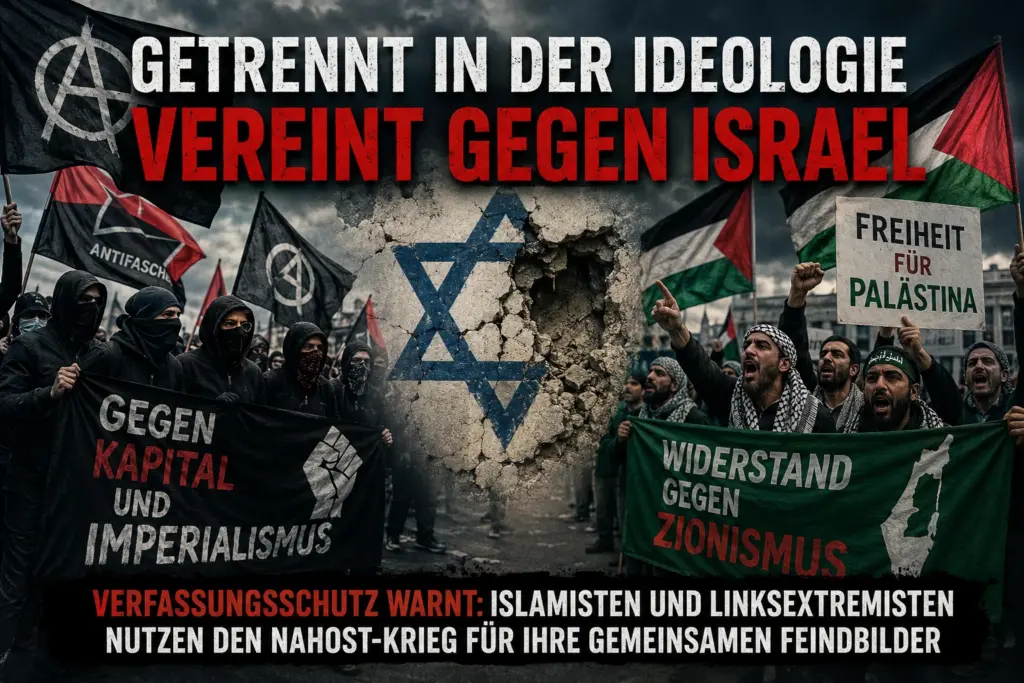

Islamists and left-wing extremists represent fundamentally different worldviews. But as soon as Israel becomes their common enemy, these differences recede into the background with surprising speed. The Lower Saxony Office for the Protection of the Constitution describes a dangerous ideological overlap that is visible at demonstrations and particularly on social networks.
The connecting factor is not a shared political vision, but hostility toward Israel. Antisemitism, anti-Zionism and anti-imperialism create a resonance chamber in which actors come together who would presumably fight each other bitterly under other circumstances.
The official X post by the Office for the Protection of the Constitution
In a post on X, the Lower Saxony Office for the Protection of the Constitution also summarises its findings. The authority stresses that some Islamists and left-wing extremists demonstrate for similar goals despite their fundamental differences.
The authority’s clarification is noteworthy: Criticism of the Israeli government is, of course, permitted and can be necessary for the political examination of a conflict.
This clarification is important because it refutes a frequently used excuse. Anyone who criticises antisemitism or the delegitimisation of Israel is not thereby declaring every criticism of Israeli policy forbidden. What matters is the content, language and purpose of the statement in question.
Islamists and left-wing extremists at the same demonstration?
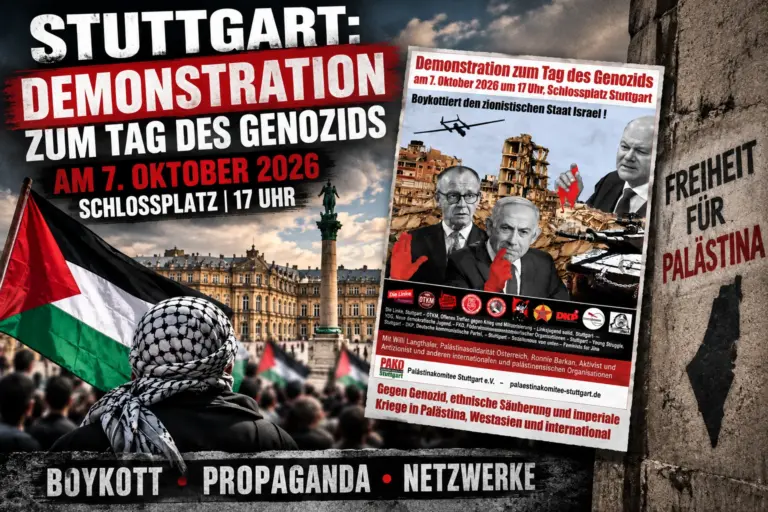
What sounds irreconcilable has already been observed several times in Lower Saxony during protests over the war in the Middle East.
Post by the Lower Saxony Office for the Protection of the Constitution on X
Together in the streets, although their ideologies collide
The 2025 Lower Saxony Office for the Protection of the Constitution report devotes a separate special chapter to the effects of the war in the Middle East and antisemitism. In it, the authority describes a development that has become increasingly visible since Hamas’s terrorist attack on 7 October 2023.
According to the report, pro-Palestinian and anti-Israel protests feature Islamists, secular Palestinian extremists, as well as German and Turkish left-wing extremists as organisers, drivers of mobilisation or participants.
Their ideological foundations differ considerably. Islamists seek a religiously determined social order. Left-wing extremists often fundamentally reject religion and explain social conflicts through capitalism, colonialism and alleged imperial power structures.
Nevertheless, these worldviews meet on the subject of Israel. Israel is portrayed as a Western, colonial or imperialist enemy. The Jewish state does not appear as a democratic actor with legitimate security interests, but as an inherently illegitimate entity whose existence must be overcome.

Passende X-Beiträge
Aus dem SCHLAGSEITE X-Archiv

What the Office for the Protection of the Constitution actually finds
The report describes antisemitism, anti-imperialism, hostility toward Israel and the rejection of Western values as connecting elements between the extremist actors involved.
The common denominator does not, however, mean that Islamists and left-wing extremists have suddenly formed a united organisation or a lasting political alliance. The Office for the Protection of the Constitution expressly does not speak of an already existing structural cooperation.
Rather, the issue is limited overlaps, joint protests and a digital resonance chamber. In this space, similar slogans, narratives and enemy images are disseminated, even though their ideological justification may differ.
At the same time, the Office for the Protection of the Constitution warns that old connections could become visible again as a result and that new contacts could emerge. In individual cases, this could lead to stronger cooperation in the future.

ℹ️ Important distinction
The Office for the Protection of the Constitution does not classify all participants in pro-Palestinian demonstrations as extremists. According to the report, people with non-extremist, pacifist or anti-militarist views also took part in 2025. The authorities observe specific extremist actors, organisations and ideological patterns.
Where criticism ends and delegitimisation begins
Legitimate criticism addresses specific decisions by a government, an authority or the armed forces. It can be harsh, uncomfortable and morally pointed. However, it continues to recognise Israel as a legitimate state and does not hold Jews collectively responsible for political decisions.
Anti-Zionist and antisemitic agitation, by contrast, pursues a different goal. It does not merely question individual decisions, but Israel’s very right to exist. The Jewish state is portrayed as an allegedly colonial, racist or inherently criminal project.
The report describes how anti-imperialist left-wing extremists view Israel as an “apartheid state”, “settler colony” or outpost of the USA .In these milieus, Hamas’s terrorist attack of 7 October 2023 is sometimes reinterpreted as allegedly legitimate resistance, while the Jewish victims are ignored.
In Islamist circles, the same hostility is justified on religious grounds. Israel is regarded as an alien body in a supposedly exclusively Islamic region. Zionism is often not understood as Jewish national self-determination, but as a cipher for alleged Jewish power and conspiracy.
The justifications differ. The result remains similar: Israel is demonised, delegitimised and declared the enemy.
Social networks accelerate the convergence

The ideological overlap is particularly evident on the internet. There, shared communication spaces emerge in which content is circulated without users necessarily belonging to the same organisation or political movement.
A video originating in an Islamist environment can be redistributed by left-wing extremist accounts. A claim from an anti-imperialist network can, in turn, appear in Islamist channels. The origin and original justification increasingly play a lesser role as long as the message is directed against Israel.
This makes extremist narratives more socially acceptable. Terms such as colonialism, apartheid, genocide or resistance sound political and academic, but can serve as packaging for denying Israel’s right to exist or justifying terror.
This is effective precisely because many people do not share such content out of a firmly established extremist conviction. They react to images, short videos and emotionally charged claims. Extremist actors use this outrage to bring their own interpretations to a broader audience.
Islamists and left-wing extremists: a united front without a fixed alliance
The term united front only partly describes the situation. So far, there is no fixed common alliance, no unified leadership and no continuous organisational cooperation between Islamist and left-wing extremist groups.
Nevertheless, limited overlaps emerge in protest and propaganda. They become possible because a common enemy image is strong enough to temporarily conceal the ideological differences.
For Islamists, Israel is a religious and political opponent. For anti-imperialist left-wing extremists, it is allegedly a colonial outpost of the West. For secular Palestinian extremists, the elimination of the Jewish state is at the centre of their nationalist agenda.
The paths are different. The goal of politically, morally or actually delegitimising Israel unites them.
Islamists and left-wing extremists do not form a united political movement. The Lower Saxony Office for the Protection of the Constitution nevertheless documents joint protests, digital resonance chambers and ideological overlaps. Antisemitism, anti-Zionism, anti-imperialism and the enemy image of Israel act as connecting elements.
Anyone who ignores the pattern helps the extremists
The fact that groups with completely different visions of society come together on the subject of Israel should be alarming. Not because criticism of Israel is taboo, but because legitimate criticism is repeatedly mixed with delegitimisation and hatred of Jews in these milieus.
Anyone who reflexively defends every form of hostility toward Israel as mere criticism of the government overlooks the actual pattern. And anyone who relativises antisemitic narratives because they originate in a supposedly progressive or anti-colonial milieu makes them more socially acceptable.
Extremists do not need a shared party headquarters to reinforce one another. A common enemy image, the same slogans and a digital space full of hatred and disinformation are already surprisingly powerful.
ℹ️ Factual basis and primary sources for the article 📑
▶️ Lower Saxony Office for the Protection of the Constitution:
2025 Lower Saxony Office for the Protection of the Constitution report
The special chapter “Effects of the War in the Middle East and Antisemitism” on pages 38 to 52 describes extremist actors, shared enemy images, antisemitism and possible cross-phenomenon connections.
▶️ Lower Saxony Office for the Protection of the Constitution on X:
Islamists and left-wing extremists at the same demonstration
Official post on the participation of Islamist and left-wing extremist actors in protests over the war in the Middle East and their ideological overlaps.
🔎 Found an error, criticism or addition?
SCHLAGSEITE.eu stands for careful research and transparent corrections. Have you discovered a factual error, unclear wording or a broken link? Then send me your tip. If possible, please provide a verifiable source.