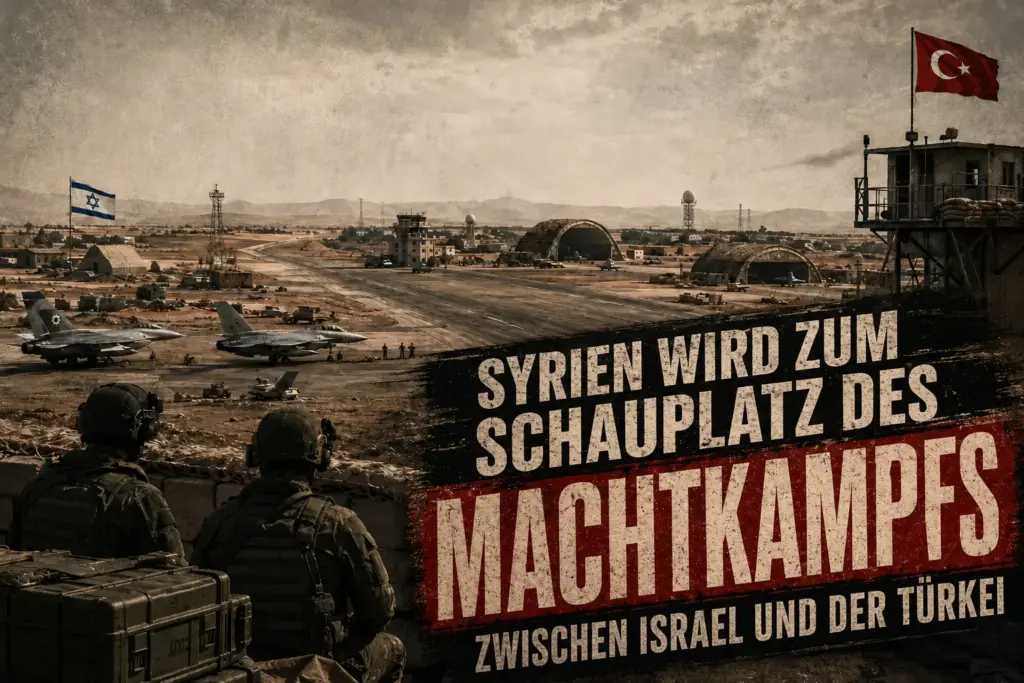


Israel and Turkey are increasingly pursuing opposing security interests in Syria. The Israeli attack on the Syrian military airfield at Abu al-Duhur was more than another strike on military infrastructure. It made visible just how fundamentally these interests now diverge. Neither state wants a direct war with the other. Yet both are drawing red lines in Syria. And that is precisely where a new regional power conflict begins.
Since the fall of Bashar al-Assad on December 8, 2024, Syria is no longer the Iranian-dominated staging ground that Israel regularly attacked for years. The old power structures have collapsed. President Ahmed al-Sharaa is trying to reunite the Syrian state, rebuild its armed forces and lead the country out of international isolation.
Al-Sharaa’s past is also part of Israel’s threat perception. He came to power as the leader of Hayat Tahrir al-Sham, HTS. The organization emerged from Syria’s Al-Qaeda milieu before breaking away from it and repositioning itself politically. Today, al-Sharaa is visibly pursuing a more pragmatic state-oriented course. Against this background, it is hardly surprising that Jerusalem is observing this transformation without simply taking it for granted.
Turkey has meanwhile become one of the most important supporters of the new leadership. Reuters describes Ankara as a central partner of Damascus. Ankara is helping build state structures, training Syrian soldiers and cooperating militarily with Damascus. Israel views this growing Turkish role with considerable mistrust.
Israel and Turkey in Syria: Abu al-Duhur Was a Message
On August 18, 2026, Israel attacked the Abu al-Duhur military airfield in northwestern Syria. According to Syrian reports, the runway and storage areas were among the targets in eight airstrikes. No deaths were reported. The airfield is located around 70 kilometers from the Turkish border and had not been operating as a regular military airfield for years.
This geography matters. Abu al-Duhur is not directly adjacent to the Israeli border and was not a suddenly established launch position against Haifa or Tel Aviv. Its relevance to Israel lay instead in the possible future use of the site, conceivable radar and air-defense infrastructure, military training and, above all, the question of whether Turkish forces could establish a permanent presence there.
After the attack, Israel said that Damascus had shortly beforehand been about to allow Turkish troops to use the site. Prime Minister Benjamin Netanyahu made clear that Israel would not accept a Turkish military establishment in Syria that, from Israel’s perspective, could endanger its security interests.
Later, the Jerusalem Post reported, citing Israeli sources, that Israeli intelligence had assumed a planned Turkish radar and air-defense presence staffed by Turkish personnel. The Israeli broadcaster Kan also reported corresponding information provided to Washington.
These accounts describe Israel’s assessment of the situation. Such an imminent deployment has so far not been independently confirmed publicly.
Damascus contradicted Israel’s account. Syria’s Foreign Minister Asaad al-Shaibani said there had been no plans for a permanent Turkish base or a permanent deployment of Turkish troops at Abu al-Duhur. At the same time, he confirmed that Turkish military personnel had visited the site as part of ongoing military cooperation.
Two Syrian government officials also confirmed to the Associated Press that a Turkish visit had taken place shortly before the attack and said it had concerned restoration work.
Ankara, by contrast, presented the matter differently. On August 20, the Turkish Defense Ministry expressly stated that no Turkish military delegation had been at Abu al-Duhur before or during the Israeli attack.

ℹ️ What Is Confirmed
Turkey is cooperating closely with Damascus militarily. Syrian officials confirmed Turkish visits to Abu al-Duhur, while the Turkish Defense Ministry denied that a military delegation had visited before the attack. Israel’s account that Turkish troops, radar or air-defense systems were about to be stationed there has not been independently confirmed publicly.
Abu al-Duhur is therefore primarily a site of signaling. Israel did not intervene because the airfield posed an immediate threat to Israel, but because Jerusalem wanted to prevent an initially limited Turkish footprint from becoming a more difficult-to-reverse military reality.

Passende X-Beiträge
Aus dem SCHLAGSEITE X-ArchivThe Warnings Came Before the Attack
That Israel was considering Turkey’s role before the attack, rather than only afterward, is shown by an unusually high-level contact just days earlier. According to reporting by Reuters Mossad chief Roman Gofman spoke by phone with Syria’s Foreign Minister al-Shaibani on August 14.
According to the report, the discussion focused on Turkish military presence, arms deliveries and drones for the Syrian armed forces. Four days later, Abu al-Duhur was bombed.
The episode shows that Israel had long been treating Turkish support for Syria’s new army as a strategic issue and did not react only once a single airfield appeared on the radar.
The Conflict Did Not Begin at Abu al-Duhur
The same underlying tension was already visible in spring 2025. Reuters reported at the time, Turkish military teams had examined, among other sites, the T4 and Palmyra air bases as well as Hama airport.
The background was talks about closer defense cooperation between Ankara and the new Syrian leadership. The discussions included training, military support and possible Turkish use of Syrian facilities.
Israel subsequently attacked several of these military sites.
Abu al-Duhur is therefore not a suddenly emerging dispute over a single airfield. It is the continuation of a strategic confrontation that began shortly after the end of the Assad regime.
Israel Thinks in Terms of Capabilities, Not Just Intentions
The Israeli response is difficult to understand if one asks only whether Turkey is planning an attack on Israel today. There is no solid evidence of that.
From Israel’s perspective, the more important question is: What military capabilities could emerge in Syria, who controls them and could they restrict Israel’s freedom of action to date?
For years, this security logic was directed primarily against Iran and Hezbollah. Tehran did not build its military infrastructure in Syria overnight either. Influence emerged gradually through advisers, arms deliveries, militias, bases and logistical networks.
After Assad’s fall, the situation changed. Iranian influence was pushed back massively. At the same time, the new Syrian leadership is attempting to restore state armed forces and military infrastructure.
This creates a new strategic calculation for Israel. In the long term, a Syrian army supported and trained by a militarily powerful NATO state has different options from the largely collapsed armed forces immediately after Assad’s fall.
Ankara is not a substitute for Tehran. Turkey is a NATO member and has not built an ideological or military project against Israel comparable to Iran’s. Nevertheless, modern air defenses, radar, drones, weapons and permanently usable military infrastructure could alter the conditions in Syrian airspace.
That is precisely why Jerusalem assesses not only stated intentions but also the capabilities that could emerge.

For Ankara, the Path Leads Through Damascus
Turkey views Syria from a completely different perspective.
Ankara wants a Syrian central state that is as capable of acting as possible. This is also in its own interest. A more stable Syria is intended to secure Turkey’s southern border, limit new refugee movements, enable economic relations and restore state control over areas that were controlled by different armed groups during the civil war.
Turkey therefore has a substantial interest in Damascus rebuilding its state authority and armed forces. Ankara has meanwhile become one of al-Sharaa’s most important allies. Turkey trains Syrian soldiers and provides military, institutional and diplomatic support.
What represents stabilization for Ankara can be interpreted by Jerusalem as the emergence of new military capabilities.
The Kurdish Question Is Not a Side Issue for Turkey
A key part of Turkish Syria policy is difficult to understand without the Kurdish question. Ankara views the Kurdish-led Syrian Democratic Forces, SDF, because of their close connection to the YPG, as part of a security problem it links to the PKK. The PKK is classified as a terrorist organization by Turkey, the United States and the European Union.
Turkish military operations in northern Syria, pressure on the SDF and support for a strong central government in Damascus therefore pursue the same strategic goal: No permanently autonomous military structure regarded by Ankara as close to the PKK should remain along Turkey’s southern border.
On August 25, 2026, SDF commander Mazloum Abdi announced the dissolution of the SDF as an independent force and its integration into the Syrian army. The following day, both AKP spokesperson Ömer Çelik and the communications director of the Turkish Presidency, Burhanettin Duran, welcomed the step as strengthening Syrian unity and state authority. Reuters reported on Çelik’s statement; Duran commented through the Presidency.
Israeli diplomats placed different emphasis on this issue. On January 7, 2025, the then director general of Israel’s Foreign Ministry, Eden Bar Tal, called for international pressure on Turkey to protect the Kurds in northern Syria. The Times of Israel reported on this at the time. This does not amount to an Israeli-Kurdish alliance against Ankara, but it does represent another point at which the two states view Syria differently.
Erdoğan’s Rhetoric Is Part of Israel’s Assessment
Israeli skepticism toward a growing Turkish military footprint is not emerging in a political vacuum.
President Recep Tayyip Erdoğan has articulated his position on Israel and Hamas very clearly over the years. Shortly after the October 7, 2023 massacre, he already declared that Hamas was not a terrorist organization for him, but rather a liberation or resistance movement. He has reaffirmed this position several times since.
At the same time, Ankara has repeatedly leveled terrorism and genocide accusations against Israel and severely strained political relations. This does not prove any Turkish intention to attack Israel militarily. But it explains why Jerusalem does not assess a growing Turkish military footprint in Syria as though it involved a politically neutral NATO partner.
After the attack on Abu al-Duhur, Erdoğan doubled down once again. In remarks reported on August 26, he said, in essence, that Turkey would not abandon Syria or other regional partners and would not allow the limits of its foreign policy to be dictated from outside.
The messages from both sides thus fit together alarmingly well: Israel draws red lines; Ankara accepts no red lines defined by Israel.
The broader strategic context of this development is examined in greater detail by the SCHLAGSEITE article “Turkish Power Politics: How Erdoğan Challenges Israel” .
Two visions of security collide
The core conflict can be reduced to one question: Who is allowed to create which military facts on the ground in Syria?
Ankara treats the rebuilding of the Syrian armed forces and cooperation with Damascus as part of a new state order. Jerusalem draws the line wherever this could produce capabilities that affect its freedom of movement or the security of its northern border.
The two sides are therefore arguing less about Syria’s abstract right to statehood than about its military reach. It is precisely this gray zone that makes misunderstandings dangerous.
The most dangerous moment would be a misunderstanding
The attack on Abu al-Duhur showed how quickly precisely this scenario can become reality.
Tom Barrack is not just any mediator. He is the American ambassador to Turkey and, at the same time, the U.S. government’s special envoy for Syria. Washington is therefore effectively positioned between a NATO ally and Israel, one of its closest security partners in the Middle East.
After the attack, Barrack said that the Turkish side had not been informed in advance about the Israeli operation. Turkish authorities could have observed Israeli aircraft heading toward their territory and might therefore have assumed that they themselves were being targeted.
According to Barrack’s account, there was a real risk that Turkey would place its own fighter jets on alert. An Israeli-Turkish incident would therefore not have required a major political war plan. A mistaken picture of the situation might have been enough.
Washington is therefore working on a so-called deconfliction mechanism between Israel, Turkey, and Syria. This refers to a permanent communication channel through which sensitive military operations are to be coordinated in such a way that no state reacts on the basis of a misunderstanding.
That sounds extremely bureaucratic. It is. But international security occasionally really does consist of ensuring that several heavily armed states do not accidentally start shooting at one another.
The fact that such a mechanism has now become necessary shows how real the reciprocal red lines have become.

The Jordan meeting has already taken place
On August 23, Syria’s Foreign Minister Asaad al-Shaibani and Mossad chief Roman Gofman met in Jordan for high-level talks mediated by the United States. According to Syrian statements, the heads of Syria’s general and military intelligence services also took part.
According to the Syrian news agency SANA, the talks concerned practical mechanisms for de-escalation, resuming negotiations on a security agreement, and explicitly preventing Israeli-Turkish tensions from escalating on Syrian soil. Reuters reported on the meeting.
Israeli sources subsequently described the talks as positive or constructive. This does not mean that a finalized agreement is anywhere near in place. But the process shows that all those involved understood how close the competition over Abu al-Duhur had come to a more dangerous escalation.
Israel’s second red line runs in the south
Anyone who explains the Israeli-Syrian conflict solely through Abu al-Duhur is seeing only its northern half.
For Jerusalem, southern Syria is at least as important.
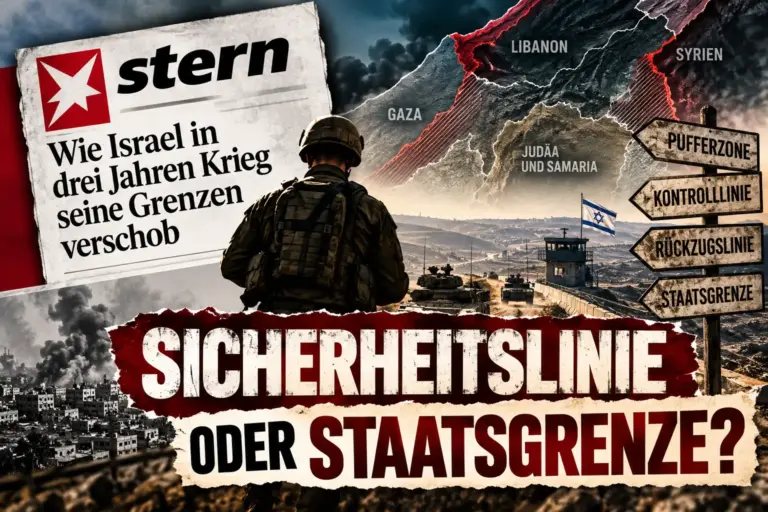
Following the collapse of the Assad regime, the Israeli army moved into the buffer zone between Israel and Syria previously monitored by the United Nations in December 2024 and occupied additional strategic positions, including on the Syrian side of Mount Hermon.
Israel justifies this presence by citing the changed security situation following the collapse of the old regime and the danger that hostile or jihadist forces could advance directly to the Israeli border.
Prime Minister Netanyahu formulated Israel’s demand much more broadly as early as February 2025. According to Reuters, he demanded the complete demilitarization of the southern provinces of Quneitra, Daraa, and Sweida and declared that neither HTS forces nor the new Syrian army should be able to build up a military threat south of Damascus.
Since then, Israeli forces have operated regularly in parts of Quneitra and Daraa. On August 22, both sides again reported an Israeli operation near Beit Jinn: Israel said that the target had posed an immediate threat to Israeli forces; Damascus spoke of a drone strike on a civilian vehicle in which one person was injured. Reuters presented both accounts.
Defense Minister Israel Katz reaffirmed on August 25, during a visit to Israeli troops in the area, that Israel would not withdraw from Mount Hermon and the security zone as long as jihadist threats could emanate from there.
Israel thus has two interconnected red lines in Syria: In the north, the issue is a possible Turkish military entrenchment. In the south, it concerns immediate strategic depth, border security, and the question of which Syrian or other armed forces may approach Israel.
Damascus wants to negotiate precisely over these points
For Syria’s leadership, the situation is almost paradoxical.
Al-Sharaa needs international recognition, investment, military training, and political partners. At the same time, a state can hardly accept indefinitely that other states determine which military infrastructure it may operate on its own territory.
Syria is therefore seeking to expand relations with Ankara while also reaching a security understanding with Israel.
At the Jordan meeting, Damascus once again made its core demand clear: Israel should return to the positions it held before December 8, 2024, and the 1974 Separation of Forces Agreement should once again be fully implemented.
At the same time, the Syrian side insists on the right to rebuild its armed forces and decide for itself on international partnerships.
The real dispute is therefore out in the open. Damascus wants its sovereignty back. Israel demands security limits on precisely that sovereignty when it produces military capabilities in sensitive areas.
Turkey, in turn, does not accept Israel dictating how far its military cooperation with Syria may go.
It takes remarkably little imagination to understand why these negotiations are difficult.
Israel wants to retain its freedom of military action
One point is likely to remain particularly important to Israel: the ability, if necessary, to strike specific military threats in Syria itself.
For many years, this freedom of action was a core element of Israeli security policy toward Iranian arms deliveries, Hezbollah structures, and military infrastructure in Syria.
Following the collapse of the Assad regime, Israel attacked large parts of the remaining strategic Syrian weapons stockpiles and military infrastructure. Israel’s stated justification was that modern weapons and strategic systems must not fall into the hands of hostile forces.
A resurgent Syrian state inevitably changes this starting position. It would change even more if modern military systems were built with Turkish support.
From Jerusalem’s perspective, the issue is therefore not only who is in control today, but what military capabilities might exist tomorrow.
The accusation that Syria is being deliberately kept weak falls short
Some analysts go further and accuse Israel of fundamentally being interested in a weak or fragmented Syria. The Deutsche Welle article that serves as the starting point also takes up this debate.
However, a permanent fragmentation of Syria cannot be substantiated as a confirmed Israeli strategy. What can clearly be substantiated is that Israel wants to prevent certain military capabilities, hostile forces, and deployments in Syria that it considers dangerous.
That is a difference.
One can criticize Israel’s concrete Syria policy without automatically deriving from every Israeli security measure a plan to permanently dismantle the Syrian state. Particularly in a conflict as complicated as this one, the most dramatic interpretation does not automatically contribute to understanding.
Not enemies at war, but hardly any trust left
Israel and Turkey are not classic enemies at war. Ankara is a member of NATO. Both states maintain close relations with Washington, and neither Jerusalem nor Ankara currently appears to have an interest in a direct military war.
That is precisely what makes the situation so peculiar.
The rivalry is unfolding below the threshold of open conflict. Both sides have communication channels, both know the risks, and both state that they do not want escalation. At the same time, they are creating facts on the ground that the other side regards as a security problem.
Both sides can therefore act rationally according to their own logic and nevertheless jointly produce a dangerous situation.
The real power struggle is only beginning
The August 18 attack is therefore not a footnote in Syria’s postwar history.
For years, Syria was primarily the scene of Israel’s struggle against Iranian expansion, arms deliveries to Hezbollah, and the construction of military structures by Tehran. That order no longer exists in this form.
The new order will be judged by whether three things can succeed simultaneously: Damascus regains state control, Ankara limits its military role so that it does not become an Israeli red line, and Israel can repel concrete threats without preventing every form of Syrian consolidation as such.
Whether robust rules will emerge remains open. The meeting in Jordan shows that diplomacy is possible. Abu al-Duhur shows why it is necessary.
Abu al-Duhur was therefore not an endpoint. It was probably a preview of what future disputes in the new Syria will be about: Who sets the military rules of the game? For Israel, this is not a matter of diplomatic etiquette, but a security issue with an immediate impact on its northern border.
Syria is no longer merely the scene of the old conflicts involving Iran, Assad and Hezbollah. In the north, Israeli and Turkish security interests are colliding; in the south, Israel and Damascus are negotiating border security, military presence and withdrawal. As long as direct talks, crisis communication and American mediation function, this need not lead to war. But the red lines are no longer merely theoretical.
ℹ️ Factual basis and primary sources for the article 📑
▶️ Reuters, August 20, 2026:
Israel and Turkey step up warnings over Syria after airbase bombing
Key facts about the attack on Abu al-Duhur, Israel’s justification, the Turkish and Syrian denials, and American mediation.
▶️ Reuters, August 19, 2026:
Mossad chief, Syrian foreign minister discussed Turkish military deployments before strikes
Report on the phone call between Mossad chief Roman Gofman and Syria’s Foreign Minister Asaad al-Shaibani, as well as Israeli concerns over the Turkish military presence, weapons and drones.
▶️ Jerusalem Post, August 22, 2026:
Israel targeted Syria airbase over planned Turkish troop, radar presence
Israeli assessment of a potentially planned radar, air-defense and troop presence in Abu al-Duhur. The information is identified as based on Israeli sources and not as an independently confirmed deployment.
▶️ Turkish Ministry of Defense / Anadolu, August 20, 2026:
No Turkish military delegation present at Syria airbase before or during Israeli attack
Official Turkish denial that a military delegation visited before or during the Israeli attack.
▶️ Reuters, April 4, 2025:
Israel hit Syrian bases scoped by Turkey, hinting at regional showdown
Background on Turkish reconnaissance of T4, Palmyra and Hama, and the Israeli-Turkish tensions already visible in 2025.
▶️ Reuters, August 25, 2026:
Syria’s Kurdish-led SDF dissolves as part of integration with Damascus
Dissolution of the SDF as an independent force and its integration into the Syrian army.
▶️ Reuters, August 26, 2026:
Turkey says SDF dissolution will help with Syrian unity
Turkey’s assessment of the SDF’s dissolution and background on Turkish security logic regarding the PKK and YPG.
▶️ Turkish Presidency, August 26, 2026:
Head of Communications Duran on the dissolution of the SDF
Official statement by Burhanettin Duran on the dissolution of the SDF and the strengthening of state authority in Syria.
▶️ Reuters / Times of Israel, January 7, 2025:
Israel calls for international pressure on Turkey to stop attack on Kurds
Statement by then-Israeli Foreign Ministry Director-General Eden Bar Tal on protecting the Kurds in northern Syria.
▶️ Reuters, August 23, 2026:
Syria, Israel hold US-mediated talks to ease tensions
US-mediated meeting between Syrian and Israeli representatives in Jordan. The topics included de-escalation, a possible security agreement, and Israeli-Turkish tensions in Syria.
▶️ Reuters, February 23, 2025:
Israel won’t allow HTS forces in southern Syria, Netanyahu says
Netanyahu’s demand for a demilitarized zone in Quneitra, Daraa and Sweida, as well as background on the Israeli presence following Assad’s fall.
▶️ Reuters, August 22, 2026:
Israel strikes southern Syria; Damascus condemns attack
Current Israeli operation in southern Syria and background on the military presence since December 2024.
▶️ Times of Israel, August 25, 2026:
Katz: Israel won’t leave Syria buffer zone
Current statement by Defense Minister Israel Katz on the Israeli presence on Mount Hermon and in the security zone.
▶️ Reuters, May 13, 2024:
Erdogan defends Hamas
Documents Erdoğan’s continued classification of Hamas as a resistance movement rather than a terrorist organization.
▶️ Deutsche Welle, August 25, 2026:
Syria – Stage for the Conflict Between Israel and Turkey
Introductory article on the rivalry between Israel and Turkey. The present article uses an independent structure, additional sources and its own security-policy assessment.
🔎 Spotted an error, criticism or addition?
SCHLAGSEITE.eu stands for careful research and transparent corrections. Have you spotted a factual error, unclear wording or a broken link? Then send me your note. If possible, please provide a verifiable source.