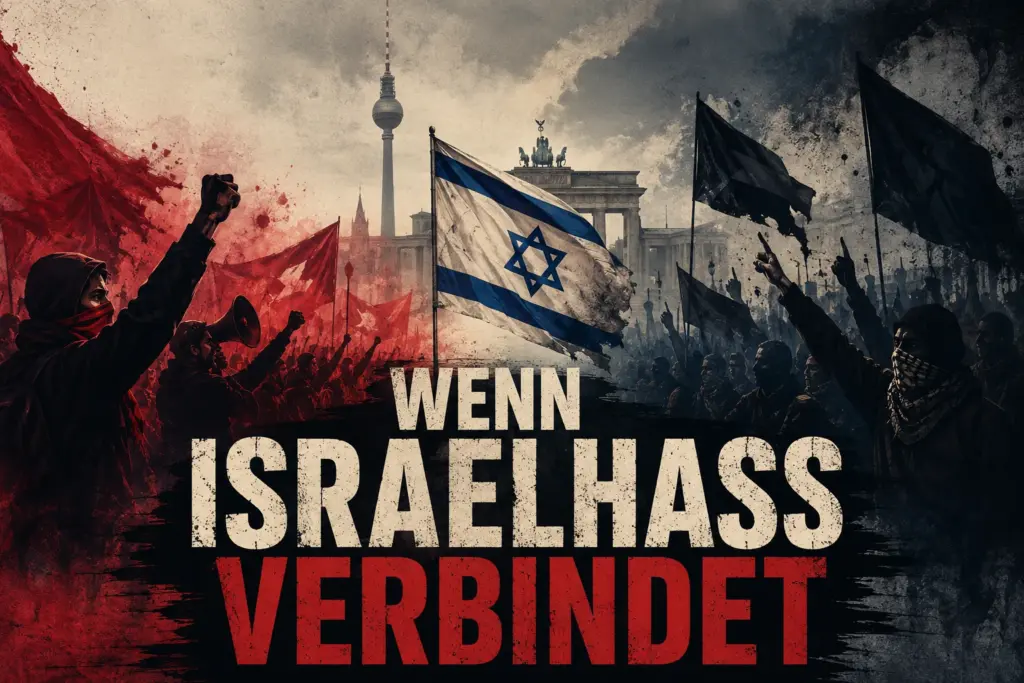

Radical leftists and Islamists often hold opposing views on religion, women’s rights, sexual freedom and society. In Berlin, parts of these milieus nevertheless repeatedly meet on the same political terrain: radical hostility toward Israel. The Berlin Office for the Protection of the Constitution now describes not only similar narratives, but explicitly networks between ideologically opposing extremist spectra.
How quickly such positions can move from extremist milieus into a normal political and cultural space became apparent on 29 August 2026 at Herrfurthplatz in Berlin-Neukölln.
Three weeks before the election to the House of Representatives, Die Linke Neukölln held an election campaign rally there together with theatre director Volker Lösch. Around 1,000 people are said to have attended. Politicians, activists and cultural figures had been announced, including Deborah Feldman, Volksbühne director Matthias Lilienthal and rapper Dahabflex.
The event then became a fairly vivid example of how far-reaching radical hostility toward Israel has now become in other political spaces.
What happened at Herrfurthplatz
Dahabflex performed his song “Stop the Genocide” toward the end of the event. In it, he chanted an intifada slogan referring to Judea and Samaria, Palestine and Gaza, as well as “Death to the IDF”. The Tagesspiegel, the Berliner Zeitung and other media consistently documented the lines in question.
During the song, numerous, predominantly young visitors danced and sang along. Palestinian flags were waved, and some attendees covered their faces. According to the reports available, the party representatives present did not intervene immediately. Hermann Nehls, co-chairman of Die Linke Neukölln, briefly went onto the stage during the performance and took photos.
The term intifada is by no means historically neutral. It refers in particular to the two Palestinian uprisings against Israel. During the Second Intifada from 2000 to 2005, more than 1,000 Israelis were killed in terrorist attacks and other assaults, including numerous civilians.
Nor is the demand for the death of the Israeli armed forces ordinary criticism of the Israeli government or of a specific military operation.

Passende X-Beiträge
Aus dem SCHLAGSEITE X-ArchivDahabflex was not a surprise guest
After the performance, the Neukölln district association stated that Dahabflex had been invited because he was perceived as an artist who advocated against war and for peace. The song in question had not been part of the programme originally agreed upon and was performed spontaneously. At the same time, Hermann Nehls rejected the accusation that his association was calling for violence.
The evening might perhaps still be explained as an unsuccessful individual performance.
Except that Dahabflex had already been an issue within Die Linke.
As early as 2025, Die Linke Neukölln had promoted the rapper for a Gaza demonstration. The former Die Linke member of the Bundestag Martina Renner publicly criticised the musician’s lyrics at the time for their references to the PFLP and the same rhetoric directed against the Israeli armed forces. The PFLP is listed as a terrorist organisation by the European Union. The Jüdische Allgemeine documented the earlier warning again after the Neukölln incident.
The problem was therefore publicly known and had already been the subject of a dispute within the left-wing milieu.
It is difficult to claim that an artist whose political line only became completely unexpectedly visible at Herrfurthplatz was involved here.
Die Linke argues with itself
That is precisely why the performance quickly developed into an internal party conflict.
Berlin’s Die Linke state chairwoman Kerstin Wolter said she was “furious” about the lyrics and called for consequences. Lead candidate Elif Eralp also sharply condemned the performance. Calls for violence and the killing of people were unacceptable; those responsible should have intervened immediately.
Federal managing director Janis Ehling drew a clear red line in comments to the Berliner Zeitung: The demand for the death of people could never be a left-wing demand.
Party chairman Luigi Pantisano, by contrast, took a considerably more restrained position. On 31 August, he said that he had not previously known Dahabflex or his music. He did not want to presume to make an artistic assessment. He trusted the district association, state association and lead candidate to investigate the incident.
When asked further, Pantisano did say that there should be no calls for violence at events. At the same time, however, he criticised the subsequent debate in comments to t-online and said that more important political questions had to be discussed, rather than songs by random rappers.
The conflict therefore does not simply run between “Die Linke” and its critics.
It runs right through the party.
The Tagesspiegel describes a clearly visible pro-Palestinian faction within Berlin’s Die Linke. According to its reporting, the state leadership recently managed, with considerable effort at party conferences, to moderate motions from this camp. At the same time, the report describes personal and organisational power struggles in several district associations.
How strongly this camp actually determines the party as a whole cannot be responsibly inferred from this.
That it exists and wields political influence within the party, however, can.
It would therefore be wrong to equate the entire Left Party with a Neukölln district association. But it would be equally wrong to play down the incident as the misstep of an individual rapper.
Here, a politically relevant district association organised an event with around 1,000 attendees in the middle of an election campaign, invited an artist who had already been controversial, did not intervene during his performance and subsequently defended the invitation.
Berlin will vote on 20 September. Political competitors reacted accordingly. In view of the incident, Green Party lead candidate Werner Graf questioned whether Die Linke was fit to govern.
The Office for the Protection of the Constitution explicitly describes the political networking
The case only acquires its real significance, however, in the broader context.
For years, the Berlin Office for the Protection of the Constitution has described an anti-Israel scene in which different extremist spectra overlap.
In the 2024 Report by the Office for the Protection of the Constitution anti-Israel and antisemitic actors are explicitly described as formative forces in the area of foreign-related extremism. At the same time, the authority states that dogmatic left-wing extremist groups have become an integral part of Berlin’s anti-Israel scene.
The detailed report also describes the particular role of the PFLP. According to the report, supporters of the organisation appeared together with Berlin-based Hamas supporters under the umbrella designation United Palestinian National Committee. According to the authority, this alliance mobilised for demonstrations and cooperated, among others, with the BDS network and dogmatic left-wing extremists.
According to the Office for the Protection of the Constitution, the PFLP assumed an important bridging function between Islamist and secular anti-Israel enemies of the constitution.
That is the decisive point.
It is not merely that Islamists and radical leftists sometimes think the same thing about Israel.
The security authority describes concrete organisational overlaps.
Samidoun disappeared as a name, not as a milieu
The now-banned Samidoun network also belongs in this context.
The Berlin Office for the Protection of the Constitution describes Samidoun as closely intertwined with the PFLP. After the ban on its activities in November 2023, the organisation no longer appeared under its previous name.
According to the Office for the Protection of the Constitution, former Samidoun activists nevertheless continued to participate in anti-Israel protests, where they attracted attention with statements glorifying violence, hostile to Israel and antisemitic.
This illustrates a fundamental problem faced by extremist networks.
An organisational ban can target a name and formal structures. The people, contacts and political milieus therefore do not automatically disappear.
Young Struggle connects left-wing extremist and anti-Israel milieus
The connection becomes even clearer in the example of Young Struggle.
The Berlin Office for the Protection of the Constitution’s 2025 report lists Young Struggle, alongside the United Palestinian National Committee and BDS Berlin, among the key actors in the anti-Israel scene relevant to the Office for the Protection of the Constitution.
The detailed report describes Young Struggle as a relevant actor in anti-Israel protests. The group calls for resistance and intifada and, according to the authority, denies Israel’s right to exist.
Its position on 7 October 2023 carries particular weight.
The Office for the Protection of the Constitution identifies clear support for Hamas and a legitimisation of the terrorist attack by Young Struggle. The group’s publications placed the attack within a narrative of Palestinian “resistance” and alleged liberation.
The group’s composition is also noteworthy. According to the Office for the Protection of the Constitution, many young people without a migration background are also found among Young Struggle’s members. At the same time, the authority describes the organisation as focused on broad appeal and networking.
This is precisely where an ideological commonality becomes a political bridge.

BDS is growing within the anti-Israel scene
BDS Berlin also plays a central role, according to the Office for the Protection of the Constitution.
The movement is classified as an organisation demonstrably hostile to the constitution. For 2024, the Berlin Office for the Protection of the Constitution justified this by citing the BDS campaign’s ideology, which denies Israel’s right to exist, and its central role within Berlin’s anti-Israel scene.
For 2025, the authority again lists BDS Berlin among the key actors in the anti-Israel scene relevant to the Office for the Protection of the Constitution.
Together with Young Struggle, PFLP and Hamas supporters, former Samidoun activists and other groups, this does not amount to a unified bloc.
But it does amount to a protest and networking milieu.
Hatred of Israel bridges ideological divides
Why does this cooperation work at all?
After all, Islamists and communists do not share a common model of society. When it comes to the relationship with religion, women’s rights, homosexuality or individual freedom, the differences could hardly be greater.
But they do not have to resolve these differences.
A common opponent is sufficient for political cooperation.
Parts of the radical left view Israel through a strictly anti-imperialist and anti-colonial lens. In this view, the Jewish state appears less as a democratic society with its own security interests and a complex history, and more as a Western colonial project.
This shifts the crucial question.
What matters less is what an actor stands for than whom they are fighting against.
A secular terrorist organisation such as the PFLP, Islamist Hamas supporters and German far-left extremists can thereby become part of the same protest milieu, even though their political end goals differ considerably.
Hostility toward Israel creates a political overlap between opposing milieus.
This requires neither a secret plan nor a central command room. The networks, joint demonstrations and organisational overlaps are publicly documented.
“Islamo-Gauchisme” explains only part of it
In France, the term “Islamo-Gauchisme” is often used for such overlaps.
As a scholarly category, it is problematic. In 2021, a research consortium of the French CNRS referred to the CNRS’s statement at the time, according to which the term did not correspond to any scientifically defined reality and was being politically instrumentalised.
That does not make the observed Berlin phenomenon disappear, however.
For Berlin, it is less important anyway what one calls it.
What matters is what can be substantiated.
The Berlin Office for the Protection of the Constitution documents cooperation and overlap between PFLP supporters, Hamas supporters, BDS activists and far-left extremists. It describes Young Struggle as an influential actor in anti-Israel protest activity and documents networking across ideological boundaries. The finding requires no French buzzword.
Criticism of Islamism is not hostility toward Muslims
A clear distinction is particularly necessary on this issue.
Muslims are not a political movement. They hold highly diverse religious and political positions.
Islamism, by contrast, is a political ideology that seeks to make religious norms the determining principle of society and the state.
A liberal democracy must be able to protect Muslim life while combating Islamism at the same time.
Anyone who equates the two does not protect Muslims. Rather, they strengthen those Islamists who themselves claim to speak for Muslims as a whole.
The same applies to Palestine. Solidarity with Palestinian civilians is not extremist. Criticism of Israeli government policy is not antisemitic.
But legitimising terrorist organisations, denying Israel’s right to exist or advocating violence against Israelis does not become democratic merely because it is called solidarity with Palestine.
For Jewish Berliners, this is not an academic debate
The Berlin Office for the Protection of the Constitution explicitly establishes a connection to Jewish life in the capital.
When presenting the 2025 report, Interior Senator Iris Spranger specifically warned that extremist groups were increasingly directing their activities at adolescents and young adults. According to the authorities, the anti-Israel scene relevant to the protection of the constitution continued to spread propaganda and organise events at which Israel’s right to exist was denied and Hamas’s terrorism celebrated.
This turns an ideological dispute into a concrete social security issue.
Because radical hostility toward Israel does not necessarily stop at the abstract state of Israel.
It also changes the everyday lives and sense of security of Jewish people in Berlin.
The cultural scene is not automatically complicit either
The fact that several cultural figures appeared at the same event does not automatically make them supporters of Dahabflex’s statements.
Volksbühne director Matthias Lilienthal told the Tagesspiegel, he had not previously known Dahabflex. He was no longer on site during the rapper’s later performance. In his view, the call for the death of members of the Israeli armed forces clearly crossed a line and could not be justified.
The political question is not who happened to take the same stage on the same evening.
It is who consciously gives extremist positions space, who defends them and who draws boundaries.
No infiltration theory necessary
What is documented is entirely sufficient.
There are milieus and networks in which the radical left, secular Palestinian extremists and Islamists come together despite considerable ideological differences. The Berlin Office for the Protection of the Constitution describes cooperation, joint protest structures and a bridging function between these spheres.
The appearance at Herrfurthplatz shows how positions that have been widespread for years in extremist anti-Israel milieus have meanwhile become capable of gaining traction in democratic political spaces.
A democratic actor bears responsibility for whom they gives their stage to and where they draw their red lines.
Anyone who repeatedly invites radical hostility toward Israel into democratic spaces may eventually no longer be surprised that it takes hold there.
ℹ️ Factual basis and primary sources for the article 📑
▶️ Berlin Office for the Protection of the Constitution:
Berlin Office for the Protection of the Constitution publishes 2025 report
Current official assessment of the anti-Israel scene, BDS Berlin, Young Struggle, foreign-related extremism, Islamism and the targeted recruitment of young people.
▶️ Berlin Office for the Protection of the Constitution:
Berlin Office for the Protection of the Constitution publishes 2024 report
Assessment of the PFLP, BDS Berlin, Islamist and far-left actors, as well as the growing significance of anti-Israel activities in Berlin.
▶️ Tagesspiegel:
Open Jew-hatred in the Neukölln Left’s election campaign
Documentation of Dahabflex’s appearance at Herrfurthplatz, the slogans and the initial political reactions.
▶️ Tagesspiegel:
This is how deeply antisemitism is entrenched in Berlin’s Left Party
Investigation into the internal party split, the pro-Palestinian solidarity camp and the power struggles within Berlin’s Left Party.
▶️ Tagesspiegel:
Matthias Lilienthal on the Dahabflex appearance
Interview with the Volksbühne director about his participation in the event and his subsequent assessment of the rapper’s performance.
▶️ Berliner Zeitung:
Neukölln Left defends rapper Dahabflex’s appearance
Report on the course of the rally, Hermann Nehls, the reactions of the party leadership and the position of Federal Managing Director Janis Ehling.
▶️ t-online:
Left Party leader Pantisano reacts to the Dahabflex appearance
Documentation of Luigi Pantisano’s statements of 31 August 2026 and his reaction to the internal party debate.
▶️ Jüdische Allgemeine:
Earlier warnings about Dahabflex were already known
Report on Martina Renner’s warning from 2025 and the debate at the time over the rapper’s lyrics and links to the PFLP.
▶️ TEMOS / CNRS:
Contextualising the term “Islamo-Gauchisme”
Scholarly criticism of the politically used term and reference to the CNRS statement of February 2021.
🔎 Found an error, criticism or addition?
SCHLAGSEITE.eu stands for careful research and transparent corrections. Have you discovered a factual error, unclear wording or a broken link? Then send me your information. If possible, please provide a verifiable source.