
00:00 / –:–
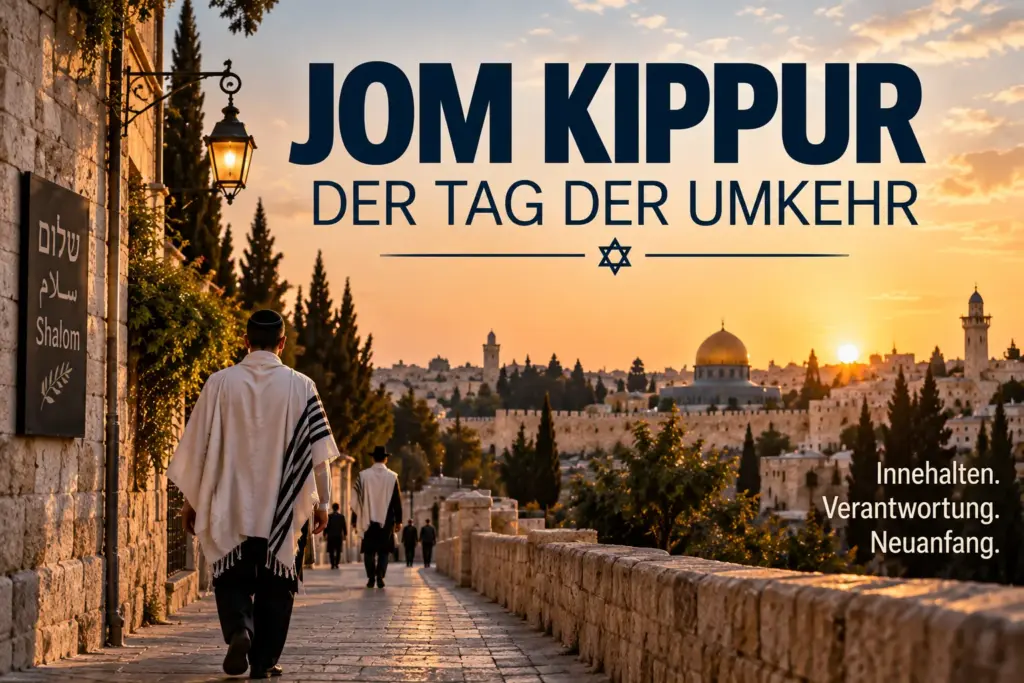
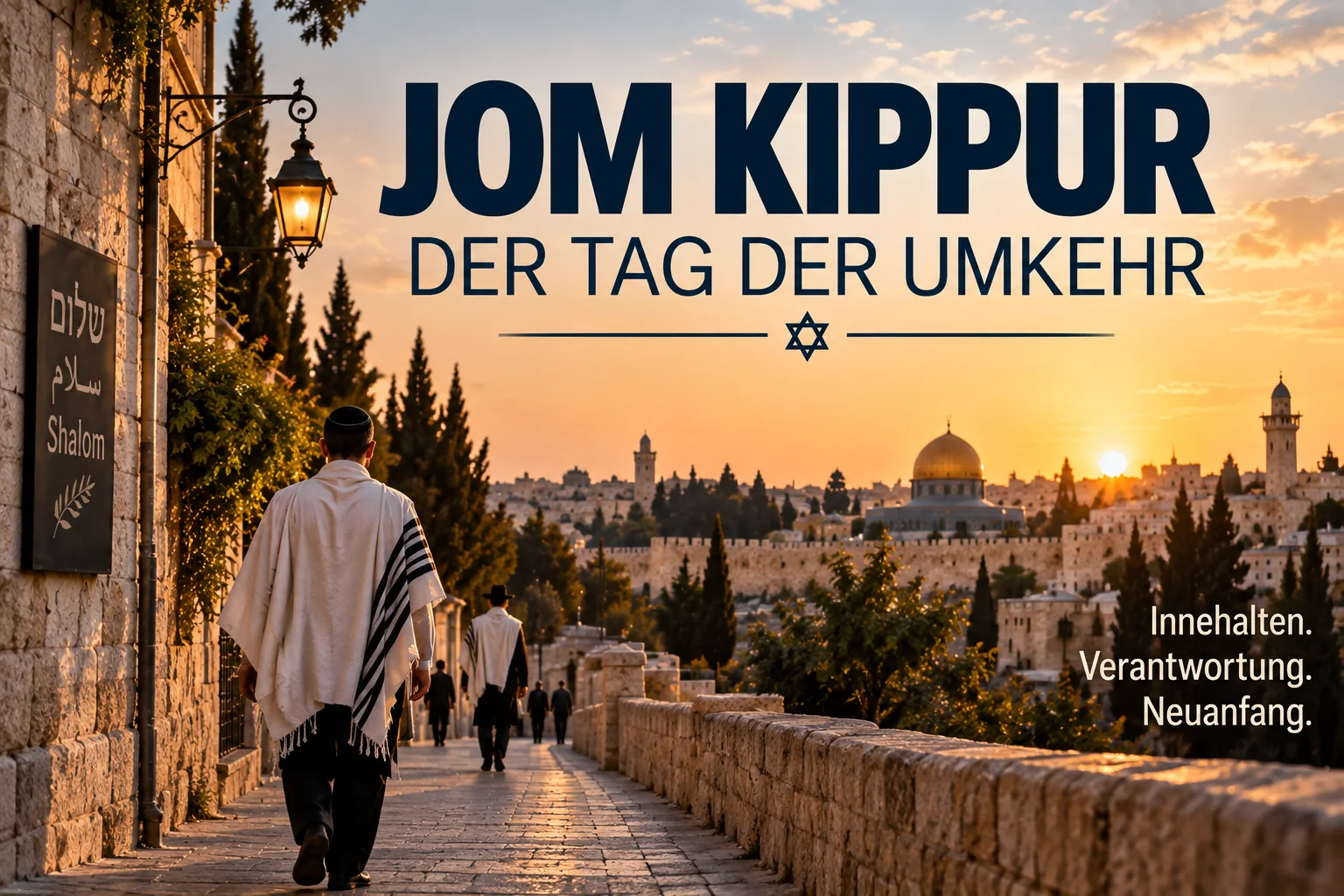
Yom Kippur begins on Sunday evening, September 20, 2026. For around 25 hours, Israel visibly changes. Streets empty, air traffic comes to a standstill, shops remain closed and millions of people fast. But the holiest day of the Jewish year is about far more than abstinence. At its core is a more uncomfortable question: What must a person change when a simple “I’m sorry” is not enough?
In the Jewish year 5787, Yom Kippur falls on the 10th of Tishrei. The Day of Atonement begins at sunset on Sunday and ends on Monday evening, September 21. This marks the culmination of the Ten Days of Repentance, which began with Rosh Hashanah. According to Jewish tradition, the judgment for the coming year is written on Rosh Hashanah and sealed on Yom Kippur. This is also the origin of the traditional greeting “G’mar Chatima Tova,” which essentially wishes for a good final sealing. The Jewish calendar platform Hebcal confirms the period from the evening of September 20 to the evening of September 21 for 2026.
How deeply this day is rooted in Israel can be seen not only in synagogues. The Israel Airports Authority gradually suspends operations. At Terminal 3 of Ben Gurion Airport, both the last international departure and the last international arrival are scheduled for 13:55 on Sunday. On Monday evening, the first international aircraft is scheduled to land at 22:30, while the first international departure is scheduled for 23:30. Ramon and Haifa airports, as well as several land border crossings, also close temporarily. A modern state really does shut down for Yom Kippur.

Yom Kippur: Teshuvah Means More Than Remorse
The key concept of Yom Kippur is teshuvah. The Hebrew word is often translated as remorse or repentance, but literally means “return.” It does not mean feeling bad for one day and then continuing exactly as before. Teshuvah requires recognizing a wrong path and leaving it.
This makes the Jewish understanding of repentance significantly different from the convenient idea of a religious reset that returns every year. Yom Kippur is not a free pass for the past year, and certainly not a pre-booked acquittal for the coming one.
The Mishnah in Tractate Yoma 8:9 formulates this particularly clearly. It distinguishes between transgressions against G’tt and transgressions against other people. For transgressions between a person and G’tt, Yom Kippur can bring atonement. But if someone has wronged another person, the Day of Atonement is not enough. First, reconciliation must be sought with the person who was harmed.

ℹ️ What Teshuvah Requires
In Judaism, repentance means more than remorse. Wrongdoing should be recognized, stopped and corrected as far as possible. Someone who has wronged another person cannot replace this responsibility merely through fasting or prayer.
Yom Kippur Requires Responsibility and Restitution
This very idea makes Yom Kippur remarkably concrete. Someone who has deceived, humiliated, injured or harmed another person cannot simply settle the matter between themselves and G’tt. The wrong arose between people and must also be addressed there.
Fasting does not replace restitution. A prayer does not replace a necessary apology. And a sacred calendar day does not automatically relieve a person of responsibility for their conduct.
The Mishnah goes even further. It expressly rejects the notion that someone could sin deliberately while already relying on Yom Kippur to settle the matter later. Thus, the Day of Atonement is not directed only toward the past. It demands change for the future.

The Roots Lie in the Torah
The biblical foundation of the Day of Atonement is found primarily in Leviticus 16. There, the tenth day of the seventh month is described as a special day of atonement and purification. At the same time, an extraordinary Temple service is established, whose central duties were performed by the Kohen HaGadol, the High Priest.
Among the best-known elements were two male goats. Lots were cast over them. One was designated for G’tt, the other “for Azazel.” The High Priest symbolically placed the transgressions of the people of Israel on the second goat before sending it into the wilderness. The precise meaning of Azazel has been interpreted in different ways in Jewish tradition.
Israelnetz covers this Temple service in detail and describes various traditional interpretations of Azazel. For the meaning of today’s Yom Kippur, however, it is decisive that the Temple service can no longer be performed since the destruction of the Second Temple by the Romans in the year 70.
Prayer, vidui, the confession of sins, fasting and teshuvah consequently moved even more strongly to the center. The memory of the Temple service remained part of the liturgy, but the individual’s responsibility could never be reduced to a Temple ritual in any case.
Fasting Is a Means, Not the Goal
Outside Judaism, Yom Kippur is often reduced to its best-known feature: fasting. According to traditional Jewish practice, five forms of physical abstinence apply during the Day of Atonement. They include eating and drinking, washing and anointing the body, wearing leather shoes and marital intimacy. An up-to-date overview for 2026 is provided, among others, by the Chabad Yom Kippur guide.
The purpose is not to suffer as impressively as possible. Physical everyday life recedes for a limited period. Prayer, self-examination and repentance are meant to come to the forefront.
For this reason, too, the fasting requirement is not understood as a religious endurance test. If fasting could pose a serious health risk, special halachic rules apply. In such a situation, the fasting requirement may take second place. In its halachic explanation of eating for medical reasons, Chabad expressly points out that necessary food or drink should not be refused against medical advice.
The service begins on the eve with Kol Nidrei. Long prayers and repeated confessions of sin follow throughout the day. The conclusion is Ne’ila, the closing liturgy. The name means “closing” and is traditionally associated with the closing of the gates. At the end, the shofar is sounded.
Yom Kippur Brings Religious and Secular Israelis Together
Anyone who views Yom Kippur merely as a holiday for Orthodox Jews overlooks its social significance in Israel. A study by the Israel Democracy Institute published on September 15, 2026, shows how deeply the day is rooted even outside strictly religious circles.
The underlying survey of 1,002 Jewish Israelis aged 18 and over was conducted in July and August 2026. According to it, 74 percent of Jewish Israelis fast completely or at least partially on Yom Kippur. Sixty-three percent observe the full fast, while a further 11 percent fast partially.
Even among Israelis who describe themselves as secular, 28 percent fast completely. Another 19 percent fast at least partially or in some years. This means that almost half of secular Jewish Israelis observe at least part of the fasting tradition.
Synagogue attendance is similarly revealing. Fifty-seven percent of Jewish Israelis usually attend a service on Yom Kippur. For 18 percent, Yom Kippur is typically even the only occasion during the year on which they visit a synagogue.
These figures reveal a distinctive feature of Israeli society. Religious and secular are not always two clearly separate worlds there. People may live secular lives day to day and still fast, listen to Kol Nidrei, go to the synagogue for Ne’ila or consciously spend the day in quiet. Yom Kippur is therefore part not only of Israel’s religious life, but also of its Jewish cultural identity.
Yom Kippur Visibly and Audibly Changes Everyday Life in Israel
This connection is visible on hardly any other day to the same extent. Road traffic drops drastically, and pedestrians and cyclists shape the streetscape in many Israeli cities. Public life slows down in a way that is unusual in the everyday life of a modern state.
The fact that even international air traffic at the country’s largest airport comes to a complete stop for hours makes the scale tangible. In Israel, Yom Kippur is not a holiday recognizable only on the calendar. The character of the country changes audibly and visibly.
This does not mean that every Israeli has the same religious approach. The new IDI survey clearly distinguishes between Haredim, national-religious, religious-traditional, nonreligious-traditional and secular Jews. That is precisely why the day’s shared social imprint is remarkable.
No Acquittal at No Cost
Perhaps this is where the true strength of Yom Kippur lies. The day speaks of forgiveness, but does not make it cheap. It combines hope for atonement with personal responsibility.
Anyone who has taken a wrong path should leave it. Anyone who has hurt another person should not merely ask G’tt for forgiveness, but face that person. Anyone who takes teshuvah seriously does not merely try to feel better. They try to act better.
Yom Kippur is not an annual religious delete button. The Day of Atonement combines forgiveness with responsibility. That is precisely why genuine teshuvah does not begin with the question of whether the fast was completed, but with the question of what changes afterward.
When the shofar sounds on Monday evening and Israel slowly returns to everyday life, more than a day of fasting therefore comes to an end. The decisive question of Yom Kippur is not only what a person has been forgiven for. It is also which path they take afterward. G’mar Chatima Tova.
ℹ️ Factual basis and primary sources for the article 📑
▶️ Torah / Sefaria:
Leviticus 16
Biblical foundation of the Day of Atonement and the special Temple service of the Kohen HaGadol.
▶️ Mishnah / Sefaria:
Mishnah Yoma 8:9
Basis for the distinction between transgressions against G’tt and transgressions against other people, as well as for the importance of personal reconciliation.
▶️ Israel Democracy Institute:
Patterns of Fasting and Synagogue Attendance on Yom Kippur
Analysis published on September 15, 2026, of a representative survey of 1,002 Jewish Israelis on fasting and synagogue attendance on Yom Kippur.
▶️ Israel Airports Authority:
Current information on Yom Kippur 2026
Official operating hours and closures of Ben Gurion Airport, as well as Ramon and Haifa airports and several land border crossings.
▶️ Hebcal:
Yom Kippur 2026
Calendar dates for the 10th of Tishrei 5787, as well as the beginning and end of the Day of Atonement in 2026.
▶️ Chabad:
Yom Kippur Reference Guide 2026
Overview of fasting, physical abstinences, prayers and religious practice on Yom Kippur.
▶️ Chabad on the medical exception to fasting:
What is the procedure for one who must eat on Yom Kippur?
Halachic classification of eating and drinking on Yom Kippur when this is medically necessary.
▶️ Israelnetz:
The Fate Is Sealed
Background on the Temple service, Azazel, and the traditional significance of the Day of Atonement.
🔎 Found an error, criticism, or addition?
SCHLAGSEITE.eu stands for thorough research and transparent corrections. Have you discovered a factual error, unclear wording, or a broken link? Then send me your note. If possible, please provide a verifiable source.