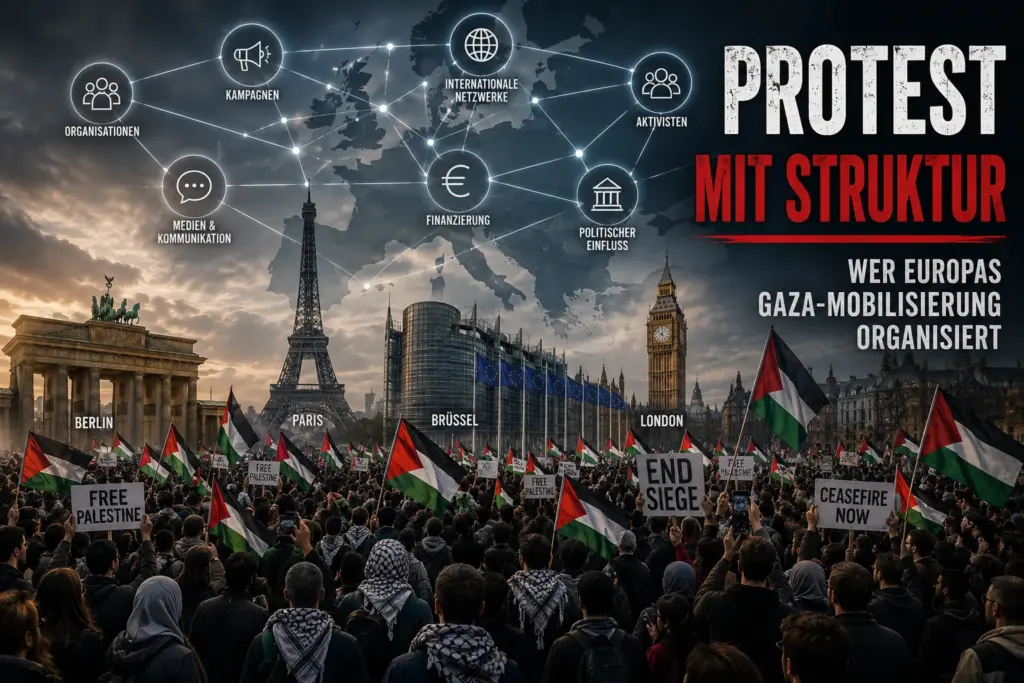

Gaza protests in Europe have been part of the political street scene in London, Berlin and Brussels since the Hamas massacre of October 7, 2023. Many participants take to the streets out of personal conviction. But the idea that these protests are driven merely by spontaneous outrage falls short. Large demonstrations require organization, money, communication, campaign structures and networks. And these structures can be traced in several European countries.
This does not mean that Europe’s Gaza protests are controlled by a secret headquarters. Nor does it mean that every demonstrator is a member of an extremist organization. The verifiable finding is considerably more sober—and precisely for that reason more interesting: In the United Kingdom, Germany and at the European level, organizations and alliances have existed for years that coordinate protests, mobilize activists, develop campaigns and exert political pressure on governments and institutions.
Authorities have also documented links between individual actors and extremist organizations or milieus. Others operate entirely legally as NGOs, political campaigns or solidarity groups. Some benefit from tax advantages or public funding. These different levels must be kept separate if legitimate criticism is not to turn into a conspiracy narrative.

Passende X-Beiträge
Aus dem SCHLAGSEITE X-ArchivThe crowd is visible; the infrastructure behind it is not
At first glance, a demonstration seems simple in pictures: People come together, carry flags and posters, and chant slogans.
Yet even a larger rally requires someone to register it, organize a route, provide loudspeakers and stages, coordinate stewards, invite speakers, manage social media channels, produce graphics, handle press relations and mobilize supporters.
The larger and more sustained a protest movement becomes, the less it can be explained without organizational infrastructure.
That is precisely what makes the United Kingdom an interesting case study. A report published in July 2026 by NGO Monitor examined 40 organizations and campaigns that had repeatedly appeared in the context of British Gaza protests since October 7, 2023.
The report examines not only organizers, but also funding, campaign work, personnel overlaps and international links. The different organizational forms are particularly revealing: According to NGO Monitor, of the 40 actors examined, ten are registered as charities, eight as companies, nine operate in hybrid structures and 13 fall outside a formal British regulatory framework.
These different configurations make it particularly difficult to trace responsibility and flows of money. NGO Monitor explicitly states that, because of a lack of transparency, neither all sources of funding nor the full expenses for demonstrations can be determined.
United Kingdom: Six organizations coordinate the major protests
The fact that established structures stand behind the major demonstrations is not a finding made only by NGO Monitor.
The British government investigation published in 2024, “Protecting our Democracy from Coercion”, often referred to as the Walney Review, had already identified six organizations that jointly coordinated major national protests:
- Palestine Solidarity Campaign
- Friends of Al-Aqsa
- Palestinian Forum in Britain
- Stop the War Coalition
- Campaign for Nuclear Disarmament
- Muslim Association of Britain
These organizations worked together as a British protest coalition under the name “Together for Palestine.” This explicitly refers to the coalition of the six groups, not to the identically named charity concert organized by Brian Eno, which took place at Wembley Arena in 2025.
Two levels of investigation must therefore be clearly distinguished: The six-member coalition and its role in demonstrations had already been officially described in 2024. In 2026, NGO Monitor broadened the scope to a larger field of 40 organizations and campaigns, as well as funding, regulation and transparency.
The Walney Review describes the protest coalition as an expression of alliances between parts of the British radical left and Islamist organizations. These relationships had grown over many years and developed out of joint political campaigns.
Personnel links are also identified. The investigation refers, for example, to the Muslim Association of Britain and its historical links to the Muslim Brotherhood. In the case of Friends of Al-Aqsa, it documents earlier positive statements by its founder Ismail Patel about Hamas, as well as his meetings with Ismail Haniyeh.
Regarding the Palestinian Forum in Britain, the report refers to several individuals who are said to have links to Hamas. For some of the claims, the investigation explicitly relies on Israeli security information.
This is not proof that Hamas controls the British demonstrations. But it does show that part of the organizational infrastructure contains political and personal overlaps that go far beyond ordinary peace activism.

ℹ️ Two levels that must not be confused
A demonstrator can participate out of personal conviction without belonging to an organizing body. However, the fact that participation is voluntary says nothing about whether the event itself was professionally organized. Spontaneous motivation and organized mobilization are not mutually exclusive.
Tax money in the United Kingdom: The finding is more complicated
The question of public support is particularly explosive.
NGO Monitor states that 19 of the 40 organizations examined receive support from the British state, either through funding relationships with the Foreign, Commonwealth & Development Office or through the so-called Gift Aid system. At least eleven organizations are also said to be supported by government bodies in other countries or by European institutions.
But direct funding and Gift Aid are not the same thing.
Under the British Gift Aid system, recognized charitable organizations can receive an additional 25 pence from the tax authorities for every pound donated in qualifying private donations. A private donation of £100 can thus become £125 for the organization.
This is a state-provided tax benefit. But it does not mean that the British government is financing a budget item called “Gaza demonstrations.”
The relevant political question is a different one: What transparency and political accountability requirements apply to organizations that receive tax privileges or public funding while also participating in highly political campaigns?
This question becomes all the more important when officials’ links to extremist milieus have been documented.
Germany: Samidoun shows how mobilization works
Anyone who now believes this is a specifically British problem should take a look at Germany.
The Federal Office for the Protection of the Constitution describes the now-banned Samidoun network as an organization founded in 2011 by members of the terrorist Popular Front for the Liberation of Palestine, PFLP, living abroad.
According to the Office for the Protection of the Constitution, Samidoun’s political positions corresponded to those of the PFLP, including its rejection of Israel’s right to exist. The network allegedly endorsed violence as a political means and supported terrorist organizations such as the PFLP and Hamas, primarily through propaganda.
For our question, however, another part of the report is particularly interesting.
According to the Office for the Protection of the Constitution, Samidoun deliberately used demonstrations and the internet for networking, recruiting members, collecting donations and disseminating propaganda. This enabled it to reach people far beyond its own established circle of supporters.
That is precisely what political mobilization consists of: A relatively small organizational structure reaches a much larger audience.
After the Hamas massacre of October 7, 2023, Samidoun intensified these activities. Supporters publicly celebrated the terrorist attack. On November 2, 2023, the Federal Ministry of the Interior banned the network’s activities in Germany and dissolved its German structures.
The milieu did not disappear as a result, however. The Office for the Protection of the Constitution explicitly states that former Samidoun actors remained active in the extremist pro-Palestinian scene in 2024.
Berlin provides perhaps the clearest finding
A study published by the state of Berlin on antisemitic protest mobilization after October 7 addresses the question of structures in unusual detail.
It describes Hamas, the PFLP and Samidoun as central anti-constitutional actors in the first phase of the protests. People from this milieu had called almost daily for anti-Israel rallies.
The study draws a direct conclusion from this: Several thousand people do not take part in such a rally spontaneously and out of nowhere. Gatherings of this size would not be possible without structures that coordinate, network, mobilize and set the slogans.
After Hamas and Samidoun were banned on November 2, 2023, the situation changed. The number of participants declined, and fewer offenses were recorded at the demonstrations subsequently approved.
This is not a theoretical model, but an observable connection: An organizational structure disappears, and the capacity for mobilization changes.

The structures in Berlin continue to exist
The 2025 Berlin Office for the Protection of the Constitution report shows that the anti-Israel scene did not disappear with the Samidoun ban.
The authority names the United Palestinian National Committee, BDS Berlin and Young Struggle among the key actors.
The United Palestinian National Committee, VPNK, describes the Berlin Office for the Protection of the Constitution as an umbrella term under which supporters of Hamas and the PFLP worked closely together in Berlin and jointly held rallies.
The Federal Office for the Protection of the Constitution describes Young Struggle as the European umbrella association of the youth organizations of the Marxist-Leninist Communist Party, MLKP, and as its youth organization operating directly in Germany. According to the assessment of the Office for the Protection of the Constitution, the MLKP also pursues its goals in Turkey through terrorist means. After October 7, 2023, Young Struggle was particularly active in mobilizing, organizing and participating in pro-Palestinian rallies.
BDS Berlin, in turn, sees itself as part of the international movement for boycotts, divestment and sanctions against Israel and organizes corresponding actions, protests and campaigns. In its 2025 report, the Berlin Office for the Protection of the Constitution listed the group as one of the defining actors in the anti-Israel scene relevant to the protection of the constitution.
According to the authority, this scene was also responsible in 2025 for numerous events at which Israel’s right to exist was denied and Hamas terrorism was celebrated.
The security authorities thus describe specific actors, networks and mobilization structures. This is considerably more informative for the question of how larger protest situations emerge from political milieus than a blanket labeling of all participants.
1,744 rallies involving antisemitic incidents
How strongly antisemitism is now connected with protest activity is shown by the figures from RIAS, the Federal Association of Departments for Research and Information on Antisemitism.
In 2025, the reporting centers documented a total of 8,725 antisemitic incidents in Germany. That corresponds mathematically to just under 24 incidents per day.
Particularly relevant to the protest movement: RIAS recorded 1,744 rallies involving antisemitic incidents. That is almost 34 per week.
In 89 percent of these rally-related incidents, RIAS classified the antisemitic statements or actions as Israel-related antisemitism.
RIAS therefore does not simply count every criticism of Israel as antisemitic. It records incidents that, according to the criteria of the reporting centers, possess an antisemitic quality.
The figures therefore do not permit the statement “Gaza demonstrations are antisemitic.” But they do very much permit the conclusion that antisemitic manifestations within protest activity surrounding Israel are not a rare marginal phenomenon.
And is Germany paying for this?
Here, too, a careful distinction must be made.
Based on the verifiable evidence currently available, there is no reliable proof of systematic state financing of German Gaza demonstrations.
Germany finances numerous civil-society, humanitarian and development-policy projects in the Middle East. However, this does not automatically mean that German tax money flows into demonstrations on German streets.
At the same time, Bundestag documents from 2026 show that the German government maintained a funding freeze for six Palestinian organizations, including Al-Haq, Addameer and Defense for Children International Palestine. This concerns the review and funding of civil-society projects abroad.
This process is expressly not evidence of financing for demonstrations in Berlin, London or elsewhere in Europe. It is included here solely as a parallel finding concerning the question of state funding controls: Public donors must verifiably examine to whom they provide funds or funding opportunities and what political or security-relevant connections exist in this context.
Gaza protests in Europe: The networks do not end at national borders
Perhaps the most important difference from a purely national perspective is that many of these structures explicitly operate internationally.
A good example is the Brussels-based European Coordination of Committees and Associations for Palestine, ECCP.
The organization describes itself as a network of 46 European organizations, NGOs, trade unions and solidarity groups from 19 European countries. According to its own account, it coordinates political actions, grassroots campaigns and debates at the European level.
Its membership list shows how geographically broad this network is. For Germany, ECCP lists BDS Berlin, among others. In France, for example, the Association France Palestine Solidarité, AFPS, the Plateforme des ONG françaises pour la Palestine, the Union Juive Française pour la Paix and BDS France belong to the network.
Gaza protests in Europe differ from country to country, but in some cases draw on shared networks and campaign structures. This does not make London, Berlin or Brussels a centrally controlled European system. It does show, however, that national organizations are connected through common European structures and that political campaigns do not necessarily end at national borders.
ECCP makes no secret of its political role. The organization seeks to coordinate campaigns at the European level and exert political pressure on relations between the European Union and Israel.
This is initially legal political lobbying and campaign work. At the same time, it disproves the notion that Europe’s Gaza activism consists merely of independent local protests.
From the streets into institutions
The fact that mobilization does not end along the demonstration route is also shown by the European Citizens’ Initiative “Justice for Palestine,” launched in 2026.
Supported by the Alliance of the European Left, the initiative seeks to achieve the complete suspension of the Association Agreement between the European Union and Israel.
The official European Citizens’ Initiative forum describes the campaign as an attempt to translate the mobilization that has become visible on Europe’s streets in recent years into concrete political pressure on EU institutions.
This is democratically legitimate. But it clearly illustrates the chain of development:
Demonstration, mobilization, campaign, signature collection, lobbying, institutional pressure.
Those who look only at the crowd on Saturday therefore see only the most visible part of political organization.
Billions for NGOs, but no evidence of protest financing
At the European level at the latest, one inevitably returns to the question of public funds.
The European Court of Auditors examined NGO funding in the EU’s internal policy areas. For the years 2021 to 2023, this involved more than seven billion euros in public funds.
Its conclusion was clear: Information about funding was in some cases fragmented, incomplete and unreliable. Lobbying and advocacy activities by EU-funded NGOs were also not always presented with sufficient transparency.
The Court of Auditors also criticized the fact that there was no systematic proactive review of whether funded organizations complied with the fundamental values of the European Union.
However, the Court of Auditors does not claim that these billions flow into Gaza protests or anti-Israel campaigns. Anyone who presented the total as if Brussels were using it to finance demonstrations against Israel would be conflating two different matters.
The report shows something else: There are transparency problems in European NGO funding. When publicly funded organizations also engage in political campaigns and lobbying, it must be possible to verify which funds are used for what purposes.
⚠️ The distinction is crucial
Public NGO funding is not automatically protest financing. Membership in a network is not automatically extremism. A personal connection is not automatically organizational control. That is precisely why financial flows, organizational structures and extremist connections must each be substantiated individually.
Not a command center, but a political ecosystem
So what remains of the original question?
There is no reliable evidence of a central European command center directing Gaza protests from London to Berlin.
However, such a thing is not necessary for successful political mobilization.
Rather, the available sources show a political ecosystem: local organizers, national alliances, NGOs, activist groups, left-wing organizations, Islamist networks, international solidarity associations, campaign platforms and political actors.
Some of these groups work together only occasionally. Others are institutionally networked. Some are entirely legal and democratically organized. In other cases, security authorities have documented links to extremist or terrorist organizations.
It is precisely this mix that makes the network harder to understand than the simple idea of a centrally controlled movement.

So who is behind it?
The answer is not: one organization.
In the United Kingdom, six central groups are documented as coordinators of major demonstrations. In Germany, security authorities describe extremist and activist structures that organize demonstrations and mobilize far beyond their own supporters. At the European level, networks such as ECCP connect organizations from numerous countries and transfer political demands to the EU level.
In addition, there are political parties, trade unions, NGOs, student initiatives, local groups and loose activist networks.
The Gaza protests in Europe are therefore grassroots and organized at the same time. People participate voluntarily. But the political spaces in which they are mobilized do not arise by themselves.
And this is precisely where the decisive journalistic question lies.
Not: Who told every demonstrator to take to the streets?
But: Who builds the structures, formulates campaigns, disseminates messages, collects money, organizes events and transforms outrage into sustained political pressure?
Anyone seeking to understand the Gaza protests in Europe must not look only at flags, posters and participant numbers. The structures behind them are decisive. The United Kingdom, Germany and European networks show that mobilization is organized, financed, networked and carried forward politically. This is not a secret conspiracy. It is political infrastructure.
ℹ️ Factual basis and primary sources for the article 📑
▶️ NGO Monitor:
Imported Influence: Foreign Funding, Regulatory Black Holes and Extremist Connections of the Post-October 7 UK Protest Infrastructure
Report dated July 8, 2026, on 40 organizations and campaigns in the British protest network, their organizational forms, financing, transparency and documented personal and organizational connections.
▶️ British government investigation:
Protecting our Democracy from Coercion
Walney Review published in 2024, with information on the protest coalition Together for Palestine, its six central organizations, and overlaps between the radical left and Islamist actors.
▶️ HM Revenue & Customs:
Claiming Gift Aid as a charity or CASC
Official explanation of the British Gift Aid scheme and the tax top-up for qualifying private donations.
▶️ Federal Office for the Protection of the Constitution:
2024 Report on the Protection of the Constitution
Information on Samidoun, its connection to the PFLP, and the use of demonstrations, the internet, fundraising and propaganda for mobilization and networking. The report also describes Young Struggle as a European umbrella organization of MLKP youth organizations and its youth organization in Germany.
▶️ State of Berlin:
Investigation into antisemitic assembly situations after October 7, 2023
Analysis of the organizational significance of Hamas, the PFLP and Samidoun for the early mobilization of protests in Berlin and developments following the bans of November 2, 2023.
▶️ Berlin Office for the Protection of the Constitution report 2024:
Berlin Office for the Protection of the Constitution Report 2024
Classification of the United Palestinian National Committee as an umbrella designation for cooperation between Hamas and PFLP supporters in Berlin, as well as information on joint assemblies.
▶️ Berlin Office for the Protection of the Constitution:
Berlin Office for the Protection of the Constitution Report 2025
Current assessment of the anti-Israel scene relevant to the protection of the constitution and identification of prominent actors such as the United Palestinian National Committee, BDS Berlin and Young Struggle.
▶️ BDS Berlin:
BDS Berlin’s self-description
Self-description as part of the international Boycott, Divestment and Sanctions movement, as well as information on actions, protests and campaigns.
▶️ Federal Association RIAS:
Antisemitic incidents in Germany in 2025
Nationwide documentation of 8,725 antisemitic incidents and 1,744 assemblies involving antisemitic incidents.
▶️ German Bundestag:
The work of civil society organizations in Israel
Parliamentary documents on the continued suspension of funding for six Palestinian organizations. In the article, used exclusively as a parallel finding on state funding controls, not as evidence of protest financing.
▶️ European Coordination of Committees and Associations for Palestine:
European Coordination of Committees and Associations for Palestine
Self-description as a network of 46 European organizations, NGOs, trade unions and solidarity groups from 19 countries, as well as information on political campaign work at the European level.
▶️ European Citizens’ Initiative:
Justice for Palestine European Citizens’ Initiative
Description of the campaign launched in 2026 for the complete suspension of the EU-Israel Association Agreement.
▶️ European Court of Auditors:
EU funding granted to NGOs suffers from lack of transparency
Audit report on transparency deficits concerning more than seven billion euros in EU funding granted to NGOs in internal policy areas between 2021 and 2023.
🔎 Found an error, criticism or addition?
SCHLAGSEITE.eu stands for careful research and transparent corrections. Have you discovered a factual error, unclear wording or a broken link? Then send me your note. If possible, please provide a verifiable source.