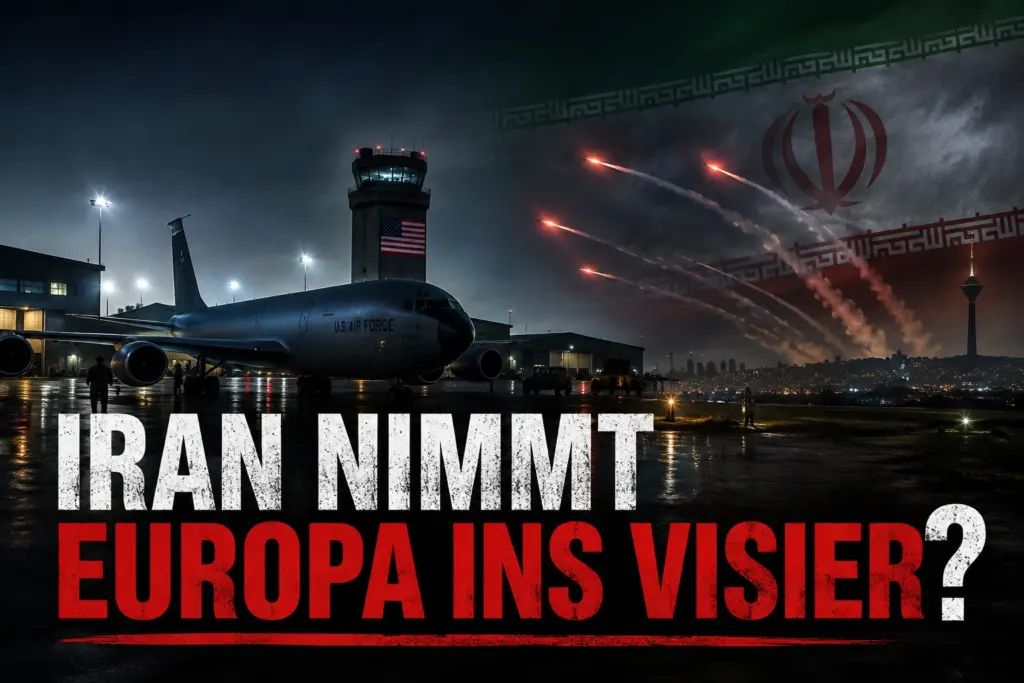

Iran is examining targets in Europe, at least as a possible military escalation scenario. According to research by the Financial Times, this concerns possible retaliation options against Western military infrastructure if the United States significantly expands the war against Iran again. Bulgaria and Cyprus are specifically mentioned.
That sounds like a new level of escalation. And that may be exactly what it is. However, there is still neither a confirmed Iranian order to attack nor a publicly known target list. Anyone who turns the report into an imminent Iranian attack on Europe is a few uncomfortable miles ahead of the established facts.
The timing of the investigation is particularly relevant. The 60-day window agreed in June for a broader understanding between Washington and Tehran expired on August 17 without a new agreement being reached. US President Donald Trump said one day later that there were currently no talks with Iran, nor were any planned. At the same time, Reuters reported, citing a senior Iranian official, that Tehran was adopting a more offensive military posture because of the diplomatic deadlock. However, no new attacks had been reported at that point.

Passende X-Beiträge
Aus dem SCHLAGSEITE X-Archiv

Iran Examines Targets in Europe: What the FT Reports
The Financial Times reports, citing two people close to the Iranian leadership, that Tehran has examined military response options extending beyond the Middle East. The focus is reportedly on US-related military targets in southeastern Europe if President Donald Trump again expands American attacks on Iran.
According to the sources, possible targets in Bulgaria and Cyprus were considered. At the same time, Iranian authorities reportedly examined scenarios for attacks on undersea fiber-optic cables in the Strait of Hormuz.
The line between verified information and possible escalation is therefore clear: The Financial Times is reporting on Iranian options that were examined. What is not known is whether their implementation has been decided. There is still no confirmed order to attack or official Iranian target list.

ℹ️ What Is Actually Established at Present
The Financial Times reports on Iranian escalation options against targets in Europe that were examined internally. Bulgaria and Cyprus are specifically mentioned. There is no evidence of an issued order to attack, a complete Iranian target list or an imminent attack.
However, the report does not stand in isolation. Tehran had already warned European countries not to make their infrastructure available for American operations against Iran. The new investigation now adds military planning scenarios to these public warnings.
Western officials also responded publicly to the report. A NATO representative said on August 19 that the alliance was prepared to counter any threat and would do everything necessary to defend its members. At the same time, NATO referred to its existing deterrence and defense capabilities. Bulgaria had already strengthened protection at Bezmer base and, according to the interior minister, had taken precautionary measures that even went beyond the threat level currently assumed by the security services.
Why Bulgaria Has Suddenly Become a Focus
The focus is Bezmer Air Base in southeastern Bulgaria. On July 22, 2026, the Bulgarian parliament approved the temporary deployment of up to eight American KC-135 tanker aircraft, their crews and up to 250 US soldiers. The authorization is valid from July 24 to October 1, 2026.
The official parliamentary resolution explicitly describes the purpose as supporting American operations in the Middle East. During the parliamentary debate, it was also explained that the planned activities were intended to be supportive and logistical in nature. The resolution does not mention Bulgarian participation in attacks on Iran.
Tehran nevertheless sees the deployment differently. At the end of July, Iranian Foreign Minister Abbas Araghchi urged Bulgaria to reconsider the use of its territory for American operations. Sofia, by contrast, said that no offensive weapons would be stationed and that Bulgaria was not a participant in military operations against Iran. Reuters reported this.
The warnings also did not begin with the current FT investigation. Iran had already repeatedly warned Bulgaria publicly against making infrastructure available to American forces for operations against Iran. NATO officials responded as early as July by stating that the alliance would defend Bulgaria against threats.
The Bulgarian security authorities subsequently increased protection of Bezmer and the country’s airspace. At the end of July, following a meeting of the Security Council, the government said that there was no direct threat to Bulgaria. At the same time, additional security measures were introduced and coordination with NATO partners was intensified.

Cyprus Is More Complicated Than It First Sounds
In the case of Cyprus, it is worth taking a close look at the map and the legal situation. RAF Akrotiri is neither a Cypriot nor an American military base. It lies within a British sovereign military area on the island. Britain retained the Sovereign Base Areas of Akrotiri and Dhekelia under its own sovereignty when Cyprus became independent in 1960.
The British government explicitly describes these areas as British sovereign territory. The Republic of Cyprus and the British military areas therefore cannot simply be equated politically or legally.
Akrotiri is nevertheless far from being a merely theoretical name on a military map. At the beginning of March 2026, RAF Akrotiri was already hit by an Iranian-made drone. According to British and Cypriot authorities, limited property damage occurred and there were no fatalities. Reuters reported that senior Cypriot officials considered Hezbollah, operating from Lebanon, the most likely perpetrator. Other drones heading toward the base were intercepted.
The British Ministry of Defense later confirmed that the drone had not been launched from Iran. According to the British assessment, it came from Lebanon or Iraq. Akrotiri therefore also illustrates a second dimension of Iranian power projection: An attack does not necessarily have to originate directly from Iranian territory. For years, Tehran has had allied and Iranian-supported armed groups through which pressure can be exerted. In the case of Akrotiri, however, the specific attribution remains an assessment and not conclusively proven evidence of a direct order from Tehran.
The government of the Republic of Cyprus subsequently emphasized repeatedly that it was not Cyprus itself, but the British military areas, that had been the target. Foreign Minister Constantinos Kombos also told the Iranian foreign minister that the Republic of Cyprus was not involved in offensive military operations.
For Tehran, however, this legal distinction appears to offer only limited reassurance. Iranian officials have repeatedly addressed the use of foreign military bases on the island. The strategic question for Iran is apparently less who formally owns a piece of land than whether Western military operations can be supported from there.
The Second Threat Lies Underwater
A second part of the FT investigation has nearly been overlooked in the debate. According to the report, Iranian authorities also examined possible attacks on undersea fiber-optic cables in the Strait of Hormuz.
The threat is technically quite significant. Several active international cable systems run through the Strait of Hormuz. An analysis by telecommunications data provider TeleGeography names, among others, AAE-1, FALCON and the Gulf Bridge International Cable System.
Damage could significantly disrupt telecommunications, cloud services and other digital connections in the Gulf states. Repairs would be additionally difficult during a military conflict because specialized repair ships have to work at a fixed location for extended periods.
But here too, it is worth looking beyond the apocalyptic headline. According to TeleGeography, the most important direct data connections between Europe and Asia do not run through the Strait of Hormuz, but farther west through the Red Sea. The provider therefore assesses the immediate risk to Europe-Asia data traffic from disruptions exclusively in Hormuz as comparatively limited.
An attack on the cables would therefore be serious, particularly for the Gulf states. But it would not simply “shut down Europe’s internet.” The real vulnerability lies less in a complete digital blackout of Europe than in possible regional disruptions, additional rerouting and economic follow-on costs. That sounds less apocalyptic, but it is closer to the technical reality.

How Serious Is the Military Threat?
The military threat is real, but it has clear limits. Over the course of the conflict, Iran has shown that its ballistic systems can threaten targets over great distances. However, RUSI expert Sidharth Kaushal points out that very long ranges entail significant limitations. To strike at a distance of around 4,000 kilometers, the payload would have to be reduced, while precision and impact would remain limited. In addition, such a flight path would encounter European air and missile defenses. An Iranian attack on southeastern Europe is therefore militarily conceivable, but by no means equivalent to a certain or effective hit.
The political calculation is at least as important. Bulgaria has been a member of NATO since 2004. An armed attack on Bulgarian territory would therefore raise the question of the alliance’s collective defense.
Article 5 of the North Atlantic Treaty stipulates that an armed attack against one ally is considered an attack against all. However, this does not mean that a predetermined military program automatically follows. Each ally decides which measures it considers necessary to provide support. This may also include military force.
That is precisely why an attack on a site in Bulgaria would be qualitatively different for Tehran from an attack on American facilities within the Middle East. Iran would not only be challenging Washington, but the security architecture of the entire North Atlantic alliance. Militarily, such an attack would be possible. Politically, it would be an extraordinarily risky step for Tehran.
And What About Germany?
Current reporting is already being expanded in some cases into a general warning for Europe. So far, there is no sufficient basis for this.
Germany is not named as a vetted attack target in the current FT investigation. Nor is there any reliable source for the claim that Iran has decided to attack all European states with an American military presence.
The fact that Iranian missile systems are generally capable of covering great distances is a different question from that of actually selected targets. Military range is not a target list.
That does not make the development any less serious. On the contrary. A credible assessment loses nothing by stopping where the evidence stops.
Tehran moves the boundary
That is precisely where the real significance of the FT investigation lies. According to the newspaper, Iran has included European military sites in its escalation planning if, from Tehran’s perspective, they support American operations against Iran.
This development builds on a long-standing strategy of projecting regional power. The SCHLAGSEITE article “Iran’s Shadow Empire: How Tehran Is Corroding the Middle East” provides detailed background on this. What is not new is Iran’s willingness to exert military and political pressure beyond its own borders. What is new is the possible inclusion of military targets on European soil.
This is rooted in classic deterrence logic. European governments are supposed to take into account that supporting American operations against Iran may carry security costs of their own. The message is therefore directed not only at Washington but also at its European partners: From Tehran’s perspective, those who make military infrastructure available should not be able to assume that they are outside the conflict.
This represents a significant geographic shift in Iran’s escalation logic. Under this calculation, the area of conflict no longer necessarily ends at the borders of the Middle East. In this logic, military infrastructure in Europe becomes part of Iran’s deterrence calculus if Tehran assesses it as support for American operations against Iran.
Whether this will actually lead to an attack is not known. There is a crucial difference between a militarily examined scenario and a political order to attack. That precise difference must not be blurred.
The warning at present is not that Europe is on the verge of an Iranian attack. The key finding is rather that, according to reports by the Financial Times, Tehran has included targets on European soil in military escalation scenarios. This apparently is also intended to increase the cost of European support for American operations. That alone already marks a significant shift.
ℹ️ Factual basis and primary sources for the article 📑
▶️ Financial Times:
Iran eyes military targets in Europe if Donald Trump escalates war, insiders say
Original investigation into Iranian escalation options internally examined against targets in Europe and undersea cables in the Strait of Hormuz.
▶️ Reuters:
Trump says no talks planned with Iran, Tehran says Strait of Hormuz still shut
Current status of the conflict after the 60-day period expired, Trump’s statement that no talks are planned, and Iran’s intensified military posture.
▶️ Bulgarian Parliament:
Decision on the deployment of American KC-135s and military personnel in Bezmer
Official decision of 22 July 2026 on up to eight KC-135s, their crews, and up to 250 US soldiers from 24 July to 1 October 2026.
▶️ Reuters:
Iran’s Araqchi presses European counterparts over use of bases in US operations
Iranian warnings to Bulgaria and Cyprus, as well as the respective reactions of the European governments.
▶️ Reuters:
Iranian-made drone hits British air base in Cyprus
Report on the drone strike on RAF Akrotiri and the assessment by senior Cypriot officials of the attack’s possible origin.
▶️ British Parliament:
Written response from the British Ministry of Defence on the attack on RAF Akrotiri
Official assessment that the drone was not launched from Iran and probably came from Lebanon or Iraq.
▶️ Government of the Republic of Cyprus:
Statements by the Government Spokesman of the Republic of Cyprus, 2 March 2026
Official assessment that the British military areas, rather than the Republic of Cyprus, were the target of the drones.
▶️ British Government:
Integrated Global Defence Network
Official information on the status of the British Sovereign Base Areas in Cyprus.
▶️ TeleGeography:
Navigating Hostile Waters: Submarine Cable Infrastructure and the Strait of Hormuz
Analysis of undersea cables in the Strait of Hormuz and the potential effects of disruptions on regional and Europe–Asia data connections.
▶️ RUSI:
Can Iranian missiles reach the UK and could our defences stop them?
Military assessment of the range, payload, precision, and interception options involved in very long-range Iranian missile strikes.
▶️ NATO response:
NATO prepared to defend allies amid report of Iranian strike plans
Documents NATO’s response to the FT investigation and the enhanced security measures at the Bulgarian base in Bezmer.
▶️ NATO:
The North Atlantic Treaty, Article 5
Primary source on collective defence and the nature of the measures to be taken by the member states.
🔎 Spotted an error, criticism, or addition?
SCHLAGSEITE.eu stands for careful research and transparent corrections. Have you discovered a factual error, unclear wording, or a broken link? Then send me your information. If possible, please provide a verifiable source.