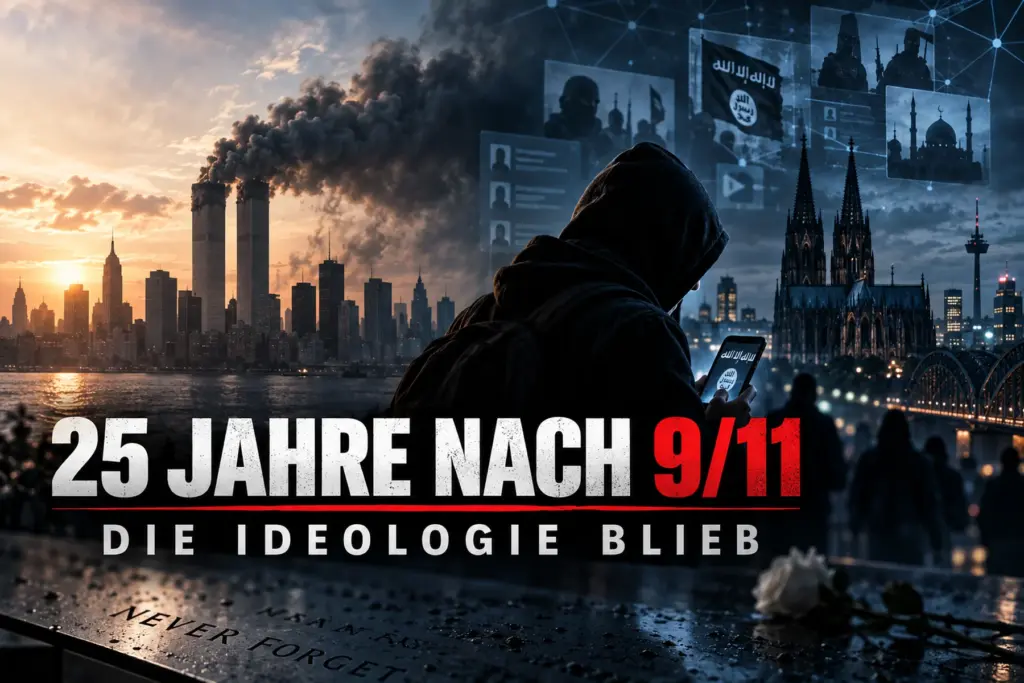

25 years ago, the 11 September attacks destroyed the illusion that jihadist terrorism was a distant problem belonging to other regions of the world. Al-Qaeda was weakened militarily, Osama bin Laden is dead and the so-called Islamic State lost its territory. Islamism and its jihadist manifestation did not disappear as a result. They changed their structures, their channels of communication and, in some cases, even their target group.
On 11 September 2026, the Neue Zürcher Zeitung also draws a sobering conclusion. Under the headline “The jihadists’ declaration of war – Islamisation is advancing in Europe”, it recalls that the attacks of 2001 were a wake-up call. The term “Islamisation”, however, is defined so broadly that it can obscure more than it explains.
For Islam, Islamism and jihadism are not the same thing. Anyone who conflates these terms does not make the analysis more rigorous, but poorer, because the actual problem can be named more precisely.
The 2004 warning sounds remarkably current today
Just three years after the attacks, the American 9/11 Commission reached a remarkably clear conclusion. The enemy was not Islam as a religion. The strategic threat came from Islamist terrorism and the radical ideological movement that produced it.
A second finding was even more important: it was not enough to dismantle Al-Qaeda organisationally. In the long term, the ideology from which ever-new terrorist movements can emerge would also have to be addressed. The 9/11 Commission’s final report therefore explicitly distinguished between combating specific terrorist organisations and engaging in a long-term confrontation with the ideology of Islamist terrorism. That is precisely where the uncomfortable point lies 25 years later.
The West was indeed militarily successful. Al-Qaeda lost leaders and safe havens. The “Islamic State” lost its self-proclaimed caliphate in Syria and Iraq. Security authorities built extensive investigation, surveillance and cooperation structures.
But an ideology cannot be bombed. It can outlive organisations, cross borders, take on new names and reach followers who have never set foot in a training camp.
Europol: Jihadism Remains the Most Widespread Form of Terrorism
The latest figures from Europol contradict the notion that jihadist terrorism has by now become a historical chapter in Europe.
For 2025, Europol’s EU Terrorism Situation and Trend Report 2026 recorded a total of 45 completed, failed or foiled terrorist attacks and attack plots in ten member states. 24 of these were attributed to jihadism.
Nine of these jihadist attacks were carried out. Four of them occurred in Germany. France recorded the highest number of foiled jihadist attack plots. For a European assessment of the situation, this is a statistical distribution. For Germany, it means that jihadist terrorism in 2025 was by no means merely an abstract threat outside its own borders.
Of a total of 486 arrests for terrorist offences, 347 involved jihadism-related offences. That corresponds to around 71 percent. Five people were killed and 81 injured in jihadist attacks.
Europol describes jihadism as the most widespread form of terrorism in the European Union and continues to regard it as the central terrorist threat. This does not mean that other extremist dangers are insignificant. Right-wing extremism, left-wing extremism and other forms of politically motivated violence also clearly exist. Nevertheless, anyone discussing Europe’s current terrorist threat cannot declare jihadism a historical fringe phenomenon, because the figures do not support that.
The terrorist no longer needs a training camp
At the same time, the threat itself is changing, as Europol describes a terrorist landscape in which large hierarchical organisations are becoming less and less necessary for radicalisation and mobilisation. Social media, encrypted messaging services, gaming platforms and decentralised online communities create spaces where propaganda, recruitment and radicalisation can overlap.
Individuals or small self-initiated groups can radicalise themselves there and act largely autonomously. Formal membership in a terrorist organisation is not necessarily required for this.
This also changes the speed of the process. In the past, jihadist radicalisation often involved personal contact with an organisation, travel, training, networks and operational leadership. Today, a significant part of this process can take place digitally.
Europol also points out that, for some perpetrators, ideological motives become mixed with personal crises, a fascination with violence, a need to belong and other extremist narratives. This makes the threat more fragmented and harder to predict.
There is also a marked lowering of the age of those targeted. The German federal government refers, in connection with the 2025 report of the Office for the Protection of the Constitution to the targeted use of social media and gaming platforms to reach children and young people with extremist content. State authorities are observing the same trend in even more concrete terms. The Bavarian Office for the Protection of the Constitution’s 2025 report identifies young people between 14 and 29 as the main target group of Salafist online propaganda and also documents, in individual cases, the radicalisation of children under 14. Under German law, these children are not yet of an age of criminal responsibility.

Passende X-Beiträge
Aus dem SCHLAGSEITE X-ArchivIslamism in Germany: more than 28,000 people in the spectrum
The German Office for the Protection of the Constitution also describes no all-clear. For 2025, the number of people in Germany within the Islamist spectrum is estimated at 28,645. The previous year, the figure was 28,280. The number of people in the violent Islamist spectrum, by contrast, fell slightly from around 9,540 to approximately 9,110. The Salafist scene is estimated at 11,200 people.
The figures come from the 2025 report of the Office for the Protection of the Constitution and are also summarised by the Federal Agency for Civic Education.
Islamism is not automatically terrorism. The Federal Office for the Protection of the Constitution describes it as a form of political extremism. Islamists invoke Islam, but link it to a political and social order in which religiously based norms are supposed to stand wholly or partly above democratically enacted law.
According to the Federal Office for the Protection of the Constitution’s account of Islamism in Germany such ideas conflict in particular with popular sovereignty, equality, freedom of expression and the separation of state and religion. Different currents and strategies exist within the Islamist spectrum.
A Muslim who practises their faith is therefore not an Islamist. A conservative Muslim is not automatically an extremist. And not every Islamist is planning terrorist attacks. Conversely, an anti-democratic ideology does not become democratic simply because its followers are not currently building a bomb.
The problem does not begin only with the attack plot
The state naturally responds particularly forcefully when someone is preparing violence, supporting terrorist organisations or planning attacks. That is when the police, intelligence services and criminal law come into play.
Islamist ideology, however, begins earlier. It begins where democratically legitimised legislation is to be subordinated to an allegedly divinely ordained political order, popular sovereignty is not recognised as a legitimate foundation of the state and social pluralism is viewed not as an expression of freedom but as decay.
Anyone who looks exclusively at the terrorist may realise too late the ideological milieus from which rejection of democracy, antisemitism or separation from the majority society draw their strength. Anyone who, by contrast, calls every visible expression of Islam “Islamisation” makes the opposite mistake and lumps millions of people together with extremists. Both approaches help the Islamists.

Antisemitism is not coincidentally part of the worldview
A further point belongs in this assessment of Islamism. The Federal Office for the Protection of the Constitution describes antisemitism as a key ideological element of Islamist currents. In its publication on Islamism in Germany, it documents anti-Israel and antisemitic statements as well as activities by various Islamist organisations.
The conflict in the Middle East also has considerable mobilisation potential for Islamist actors. The 2024 report of the Office for the Protection of the Constitution had already documented that Islamist organisations and jihadist propaganda deliberately used the war between Israel and Hamas for their own mobilisation.
Since Hamas’s massacre of 7 October 2023, it has become even clearer how quickly the conflict in the Middle East can also be used in Europe as a projection surface for extremist ideologies. Hatred of Israel is not automatically Islamism, and criticism of the decisions of an Israeli government is of course not automatically antisemitic. But an ideology that demonises Jews, denies Israel’s right to exist or legitimises terrorist violence on religious or political grounds does not become less dangerous when it disguises itself as Middle East policy.
Europe has learned to prevent attacks
Nevertheless, it would be wrong to claim that Europe learned nothing at all from 11 September. Many attacks are prevented, intelligence services and police authorities cooperate more closely internationally, terrorist financing is pursued, propaganda networks are disrupted, organisations are banned and individuals deemed a threat are monitored.
Europol’s figures also show this side of the picture: of the 45 terrorist attacks and attack plots recorded for 2025, 22 were completed, 20 were foiled and three failed. The fact that a considerable proportion of the plots were prevented shows that European security authorities are indeed capable of taking action.
The problem lies deeper, because Europe has become comparatively good at looking for the person with the concrete attack plan. Much more difficult is confronting an ideology that explains to a young person why an open society is supposedly corrupt, why democratic law is worth less than a religiously justified system of rule or why Jews, people of other faiths and supposed apostates may be declared enemies.
The German federal government refers, in connection with the 2025 report of the Office for the Protection of the Constitution explicitly to the fact that extremist actors use social media such as Instagram and TikTok as well as gaming platforms to appeal particularly to young people and accelerate radicalisation processes. The recruitment spaces have changed, but the fundamental question has remained the same.

The wake-up call did not go unheard. But it grew quieter
25 years after 9/11, it would be convenient to view jihadism as a problem of a bygone era, but the data do not allow for that luxury.
Jihadist organizations have changed. Propaganda has become more digital. Paths to radicalization have become shorter and more difficult to trace. At the same time, Islamist currents exist whose followers do not necessarily use terrorist violence, but whose political ideas conflict with core principles of a liberal democracy.
An open society must be able to discuss this without placing Muslims under general suspicion, but equally without allowing fear of unfounded accusations to make Islamism disappear from our vocabulary.
The 9/11 Commission articulated the real challenge as early as 2004. Al-Qaeda was a specific terrorist organization. Behind it, however, the Commission saw a radical ideological movement capable of producing further terrorist groups and violence and therefore likely to outlast individual leaders or organizations.
25 years after 9/11, Europe’s failure therefore does not lie in having forgotten terrorism. It lies in too often talking about Islamism only once ideology has already turned into violence.
ℹ️ Factual Basis and Primary Sources for the Article 📑
▶️ Europol:
European Union Terrorism Situation and Trend Report 2026
Current data on terrorist attacks and arrests in 2025, the distribution of jihadist attacks across EU member states, and the development of digital radicalization.
▶️ German Federal Government:
2025 Report on the Protection of the Constitution – Rising Threat from Extremism
Official summary of the 2025 Report on the Protection of the Constitution, including developments within extremist milieus and the radicalization of young people via social media and gaming platforms.
▶️ Bavarian State Office for the Protection of the Constitution:
2025 Report on the Protection of the Constitution in Bavaria
Documents the targeted recruitment of young people through Salafist online propaganda and, in individual cases, the radicalization of children under the age of 14.
▶️ Federal Agency for Civic Education:
Figures on the Islamist Scene in Germany
Current overview of the Islamist, violence-oriented and Salafist potential in Germany for 2025.
▶️ Federal Office for the Protection of the Constitution:
Islamism in Germany
Background information on the definition of Islamism, its various currents, as well as Islamist antisemitism and terrorist organizations.
▶️ National Commission on Terrorist Attacks Upon the United States:
The 9/11 Commission Report – Chapter 12: What to Do? A Global Strategy
Official investigative report making the strategic distinction between Al-Qaeda as an organization and the longer-term ideological challenge posed by Islamist terrorism.
▶️ Neue Zürcher Zeitung:
The Jihadists’ Declaration of War – Islamization Is Advancing in Europe
Commentary dated September 11, 2026, and the starting point for the independent analysis.
🔎 Spotted an Error, Have Criticism or an Addition?
SCHLAGSEITE.eu stands for careful research and transparent corrections. Have you spotted a factual error, unclear wording or a broken link? Then send me your note. If possible, please provide a verifiable source.