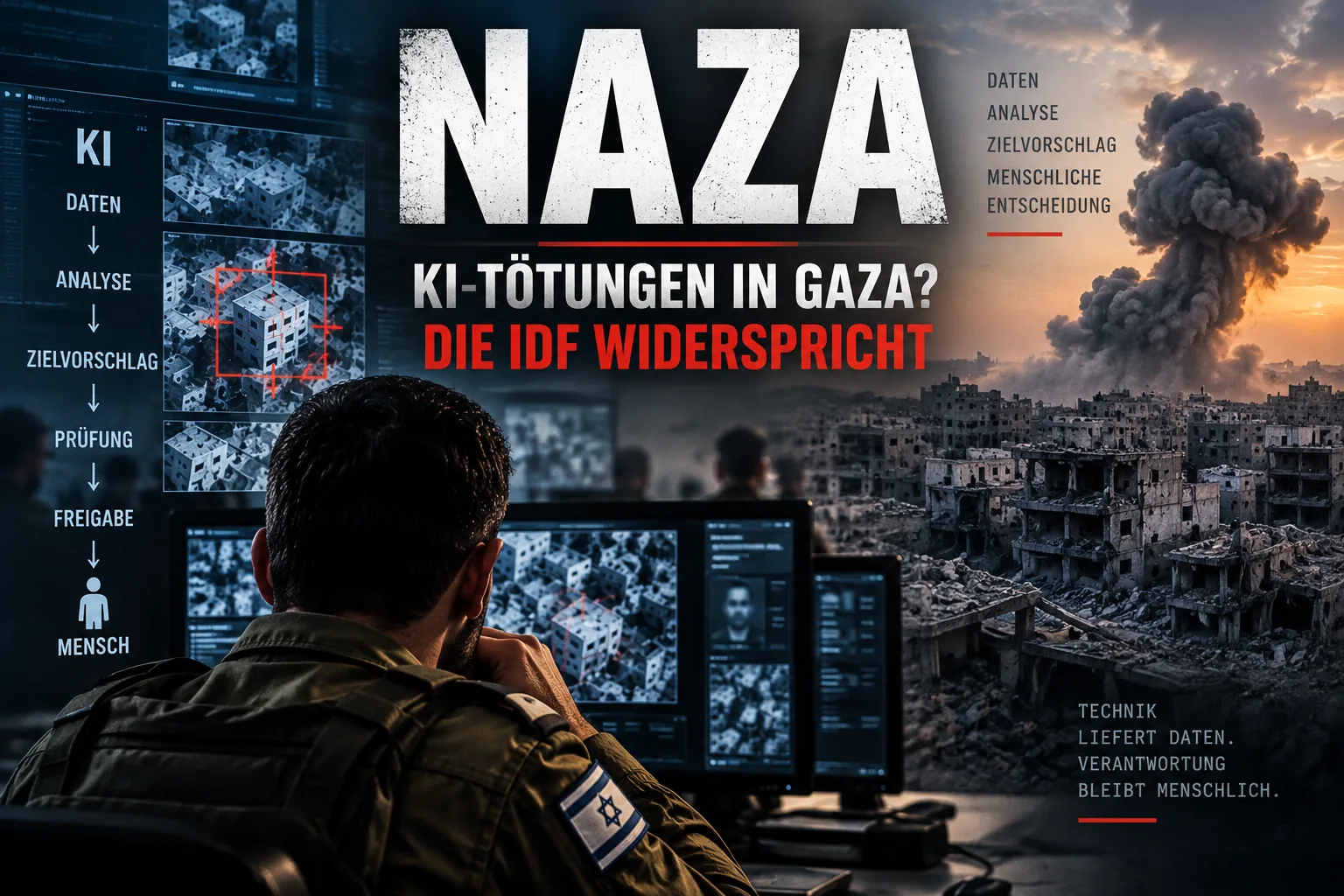
The documentary film “NAZA” alleges AI killings in Gaza, thereby making serious accusations against Israel’s conduct of the war. Twenty-four anonymous Israeli military and intelligence personnel describe a system in which data analysis and artificial intelligence are said to have played a central role in selecting possible targets. The IDF rejects key portrayals. The actual dispute does not begin with the question of whether Israel uses modern data technology, but with what this technology decides and what humans continue to decide.
The film’s title itself carries a message. “NAZA,” נז״א in Hebrew, is the military shorthand for “nezek agavi,” roughly meaning collateral damage. In the film, this refers in particular to the estimated number of potential civilian victims before an attack. Such estimates are not a uniquely Israeli procedure. NATO forces also use “Collateral Damage Estimation” procedures, or CDE, to incorporate expected civilian harm into the military and legal assessment of an attack.
This is completely false.
The IDF has never planned, approved, or carried out a strike in Gaza in which 500 civilians or anything near that number were anticipated to be killed. Nor was any credible claim raised throughout the war suggesting that an IDF strike had caused… https://t.co/wFUNt7bYTM
— Israel Defense Forces (@IDF) September 13, 2026
The fact that an army calculates potential civilian casualties before an attack does not prove an intent to kill civilians. Rather, international humanitarian law requires an assessment of whether the expected civilian harm would be excessive in relation to the anticipated concrete and direct military advantage. The difficult question is therefore not whether collateral damage is estimated, but how that estimate is reached, what military importance the target has and which risks are ultimately accepted.
On September 11, 2026, the IDF officially responded to “NAZA”. The army rejects the central accusations and questions in particular the verifiability of the anonymous statements as well as portrayals of an alleged automated target-selection process.
Passende X-Beiträge
Aus dem SCHLAGSEITE X-Archiv


24 anonymous voices and a narrative that is already familiar
“NAZA” was made by Yuval Abraham and Rachel Szor and premiered on September 10 at the Venice International Film Festival. It is based on conversations with 24 people who, according to the filmmakers, worked in the Israeli military or intelligence units and had insight into the preparation of military operations. Their faces and voices were anonymized; their identities cannot be publicly verified.
Yuval Abraham is not merely the co-director of a new documentary. On April 3, 2024, he had already published at +972 Magazine, together with Local Call, the major Lavender investigation, which claimed, based on six anonymous sources, that the Israeli military had used the Lavender data tool with limited human oversight to identify thousands of potential targets.
“NAZA” explicitly continues this line of investigation. The Guardian is producing the film together with JW Films, and Jonathan Glazer is executive producer. In its own announcement, the Guardian itself explains that the film builds on investigations by +972 Magazine, Local Call and the Guardian from 2023 to 2025.
This does not disprove the allegations. For source criticism, however, it remains important: the film, earlier articles and parts of the accompanying coverage are not three mutually independent chains of evidence. They partly originate from the same investigative environment and develop the same thesis in different formats. A new film may contain new material, but repeating a claim in another medium does not make it independent confirmation.
Abraham’s network goes back further
Abraham’s political and journalistic collaboration with Palestinian activists and journalists did not begin with “Lavender.” As early as 2019, he founded the “Across the Wall” project together with Gaza-born journalist Ahmed Alnaouq. The aim was to translate texts by young Palestinians into Hebrew and thereby specifically reach an Israeli audience. In 2022, Alnaouq himself described the project as an attempt to change the portrayal of Palestinians in Israeli media.
The political orientation was not concealed. In a contribution of his own for The New Arab Alnaouq wrote that “Across the Wall” explicitly advocated a one-state solution as the project’s central political vision and that this position was shared by the entire team. Abraham later described Alnaouq at +972 Magazine as a close friend and colleague and recalled that the two had founded the Hebrew-language Facebook page together.
For proper context, it is equally important to distinguish between documented connections and claims that go beyond them. No evidence can be found in reliable publicly accessible sources for the claim circulating online that Ahmed Alnaouq himself was a member of Hamas. Le Monde reported in 2023 , citing its own earlier investigation, that Alnaouq’s brother Ayman had been a member of the Izz ad-Din al-Qassam Brigades, Hamas’s military wing. That is not the same as Ahmed Alnaouq being a member of Hamas.
This provides a clearer picture of Abraham’s journalistic background: “NAZA” does not stand in isolation, but follows years of joint projects, investigations and politically clearly positioned media work. That does not automatically make his work false. But it is a relevant part of source criticism, because background, networks and previously expressed theses help determine how new statements should be weighed and independently checked.
International pressure is part of Abraham’s political line
On September 13, 2026, Daniel Hanuka’s X account shared an older video clip of Abraham and framed it with the accusation of “treason.” The post directly links the clip to “NAZA” and claims that Abraham wants to reduce the power imbalance between Israel and the Palestinians and generate international pressure on Israel for that purpose. For proper context, it is important to separate the polemical framing from the actual content: The clip deals with no military targeting procedures, no Lavender and no alleged authorization of 500 expected civilian casualties. It concerns Abraham’s political view that external pressure should be used as leverage for a political solution.
This position can be documented independently of the viral post. As early as December 2021, Abraham wrote in a contribution on Sheikh Jarrah documented by +972 Magazine, that only urgent international pressure could still prevent an eviction that was then threatened. At the premiere of “NAZA” in Venice, Abraham also stated, according to Reuters, that justice and accountability for civilian deaths in Gaza also depended on the political will of the United States and the European Union.
International pressure is therefore not a motive retroactively attached to “NAZA” for Abraham, but part of a political and journalistic line that has been recognizable for some time. For assessing the film, this means two things: It explains why Abraham explicitly regards international attention as political leverage. But it neither proves nor disproves the film’s military allegations. “NAZA” must therefore be judged on its concrete evidence, not on applause, outrage or the political intentions of its co-director.
The claim of 500 expected civilian casualties
The sharpest individual allegation can now be stated concretely. In a released excerpt from “NAZA,” an anonymous interviewee is asked what the highest number of expected civilian casualties ever approved for an attack was. His answer, in substance, is that there was once authorization for 500.
The IDF responded to this separately on September 13, and considerably more specifically than in its initial statement on the film. According to the army, no attack in Gaza had ever been planned, approved or carried out in which 500 civilians, or even approximately that many civilian deaths, were expected. The army called the claim false and said the filmmakers could independently substantiate neither the underlying statement nor the identity and specific function of the anonymous interviewee.
At least on this point, there is therefore a clearly verifiable confrontation: On one side is the statement of an anonymous interviewee. On the other is an explicit denial by the institution that would have to possess records of such operational planning. Publicly accessible operational files or other independent evidence confirming the specific figure of 500 are not currently available.

AI and target selection:
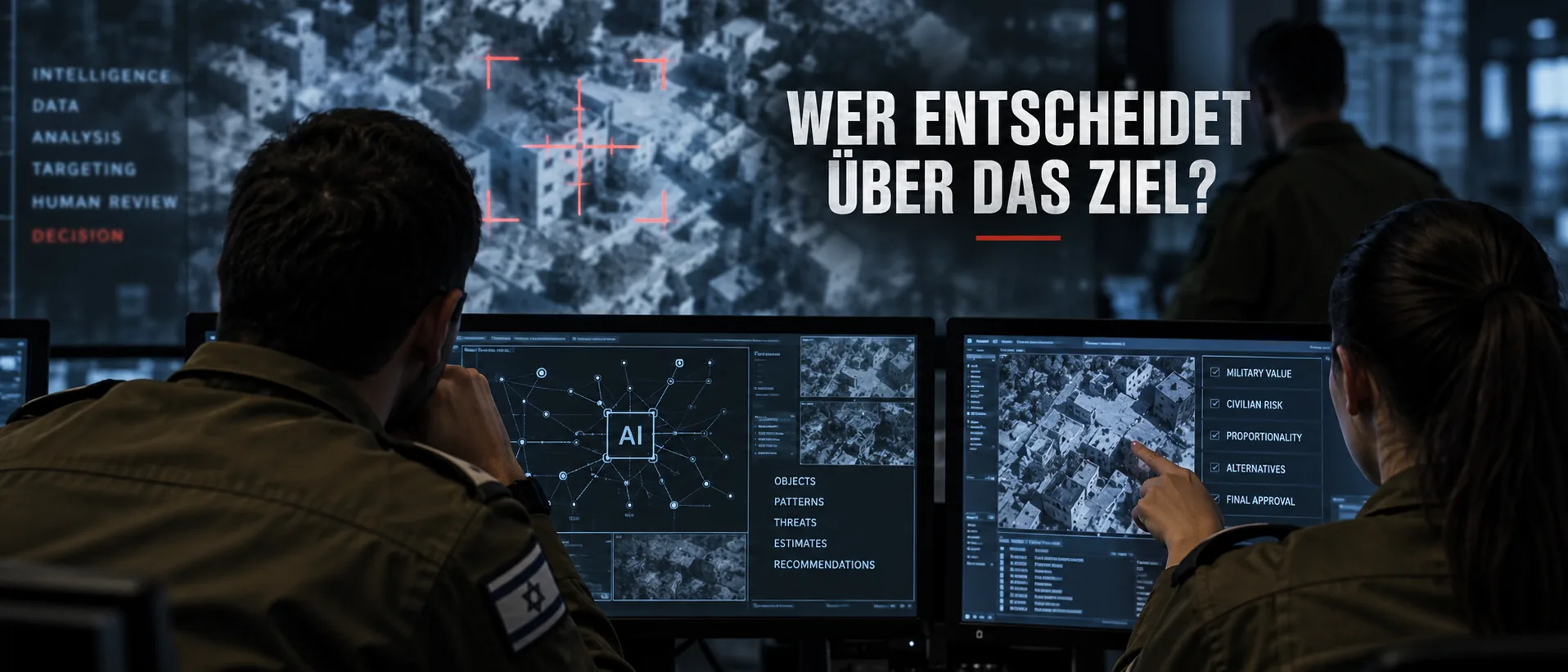
The film presents algorithmic systems as the driving force behind target selection in Gaza. It is publicly documented that the IDF uses Habsora, Lavender and other data tools. The IDF says that these systems may not independently designate any person or object as an attack target and that attacks are authorized exclusively by humans.
500 expected civilian casualties:
An anonymous interviewee claims in the film that such a figure was once approved. No independent operational file on this is publicly available. The IDF explicitly says it has never planned, approved or carried out an attack with 500, or approximately 500, expected civilian deaths.
Intentional mass killing:
The massive destruction and high number of civilian casualties in Gaza are beyond dispute. That alone legally establishes neither an intent to kill civilians nor a finding of genocide. These require their own legal conditions, which cannot be replaced by a collateral-damage estimate.
AI killings in Gaza: What the IDF says about the technology
That is precisely why the simple question “Does Israel use AI in the war?” does not get us very far. Israel itself confirms the use of modern data processing. The broader expansion of robotics and AI within the IDF is also publicly documented. On June 18, 2024, the IDF published an detailed account of the use of data technologies in intelligence analysis. Among other things, she describes Habsora and Lavender.
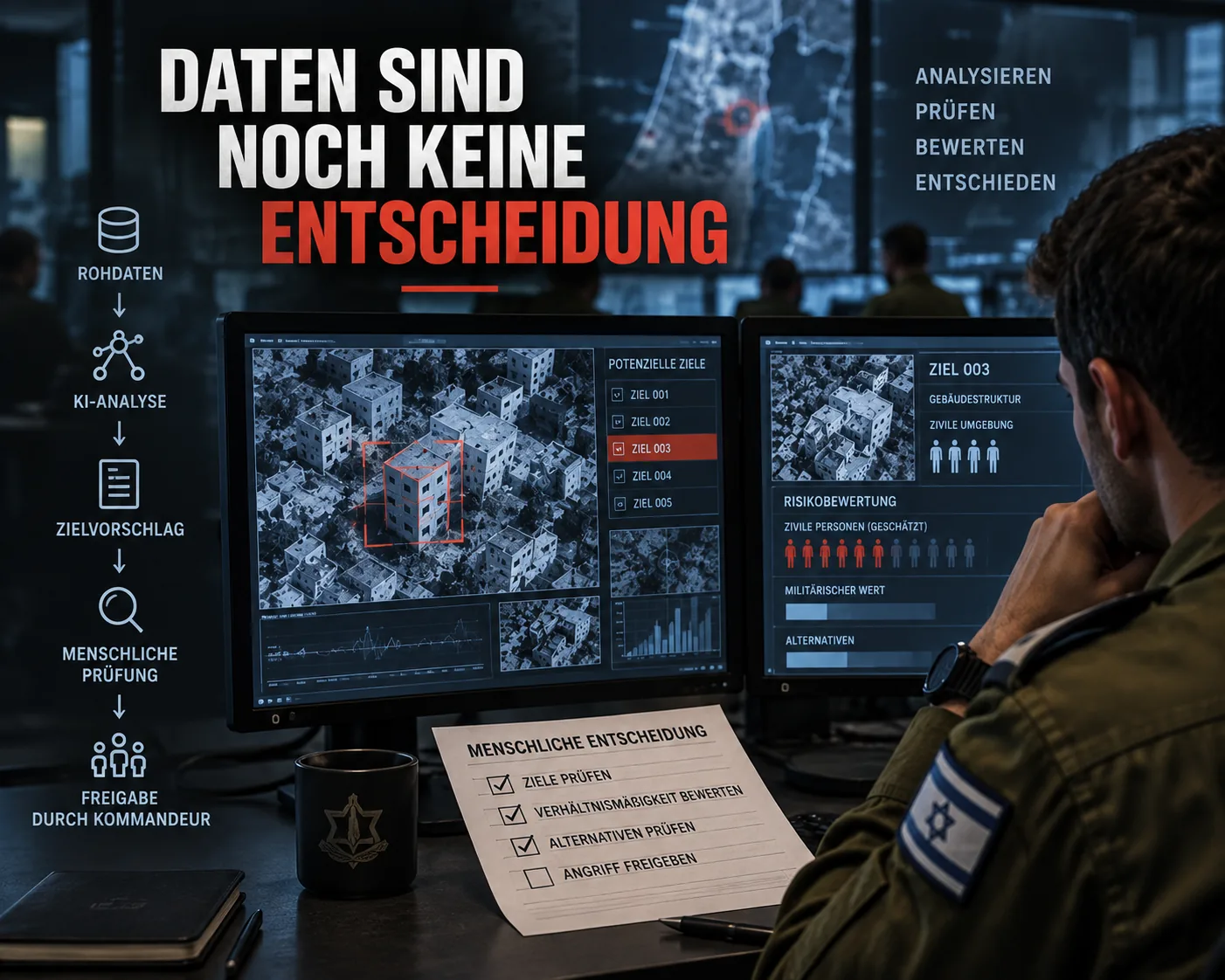
According to this account, Habsora brings together different pre-existing intelligence sources and points analysts to data that could be relevant to their investigation. A suggestion by the system alone may not be sufficient to classify an object as a military target. Identification must be carried out by a trained human analyst and subsequently confirmed by an authorized intelligence officer.
The IDF describes Lavender as a database that organizes and links existing information about possible members of terrorist organizations. Here too, the military expressly states that adding a person to the database is not sufficient on its own to identify them as a military actor who may be attacked. The decision to launch an attack ultimately lies with an operational commander.
This is a verifiably published description of procedures. It does not prove that every individual soldier and every unit complied with these rules at every stage of the war. But it has a different evidentiary quality from an unverifiable claim about what the official procedures supposedly provided for in principle.
An estimate is not yet a violation of the law
NATO explicitly lists “Collateral Damage Estimation,” or CDE for short, as part of military targeting in its joint targeting doctrine AJP-3.9. Legally, what matters is not merely the existence of such an estimate. Under the rules of international humanitarian law, military planners must assess whether foreseeable civilian harm would be excessive in relation to the concrete and direct military advantage anticipated, and what possible precautionary measures can be taken.
International humanitarian law does not set a fixed mathematical upper limit. Ten, twenty or one hundred expected civilian casualties are not automatically legal or illegal solely because of the number. What matters is the specific military target, the anticipated military advantage, available alternatives, possible precautionary measures and the information that was reasonably available to decision-makers at that time.
The serious dispute begins in the first weeks of the war
This does not make the criticism of Israel’s conduct of the war at that time disappear. An extensive investigation by the “New York Times,” reported on by Reuters in December 2024, concluded that the IDF adjusted its rules of engagement immediately after October 7 and allowed greater risks to civilians. The report described, among other things, greater discretion in decisions on attacks and cases in which high civilian risks were allegedly accepted when targeting senior Hamas members.
The IDF responded in detail in January 2025. It confirmed that operational regulations had been adjusted after the Hamas attack in view of the immediate military situation, but rejected the portrayal of a blanket authorization of specific numbers of casualties. Thresholds had regulated, among other things, which level of command had to authorize an attack. According to the IDF, an individual proportionality assessment continued to be required for every single attack.
This dispute is substantially more serious than the mere fact that a database exists. The question here is whether the thresholds for accepted civilian risks were significantly changed in the first phase of the war, how these changes worked in practice and whether all required controls actually functioned under the enormous time pressure.
Another point in the IDF’s 2025 response is also noteworthy. The “New York Times” had quoted statements by three officers according to which, in some other units, people had already been treated as confirmed fighters if they were listed in Lavender. The IDF said it was not aware of such practices. But it added that such conduct would violate its own protocols.
The war did not begin with an AI database
The starting point of the war also matters for context. The current military confrontation began after the Hamas-led massacre of October 7, 2023, in which around 1,200 people were killed in Israel and more than 250 people were taken hostage to the Gaza Strip. At the same time, Israeli cities came under massive rocket fire.
This starting point does not automatically justify every subsequent military decision. But it does explain why, from October 7 onward, Israel was not operating in an ordinary, limited Gaza round, but was waging a war against an organization that had spent years building military infrastructure in an extremely densely populated area.
The extent to which military and civilian structures can sometimes lie close together was illustrated by a specific case in June 2025. On June 8, Reuters reported on an inspection of a tunnel complex uncovered by the IDF under the European Hospital in Khan Younis. A small group of foreign journalists was taken into the tunnel. According to the Reuters report, the entrance was directly beneath the hospital’s emergency department. The IDF described the facility as a Hamas command center and said that weapons, ammunition, cash and documents had been found there, among other items. The bodies of Mohammed Sinwar and the senior Hamas commander Mohammad Shabana were also reportedly discovered there.
Reuters also points out that during the war Israel repeatedly accused hospitals or other civilian facilities of being used militarily by Hamas, that Hamas has repeatedly denied such accusations and that not every Israeli claim could be independently confirmed. The tunnel beneath the European Hospital, however, is not an abstract allegation: foreign journalists inspected the uncovered facility themselves.
For the proportionality assessment, such an environment significantly changes the operational situation. A military target does not automatically lose its status because it is located inside or beneath civilian infrastructure. At the same time, Israel remains obligated to avoid or minimize civilian harm as far as possible and to refrain from an attack if the expected civilian harm would be excessive in relation to the anticipated military advantage.
24 anonymous sources are material, not a seal of quality
The identities of the interviewees in “NAZA” are protected. This may be necessary for investigative work. But it creates an unavoidable problem for assessing their statements: outsiders cannot independently verify the interviewees’ rank, specific function, period of deployment, direct knowledge or access to the decision-making levels described.
The IDF attacks precisely this point. In its statement of September 11, it said that some statements concerned national or military strategy, even though, in the army’s view, the interviewees’ described functions would not have given them the corresponding insight. Other statements allegedly described events in which members of military intelligence would not have been involved in the claimed capacity at all.
Such objections do not automatically disprove anonymous sources. But they prevent their statements from being treated as independently confirmed facts solely because of their number. What matters is whether documents, known procedures, specific operational data or further independent sources support the same allegation.
International law is not a matter of sentiment
The debate about AI killings in Gaza becomes particularly problematic where military and legal terms are conflated. Expected collateral damage initially means that unintended harm to civilians is forecast in an attack on a military target. The existence of this figure does not in itself prove intentional killing.
Conversely, calling something “collateral damage” does not automatically make an attack lawful. An attack may violate international humanitarian law if the target was not military, the expected civilian harm was excessive, available precautions were not taken or other protection rules were violated. Such questions must be assessed on the basis of the specific attack.
The same applies to the term genocide. High casualty figures, massive destruction and severe human suffering are not, by themselves, identical to the specific legal proof of genocidal intent. Anyone who uses this term must be measured against its legal requirements. A collateral-damage estimate proves neither this claim nor its opposite.
The more difficult question begins after the algorithm
Despite the film’s exaggeration, a serious question remains. A computer system does not have to trigger an attack itself to significantly influence human decisions. When analysts cannot manually search through vast amounts of data and technical systems pre-sort, weigh and link information, their architecture inevitably influences what a person sees first and where they directs their attention.
That is precisely why several steps must be distinguished: data collection, combining existing information, prioritizing possible indications, human identification of a military target, proportionality assessment and finally the decision to launch the attack. Anyone who summarizes all these steps under the label “AI chooses targets” turns a complex process into a catchy headline, but not yet into a precise description.
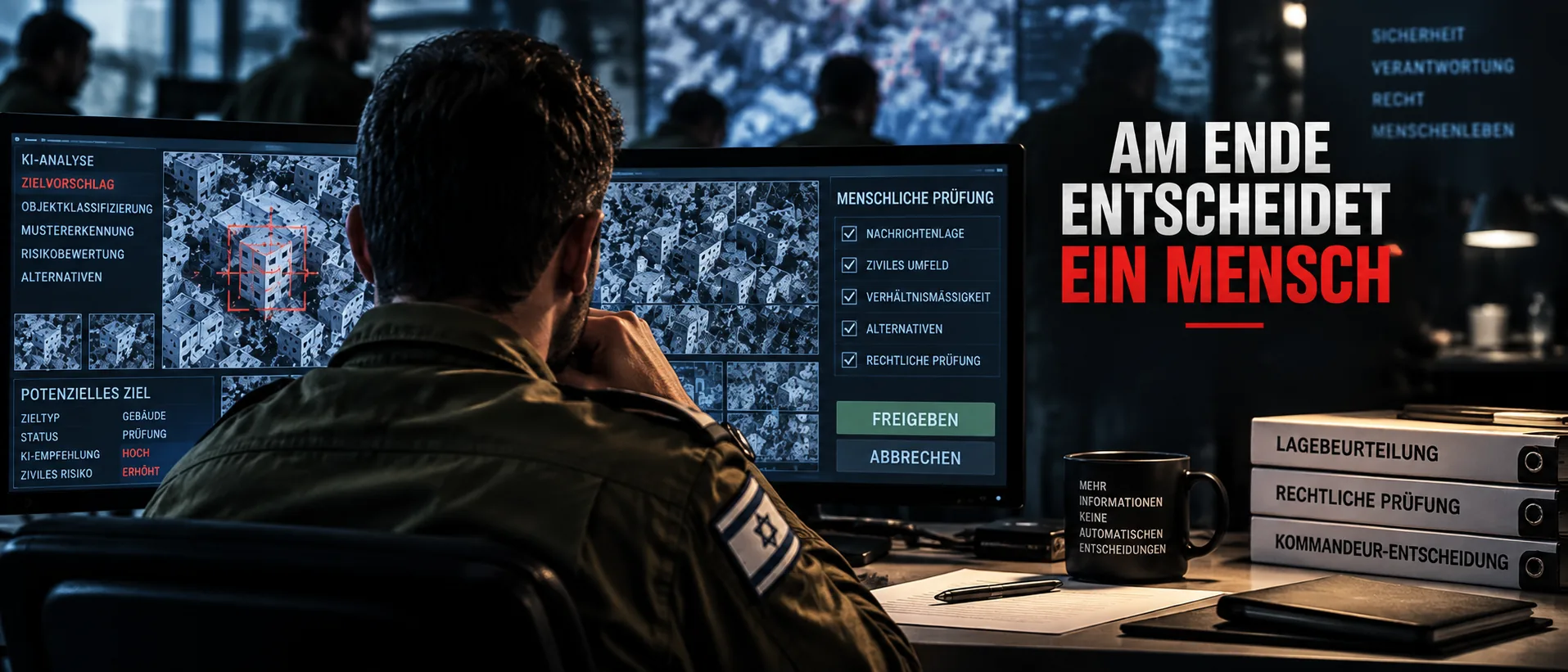
According to the publicly accessible IDF regulations, several human decisions lie between the technical tools and an attack. A regulation alone cannot prove whether these controls were followed in every unit and at all times. But the claim of a systematically automated killing process likewise requires more than anonymous statements and the repetition of already familiar allegations.
Venice can honor films, not examine operational files
“NAZA” received the Special Jury Prize at the Venice Film Festival on September 12 and was met by the audience with long standing ovations. The film therefore already has considerable political and media impact.
That says little about the evidentiary value of its military claims. A film jury evaluates cinematic and artistic work. It does not examine classified operational files, duty rosters, target folders or chains of command. Festival applause can show how powerfully a narrative works. It cannot establish whether a specific attack with 500 expected civilian casualties was ever authorized.
Conversely, an IDF statement does not automatically dispose of every criticism either. Where specific allegations concerning individual operations are reliably documented, they must be investigated. The army itself states that suspected violations of the law should be reported and would be examined through its investigative and prosecutorial mechanisms.
The dispute over “NAZA” does not begin with the existence of Israeli data technology. That is documented. What matters is which decisions these systems prepare, which people review them, which thresholds applied in the first phase of the war, and whether the prescribed checks were followed in the specific operation. That is precisely why evidence is needed, not merely an impressive film.
“NAZA” raises serious questions about Israel’s conduct of the war. But the film does not answer them merely because 24 anonymous voices describe the same general direction. The claim of 500 expected civilian casualties in particular requires more than an unverifiable statement after the IDF has explicitly and specifically denied it. Anyone seeking to examine the allegation of AI killings in Gaza should therefore look where the real dispute lies: at the rules, their changes after October 7, human oversight, and the specific decisions behind individual attacks. Everything else primarily produces impact. Venice is an excellent place for that; it is not a fact-check.
ℹ️ Factual basis and primary sources for the article 📑
▶️ Israel Defense Forces:
The IDF Spokesperson’s Response Following the Publication of the Movie “NAZA”
Official statement dated September 11, 2026, on the anonymous sources, the AI allegations, legal statements, and human authorization of attacks.
▶️ Israel Defense Forces:
The IDF’s Use of Data Technologies in Intelligence Processing
Detailed account dated June 18, 2024, of Habsora, Lavender, human target identification, collateral-damage estimation, and military authorization of attacks.
▶️ Israel Defense Forces:
IDF Targeting Methods During the First Weeks of the Hamas-Israel War
Statement dated January 26, 2025, on changed regulations after October 7, civilian-risk thresholds, Lavender, and possible violations of internal protocols.
▶️ +972 Magazine / Local Call:
‘Lavender’: The AI machine directing Israel’s bombing spree in Gaza
Yuval Abraham’s original investigation of April 3, 2024, on whose subject matter and source environment “NAZA” explicitly builds.
▶️ The Guardian:
NAZA – a new film directed by Yuval Abraham and Rachel Szor, produced by the Guardian
Production announcement with details on the Guardian production, executive producer Jonathan Glazer, and the connection to earlier investigations by +972, Local Call, and the Guardian.
▶️ Daniel Hanuka / X:
Post from September 13, 2026, featuring an older video clip of Yuval Abraham
Example of the clip’s current political framing following the Venice award. The accompanying text calls Abraham a “traitor” and links his demand for international pressure to “NAZA”.
▶️ +972 Magazine:
Israel set to expel Sheikh Jarrah family in the new year
Article by Yuval Abraham and Oren Ziv from 2021. It documents a contribution by Abraham at the time in which he explicitly calls for urgent international pressure.
▶️ The New Arab:
Across the wall: The role of Palestinian stories in Hebrew
Article by Ahmed Alnaouq from 2022 on the joint founding of “Across the Wall”, the project’s orientation, and the explicitly advocated one-state solution.
▶️ +972 Magazine:
‘A mass assassination factory’: Inside Israel’s calculated bombing of Gaza
Yuval Abraham describes Ahmed Alnaouq there as a close friend and colleague and refers to their joint founding of the Hebrew-language Facebook page “Across the Wall”.
▶️ Le Monde:
London-based Palestinian journalist Ahmed Alnaouq has lost over 21 family members in Gaza
Profile of Ahmed Alnaouq. Le Monde describes him as a journalist and reports that his brother Ayman was allegedly a member of the Izz ad-Din al-Qassam Brigades following an earlier investigation.
▶️ UK Ministry of Defence / NATO:
Allied Joint Doctrine for Joint Targeting (AJP-3.9)
Publicly available NATO doctrine on joint targeting. The publication explicitly lists “Collateral Damage Estimation” as part of targeting doctrine.
▶️ International Committee of the Red Cross:
Frequently Asked Questions: IHL and the escalating conflict in the Middle East
Explanation of the rules on distinction, proportionality, expected civilian harm, and precautions in attacks.
▶️ Reuters:
Israeli military loosened rules of engagement at start of Gaza war, New York Times reports
Summary of the New York Times investigation into changed rules of engagement and increased civilian-risk thresholds in the first phase of the war.
▶️ Reuters:
Israel reveals tunnel under Gaza hospital, says body of Sinwar’s brother found there
Report dated June 8, 2025, on foreign journalists’ tour of a tunnel complex beneath the European Hospital in Khan Younis and the findings documented there by the IDF.
▶️ Reuters:
Israeli whistleblowers detail Gaza civilian toll in Venice film
Report on the premiere, the 24 anonymous interviewees, the film’s central allegations, and Abraham’s statement that accountability also depended on the political will of the US and the EU.
▶️ The Times of Israel:
IDF denies claim in new ‘NAZA’ documentary that it planned Gaza strike with 500 civilian deaths
Documentation of the IDF’s subsequent specific denial of the claim concerning 500 expected civilian deaths.
▶️ Reuters:
List of winners at the 2026 Venice Film Festival
Documentation of “NAZA” receiving the Special Jury Prize on September 12, 2026.
🔎 Found an error, criticism, or addition?
SCHLAGSEITE.eu stands for careful research and transparent corrections. Have you discovered a factual error, unclear wording, or broken link? Then send me your note. If possible, please provide a verifiable source.