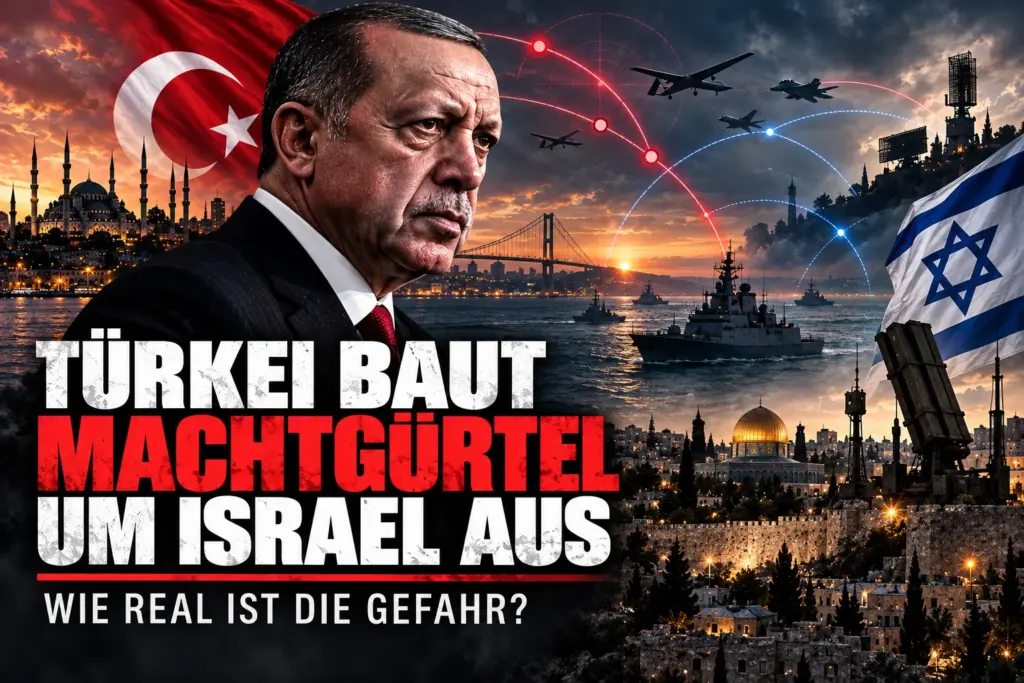


Turkey is expanding a power belt around Israel. Its political and military influence in the Middle East is growing at remarkable speed. In Syria, Ankara is becoming one of the most important foreign partners of the new leadership; with Saudi Arabia and Pakistan, it has established a joint defense agreement, while the Turkish government maintains close contacts with Hamas. Israel is therefore increasingly concerned that, after the weakened Iranian terror axis, a new strategic adversary may be emerging. The decisive question, however, is this: Is a new ring around Israel really taking shape here?
The latest debate was triggered by the Israeli airstrike on the Syrian military airfield of Abu al-Duhur on August 18, 2026. Israel justified its action by citing concerns about a growing Turkish military presence and possible Turkish air-defense systems in Syria. Ankara and Damascus denied plans for a permanent deployment at the attacked airfield. At the same time, the United States is working on a mechanism between Israel, Turkey and Syria intended to prevent mutual distrust from eventually turning into a direct military incident.
The Turkish-Israeli conflict is therefore no longer merely a matter of Recep Tayyip Erdoğan’s aggressive rhetoric. It has reached a strategic level.

Passende X-Beiträge
Aus dem SCHLAGSEITE X-ArchivTurkey Expands Power Belt Around Israel: Syria Becomes a Test Case
The central arena of this development is Syria. Turkish troops have by no means been present there only since the end of the Assad regime. Ankara began its own cross-border military operations in 2016 and, together with allied Syrian forces, established a permanent presence in parts of the north. Reuters documented this long-standing presence even before Assad’s fall.
What is new, therefore, is not Turkey’s presence in Syria. What is new is Ankara’s role as the most important foreign patron of the new central government and the question of how far Turkish military influence will extend southward.
Since the fall of the Assad regime at the end of 2024, the regional balance of power has shifted fundamentally. Iran lost one of its most important state partners and a crucial corridor linking it to Hezbollah in Lebanon. Turkey in particular moved into the vacuum that emerged.
Ahmed al-Sharaa now stands at the head of Syria. He previously led Hayat Tahrir al-Sham, or HTS, which emerged from the former Syrian al-Qaeda structure and later broke with al-Qaeda. After Assad’s fall, al-Sharaa was declared president for the transitional phase in early 2025. Reuters documented his appointment and his former leadership role at HTS.
This background does not automatically make today’s Syrian government a terrorist government. It does, however, explain why Israel is monitoring Syria’s military reconstruction under Turkish leadership with particular attention. Jerusalem does not view Turkish training, radar installations or air defenses simply as ordinary intergovernmental military assistance.
Ankara has by now become one of al-Sharaa’s most important supporters. In August 2025, Turkey and Syria signed an agreement on military training and advisory support. According to the Turkish Defense Ministry, the cooperation also includes military equipment, logistics and assistance in rebuilding the Syrian armed forces. Reuters reported on the agreement immediately after it was signed.
For Ankara, this is understandable power politics. Turkey borders Syria, is fighting Kurdish structures along its southern border and has significant economic interests in the country’s reconstruction.
For Israel, the same development looks different. The decisive red line is not the mere existence of Turkish troops in northern Syria. It concerns a possible expansion of this presence farther south and, above all, systems that could restrict Israel’s freedom of operation over Syria.
According to Israeli sources cited by the Jerusalem Post Israel had indications before the attack on Abu al-Duhur that Turkish personnel were to be stationed there together with radar and air-defense systems. Ankara and Damascus denied that a permanent deployment was planned. The specific facts therefore remain disputed among the states involved. What is clear, however, is why radar and air defenses have a different significance for Jerusalem than training or advisory support: They could limit the Israeli air force’s freedom of movement over Syrian territory.
Abu al-Duhur was therefore not the starting point of the Turkish presence in Syria. The attack marked a new escalation in the dispute over how far Ankara can extend its military infrastructure toward Israel’s security sphere.
Israel and Turkey had already begun talks in April 2025 on a so-called deconfliction mechanism. Israel made clear at the time that an expansion of the Turkish military presence into certain areas of Syria would be considered a red line. The talks took place in Azerbaijan.
The fact that Baku of all places served as the venue for mediation was no coincidence. Azerbaijan is strategically closely linked to Turkey while also maintaining intensive military and security ties with Israel. In May 2025, the leadership of the Azerbaijani Ministry of Defense visited Israel, in order to further expand military cooperation. Such connections explain why, despite the political hostility between Ankara and Jerusalem, some remaining bridges still exist.

Turkey’s growing power in Syria is real. However, automatically turning every Turkish cooperation agreement into part of a completed anti-Israel alliance would go too far. What matters is not only whom Ankara cooperates with, but what obligations actually arise from it and which military capabilities directly affect Israel’s room for maneuver.
Washington Caught Between Ankara, Damascus and Jerusalem
The role of the United States is also more complicated than the term mediation might suggest. Tom Barrack is not only the American envoy for Syria. He is also the U.S. ambassador to Turkey. Since the change of power in Damascus, Washington has invested considerable political capital in stabilizing the new Syrian leadership while also having a strong interest in avoiding damage to its cooperation with Ankara.
Barrack received his additional Syria role in May 2025, when the Trump administration began fundamentally redirecting its policy toward Damascus and rolling back sanctions.
After the attack on Abu al-Duhur, Barrack criticized Israel’s actions with unusual clarity. The confirmed Israeli airstrikes were an “unnecessary escalation that does not advance regional stability,” he stated on August 18. Reuters documented the American criticism. At the same time, Barrack warned that the attack could have triggered a direct incident between Israeli and Turkish forces. His position therefore cannot be read merely as a general desire for peace. Washington is simultaneously trying to stabilize al-Sharaa’s government, integrate Turkey as a central partner and deter Israel from steps that could endanger this order.
The deconfliction channel is therefore not a sign of political rapprochement. It is damage control between states whose interests in Syria are increasingly colliding.
The Conflict Began Long Before the Syrian Airfields
Mutual distrust did not emerge in 2026. Relations between Israel and Turkey deteriorated over many years and almost completely broke down politically after the Hamas massacre of October 7, 2023.
Erdoğan refused to classify Hamas as a terrorist organization and instead called it a liberation movement. Senior Turkish politicians repeatedly met Hamas leaders. In April 2024, Erdoğan personally received then-Hamas leader Ismail Haniyeh in Istanbul. Reuters documented the meeting.
The relationship is not limited to individual reception photographs, however. Hamas political officials regularly stayed in Turkey. Ankara expressly denied that Hamas’s political office had been fully relocated from Qatar to Turkey. At the same time, over several years the U.S. Treasury documented and sanctioned Turkish financial and organizational structures linked to Hamas.
The U.S. Treasury described, for example, Turkey-based Haroun Nasser Al-Din as an important Hamas financial operative. The department had previously sanctioned Turkish companies and individuals that, according to the United States, belonged to the organization’s international investment network.
This does not prove the existence of a central Hamas command structure in Istanbul. It does show, however, that the connection between Ankara and Hamas goes considerably deeper than occasional diplomatic talks.
For Israel, this is far more than a diplomatic blemish. On October 7, 2023, Hamas carried out the worst massacre of Jews since the Shoah. A government that continues to treat its leadership as a legitimate political interlocutor can hardly present itself as a credible neutral mediator in Jerusalem at the same time.
Ankara subsequently increased pressure on other fronts as well. In May 2024, Turkey halted direct trade with Israel. At the time, trade volume had amounted to around 6.8 billion dollars in 2023. The Turkish government stated, that the restrictions were to remain in place until a permanent cease-fire and unhindered aid deliveries to Gaza were achieved.
In August 2024, Turkey also intervened in South Africa’s proceedings against Israel before the International Court of Justice. The intervention is documented at the ICJ.
Taken individually, none of these measures makes Turkey a military adversary of Israel. Taken together, however, they show a political development: Under Erdoğan, relations with Israel are increasingly shaped by the Palestinian issue and his Islamist-influenced regional policy.
Then Came the Mecca Agreement
Another change took place on August 7, 2026. Turkey, Saudi Arabia and Pakistan concluded a joint defense agreement in Mecca. It provides for an armed attack on one of the three states to be treated as an attack on all of them.
This is not a newspaper report about some alleged alliance that disappears into the digital wilderness after three days. On August 31, the foreign and defense ministers as well as the military leaderships of the three countries met in Istanbul. In the joint official statement announced the further institutionalization of the alliance and the establishment of a permanent secretariat in Saudi Arabia.
This creates, for the first time, a formalized security structure linking a NATO power, Saudi Arabia, and Pakistan.
But precision is crucial here as well. The agreement was officially not directed against Israel. Saudi Arabia is pursuing its own security interests, particularly with regard to Iran and the regional consequences of the recent wars. Pakistan, in turn, has its own strategic priorities in South Asia. A joint agreement therefore does not by any means amount to a common Turkish Middle East policy.
Saudi Arabia in particular cannot easily be forced into the role of a simple component of an Erdoğan axis. Riyadh maintains its own relations with Washington at the same time and has for years pursued a policy in which regional security, Iran, economic modernization, and a possible future relationship with Israel are weighed against one another.

The R4 is not a ready-made anti-Israel alliance either
This becomes even clearer in the so-called R4 format between Turkey, Egypt, Saudi Arabia, and Pakistan. The quartet met in Cairo in June 2026. In some Turkish pro-government media, this had already been turned into the idea of a new Islamic power bloc.
The official documents tell a more sober story. According to the Saudi state news agency SPA the fourth R4 round on June 21 focused on regional crises, de-escalation, Iran, and the situation in Lebanon. So far, the format is a platform for strategic consultations, not a joint military pact.
Egypt is the best evidence of why the term “closed Turkish ring” falls short. Cairo has had a peace treaty with Israel since 1979, has its own security interests, and specifically did not join the Mecca Defense Agreement.
In other words: Erdoğan is indeed attempting to consolidate Turkish influence in various regional formats. But it does not automatically follow that all participating states will adopt his confrontational policy toward Israel.
The comparison with Iran is flawed—and nevertheless not absurd
In Israel, Turkey is now occasionally described as a possible “new Iran.” The comparison has an obvious weakness. Over decades, Iran built an axis of armed non-state organizations, including Hezbollah, Hamas, the Houthis, and Shiite militias in Iraq. These groups were used as instruments to put opponents under pressure without having to wage an open interstate war every time.
Turkey operates differently. Ankara is expanding its influence primarily through states, governments, economic relations, defense agreements, diplomacy, and political patronage. Even the close relationship with Hamas does not make this a Turkish copy of the Iranian system.
That is precisely why the danger should not be downplayed.
Iran was able to threaten Israel above all through proxies. Turkey, by contrast, is itself a large state, a NATO member, an economic power, and a regional actor with considerable diplomatic capabilities. If Turkish-Israeli rivalry continues to intensify over years, the challenge would therefore be fundamentally different in nature.
A new Iran would not emerge. Something else could emerge: a powerful state competitor that politically and strategically constrains Israel’s room for maneuver in its immediate surroundings.
The actual ring consists of influence
This is precisely where the strongest point lies in the analysis by Hay Eytan Cohen Yanarocak, which appeared in the magazine Mosaic in September 2026. The author does not describe a single Turkish alliance, but rather the development of several overlapping spheres of influence.
Syria binds Ankara directly to Israel’s northern security environment. R4 creates regular political coordination with Egypt and Saudi Arabia. The Mecca Agreement links Turkey more closely to Saudi Arabia and Pakistan in security terms.
As a geographical drawing, this actually produces something that looks like a ring.
Politically, however, this ring is more porous than a map might suggest. Saudi Arabia is not a Turkish satellite. Egypt even less so. Pakistan is pursuing its own interests. Syria is heavily dependent on Ankara, but is likewise not merely Erdoğan’s obedient subordinate.
The formula “Turkey is expanding its belt of power around Israel” therefore does not describe a closed bloc with a common operational plan. Rather, it describes Ankara’s growing ability to influence decisions in an increasing number of states and institutions, thereby helping shape Israel’s strategic environment.
Israel is already responding
Jerusalem is not watching this development from the sidelines. Israel’s cooperation with Greece and Cyprus has intensified over the years. Both states themselves have difficult relations with Turkey. At the same time, relations with the United Arab Emirates and other partners in the Abraham Accords remain strategically important.
The cooperation between Israel, Greece, and Cyprus has long been more than symbolic politics. For 2026, the three states agreed to expand joint air and naval exercises in the eastern Mediterranean. This is accompanied by defense cooperation, maritime security, and joint energy projects. Reuters reported on the joint action plan.
The strategic competition therefore extends beyond Syria. It concerns airspace in the north as well as sea routes, energy connections, and military presence in the eastern Mediterranean. Ankara thinks in these spaces. So does Jerusalem.
The result is not a neat division of the Middle East into two blocs. Not yet. But the contours of competing regional networks are becoming clearer.
The fact that Washington wants to maintain or expand a communication mechanism between Israel, Turkey, and Syria says a great deal about the situation. Such channels do not emerge because the participating states particularly like one another. They emerge because a misunderstanding could now have significant consequences.

Turkey is not yet an enemy state, but it is no longer a normal partner
This is the point at which exaggeration would be just as harmful as downplaying the situation. Diplomatic relations between Israel and Turkey have not formally been severed, but have been largely frozen since the end of 2023. Both sides have so far clearly sought to prevent a direct military confrontation. Even the talks on Syria show that communication channels still exist.
At the same time, it would be detached from reality to reduce the development to Erdoğan’s familiar rhetoric. Ankara politically supports an organization that, on October 7, 2023, perpetrated the worst massacre of Jews since the Shoah. Turkey has drastically curtailed its economic relations with Israel, is campaigning against the Israeli government on international stages, and is simultaneously expanding its strategic position in Syria and in regional security formats.
A closed Turkish “Ring of Fire” around Israel does not yet exist. What is emerging is politically more complicated and potentially more significant in the long term: a growing network of Turkish influence around Israel’s strategic environment. Not every state within it shares Erdoğan’s policy toward Israel. But Ankara increasingly possesses more leverage to help shape regional developments.
Israel therefore neither needs to declare Turkey the new Iran nor downplay its development. The decisive danger does not lie in an imminent Turkish-Israeli war. It lies in the possibility that years of hostile rhetoric, proximity to Hamas, and growing regional power could produce a strategic order in which Ankara increasingly limits Israel’s room for maneuver. This conflict has already become visible in Syria. It is also beginning to take shape in the eastern Mediterranean and in the new regional alliances.
ℹ️ Factual basis and primary sources for the article 📑
▶️ Tikvah Ideas / Mosaic:
How Turkey Is Forging a New Ring of Fire around Israel
Detailed analysis by Hay Eytan Cohen Yanarocak on the development of Turkish-Israeli relations and Ankara’s growing regional influence.
▶️ Reuters:
Foreign armies in Syria and how they came to be there
Overview of Turkey’s military presence in northern Syria, which has existed for years, and the Turkish operations carried out since 2016.
▶️ Reuters:
Syria’s Sharaa declared president for transition
Documents Ahmed al-Sharaa’s appointment as transitional president, as well as his former leadership role at Hayat Tahrir al-Sham.
▶️ Reuters:
Turkey to help Syria under new military cooperation accord
Documents Turkish-Syrian military cooperation, training, advisory support, and logistical assistance.
▶️ Jerusalem Post:
Israel targeted Syria airbase over planned Turkish troop and radar presence
Reports Israeli claims that radar, Turkish personnel, and air defenses were planned for Abu al-Duhur.
▶️ Reuters:
Turkey, Israel have begun talks to avoid clashes in Syria
Reports on talks begun in Azerbaijan to prevent unintended military incidents.
▶️ Azerbaijan’s Ministry of Defense:
Azerbaijani-Israeli military cooperation develops
Official documentation of military and security cooperation between Azerbaijan and Israel.
▶️ Reuters:
US ambassador to Turkey will serve as special envoy to Syria
Documents Tom Barrack’s dual role and the American realignment toward Syria’s transitional government.
▶️ Reuters:
Israeli airstrikes hit Syrian airbase, drawing Turkish condemnation
Documents the attack on Abu al-Duhur and Tom Barrack’s criticism of the Israeli operation as “unnecessary escalation.”
▶️ Reuters:
Erdogan meets Hamas leader in Turkey
Documents Erdoğan’s meeting with then-Hamas leader Ismail Haniyeh and Turkey’s stance toward Hamas.
▶️ U.S. Treasury Department:
U.S. and UK target additional Hamas finance officials and representatives
Documents Hamas financial operatives and organizational structures based in Turkey.
▶️ U.S. Treasury Department:
Treasury targets covert Hamas investment network and finance official
Documents companies and financial structures in Turkey that Washington attributes to the international Hamas investment network.
▶️ Reuters:
Turkey says it is not easing Israel export ban
Provides evidence of Turkey’s trade halt with Israel and the volume of trade before the measures were introduced.
▶️ International Court of Justice:
Declaration of intervention of Türkiye
Official documentation of Turkey’s intervention in South Africa’s case against Israel on August 7, 2024.
▶️ Turkish Foreign Ministry:
Strategic Political and Defence Committee of the Makkah Agreement for Joint Defence
Official joint statement by Turkey, Saudi Arabia, and Pakistan on the institutionalization of the Mecca Defense Agreement.
▶️ Saudi Press Agency:
Foreign Minister Participates in R4 Meeting in Cairo
Official Saudi account of the R4 meeting between Saudi Arabia, Egypt, Pakistan, and Turkey on June 21, 2026.
▶️ Reuters:
Greece, Israel and Cyprus to step up joint exercises in eastern Mediterranean
Documents deepened cooperation on security, defense, maritime interests, and energy in the eastern Mediterranean.
🔎 Spotted an error, criticism, or addition?
SCHLAGSEITE.eu stands for careful research and transparent corrections. Have you spotted a factual error, unclear wording, or a broken link? Then send me your note. If possible, please provide a verifiable source.