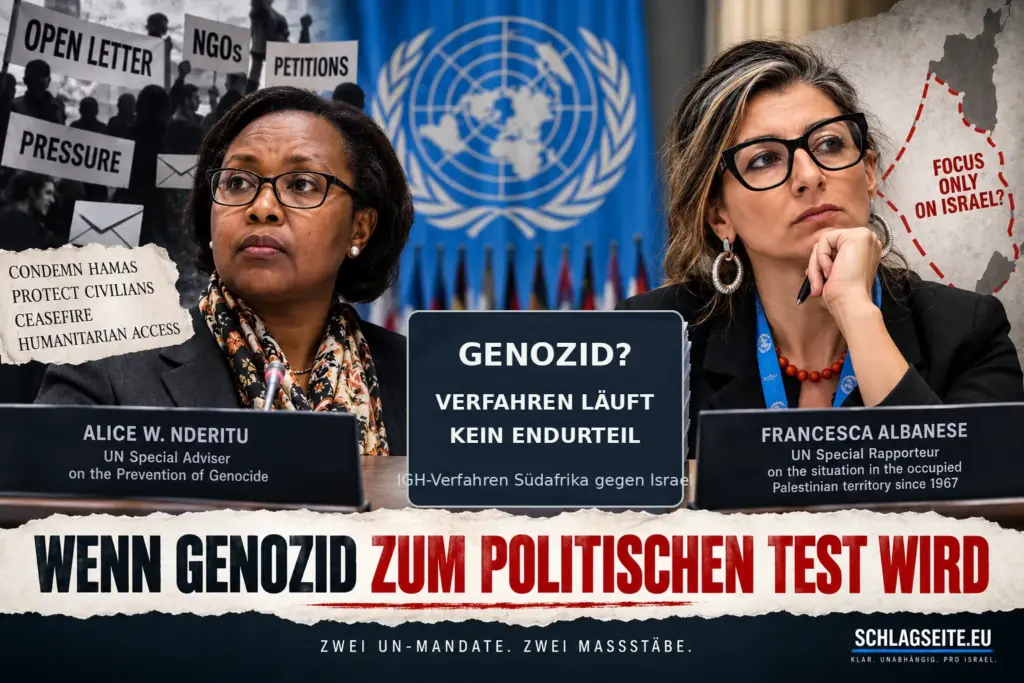

For four years, Alice Nderitu served as the UN Special Adviser on the Prevention of Genocide. After October 7, 2023, she condemned Hamas’s terror, the hostage-taking and the targeted violence against Israeli civilians. At the same time, she demanded protection for Palestinian civilians, humanitarian access and a ceasefire. That is precisely why her case is so revealing: Nderitu was not an advocate for Israel. She merely insisted that severe suffering does not automatically amount to a legally established genocide. By her own account, this brought her under massive pressure.
Alice Wairimu Nderitu fits poorly into the political framework in which restraint over the genocide accusation against Israel is quickly treated as taking the side of the Jewish state. The Kenyan is not an Israeli official and did not come from a pro-Israel organization. António Guterres appointed her on November 10, 2020, as the UN Secretary-General’s Special Adviser on the Prevention of Genocide.
The United Nations described Nderitu upon her appointment as an experienced expert in peacebuilding, violence prevention and reconciliation processes. She had mediated between hostile communities in Kenya and other African conflict regions. Her predecessor, Adama Dieng, held the post from 2012 to 2020.
Alice Nderitu. Most people don't know that name.
I talk about her all the time. Why is she important? She was one of the world's preeminent experts on genocide.
She's a Kenyan woman, not a Jew, not married to a Jew, obviously not Israeli.
She rose in the ranks of… pic.twitter.com/ROXZAKTzTn
— Roy K. Altman (@RoyKAltman) September 2, 2026

Passende X-Beiträge
Aus dem SCHLAGSEITE X-ArchivAlice Nderitu named Hamas and the suffering in Gaza
After the massacre of October 7, 2023, Nderitu did not take a one-sided position. That is precisely what makes her later conflict with parts of the UN environment so interesting.
In her statement of October 15, 2023 she explicitly condemned Hamas’s coordinated attacks on Israeli cities and civilians. She condemned the abduction of Israeli civilians and the continued rocket fire. Particularly sharp was her characterization of the targeted violence against people because of their identity.
But Alice Nderitu did not limit herself to Israel. She also warned of the consequences of Israeli bombardments for Palestinian civilians, demanded compliance with international law, humanitarian supplies and protection for people who had had to leave their homes in the Gaza Strip or were trapped there.
She even explicitly called for an immediate ceasefire so that diplomatic talks could take place.
In February 2024, she reiterated this position. She demanded a humanitarian ceasefire, the protection of civilians and civilian infrastructure on both sides, the safe return of the hostages abducted by Hamas and an investigation into reports of sexual violence during the October 7 attack.
Anyone who subsequently turns Nderitu into an Israeli crown witness therefore misses the core of her position. She criticized Israeli warfare, warned of severe civilian suffering in Gaza and demanded humanitarian measures. She merely refused to take the step of turning these findings themselves into a legally binding determination of genocide.
That is precisely where the strength of her case lies.
I had previously summarized the starting point for this article in my post on X: Alice Wairimu Nderitu and the dispute over the term genocide.
Alice Nderitu: Her office was meant to warn, not judge
The distinction between warning and judgment was not a personal quirk of Nderitu’s. It was part of the structure of her office.
The mandate of the Special Adviser on the Prevention of Genocide was created as an early-warning mechanism. The office is supposed to identify risks, gather information, warn the UN Secretary-General and the Security Council, and make recommendations for preventing the most serious crimes.
It is not a court.
The UN office itself therefore published guidance on when the term genocide should be used. It expressly warns against its frequent misuse in connection with serious mass crimes, its enormous political charge and the legal consequences of a genocide determination.

The term genocide does not simply describe a particularly high death toll or particularly extensive destruction. It requires specific acts and the specific intent to destroy, in whole or in part, a national, ethnic, racial or religious group as such. War crimes, crimes against humanity and genocide are different legal categories.
On October 29, 2024, Nderitu herself formulated this boundary unequivocally.
In her statement on the Middle East she expressly stated that her prevention mandate did not allow her to determine whether genocide or another specific international crime had been committed. Only a competent, independent and impartial court could decide that.
She therefore did not say: No genocide is taking place in Gaza.
She said: My office is not authorized to rule on that.
This distinction is crucial to the entire case.

The pressure can be traced chronologically
The conflict surrounding Alice Nderitu did not arise only shortly before her departure. The pressure campaign is documented.
On December 2, 2023, several Palestinian human rights organizations addressed Nderitu and the UN Special Adviser on the Responsibility to Protect, George Okoth-Obbo, directly. They expressly criticized the fact that Nderitu’s October 15 statement had not warned the international community of an allegedly ongoing genocide against Palestinians.
The organizations demanded that the two Special Advisers use their mandates to mobilize the international community against Israel’s actions, which they had already designated as genocide.
The next step followed on February 7, 2024. Palestinian organizations sent an open letter to António Guterres. In it, they accused Nderitu of failing to fulfill her mandate and called for an investigation into her conduct in office.
Criticism of a legal assessment had thus become a campaign against the officeholder herself.
Alice Nderitu did not change her position.
“I Was Hounded, Day In, Day Out”
After leaving office, Alice Nderitu spoke in greater detail for the first time about how far the pressure had gone, according to her own account.
The original interview appeared on February 1, 2025, in the magazine Air Mail under the title “I Was Hounded, Day In, Day Out”. The title was not invented later. It comes from the original article by journalist Johanna Berkman.
In it, Nderitu said she had been pressured and harassed practically every day because she did not accuse Israel of genocide. According to her account, the pressure did not come only through public channels. She also reported messages on her phone, threats on social media and messages sent to her UN email address.
She also described pressure from within the UN environment itself. According to her account, colleagues wanted to know why she would not at least publicly identify an unequivocal risk of genocide by Israel.
Her comparison with other wars was particularly revealing. Nderitu said she had experienced no such pressure in connection with Ukraine, Sudan, Myanmar or the Democratic Republic of the Congo.
The focus was always Israel.
This is Nderitu’s personal account of her time in office. The public part of the campaign against her is documented independently of that: letters to her office, open letters to Guterres, demands for an investigation into her conduct in office and the political accusation that she was refusing to make the expected genocide accusation.
What might otherwise be perceived merely as a mood thus becomes a comprehensible chronology.
Then her contract was not renewed
Alice Nderitu’s term of office ended in November 2024. Her contract was not renewed.
The United Nations denies that this happened because of her position on the genocide accusation. The Secretary-General’s spokesperson stated that Nderitu had properly completed her term and that António Guterres appreciated her work.
This account is part of the facts and is sufficient as a counterposition.
The preceding sequence remains unaffected: Nderitu was publicly pressured because of her refusal to use the term genocide against Israel. She later described additional internal pressure. Shortly afterward, her contract ended without renewal.
No written instruction stating that she had to accuse Israel of genocide or leave has been documented. That is precisely why the article should not claim such a direct causal link.
The documented process is already explosive enough.
Alice Nderitu’s predecessor, Adama Dieng, had held the same office for eight years. Alice Nderitu remained for four.
After her departure, the office was initially run on an acting basis. In August 2025, António Guterres appointed the Zambian international lawyer Chaloka Beyani as the new Special Adviser on the Prevention of Genocide.
The statements published by his office to date provide no solid evidence that Beyani has publicly abandoned Nderitu’s fundamental separation between the prevention mandate and a judicial determination of genocide in the Gaza context. Nothing more can responsibly be inferred from them.
December 2023: Palestinian organizations call on Nderitu to issue a genocide warning against Israel.
February 2024: Organizations call on António Guterres to investigate her conduct in office.
2024: Nderitu maintains the limits of her mandate and continues to speak about Hamas, hostages, Palestinian civilians, a ceasefire and humanitarian protection.
November 2024: Her contract is not renewed.
February 2025: Nderitu publicly reports massive pressure inside and outside the United Nations.
The ICJ has not issued a genocide ruling against Israel
For understanding Alice Nderitu’s position, the status of the proceedings before the International Court of Justice is crucial.
On December 29, 2023, South Africa sued Israel over alleged violations of the Genocide Convention. The Court subsequently issued several provisional measures.
These measures are not a conviction.
In January 2024, the Court did not decide that Israel was committing genocide. Nor did it decide that an Israeli genocide was “plausible” as such. In ordering provisional measures, it examined, among other things, whether certain rights asserted by South Africa under the Genocide Convention were plausible and whether there was a risk of irreparable prejudice.
Plausible rights to protection are not a genocide plausibly established as a matter of law.
The merits proceedings are ongoing.
The official proceedings page of the International Court of Justice continues to document ongoing proceedings on the merits. In an order dated May 21, 2026, the Court set further deadlines for the parties’ written pleadings.
South Africa may reply by November 22, 2027. Israel will then have until May 22, 2029, to submit its rejoinder.
Thus, as of September 2026, one thing remains clear: The International Court of Justice has not issued a final judgment finding Israel guilty of genocide.
SCHLAGSEITE.eu has already addressed the detailed legal and factual debate surrounding the genocide allegation in separate articles. This article need not revisit it in full. It is about something else: how the United Nations deals with an ongoing court case and with officials who insist on that openness.

Nderitu and Albanese did not hold the same mandate
The comparison between Alice Nderitu and Francesca Albanese only becomes truly meaningful when one crucial difference is not overlooked.
Alice Nderitu had a general prevention mandate. Her office was meant to identify risks of genocide and related crimes and warn the UN Secretary-General.
Albanese, by contrast, holds a country- or territory-specific mandate with a completely different structure.
The office of the UN Special Rapporteur on the human rights situation in the Palestinian territories was created in 1993. The underlying resolution expressly tasked the Special Rapporteur with investigating violations by Israel of international law and international humanitarian law in the Palestinian territories occupied since 1967.
The mandate is therefore structurally directed at Israel. It is not Albanese’s task to comprehensively investigate Hamas crimes on Israeli territory. Other UN mechanisms exist for that purpose. Anyone who simply places Nderitu and Albanese side by side as two comparable UN experts is therefore actually comparing apples and oranges. That does not excuse Albanese’s statements. On the contrary. It shows that the institutional asymmetry is already embedded in the mandate and is further intensified by her political work.
Albanese’s anti-Israel line did not begin in 2026
The problematic nature of Francesca Albanese’s public conduct cannot be reduced to a single controversial appearance or a video clip cut out of context. The evidence goes back years.
As early as 2014, Albanese publicly used the antisemitic stereotype of a powerful “Jewish lobby” influencing American policy. She later said she regretted that wording.
On February 10, 2024, she responded to Emmanuel Macron’s description of October 7 as the century’s largest antisemitic massacre by claiming that the victims had not been murdered because of their Jewish identity, but in response to Israeli oppression.
France and Germany sharply condemned this statement at the time. A few weeks later, the US State Department publicly referred to Albanese’s record of antisemitic remarks and to comments that appeared to justify October 7.
In March 2024, Albanese published the report “Anatomy of a Genocide” . In it, she stated that there were reasonable grounds to believe that Israel had committed acts in Gaza that reached the threshold of genocide.
In October 2024, she intensified this line further, describing Israel’s actions as part of a long-term process of colonial erasure.
This amounts to a documented development well before the disputes of 2026: antisemitic stereotypes, relativization of the antisemitic nature of October 7, and an increasingly sweeping political indictment of Israel.
For SCHLAGSEITE.eu, the assessment is therefore clear: Albanese does not adopt a neutral observer role toward Israel. She pursues a pronounced anti-Israel political agenda and uses her UN mandate as an international platform for this viewpoint.
The contrast lies not in identical offices, but in how they are treated
Precisely because Alice Nderitu’s and Francesca Albanese’s mandates differ, the comparison must be formulated precisely.
Nderitu held a prevention office whose own rules prevented her from becoming a court herself. She identified Hamas crimes, Israeli airstrikes, civilian suffering, hostage-taking, humanitarian distress, and the protection of both populations. She insisted that the term genocide be used with legal precision.
Albanese works under a mandate that is institutionally already directed at Israeli violations. Her own public activity goes further still. She has repeatedly placed Israel within an overarching colonial and genocidal framework while simultaneously relativizing the antisemitic nature of October 7.
The double standard therefore does not consist in two identical officials being treated differently.
It consists in the fact that legal restraint toward the gravest accusation against Israel generated massive political pressure, while an explicitly anti-Israel mandate holder retained an international UN platform for sweeping accusations against Israel for years.
The UN Commission of Inquiry is not a court either
In September 2025, the independent international Commission of Inquiry established by the UN Human Rights Council reached a substantially more far-reaching assessment.
In its report A/HRC/60/CRP.3, the Commission stated that Israeli authorities and security forces had committed four of the five acts listed in Article II of the Genocide Convention in Gaza. It also concluded that the required specific intent to destroy was present.
This is a serious and unequivocal genocide accusation from a UN body. It is not a judgment by the International Court of Justice.
The Commission was established by the UN Human Rights Council. It can investigate facts, develop legal views, and issue recommendations. It does not make a legally binding determination of Israel’s state responsibility in the proceedings South Africa v. Israel.
This precise institutional distinction must appear in the article. Otherwise, “a UN commission reaches this assessment” once again becomes “the UN convicted Israel of genocide” after a few rounds of retelling. It did not.
The ICJ continues to decide the case.
And what about Hamas?
Anyone who takes the term genocide seriously cannot apply the standard in only one direction.
Alice Nderitu herself described the attacks of October 7 as targeted violence against Israeli civilians and explicitly emphasized their identity-based character.
A subsequent UN Commission of Inquiry found that Hamas and other Palestinian armed groups deliberately attacked civilians, that the attack had been prepared and coordinated, and that people were abducted as hostages without regard to age or sex.
Hamas’s ideological background must also be considered. Its 1988 founding charter contains overtly antisemitic rhetoric calling for the destruction of Jews and demands Israel’s elimination. The 2017 political document changed the language and defined the conflict as a struggle against Zionism rather than against Jews as a religion. A senior Hamas official explicitly clarified at the time that this document did not replace the original charter and that the rejection of Israel remained in place.
None of this automatically means that an international court would have to legally classify the October 7 attack as genocide. Here, too, rules of evidence, the constituent elements of the crime, and specific intent apply. That is precisely the point.
Anyone who demands that an intent to destroy be inferred from Israel’s rhetoric, choice of targets, and military conduct cannot pretend, in Hamas’s case, that antisemitic ideology, targeted attacks on Jewish and Israeli civilians, and identity-based violence are irrelevant to the same examination. The standard must remain the same.
Nderitu’s later account is therefore also striking: The massive pressure on her office was aimed at using the term genocide against Israel. She said she had not experienced comparable pressure to apply the same term to Hamas.
The successor has so far offered no new Gaza doctrine
On August 22, 2025, António Guterres appointed Zambian international lawyer Chaloka Beyani as Nderitu’s successor. A publicly documented change of course by the office on the Gaza issue cannot so far be inferred from this.
This article is not revisiting the entire Gaza case
SCHLAGSEITE.eu has already examined the legal and factual basis of the genocide allegation against Israel in the article “Genocide Allegation Against Israel: What Experts Say and Courts Must Prove” . That article addresses intent to destroy, casualty figures, humanitarian supplies, statements by Israeli politicians, NGO reports, scholarly assessments, and the decisions of the International Court of Justice. The Alice Nderitu case does not require a repetition of this entire dossier.
Its journalistic value lies elsewhere. It allows us to observe what happens within an international system when a legally defined term has long since become a political declaration of allegiance. Alice Nderitu openly criticized Israeli measures and Palestinian suffering. She called for a ceasefire. She demanded humanitarian aid. She condemned Hamas, the abduction of the hostages, and targeted violence against Israeli civilians.
And yet that was not enough for her critics. The decisive word was missing — genocide.
When a legal term becomes a loyalty test
This gives the case its real significance.
Alice Nderitu showed that one can take Palestinian suffering seriously, criticize Israeli military actions, and demand the protection of civilians without therefore prejudging an ongoing court case in language. In a system that invokes international law, precisely this position should have been self-evident.
Instead, her refusal to adopt the term genocide against Israel itself became the subject of a campaign.
Francesca Albanese represents the opposite development. Her mandate is already structurally directed at investigating Israel. Her own political work has turned it into a comprehensive indictment of the Jewish state. Antisemitic stereotypes and the relativization of the antisemitic nature of October 7 have not ended this line.
The Nderitu case does not prove that every institution of the United Nations operates according to the same political script. The article does not need such proof.
It shows something more concrete and therefore stronger: In the genocide allegation against Israel, documented pressure was brought to bear on a UN Special Adviser who adhered to the limits of her own mandate. At the same time, within the same international system, an openly anti-Israel political line could be pursued for years under a UN mandate.
The decisive contrast is not Israel versus Palestinians. It is political expectation versus legal precision. Alice Nderitu named Hamas terrorism and Palestinian suffering. She merely refused to issue the final verdict. That is precisely what made her a problem.
Alice Nderitu is therefore not Israel’s star witness. She is the more inconvenient witness: a genocide expert who named both sides of the war, demanded protection for Palestinian civilians, and nevertheless was not prepared to turn a court ruling into a product of political pressure. To this day, the International Court of Justice has issued no final judgment against Israel. Anyone who demands beforehand that the gravest crime under international law already be pronounced an established fact is not defending the precision of the law. They are replacing it with politics.
ℹ️ Factual basis and primary sources for the article 📑
▶️ United Nations:
Appointment of Alice Wairimu Nderitu as Special Adviser on the Prevention of Genocide
Official statement of 10 November 2020 on the appointment, professional background and predecessor Adama Dieng.
▶️ UN Special Adviser on the Prevention of Genocide:
Statement on the Middle East of 15 October 2023
Nderitu’s condemnation of the Hamas attacks and hostage-taking, as well as her calls for the protection of Palestinian civilians, humanitarian supplies and a ceasefire.
▶️ UN Special Adviser on the Prevention of Genocide:
Statement of 9 February 2024
Nderitu reaffirms her call for a ceasefire, the protection of civilians on both sides, the release of the hostages and her neutrality regarding the ongoing ICJ proceedings.
▶️ UN Office on Genocide Prevention:
When to refer to a situation as genocide
Guidance on the correct use of the term genocide, its political sensitivity and the legal requirements.
▶️ UN Special Adviser on the Prevention of Genocide:
Statement of 29 October 2024
Nderitu expressly states that her prevention mandate does not permit her to determine that genocide or any other specific international crime has occurred.
▶️ Palestinian human rights organizations:
Letter to Nderitu and Okoth-Obbo of 2 December 2023
Documents the demand that Nderitu warn of genocide by Israel and mobilize international measures.
▶️ Palestinian human rights organizations:
Open letter to António Guterres of 7 February 2024
Demand for an investigation into Nderitu’s conduct in office over her handling of the allegation of genocide against Israel.
▶️ Air Mail:
“I Was Hounded, Day In, Day Out”
Original interview by Johanna Berkman of 1 February 2025 about Nderitu’s account of the internal and external pressure.
▶️ UN Commission on Human Rights:
Resolution E/CN.4/RES/1993/2 of 19 February 1993
The original mandate of the Special Rapporteur expressly concerns the investigation of Israeli violations in the Palestinian territories controlled since 1967.
▶️ International Court of Justice:
South Africa v. Israel
Official proceedings page for the case under the Genocide Convention, which is still ongoing.
▶️ International Court of Justice:
Order of 21 May 2026
Further written-submission deadlines are 22 November 2027 for South Africa and 22 May 2029 for Israel. No final judgment has been issued.
▶️ Francesca Albanese:
A/HRC/55/73 – Anatomy of a Genocide
Albanese’s report of March 2024 containing her genocide assessment against Israel.
▶️ US Department of State:
Department Press Briefing of 27 March 2024
The US Department of State refers to Albanese’s history of antisemitic statements, as well as statements that appeared to justify 7 October.
▶️ UN Commission of Inquiry:
A/HRC/60/CRP.3 of 16 September 2025
The Commission of Inquiry established by the Human Rights Council alleges that Israel committed genocide in Gaza. The commission is not a court, and its report is not an ICJ judgment.
▶️ UN Commission of Inquiry on 7 October:
A/HRC/56/26 of 27 May 2024
The commission documents intentional attacks on civilians, the planned and coordinated execution of the Hamas-led attack, and hostage-taking without regard to age or gender.
▶️ Hamas founding charter of 1988:
English translation of the 1988 Hamas Charter
Documents the antisemitic ideology of the original Hamas Charter and its aim of eliminating Israel.
▶️ Reuters:
Leading Hamas official says no softened stance towards Israel, 10 May 2017
Mahmoud al-Zahar stated after the publication of the 2017 policy document that it did not replace the founding charter and did not mean recognition of Israel.
▶️ UN Secretary-General:
Appointment of Chaloka Beyani of 22 August 2025
Documents Beyani’s appointment as Nderitu’s successor after an interim acting period.
🔎 Spotted an error, criticism or addition?
SCHLAGSEITE.eu stands for careful research and transparent corrections. Have you discovered a factual error, unclear wording or a broken link? Then send me your note. If possible, please provide a verifiable source.