
00:00 / –:–
Gastbeitrag von Nida Banou

Rise Iran & Javid Shah | anti-postkoloniale Ideologie & anti-Islamismus | Eure Freiheit ist heilig. Beschützt sie.
Some have taken issue with Constantin Schreiber’s (@ConstSchreiber) book title “The Power of Islam,” and in particular with the fact that he also speaks of the appeal of Islam. To some, the wording already seemed too positive—almost as if one were not allowed to describe a religion that strongly regulates individual conduct in many areas using terms such as “power” or “appeal.”
Yet that is precisely where a misunderstanding lies. Appeal is not a moral judgment. Explaining why a religion attracts people neither means endorsing it nor downplaying its social consequences. On the contrary: Anyone who takes a critical view of a religion should, precisely for that reason, want to understand what its psychological strength lies in.
This question is particularly interesting in the case of Islam. From a liberal Western perspective, a religion with fixed prayer times, fasting requirements, dietary regulations, sexual norms and far-reaching ideas about marriage, family and gender roles ought actually to be the less attractive offering. The greater the restriction of individual freedom, the weaker the appeal—the obvious calculation would suggest. Yet the psychology and sociology of religion show that this calculation does not hold.
Restriction can itself be part of the appeal.
Michael Hogg and colleagues explain part of this phenomenon using Uncertainty-Identity Theory. People seek not only freedom, but also certainty about who they are, where they belong, and according to which standards they should judge their world. Strongly delineated groups can reduce such uncertainty because they offer clear identities, norms, and boundaries. Religion has particular advantages in this regard: It provides an interpretation of the world, community, morality, and concrete rules for conducting one’s life.[1] Laurence Iannaccone already demonstrated in his classic work Why Strict Churches Are Strong, that high demands do not necessarily weaken religious communities. They can intensify participation, consolidate group boundaries, and enhance belonging precisely because they come at a cost.[2]
From this perspective, the meaning of restriction changes. What looks from the outside like external control can be experienced from within as order, self-discipline, or moral clarity. A rule takes away options, but at the same time reduces ambiguity.
In a culture that requires individuals to define their identity, sexuality, relationships, way of life, and sense of meaning largely for themselves, a closed system of norms can provide relief precisely through its clarity.
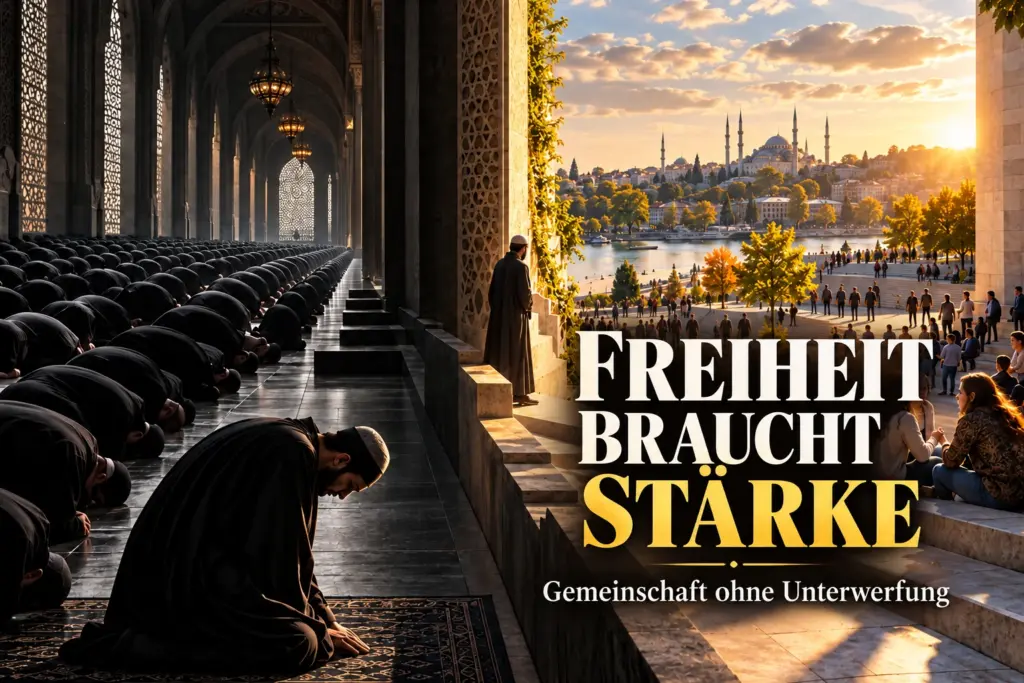
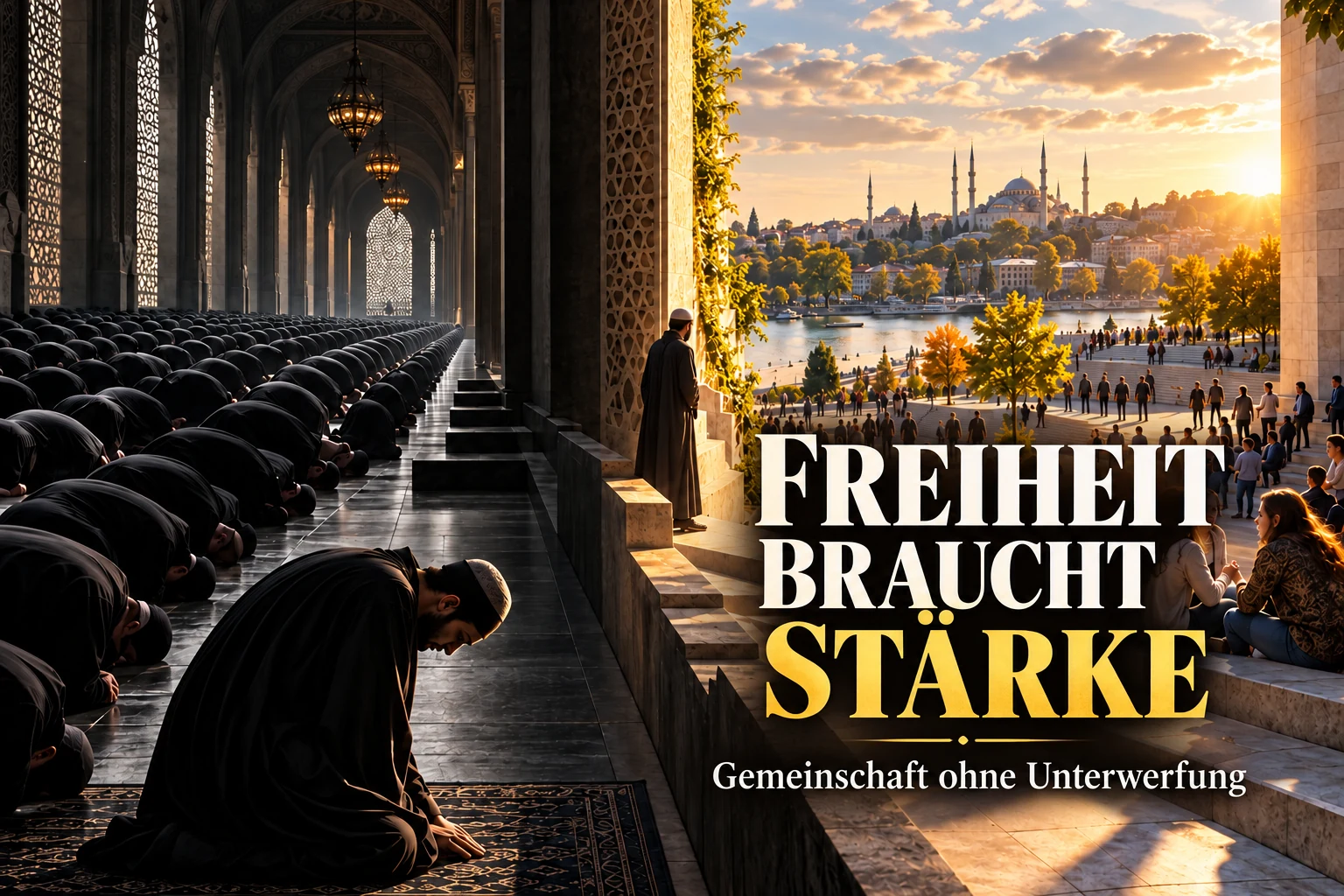
In Islam, another idea becomes particularly clear: devotion to, if not outright submission to, God. The term Islam is associated with submission to God’s will. This attitude does not remain abstract, but is physically practiced in prayer: standing, bowing, prostrating oneself. The sujūd, prostration, is a visible expression of this attitude.
Psychologically, this represents a countermodel to radical individualism: the self is not the ultimate standard. Self-limitation can therefore be experienced precisely as a virtue, purity, and integration into a higher order.
Women and men: different emphases
Conversion research initially shows many commonalities. The search for meaning, spirituality, the message of the Quran, identity, and belonging play a role for both men and women. Comparative studies also find different emphases: women more frequently report relational factors, Muslim partners, and social integration; men more frequently cite the example of Mohammed and personal experiences of crisis.[3]
For women, the ideal of a morally exemplary femininity can additionally become attractive. In her research on Islamic piety movements, Saba Mahmood showed that modesty, sexual restraint, humility, and shyness are not experienced merely as restrictions, but can consciously be cultivated as virtues.[4]
This potentially contains a strong sense of purity and distinctiveness: By visibly covering herself, refraining from sexual permissiveness, and adhering to a demanding moral code, a person can thereby distinguish herself from an environment perceived as sexualized or superficial.
Restriction then becomes a sign of moral seriousness.
The underlying classical legal order should not be glossed over in this regard. Classical Islamic fiqh treats men and women in existentially asymmetrical ways in various areas of law, for example with regard to inheritance, marriage, divorce, rules of testimony, and through concepts such as walī and qiwāma, which assign men particular legal or familial duties of authority and provision.[5]
For the psychological question, however, it remains noteworthy that precisely such clear-cut gender roles can be, for some Western female converts, not merely a disadvantage to be accepted, but part of the initial appeal .[6] They can be interpreted as protection, as enhancing the value of marriage and motherhood, or as relief from the constant need to define oneself.
For men, by contrast, duty, discipline, brotherhood, providing for the family, and a clear male role may be particularly relatable.[3] In addition, there is a historical element that deserves consideration, at least as a hypothesis: Early Muslim rule expanded to a considerable extent through military conquest and masculine dominance.[7]
A triumphalist reading of this history—a small faith community that pushes back great empires and becomes a global power within just a few generations—can function as a narrative of strength, victory, and the subjugation of others through divine favor.
What must a liberal culture offer in response?
This raises the more politically important question. If a free society wants to prevent young people in particular from experiencing closed religious or political orders as the emotionally stronger option, its answer cannot merely be: You are free with us.
Freedom alone does not satisfy all human needs. Ryan and Deci’s Self-Determination Theory describes competence and social connectedness, alongside autonomy, as fundamental psychological needs.[8]People want to make their own decisions, but also to belong, to be needed, and to experience that their actions have meaning. This is precisely where strongly normative communities can gain traction: You belong to us. We know what is right. You have a task. You matter.
A liberal democracy therefore needs meaningful bonds without submission. It needs the value of a family, loyal and principled friendships, clubs, sport, culture, neighbourhoods, voluntary work, traditions and a positive political identity.
Incidentally, these characteristics of a culture and society are precisely those that are systematically devalued, ridiculed and deconstructed by progressive ideologies – perhaps precisely because, deep down, they know that they can serve society as an anchor against Islamisation.
A liberal democracy must not only open up spaces for young people, but also trust them with responsibility. Freedom must not appear as social rootlessness.
Nor should liberalism be confused with a lack of values. An open society can leave many matters to the individual and still state very clearly what its common order is based on: human dignity, equality before the law, freedom of conscience, gender equality, freedom of expression and the freedom to adopt, change or completely leave a religion. One may live traditionally, but not force others to do so. One may believe that one’s own religion possesses the truth, but one may not derive from this a right to rule over others. Religious freedom therefore means not only freedom to practise a religion, but also freedom from religious coercion.
That is precisely why a liberal order must be capable of defending itself.
For historical reasons, German constitutional law uses the term militant democracy: A free order must protect political pluralism, but it is not obliged to stand idly by while its own abolition takes place.[9]This thought extends beyond combating extremism. A political order loses credibility when it solemnly proclaims its principles but, when they are violated, retreats out of fear of conflict or misplaced tolerance and throws its citizens “to the wolves.”
Being capable of defending itself means neither arbitrariness nor collective suspicion. Its strength lies precisely in the general applicability of its rules. Violence remains violence, regardless of whether it is justified by right-wing, left-wing, religious or other ideological convictions. Women’s rights do not become relative because their restriction is justified on religious grounds. A person who leaves a religion must be able to rely on their right to make that decision being protected. Teachers, artists or writers must not have to experience their freedom ending where an aggressive group generates sufficient pressure. But that is exactly what we are experiencing right now. Advantages through aggression. Freedom becomes more credible and appealing when it does not have to be confused with helplessness.
Israel as a Contrast
Israel is not a model that can simply be transferred, nor is it by any means a conflict-free democracy. Nevertheless, the country demonstrates a combination that is interesting for this discussion: an exceptionally combative political public sphere, individual rights and freedoms, and at the same time a strong awareness that the community must be defended.[10]
The cultural message is therefore interesting: Freedom and the willingness to defend oneself do not have to be opposites. Citizens are not exclusively recipients of rights; they can also see themselves as bearers of a community whose continued existence is not treated as an embarrassing or morally suspect concern.
Judaism has a particular limitation as a religious alternative: It has traditionally not been missionary, and conversion to Orthodox Judaism in particular is subject to considerable hurdles.[11]Especially from the perspective of the sociology of religion, this is remarkable. A tradition that combines strong community, ritual, historical identity and, in many modern currents, a high degree of compatibility with individual freedom, makes comparatively little effort to appeal to outsiders.
Freedom must once again radiate strength
Perhaps this is the crucial point. Liberal societies must not confuse their attractiveness with the absence of demands. People are not merely looking for as many options as possible. They seek belonging, meaning, moral guidance, “purity,” responsibility, self-transcendence and, above all, strength. Restrictive religions and political ideologies can appeal to precisely these needs.
The liberal alternative must therefore be greater than consumption, individualization and the absence of prohibitions. It needs cultural self-confidence without ethnic exclusion, morality without theocracy, community without coercion, tradition without unfreedom and the capacity for self-defence without arbitrariness.
Above all, it needs clear boundaries. Not toward people, but toward claims to power.
The answer to a closed system is not: We have no rules here. It is: For us, fundamental rules and consequences—positive as well as negative—apply to everyone.
The counteroffer to a restrictive religious or political order is therefore not a lack of commitment.
It is commitment without submission, meaning without prescribed truth, community without enforced conformity, and the ability to defend oneself without arbitrariness.
A liberal democracy must therefore be able to tell its citizens more than: You are free.
It must be able to say: You are free. You belong. This order has values. And this freedom is worth defending. And we are strong and will protect you.
Literature
[1] Hogg, M. A., Adelman, J. R. & Blagg, R. D. (2010). Religion in the Face of Uncertainty: An Uncertainty-Identity Theory Account of Religiousness. Personality and Social Psychology Review, 14(1), 72-83.
[2] Iannaccone, L. R. (1994). Why Strict Churches Are Strong. American Journal of Sociology, 99(5), 1180-1211.
[3]Mitchell, P., Mamone, J. & Rane, H. (2021). Gender, Identity and Conversion: A Comparison of Male and Female Converts to Islam in Australia. Islam and Christian-Muslim Relations, 32(3), 279-306.
[4]Mahmood, S. (2005). Politics of Piety: The Islamic Revival and the Feminist Subject. Princeton University Press.
[5]Tucker, J. E. (2008). Women, Family, and Gender in Islamic Law. Cambridge University Press.
[6]Vroon-Najem, V. (2025). Conversions to Islam. In M. Bano (ed.), The Cambridge Companion to Women and Islam. Cambridge University Press.
[7]Lapidus, I. M. A History of Islamic Societies. Cambridge University Press, various editions.
[8]Ryan, R. M. & Deci, E. L. (2000). Self-Determination Theory and the Facilitation of Intrinsic Motivation, Social Development, and Well-Being. American Psychologist, 55(1), 68-78.
[9]Federal Constitutional Court (2024). Judgment of 23 January 2024 – 2 BvB 1/19, concerning the concept of a free and defensive democracy.
[10] Freedom House (2025). Freedom in the World 2025: Israel.
[11] Fisher, N. (2019). “Israeli” Halakha: The Chief Rabbinate’s Conversion-To-Judaism Policy 1948-2018.Modern Judaism, 39(1), 61-92.