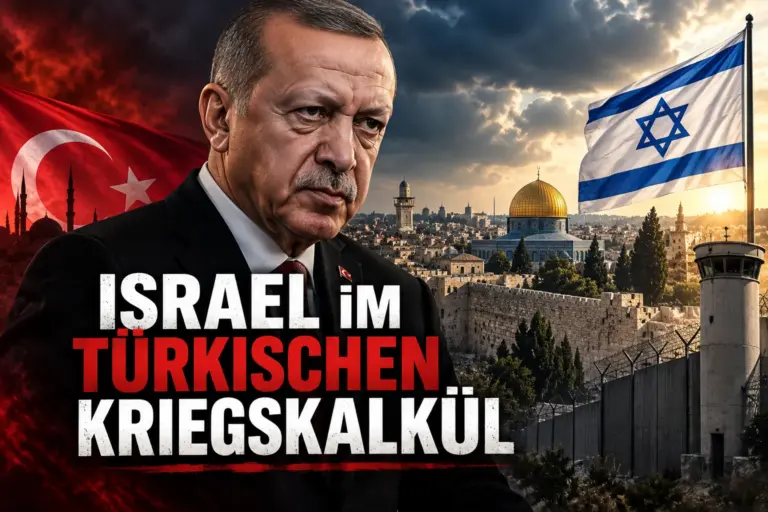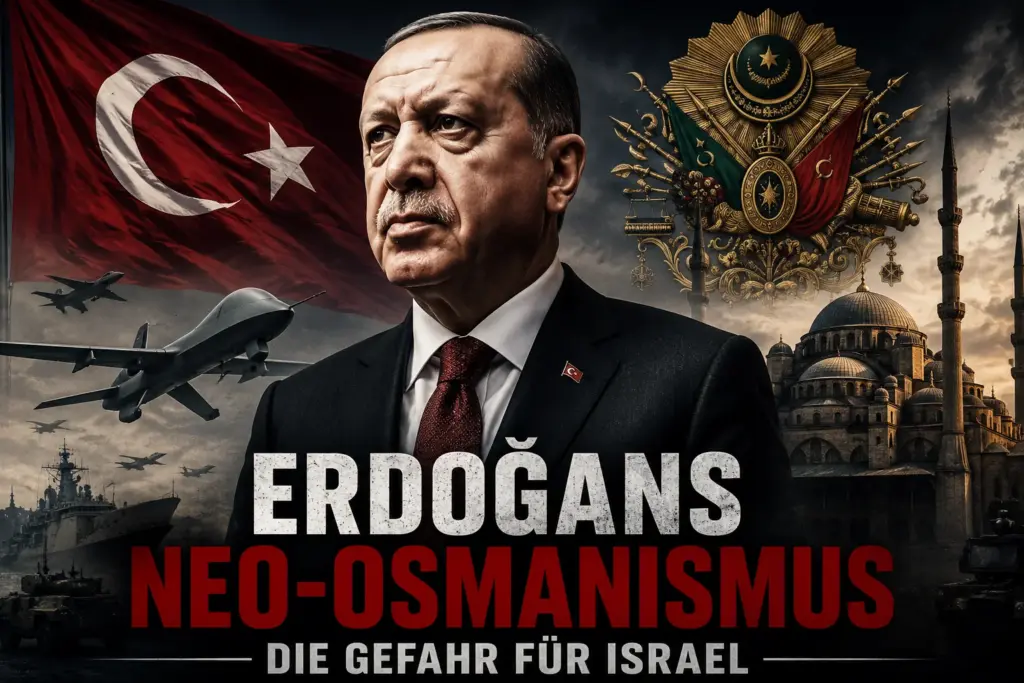

Erdoğan’s neo-Ottomanism has long been more than rhetoric. Ankara is expanding its military capabilities, creating new alliance structures and pushing into political spaces that are directly relevant to Israel’s security. At the same time, the Turkish leadership maintains close relations with Hamas and has been intensifying its confrontation with Jerusalem for years. Behind Erdoğan’s claim to power today stand real political, military, economic and ideological instruments.
The new defence pact between Turkey, Saudi Arabia and Pakistan makes this development particularly visible. Ankara does not want to be just any actor in the Middle East. Erdoğan is working to make Turkey a determining regional power.
For Israel, this is not a theoretical question. As Iran has been weakened and old power structures in Syria and the region have collapsed, Turkey is attempting to occupy the spaces that have emerged politically and in terms of security policy. Jerusalem would therefore do well to build its own reliable network of strategic partnerships, defence agreements and deliberately deepened security cooperation .

Passende X-Beiträge
Aus dem SCHLAGSEITE X-Archiv
A defence pact changes the regional balance of power
On 7 August 2026 Turkey, Saudi Arabia and Pakistan signed the so-called Mecca Joint Defence Agreement in Mecca. The agreement contains a notable core provision: An armed attack on one of the three states is to be regarded as an attack on all of them.
The Turkish government also announced political and military coordination mechanisms at the highest level, joint exercises on land, at sea and in the air, as well as deeper cooperation between the defence industries. Unmanned systems, electronic warfare and artificial intelligence are also to be included. According to the Turkish presentation, the pact is open to additional states, with Ankara already naming Egypt as a possible candidate.
Officially, the agreement is directed against no particular state. Its immediate background lies above all in the escalated regional threat posed by Iran and its allies. Its strategic impact nevertheless extends further: Erdoğan gains an institutional framework that links Turkey more closely with two heavyweights of the Islamic world and gives Ankara additional political and military weight.
The Pakistani dimension should not be underestimated. Pakistan is a nuclear power. This does not expressly mean that Islamabad has automatically promised Turkey or Saudi Arabia a nuclear umbrella. No such obligation is established by the trilateral agreement. But a common defence framework linking the NATO member Turkey, the geopolitically and energy-politically significant Gulf state of Saudi Arabia and nuclear-armed Pakistan changes the region’s strategic calculations even without speculation about nuclear weapons.
Added to this is Turkey’s growing defence industry. According to a Reuters analysis from June 2026 Turkish defence exports have more than tripled since 2021 and reached around ten billion dollars in 2025. Turkey also has the second-largest armed force within NATO.
Erdoğan is creating the conditions for Ankara to become increasingly difficult to bypass on more and more regional issues.
Hamas Is Part of Erdoğan’s Regional Power Game
Anyone seeking to understand Erdoğan’s policy toward Israel cannot avoid his relationship with Hamas. As early as October 2023, he publicly declared that Hamas was not a terrorist organisation, but a liberation movement. Ankara has not abandoned this position.
The contacts remain institutionally visible to this day. As recently as 29 July 2026 Turkish Foreign Minister Hakan Fidan met in Ankara with a Hamas delegation led by Halil al-Hayya, the head of its political bureau. The Turkish Foreign Ministry itself published the meeting.
Even more significant are findings concerning Hamas structures on Turkish soil. The US Treasury sanctioned several Hamas officials in November 2024 who, according to American information, were based in Turkey. They included a senior Hamas official who, according to the US authority, channelled funds from Turkey to Gaza and Judea and Samaria for the organisation, as well as another Hamas financial operative based in Turkey.

The publicly available evidence shows close political contacts between the Turkish leadership and Hamas, as well as Hamas financing structures on Turkish soil documented by US authorities. It does not automatically prove that the Turkish state itself organised these money flows. What it does clearly show, however, is that Ankara does not treat Hamas like a proscribed terrorist enemy.
Erdoğan supports Hamas politically, gives its leadership diplomatic access and persistently refuses to treat the organisation as what it is for Israel, the United States and the European Union: a terrorist organisation. At the same time, according to US findings, significant Hamas actors have been able to operate from Turkey.
This position does not stand apart from Erdoğan’s broader Israel policy. In July 2024, he publicly stated that Turkey could intervene in Israel, as it had previously acted in Libya and in the conflict over Nagorno-Karabakh. In June 2026, he went further, stating according to Reuters, that Israeli operations in Syria and Lebanon had reached a scale that also threatened Turkey’s security.
This is not an occasional diplomatic slip. Erdoğan politically elevates Hamas, repeatedly describes Israel as a regional security problem and combines this rhetoric with a growing Turkish claim to power.
For Israel, this concerns an organisation that on 7 October 2023 perpetrated the worst massacre of Jews since the Shoah . When the president of a major NATO state politically defends this terrorist organisation and its leadership continues to gain access to the highest levels of the Turkish government, that is a security-policy factor, not merely a disagreement of opinion.

Syria Brings Turkish Power Closer to Israel’s Security Sphere
The conflict of interests is particularly clear in Syria. Following the collapse of the Assad regime, Ankara gained considerable influence over the new Syrian order. Turkey had already supported parts of the Syrian opposition for years and has military, political and economic means of influence in the north of the country.
In spring 2025, Reuters reported that Turkish teams had examined, among other things, the T4 and Palmyra air bases and Hama airport to determine whether Turkish forces could be stationed there as part of a possible Turkish-Syrian defence agreement. Israel attacked several of these facilities and severely damaged their military infrastructure.
The then Israeli Foreign Minister Gideon Sa’ar accused Ankara of working toward a “Turkish protectorate” in Syria. Turkey, by contrast, stated that it did not seek confrontation with Israel.
For Jerusalem, this is not a matter of semantic nuances. A permanent Turkish military presence at Syrian airfields could significantly complicate Israel’s operational freedom in the north. Turkish air defences, Turkish aircraft or permanently stationed troops would create an entirely different strategic situation from that of a weak Syrian state without a strong patron.
Israel must be able to protect its northern border and its freedom of action against weapons transfers, hostile militias and military infrastructure in Syria. The more strongly Ankara shapes Syria’s security structures, the more directly Turkish and Israeli interests will collide there.
Erdoğan’s claim that Israel now itself poses a danger to Turkey further intensifies this tension. Such statements do not come from an activist on the fringes of a demonstration, but from the president of a NATO state with a large army and growing regional reach.
The NATO contradiction: Ankara benefits from the alliance and blocked cooperation with Israel
This is precisely where a contradiction arises that receives surprisingly little attention in the European debate. Turkey is a full NATO member and is therefore covered by the alliance’s collective defence. At the NATO summit in Ankara in July 2026, the member states once again expressly reaffirmed Article 5: An attack on one ally is considered an attack on all.
Turkey benefits from this solidarity not only on paper. Since mid-June 2026, the Bundeswehr has supported integrated NATO air defence in the Turkish city of Malatya with around 150 soldiers and a Patriot air-defence system . The German unit replaced American forces there. Germany is thus protecting the airspace of an allied state in very concrete terms, while that state’s government simultaneously pursues an increasingly confrontational policy toward Israel.
On the other hand, Ankara used its position within the alliance to obstruct cooperation between NATO and Israel. Reuters reported in 2024, that Turkey had blocked various forms of NATO cooperation with Israel since 7 October. Erdoğan himself stated that Ankara would not agree to such cooperation as long as, in his view, a lasting solution to the Palestinian question had not been achieved.
Ankara therefore makes use of the security guarantees and military structures of the Western alliance while simultaneously using its political influence within that alliance against closer cooperation with Israel. Israel, in turn, is not a NATO member and has no comparable guarantee of assistance.
For Jerusalem, this makes the situation more complicated. Many of Israel’s most important partners, above all the United States and several European states, are simultaneously linked to Turkey by treaty. Erdoğan therefore cannot be treated like the leader of an isolated hostile state. He sits within an alliance that is central to the security of Europe and North America.
Erdoğan’s Neo-Ottomanism Means Influence, Not Old Borders
The term neo-Ottomanism is quickly misunderstood. No one has to claim that Erdoğan is planning to re-establish the Ottoman Empire with identical borders and a sultan on the throne. That would be a caricature and would distract from the actual problem.
What matters instead is the question of whether Ankara is attempting, in areas that were under Ottoman influence for centuries, to once again assume a leading political, military, economic, cultural and religious role.
The answer is becoming increasingly clear. From Syria through Libya and the eastern Mediterranean to the Horn of Africa and the Gulf region, Turkey is expanding its room for manoeuvre. Added to this are a strongly expanded defence sector, a self-confident presence within NATO, new defence structures and Erdoğan’s claim to be a leading voice of the Islamic world on the Palestinian question and the status of Jerusalem.
Power politics also works without tanks
Erdoğan’s influence strategy is not limited to military bases, drones, and defense agreements. Turkey has been investing heavily in soft power for years. An important role is played by the state development agency TİKA, which, according to its own information, is active in more than 170 countries and has so far implemented more than 30,000 projects and activities.
These include infrastructure, education, healthcare, administration, media, cultural cooperation, and the restoration of historic sites. TİKA itself describes preserving shared historical and cultural values, particularly in the Balkans, Central Asia, and North Africa, as part of its work. Development aid and cultural policy thus also become instruments of long-term Turkish presence.
The religious dimension is added to this. The Türkiye Diyanet Foundation affiliated with the state religious authority, runs international training programs for pupils and theology students from numerous Muslim states and communities. According to its own information, the foundation also provides humanitarian assistance in 149 countries.
The foreign-policy effect of such structures is obvious: Ankara establishes lasting contacts with elites, religious representatives, institutions, and societies. Military power creates room for maneuver, while cultural, economic, and religious networks can anchor Turkish influence in the long term.
Especially regarding Jerusalem and the Palestinian issue, Erdoğan links this influence to his political claim to leadership in the Islamic world. Neo-Ottoman power politics therefore consists not only of soldiers and warships. It also works through religion, history, development policy, and cultural ties.
A critical assessment of Erdoğan requires no speculation about a secret Turkish plan of conquest. The verifiable developments are clear enough. Erdoğan commands state power, military weight, religious and cultural networks, and a growing foreign-policy reach. His government maintains contacts with Hamas and seeks influence in states and regions that are directly relevant to Israel’s security. This is not historical role-play. This is modern power politics.
Eastern Mediterranean: This is also about energy and maritime zones
The Turkish claim to power becomes particularly tangible in the eastern Mediterranean. Greece, Cyprus, and Turkey have been disputing maritime borders, continental shelves, exclusive economic zones, and the use of energy resources for years. Ankara places far-reaching maritime claims at the center of its security and foreign policy with its so-called “Blue Homeland” doctrine
Turkey has in the past also conducted controversial exploration and drilling activities in waters that Cyprus or Greece considers to fall under its own maritime jurisdiction. Temporal accuracy is important here: According to the European Commission’s Turkey Report, Ankara has conducted no unauthorized drilling activities in the eastern Mediterranean since the beginning of 2021. However, the dispute over the underlying claims has by no means disappeared.
In June 2025, Greece again protested against a Turkish maritime spatial plan that, according to Athens, claims areas falling under Greek jurisdiction. Ankara, for its part, regards numerous Greek and Cypriot claims as excessive. Today, the dispute is therefore conducted less through drilling ships than through competing maps, legal positions, military presence, and long-term spatial planning.
For Israel, this conflict also has an energy-policy dimension. Significant natural-gas deposits lie off Israel and Cyprus. Israel, Greece, and Cyprus have been working for years on energy and infrastructure links between the Middle East and Europe. At the trilateral summit in December 2025, they reaffirmed, among other things, projects for electricity interconnections, energy infrastructure, and transport and data corridors between Asia and Europe.
Israel’s partnership with Greece and Cyprus is therefore not merely a reaction to Erdoğan. It combines security interests with energy, trade, infrastructure, and the strategic control of important connections in the eastern Mediterranean. This very mix makes the axis particularly valuable to Jerusalem.

Why this also concerns Germany and Europe
Erdoğan’s power politics is not a distant matter concerning only Israel and the Middle East. Greece and Cyprus are member states of the European Union. Disputes over maritime zones, energy infrastructure, and Turkish power claims in the eastern Mediterranean therefore directly affect European interests.
Europe’s dependence on secure energy and trade routes is an additional factor. Connections between Israel, Cyprus, Greece, and the European market can contribute in the long term to diversifying energy supplies and infrastructure. Whoever gains influence over the eastern Mediterranean also gains influence over areas relevant to Europe’s energy, trade, and security policy.
For Germany, the contradiction is particularly concrete. The Bundeswehr is currently protecting Turkish allied territory with Patriot systems as part of NATO. At the same time, Ankara blocked NATO cooperation with Israel and maintains close political contacts with Hamas. Berlin is therefore not dealing with a distant foreign-policy dispute, but with tensions between two important partners that directly affect German security interests.
Turkish soft power, too, does not end at the borders of the Middle East. Religious, cultural, economic, and social networks extend far into Europe. Anyone seeking to understand Erdoğan’s regional power claim should therefore look not only at Syria, Gaza, or the Mediterranean. Turkey’s influence strategy has long had a European dimension.
Israel Is Not Standing By
The decisive counter-movement is this: Israel is not responding passively to the changed order. Jerusalem is building no rigid counter-alliance modeled on NATO Instead, Israel is developing different forms of strategic cooperation, depending on the partner and the shared interests.
Greece and Cyprus: Security, Energy, and the Mediterranean
Cooperation with Greece and Cyprus is particularly important. At the trilateral summit in December 2025, the three states expressly agreed to further expand their cooperation in security, defense, and military affairs
At the same time, they agreed to further advance energy and infrastructure links This includes the planned electrical interconnection of the grids, as well as the region’s role as a corridor between India, the Middle East, and Europe.
This is hardly geopolitically accidental. Greece and Cyprus have serious conflicts of their own with Ankara, while Israel is increasingly confronting Turkish influence in Syria and the eastern Mediterranean. These are not romantic friendships coming together, but long-term shared interests. That is precisely why this partnership can be resilient.
India: A Strategic Partnership with Global Weight
Relations with India have also been further deepened in recent months. In November 2025, senior working groups from the two defense ministries met. In February 2026, this was followed by a further agreement to strengthen cooperation between the defense industries.
The Israeli Ministry of Defense expressly stated that its strategy aimed to deepen strategic partnerships with important states.
India is of a different scale from a small regional state. For Israel, closer ties with New Delhi mean access to a rising great power with considerable political, economic, and technological weight.
Somaliland: A New Partnership on the Red Sea
The relationship with Somaliland is particularly new. Israel recognized Somaliland as an independent state on December 26, 2025. In June 2026, the first state visit by the Somaliland president to Israel followed.
President Isaac Herzog expressly highlighted the shared strategic interests. Israel and Somaliland both face radical extremism, seek security and stability, and share an interest in the freedom of navigation.
The geography makes this partnership particularly interesting. Somaliland lies on the Gulf of Aden opposite Yemen and thus in the immediate vicinity of one of the most important sea lanes between the Indian Ocean and the Red Sea.
For now, this is not a military alliance. Reports of a planned Israeli military base were denied by Somaliland. Nevertheless, a new strategic relationship is emerging here in a space that is of considerable importance to Israel’s security, the Houthi threat, and international shipping
Azerbaijan: Not a New Alliance, but an Important Pillar
Azerbaijan also belongs in this picture, albeit with an important qualification: The partnership is not new. Israel and Azerbaijan have already been working closely together for years.
The Israeli embassy in Baku explicitly describes the relationship as a strategic partnership, encompassing, among other things, political, economic, energy, security, and defense issues.
Azerbaijan’s location immediately on Iran’s border gives this partnership additional strategic significance. Baku also shows that Israel’s current security network did not emerge yesterday, but can build on older, resilient relationships.

Partnerships Instead of Strategic Dependence
Above these new and deepened relationships remain two older pillars: the strategic partnership with the United States and the relationships with several Arab states created by the Abraham Accords
The United Arab Emirates and Bahrain normalized their relations with Israel in 2020, while Morocco followed in the same year. These relationships have permanently changed the regional architecture, even though the war since October 7 has created considerable political strains.
Saudi Arabia does not explicitly belong to the Abraham Accords so far. Normalization with Israel was negotiated for years and remains strategically significant, but has still not taken place. As recently as May 2026, Washington again urged Saudi Arabia and other states to join the Abraham Accords. At the same time, Riyadh is now building a new defense structure together with Ankara and Islamabad.
This shows how little today’s Middle East still divides into neat camps. A state can cooperate with Washington, pursue economic interests with Israel, expand relations with Turkey, and simultaneously keep its own contacts with Iran open. Saudi Arabia is a particularly clear example of this.
That is precisely why Israel must remain flexible. It cannot base its security on the assumption that every partner automatically belongs to the same political camp in every conflict.
Strategic partnerships create long-term political, economic, technological, and security-policy interdependencies.
Defense agreements institutionalize concrete military and security cooperation.
Targeted, in-depth security cooperation enables collaboration on shared threats and interests without automatically creating a formal military alliance with a mutual defence obligation.
Israel is not building an Israeli NATO. It is building something more flexible. Greece and Cyprus strengthen its position in the eastern Mediterranean. India expands the strategic horizon toward Asia. Somaliland opens a new relationship in the Horn of Africa and at the gateway to the Red Sea. Azerbaijan remains an important partner in the Caucasus. The United States remains the central strategic ally, while the Abraham Accords open up additional connections for Israel in the Arab world.
This network increases Israel’s room for manoeuvre and makes it more difficult for regional adversaries to isolate the Jewish state politically, economically or strategically.
Erdoğan builds spheres of influence; Israel builds partnerships
This is where the crucial contrast lies. Erdoğan is trying to concentrate Turkish power in Ankara and expand his influence through military presence, political dependencies, economic integration, religion and new alliances. Israel, by contrast, is pursuing a decentralised network of states whose interests overlap with its own in important areas.
That explicitly does not mean that every Israeli partner is automatically opposed to Turkey. India, Azerbaijan, Saudi Arabia and the Gulf states themselves maintain relations with Ankara. Foreign policy does not work like a football league table, even if politicians occasionally go to astonishing lengths to make it look that way.
But that is precisely where the strength of Israel’s strategy lies: A partner does not have to be on Israel’s side on every issue to be of strategic value in crucial areas.
Israel does not need states that do Jerusalem a favour out of friendship. It needs states that want stable relations with Israel out of self-interest. Such relationships generally withstand political pressure better than fine declarations about eternal friendship.
Erdoğan is not a provocateur Israel can simply ignore
I consider Recep Tayyip Erdoğan a dangerous power politician. Not because he occasionally invokes Ottoman symbolism or likes to portray himself as a leader of the Islamic world. What makes him dangerous is the combination of ideology and real power.
There is a NATO member state with a large army, a rapidly growing defence industry, considerable influence in Syria and Libya, new regional defence structures and a far-reaching political, economic and religious network. At the same time, its leadership provides Hamas with political backing and increasingly portrays Israel itself as a threat.
Israel would be ill-advised to take this development seriously only once political influence has become irreversible strategic structures. Jerusalem is right to consistently expand its relations with Greece, Cyprus, India, Azerbaijan, Somaliland, the United States and other reliable states.
Strong partners do not replace strength of one’s own. But resilient international cooperation ensures that Israel has more options for action on an increasingly confusing geopolitical chessboard.
I’m just saying…
Weakening Iran does not automatically create security
For a long time, Israel’s strategic attention was rightly focused on Iran and the network supported by or allied with Tehran, consisting of Hamas, Hezbollah, the Houthis and other armed groups. The weakening of this axis is changing the region. But it does not eliminate power politics.
A vacuum in the Middle East rarely remains empty for long.
Erdoğan possesses the political ambitions, state instruments and, increasingly, the international structures to claim part of this space for Turkey. The new defence pact with Saudi Arabia and Pakistan is not proof of a completed neo-Ottoman grand project. But it is a further important piece of a picture that is becoming increasingly clear.
A strong Turkey would not necessarily have to pose a threat to Israel. A Turkey with sensible relations with Jerusalem could even be an important regional partner. The problem is Erdoğan and the political direction he has given his country. His stance on Hamas, his aggressive rhetoric about Israel, his Islamist leadership claim and his growing influence in Israel’s immediate strategic environment make Turkish strength under his leadership a security problem that Jerusalem cannot ignore.
ℹ️ Factual basis and primary sources for the article 📑
▶️ Reuters:
Saudi Arabia, Turkey, Pakistan pledge mutual defence
Details on the signing of the Mecca Joint Defence Agreement and the mutual defence clause.
▶️ Reuters:
Turkey lays out plans for defence pact with Pakistan and Saudi Arabia
Details on political and military coordination mechanisms, joint exercises, the defence industry and the involvement of nuclear-armed Pakistan.
▶️ Turkish Ministry of Foreign Affairs:
Hakan Fidan’s meeting with a Hamas delegation on 29 July 2026
Official Turkish documentation of the meeting with the Hamas leadership in Ankara.
▶️ U.S. Department of the Treasury:
Treasury Targets Key Hamas Leaders and Financiers
Documents several Hamas officials and financial actors based in Turkey, as well as the organisation’s financial structures.
▶️ Reuters:
Turkey’s Erdogan says Hamas is not terrorist organisation
Documents Erdoğan’s public defence of Hamas as a so-called liberation movement.
▶️ Reuters:
Erdogan says Turkey might enter Israel to help Palestinians
Documents Erdoğan’s statement about possible Turkish intervention analogous to Libya and Nagorno-Karabakh.
▶️ Reuters:
Erdogan says Israel’s attacks on Syria, Lebanon threaten Turkey too
Documents Erdoğan’s portrayal of Israel as a threat to Turkish security.
▶️ Reuters:
Israel hit Syrian bases scoped by Turkey
Research into Syrian military sites assessed by Turkish teams and Israel’s security concerns regarding a Turkish military presence.
▶️ NATO:
The Ankara Summit Declaration
Official declaration of the 2026 NATO summit, reaffirming collective defence under Article 5.
▶️ Bundeswehr:
German Patriot unit operational in Turkey
Documents the German Patriot mission involving around 150 soldiers in support of integrated NATO air defence in Turkey.
▶️ Reuters:
Turkey blocks NATO-Israel cooperation over Gaza war
Documents Turkey’s blockade of various forms of cooperation between NATO and Israel in 2024.
▶️ Reuters:
Turkey targets more defence sales as West rearms, alliances shift
Current assessment of the sharp growth of the Turkish defence industry.
▶️ European Commission:
Türkiye Report 2025
Current status of Turkish activities and disputes in the eastern Mediterranean, as well as the note that no unauthorised drilling activities have taken place since early 2021.
▶️ Reuters:
Turkey touts past maritime conquests ahead of talks on Mediterranean dispute
Assessment of Turkey’s “Blue Homeland” doctrine and its significance for Ankara’s maritime claims in the eastern Mediterranean.
▶️ Reuters:
Greece protests Turkey’s maritime zoning plan
Documents the ongoing dispute between Greece and Turkey over maritime jurisdictions and sea areas.
▶️ TİKA:
International activities of the Turkish Cooperation and Coordination Agency
Official account of Turkey’s global development, cultural and infrastructure engagement.
▶️ Türkiye Diyanet Foundation:
International education and cultural activities
Official information on international religious training and educational programmes.
▶️ Government of Israel:
10th Trilateral Summit of Israel, Greece and Cyprus
Joint declaration on deepening cooperation in security, defence, military affairs, energy and regional infrastructure.
▶️ Israeli Ministry of Defence:
Strategic defence cooperation between Israel and India
Documents the deepening of Israeli-Indian defence relations and strategic partnership.
▶️ Israeli Ministry of Foreign Affairs:
State visit by the President of Somaliland to Israel
Official statements on shared strategic interests, security, extremism and freedom of navigation.
▶️ Israeli Embassy in Azerbaijan:
Strategic partnership between Israel and Azerbaijan
Official description of cooperation in, among other areas, politics, energy, security and defence.
▶️ U.S. Department of State:
The Abraham Accords Declaration
Original documents and overview of the normalisation agreements between Israel and Arab states.
▶️ Reuters:
Trump links Abraham Accords to any Iran deal
Current status of American efforts to persuade, among others, Saudi Arabia to normalise relations with Israel.
▶️ Daily Wire:
How Turkey Is Making A Bid To Bring Back A Modern Ottoman Empire
Starting point for research into Turkey’s neo-Ottoman claim to power. The article’s central factual claims are supported by primary sources and other independent sources.
🔎 Found an error, criticism or addition?
SCHLAGSEITE.eu stands for careful research and transparent corrections. Have you discovered a factual error, unclear wording or a broken link? Then send me your information. If possible, please provide a verifiable source.