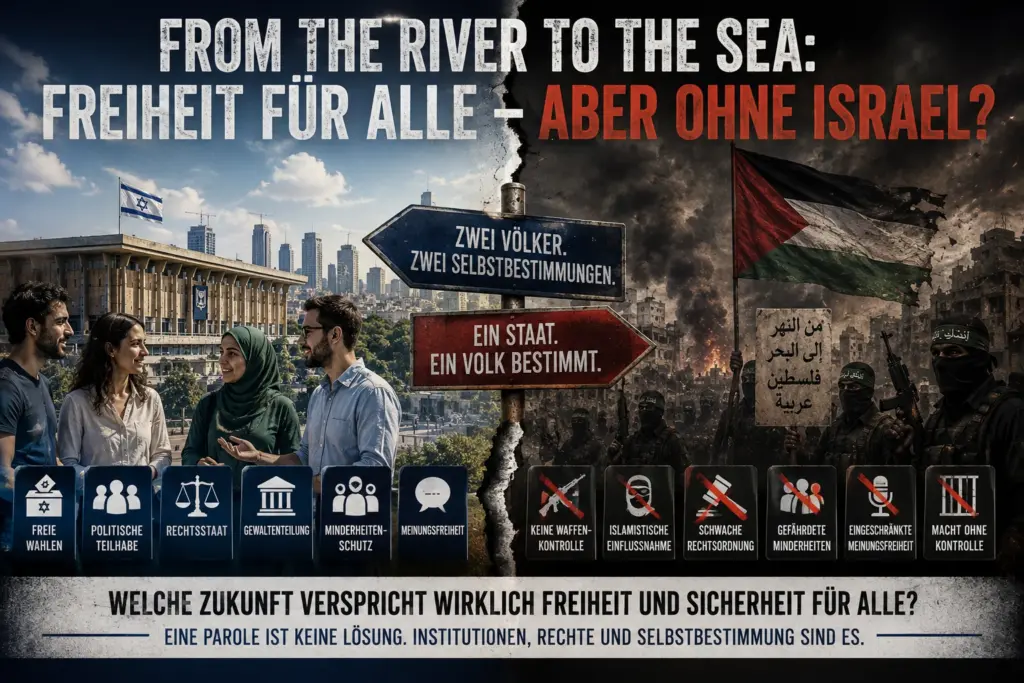

“From the river to the sea” is often explained as a promise of freedom and equal rights for all people between the Jordan River and the Mediterranean Sea. That initially sounds conciliatory. But as soon as one takes the slogan seriously in political terms, the real problem begins: What form of government is supposed to emerge across this entire area, and what happens to Israel then?
This is not mere quibbling over words. Anyone who wants to replace an existing state with a new political order must explain, who will govern in the future, how power will be limited, which rights will be guaranteed, and why the national self-determination of the Jewish people should end as a result. A promise of freedom alone answers none of these questions.

Passende X-Beiträge
Aus dem SCHLAGSEITE X-Archiv

The slogan has a political history
The idea of a Palestine encompassing the entire area between the Jordan River and the Mediterranean Sea did not originate only at today’s demonstrations. It reaches back decades into the Palestinian national movement. The PLO National Charter of 1968 described Palestine within the borders of the British Mandate as an indivisible territorial unit, rejected the partition of Palestine, and declared armed struggle to be the strategy for its liberation.
This makes the maximal territorial claim historically much older than today’s debate over the precise meaning of the English slogan. The exact origin of the English wording commonly used today is disputed. What matters, therefore, is less who first used this specific formula than the fact that the claim to the entire area has repeatedly appeared in different currents of the Palestinian movement.
There is, however, an important historical development to consider: During the Oslo process, the PLO changed its official position. In 1993, it recognized Israel’s right to exist in peace and security and declared provisions of the National Charter that contradicted these obligations to be no longer valid or operative, respectively.
The historical position of 1968 must therefore not be equated with the PLO’s current official line. This did not, however, make the maximal territorial claim disappear from Palestinian politics. Decades later, the same basic geographical idea appears in the Hamas political charter of 2017 again. There, the organization rejects any alternative to the complete “liberation of Palestine” from the Jordan River to the Mediterranean Sea.
At the same time, the Hamas document describes a Palestinian state along the lines of June 4, 1967, as a possible “formula of national consensus.” This wording is expressly not connected with recognition of Israel or with relinquishing further-reaching Palestinian claims.
Hamas therefore continues to uphold a territorial claim that geographically corresponds to the formula from the Jordan River to the Mediterranean Sea. This does not mean that every demonstrator who chants “From the river to the sea” automatically shares Hamas’s political program. But it does mean that the slogan cannot be viewed in isolation from the political movements that claim the same geographical space while rejecting Israeli sovereignty.

A slogan can be understood differently by different people. Its political meaning also depends on which territory is being claimed and which historical movements have represented that claim. Today, the area between the Jordan River and the Mediterranean Sea also contains the State of Israel, and it is precisely this area that is claimed by the territorial formula.
What would actually be changed politically?
Different political orders and power structures exist today between the Jordan River and the Mediterranean Sea. Israel is a sovereign state. Hamas seized control of Gaza by force in 2007 and ruled the territory for many years. Since the fragile ceasefire agreed in October 2025 and the subsequent transitional processes, actual control in Gaza has been fragmented. Parts of Judea and Samaria are administered by the Palestinian Authority.
Anyone who assigns this entire area to a future Palestine is therefore not simply demanding additional civil rights. They are calling for a fundamental reordering of the area in which Israel would not continue to exist in its present form.
A Palestinian state alongside Israel would be something different. A federation or confederation would also be something different. A single Palestine from the Jordan River to the Mediterranean Sea, by contrast, inevitably raises the question of what place Jewish national self-determination would still have in it.
This is precisely where it is not enough to point out that Jews could ultimately enjoy individual civil rights in such a state. Individual equality and national self-determination are two different things. Palestinians, too, could hardly be told that their right to self-determination was fully realized as long as they personally possessed equal rights within some other nation-state.
Why should a different standard apply to the Jewish people?
The reality check begins with the institutions
Anyone wishing to replace an existing democratic state with a new order should at least be able to show how the promised freedoms are to be protected institutionally.
In Israel, the Knesset is elected in general, nationwide, direct, equal, secret, and proportional elections. Arab citizens of Israel have the right to vote, can stand for election, form parties, and hold political office.
This is not an abstract constitutional formula. Arab members of parliament sit in the Knesset. In 2021, the Arab party Ra’am, under Mansour Abbas, made Israeli political history when it joined the governing coalition of Naftali Bennett and Yair Lapid. For the first time, an independent Arab party thus became a formal member of an Israeli governing coalition.
Israel is therefore not free of discrimination, social tensions, or political failures. But a democracy is not characterized by having no problems. What matters is whether its citizens have political and legal means to fight these problems.
They can vote, demonstrate, criticize governments, support parties, turn to the courts, and assume political responsibility themselves.

On the Palestinian side, this democratic continuity is lacking
The existing Palestinian political reality looks different. The last presidential election took place in 2005, and the most recent parliamentary election to date was held in 2006. After Hamas’s electoral victory, the power struggle with Fatah escalated. In 2007, Hamas seized control of Gaza by force, while the Palestinian Authority, under Fatah leadership, controlled parts of Judea and Samaria.
For November 28, 2026 parliamentary elections have now been scheduled again. The Palestinian Central Elections Commission has published an official timetable for them. If this election actually takes place freely and properly, it would be a significant step after two decades without parliamentary elections.
Until then, however, it must be noted: An announced election is not yet a renewed democratic order. National elections were already scheduled for 2021 before they were postponed.
This does not, of course, mean that Palestinians are fundamentally incapable of democracy. The crucial question is a different one: Which existing political structure currently guarantees the liberal and democratic rights promised for a future state encompassing the entire area?
October 7 intensified the question of statehood
At the latest since the Hamas-led attack and the massacres of October 7, 2023 it has become nearly impossible to fully separate the debate over the slogan from the question of which political movements claim the same territorial space and what goals they associate with that claim.
This, in turn, does not mean equating every demonstrator with Hamas. Such an equation would be cheap and analytically useless. But it does mean that the liberal interpretation of the slogan is not the only interpretation that exists.
Hamas itself upholds the claim to Palestine from the Jordan River to the Mediterranean Sea and does not recognize Israel as a legitimate Jewish state. It is therefore not an abstract historical example, but a real political and armed actor that continues to assert this territorial claim. After October 7, it is therefore even less convincing to dismiss the political and territorial dimension of the slogan as simply incidental.
Anyone who presents the formula exclusively as a universal promise of freedom must therefore also engage with those who expressly do not understand the same geographical claim as a liberal one-state model. Anyone who today demands the same borders for a future state must explain how their political vision differs from the forces that associate them with the elimination of Israeli sovereignty.
The attractive one-state vision fails on concrete questions
A hypothetical state from the Jordan River to the Mediterranean Sea would encompass millions of Jews and millions of Arabs. Minority protection there would not be an academic side issue, but a matter of existence. What would matter would not be solely which rights a constitution promises, but who would actually protect those rights in the event of conflict.
Who guarantees freedom of religion and Jewish institutions? Which courts could stop a government if it curtailed minority rights? What position would Islamist parties hold? And above all: Who controls the police, intelligence services, and armed forces?
It is precisely here that the friendly vision of a shared state encounters the real question of power. In a new political order, forces that fundamentally reject Israel and Jewish national self-determination would also have to be integrated, constrained, or disarmed. The experience of Hamas rule in Gaza shows that armed power, the state monopoly on the use of force, and democratic oversight are not theoretical peripheral issues.
What happens when a movement gains political influence while also possessing armed structures? May it retain them? Who orders their disarmament, and who enforces it? Who will the police, intelligence services, and armed forces report to afterward?
A constitution can promise equal rights. But what matters is who protects those rights when political majorities encroach upon them. Rights on paper offer little help to a minority if armed organizations remain outside effective state control or if the state monopoly on the use of force itself becomes an instrument of political power.
Equally crucial is the question of what happens when political majorities support parties that do not recognize Israel or fundamentally reject Jewish national self-determination. Who prevents democratic procedures from being used to subsequently dismantle democratic safeguards? How are Jewish communities protected when state security agencies themselves become politicized?
These are not trick questions. They are minimum requirements for any state to which millions of people are expected to entrust their security. Against the backdrop of the decades-long division between Hamas and Fatah in particular, the idea that a common successor state to Israel would automatically be liberal, pluralistic and peaceful appears remarkably optimistic.

The actual contradiction is already before us
According to this view, Israel is to be overcome so that Jews and Arabs can enjoy equal political rights. Yet Israel is currently the state in this region in which Jewish and Arab citizens participate together in national elections, form parties and assume political office.
Palestinians outside Israel obviously do not possess Israeli citizenship rights. That is precisely why the unresolved question of Palestinian self-determination remains. However, this legitimate demand does not logically entail the abolition of Israel.
Palestinian self-determination does not have to replace Jewish self-determination. And Jewish self-determination does not have to fundamentally exclude Palestinian self-determination.
What a viable political solution can concretely look like after decades of terrorism, war, failed negotiations and mutual distrust is more difficult than ever. That is precisely why a slogan should not be confused with a system of government.
Freedom needs more than a promise
“From the river to the sea” does not explain how power is to be distributed. The slogan creates no constitution, guarantees no minority protection and does not answer who controls the police and armed forces. Above all, it does not answer why Jewish national self-determination should be ended so that a new Palestinian system of government can emerge.
Anyone who truly wants freedom for Israelis and Palestinians needs a political solution that enables both peoples to have security, dignity and self-determination. A future democratic Palestinian state would not be a problem in this regard, but progress. The demand becomes problematic where its realization presupposes that the Jewish state must first disappear.
The charitable interpretation of the slogan promises equality. Its political implementation remains an open issue. Anyone who wants to give up an existing state and the national self-determination of an entire people for this bears the burden of proof.
ℹ️ Factual basis and primary sources for the article 📑
▶️ United Nations – Palestinian National Charter 1968:
The Palestinian National Charter
Documents the PLO National Charter of 1968, with its territorial claim to Palestine within the borders of the British Mandate at that time, its rejection of partition and armed struggle as a strategy of liberation.
▶️ Israeli Government – Israel-PLO Letters of Recognition 1993:
Israel-PLO Recognition: Exchange of Letters between PM Rabin and Chairman Arafat
Documents the mutual recognition of 9 September 1993 and the change in the PLO’s official position toward Israel.
▶️ Knesset:
Basic Laws of the State of Israel
Foundations of Israel’s governmental and electoral system.
▶️ Knesset:
Members of the 25th Knesset
Overview of the members of Israel’s parliament.
▶️ Israel Democracy Institute:
Ra’am
Background on the Arab party Ra’am and its participation in Israel’s governing coalition from 2021 onward.
▶️ Palestinian Central Elections Commission:
The CEC announces the Legal Periods for the 2026 Legislative Elections
Official timetable for the Palestinian parliamentary elections scheduled for 28 November 2026.
▶️ Palestinian Central Elections Commission:
Previous Election Events
Documentation of the 2005 presidential election, the 2006 parliamentary election, and the national elections scheduled for 2021 and later postponed.
▶️ PalQuest / Institute for Palestine Studies:
Hamas New Charter – Document of General Principles and Policies
Documents Hamas’s 2017 political founding document, with its claim to the complete liberation of Palestine from the Jordan River to the Mediterranean Sea, as well as the simultaneously articulated 1967-state option without recognition of Israel.
▶️ Reuters:
Trump’s Gaza plan hinges on Hamas disarmament, Israeli withdrawals
Current report on the fragile ceasefire, the still-unresolved control arrangements, the disarmament issue and the planned transitional structures in Gaza.
▶️ UN Independent International Commission of Inquiry:
Detailed findings on attacks carried out on and after 7 October 2023
Documents the Hamas-led attack of 7 October 2023, as well as attacks, killings and hostage-taking by Hamas and other Palestinian armed groups.
🔎 Error discovered, criticism or addition?
SCHLAGSEITE.eu stands for careful research and transparent corrections. Have you discovered a factual error, unclear wording or a broken link? Then send me your note. If possible, please provide a verifiable source.