00:00 / –:–
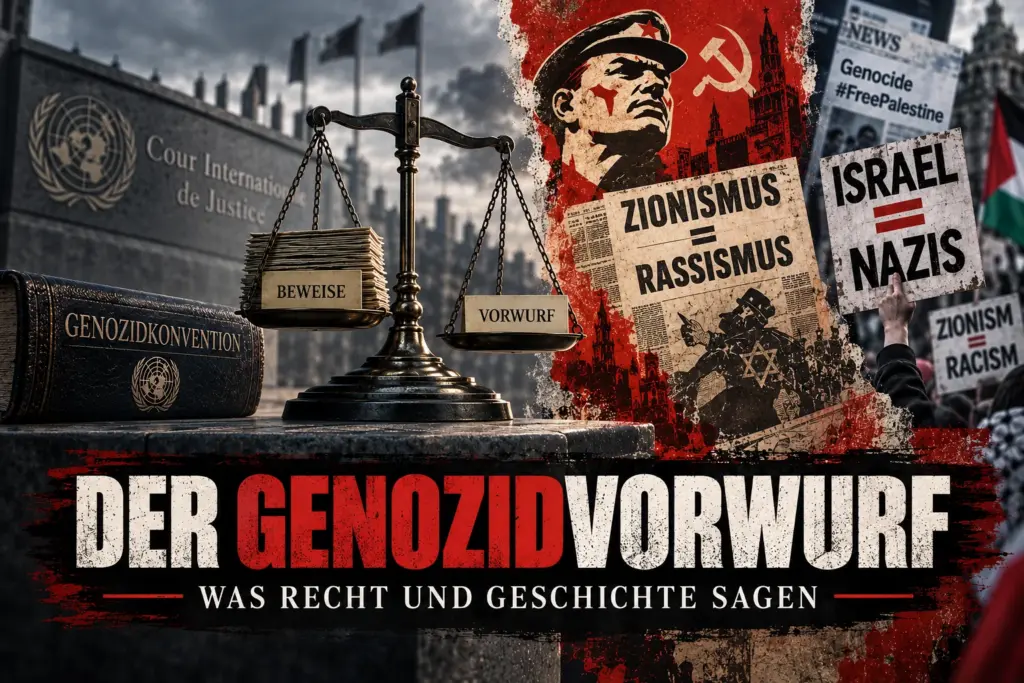
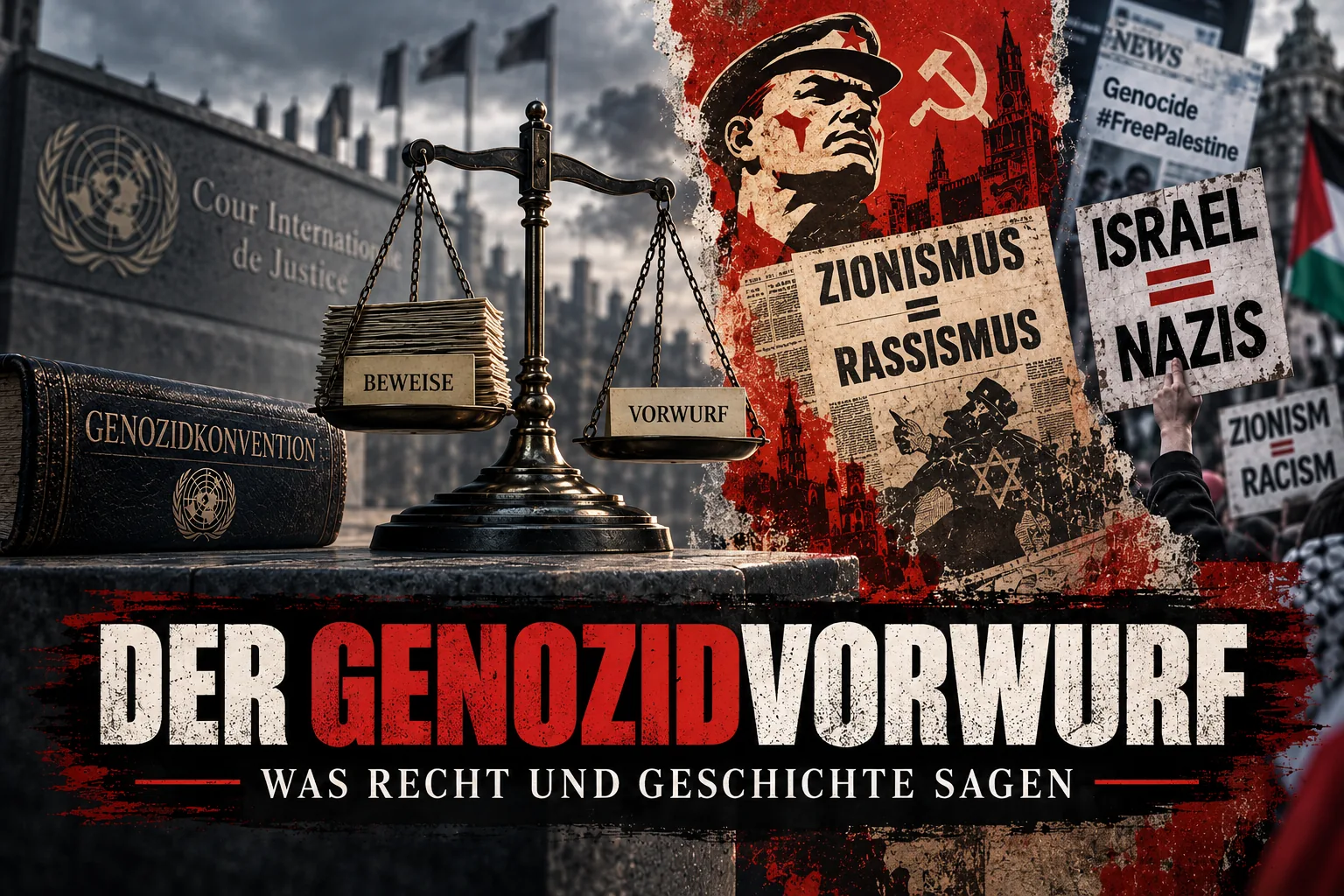
The International Court of Justice has not found that Israel committed genocide. Nor has it decided that the genocide allegation is “plausible.” Nevertheless, precisely this impression has been disseminated politically and in the media for years. An open legal question has in many places become a prejudged verdict on the Jewish state.
The difference is fundamental. “Genocide” is not another word for a cruel war, high casualty figures or destroyed cities. The crime requires the intent to destroy, in whole or in part, a national, ethnic, racial or religious group as such. Without this specific intent to destroy, there is no genocide. Anyone discussing Gaza must therefore do more than count the dead. They must prove that Israel wants to destroy the Palestinians as a group. The International Court of Justice has not so far established such an intent to destroy.
Genocide allegation: The specific intent to destroy is decisive
Article II of the Genocide Convention lists several possible acts, including killings, serious bodily or mental harm and deliberately inflicting conditions of life calculated to bring about the physical destruction of a protected group.
The decisive point lies in the intent. The case law of the International Court of Justice requires the specific intent to destroy, the dolus specialis. If this is not proven directly but inferred from a pattern of conduct, then under the existing case law the intent to destroy must be the only reasonable inference that can be drawn from that conduct.
Death and rubble are therefore not, by themselves, proof of genocide. They may be relevant to examining war crimes, disproportionate attacks or other violations of international humanitarian law. The crime of genocide additionally requires proof that a protected group as such is to be destroyed in whole or in part.
ICJ: Plausible rights, but no plausible genocide allegation
One of the most persistent distortions concerns the decision of the International Court of Justice of 26 January 2024. An earlier detailed SCHLAGSEITE analysis of the genocide allegation has already addressed this distinction.
The Court ordered provisional measures. In doing so, it found that certain rights asserted by South Africa were plausible, in particular the right of Palestinians in Gaza to be protected from acts that could fall under the Genocide Convention. That is exactly what the order says.
What the Court did not decide was expressly clarified by its then-president Joan Donoghue after her departure from the Court in a BBC interview: The Court had not decided that the genocide allegation itself was plausible. The plausibility assessment concerned the rights being asserted.
This is not a semantic quibble. It is the difference between a right to be provisionally protected during ongoing proceedings and a judicial finding on whether Israel is committing genocide.

Passende X-Beiträge
Aus dem SCHLAGSEITE X-ArchivThe Court declared certain asserted protection rights plausible. It did not find that Israel was plausibly committing genocide. The then-president of the Court, Joan Donoghue, later expressly corrected this widespread distortion.
The merits proceedings are continuing. In an order of 21 May 2026, the Court set South Africa a deadline of 22 November 2027 and Israel subsequently a deadline of 22 May 2029 for further pleadings. No judgment on the genocide allegation exists. Anyone claiming that the “World Court” has already confirmed Israel’s genocide is misrepresenting the status of the proceedings.
Other institutions speak of genocide; the ICJ has not ruled
A complete account must also note that other institutions have by now reached an opposing assessment. Amnesty International and other NGOs have made genocide allegations. In December 2024, Amnesty International concluded that Israel was committing genocide in Gaza. In 2024, UN Special Rapporteur Francesca Albanese stated that there were reasonable grounds to conclude that genocidal acts were being committed. In September 2025, the independent UN Commission of Inquiry on Israel and the Palestinian territories also concluded that Israel had committed genocide in Gaza.
These assessments exist and form part of the factual record. They are not, however, judgments of the International Court of Justice. Amnesty is a non-governmental organization, a special rapporteur is an independent mandate holder of the UN Human Rights Council, and a commission of inquiry established by the Human Rights Council is likewise not an international court. Their assessments must therefore not be turned into a judgment from The Hague that does not yet exist.
The political context of South Africa’s genocide case
The applicant itself also has a documented political history. A more detailed assessment is provided in the article on South Africa’s genocide case and the political context.
The South African government described Israel’s actions as “genocide” as early as 18 October 2023—that is, eleven days after the Hamas massacre and more than two months before the application was filed—and even spoke of an impending “Palestinian Holocaust.” This appears in an official statement by the South African Cabinet.
On 5 December 2023, the leadership of the governing African National Congress met with delegations from various Palestinian organizations. In an official ANC statement of 6 December the party expressly names Fatah, Hamas and Palestinian Islamic Jihad. South African Foreign Minister Naledi Pandor had already spoken by telephone with Hamas leader Ismail Haniyeh on 17 October. Her ministry stated that the conversation concerned humanitarian aid and dialogue.
These contacts do not determine whether the elements of genocide are met. But they are part of the political context of a case that did not emerge from a politically neutral space.
The most important casualty figure comes from a Hamas-run administration
In September 2026, the number of dead reported by the Gaza Ministry of Health stands at more than 73,000.
More precisely, the source should be described as follows: The Ministry of Health belongs to the Hamas-led administration in Gaza. Its published total does not distinguish between civilians and combatants. As a result, killed members of armed organizations are not separately identified in the overall figure.
International organizations and media outlets regularly use these figures as a central reference point. The total itself, however, does not answer how many of those killed were civilians and how many were combatants.
This is precisely the distinction that regularly disappears when a genocide allegation is derived directly from the total figure.
A total figure says how many deaths the reporting body has recorded. It does not say which individual killings were lawful or unlawful. Above all, it does not prove the specific intent to destroy the Palestinian population as such.
The fallacy begins where a wartime figure not broken down by combatant status is immediately turned into genocidal intent.
Without 7 October, this war would not exist
7 October 2023 is not a casual “backstory.” It is the starting point of this war.
The UN Commission of Inquiry found that Hamas, other Palestinian armed groups and participating attackers targeted civilians in at least 24 locations, as well as public spaces and festivals.
Attackers went from house to house, attacked residential buildings and shelters, killed residents and abducted people to Gaza. Civilians were deliberately attacked at the Nova festival and in places such as Be’eri, Nir Oz and Kfar Aza. Around 1,200 people were killed on 7 October and in the immediate context of the attack, the vast majority of them civilians. More than 250 people were abducted.
This was not an ordinary border incident and not an attack in which civilians merely happened to be caught between military targets. The Commission documented deliberate attacks on civilians.
Discussing intent to destroy without mentioning Hamas?
The debate is particularly striking where there is extensive discussion of a possible Israeli intent to destroy, while Hamas’s documented ideology disappears from view.
The 1988 Hamas Charter explicitly framed the conflict in anti-Jewish language and adopted, in Article 7, a hadith about killing Jews. It combined this religiously charged hostility with the aim of replacing Israel with an Islamic order across the entire territory of historic Palestine.
In 2017, Hamas changed its public language. The “Document of General Principles and Policies” stated that the conflict was directed against the “Zionist project” and not against Jews because of their religion. The document still did not recognize Israel. It defined Palestine as the territory from the Jordan River to the Mediterranean Sea and rejected the legitimacy of the “Zionist entity.”
Anyone placing the term dolus specialis at the center of a political debate cannot exclude from consideration the declared ideology of the organization that began the war with a targeted mass attack on Israeli civilians.
Hamas wages war from within a densely populated civilian society
The second central factor is the way Hamas and other armed groups fight in Gaza.
The UN Secretary-General’s report on children and armed conflict verified Hamas’s military use of a medical center and recorded numerous reports of Hamas and other armed groups using human shields. Israel also presented extensive material on weapons depots, rocket positions, tunnels and command structures in or near residential buildings, schools, mosques and medical facilities.
Not every Israeli claim about every individual building has been independently confirmed. Nevertheless, the basic military finding is relevant: Hamas maintains an extensive underground tunnel system in an extremely densely populated area and does not conduct the war on a battlefield separated from the civilian population. This considerably increases the risk to civilians and is essential to any analysis of casualty figures and military objectives.
Warnings sit uneasily with the theory of a plan of destruction
Israel’s actual conduct also belongs in the examination of the alleged intent to destroy.
During the war, Israel used leaflets, SMS messages, recorded voice messages and individual telephone calls to warn residents of operations and demand evacuations. According to IDF information as of 31 March 2024by then, around 9.3 million leaflets, 15.5 million text messages, 17 million recorded voice messages and approximately 100,000 individual telephone calls had been used. Israel also presented corresponding warning measures in proceedings before the International Court of Justice.
Whether individual evacuation orders were sufficient or specific attacks complied with international humanitarian law is a separate legal question. For the alleged state intent to destroy, it is relevant that substantial military resources were deployed to warn civilians of imminent hostilities.
The same applies to humanitarian pauses in fighting and polio vaccination campaigns. According to UNICEF, 558,963 children under the age of ten were reached in the first vaccination round in 2024 alone. Area-specific humanitarian pauses in fighting were agreed for this purpose. A further campaign reached almost 603,000 children in February 2025.
These measures form part of the evidentiary record when it is claimed that Israel’s state objective was the physical or biological destruction of the Palestinian population.
In 2005, Israel dismantled its settlements and ended its permanent presence in Gaza
The thesis of an Israeli extermination program pursued consistently for decades also encounters a historical problem.
In 2005, Israel dismantled all Israeli settlements in the Gaza Strip and withdrew its permanent military presence from the areas that had been evacuated. The Israeli Disengagement Plan expressly provided for the evacuation of the Israeli communities in the Gaza Strip and the relocation of the forces outside the territory.
The withdrawal did not end the subsequent dispute under international law over Gaza’s status and Israel’s control of various access points. The historical event itself, however, is clear: in 2005, Israel dismantled its settlements and withdrew the permanently stationed forces from the Gaza Strip.
In 2007, Hamas violently seized control of Gaza.
Anyone claiming that Israel pursued a straightforward plan for the physical destruction of Gaza’s population over decades must explain how the complete dismantling of its own settlements and the withdrawal of its permanent forces fit into that picture.
Demographics also contradict the long-term thesis
According to a historical UN data series, around 1.03 million Palestinians lived in Judea and Samaria, East Jerusalem and Gaza in 1967. For mid-2023, the Palestinian Central Bureau of Statistics put the population of Judea and Samaria and Gaza at around 5.48 million people, including approximately 2.23 million in the Gaza Strip.
The population had therefore more than quintupled over this period.
This development is incompatible with the broader claim of a demographic extermination program pursued continuously since 1967.
Gaza is not the first devastating urban war against Islamists
Massive destruction and high civilian losses are also known from other battles against entrenched Islamist organizations in densely built-up cities.
In the battle for Mosul, Iraqi forces and a US-led coalition fought for months against the Islamic State in densely built-up urban districts. Amnesty International documented thousands of civilian casualties and, at the same time, that IS held families captive, prevented them from fleeing and used them as human shields.
Raqqa was also massively destroyed in the fight against the Islamic State. The comparability of individual operations is limited, but the basic military finding remains: severe destruction and high civilian losses in urban warfare do not, by themselves, prove a specific intent to destroy the civilian population as a group.
The linguistic reversal began long before Gaza
The political impact of the genocide accusation cannot be explained by international law alone.
The idea of equating Zionism with fascism, racism or National Socialism has a long history. Historical research on Soviet policy toward Israel and Zionism in the 1960s already documents equivalences between Zionism and Nazism before the Six-Day War. After 1967, the anti-Zionist campaign was considerably expanded.
The mechanism was politically effective: the Jewish state was criticized not only for specific policies. Zionism itself was portrayed as a racist, imperialist or fascist ideology.
In 1975, the UN equated Zionism with “racism”
On 10 November 1975, the UN General Assembly adopted Resolution 3379. It described Zionism as a form of racism and racial discrimination.
On 16 December 1991, the General Assembly revoked this determination through Resolution 46/86.
The Soviet Union disappeared. The rhetorical pattern survived it.
When Israel is declared the new Nazi state today, Zionists are called Nazis, or the Shoah is used as a template for delegitimizing the Jewish state, this language therefore has a historical antecedent.
The term “genocide” has long had a political function
Genocide is today not only the name of a possible criminal offense in the ongoing proceedings before the ICJ. The term also has a substantial political function.
Amnesty International uses it. UN Special Rapporteur Francesca Albanese uses it. The UN Commission of Inquiry uses it. Beyond that, it frequently appears in activism, university protests and political campaigns as an already established description, even though the main proceedings before the International Court of Justice have not been decided.
This shifts the debate. In parts of public communication, an accusation that must be proven as a matter of law becomes a moral judgment.
In the process, central connections can be lost from view: the attack of 7 October, Hamas’s ideology and conduct of the war, the hostages, and the distinction between a high overall number of war casualties and the specific proof of a state intent to destroy.
The intent must not be examined only in Israel’s case
Anyone who seriously wants to discuss intent to destroy must consider the conflict as a whole. On one side is Israel, whose specific military actions, political statements and decisions are being examined in the ongoing proceedings and in other legal contexts.
On the other side is Hamas, with a historic charter full of antisemitic extermination rhetoric, a political program that remains explicitly directed against Israel’s legitimacy, a tunnel system built over years amid densely populated residential areas, and an attack planned on 7 October 2023 against Israeli civilians. Anyone who examines only Israel’s intent and removes these documented factors from the analysis is describing only one part of the conflict.
Anyone presenting the genocide accusation as an established fact is issuing a judgment that the International Court of Justice has not rendered. Anyone who also turns Israel into the new Nazi state is resorting to an inversion of perpetrator and victim, whose political history reaches back to Soviet anti-Zionist propaganda. Israel’s conduct of the war can and must be debated. The actual status of the proceedings cannot.
ℹ️ Factual basis and primary sources for the article 📑
▶️ International Court of Justice:
South Africa v. Israel – Case 192
Official proceedings page with orders, written pleadings and the current status of the proceedings.
▶️ International Court of Justice:
Order of 26 January 2024
Order on the provisional measures and the rights the Court described as plausible.
▶️ Joan Donoghue / BBC HARDtalk:
Interview of 26 April 2024
The former ICJ president explains that the Court did not establish the plausibility of the genocide allegation, but rather the plausibility of certain rights claimed.
▶️ International Court of Justice:
Order of 21 May 2026
Sets the deadlines for South Africa’s Reply on 22 November 2027 and Israel’s Rejoinder on 22 May 2029.
▶️ Amnesty International:
Israel’s Genocide Against Palestinians in Gaza
Non-judicial assessment by Amnesty International that Israel is committing genocide in Gaza.
▶️ UN Special Rapporteur Francesca Albanese:
Anatomy of a Genocide – A/HRC/55/73
2024 report assessing that there are reasonable grounds to believe that genocidal acts have been committed.
▶️ UN Independent International Commission of Inquiry:
Commission finding on genocide, September 2025
Non-judicial finding by the Commission of Inquiry that Israel has committed genocide in Gaza.
▶️ South African Government:
Cabinet Statement of 18 October 2023
Documents the South African government’s early political use of the terms genocide and “Palestinian holocaust”.
▶️ African National Congress:
Statement of 6 December 2023
The ANC confirms a meeting with representatives of various Palestinian organizations, including Fatah, Hamas and Palestinian Islamic Jihad.
▶️ South African Department of International Relations:
Statement on Naledi Pandor’s conversation with Ismail Haniyeh
Confirms the telephone call in October 2023 and describes humanitarian aid and dialogue as its content.
▶️ Reuters:
Current status of casualty figures, September 2026
Reuters cites more than 73,000 deaths reported by Gaza health authorities and notes that the figures include combatants and civilians.
▶️ UN Commission of Inquiry:
Report A/HRC/56/26 on the attacks of 7 October 2023
Documents deliberate attacks on civilian targets in at least 24 locations, as well as killings and abductions.
▶️ Hamas Charter 1988 / Yale Law School:
The Covenant of the Islamic Resistance Movement
English version of the 1988 founding charter with the anti-Jewish passage in Article 7.
▶️ Hamas Policy Document 2017:
A Document of General Principles and Policies
Documentation and reproduction of Hamas’s 2017 policy document.
▶️ UN Secretary-General’s report:
Children and Armed Conflict 2023
Documents, among other things, Hamas’s military use of a medical center and reports of human shields.
▶️ Israel Defense Forces:
Data Regarding Evacuation of Civilian Population Within Gaza
Israeli self-reported figures on leaflets, SMS messages, voice messages and individual evacuation calls, as of 31 March 2024.
▶️ UNICEF:
Around 560,000 children vaccinated in first round of polio campaign
Documents 558,963 vaccinated children and area-specific humanitarian pauses in fighting in September 2024.
▶️ UNICEF and WHO:
Polio campaign reaches around 603,000 children
Documents the vaccination campaign of February 2025.
▶️ Israeli government:
Disengagement Plan
Documents Israel’s withdrawal of the settlements and permanently stationed forces from the Gaza Strip in 2005.
▶️ Palestinian Central Bureau of Statistics:
Population data for 2023
Puts the population of Judea and Samaria and Gaza in mid-2023 at around 5.48 million people.
▶️ United Nations:
Historical Palestinian population data
Gives around 1.03 million inhabitants in Judea and Samaria, East Jerusalem and Gaza in 1967.
▶️ Amnesty International:
Battle of Mosul and civilian casualties
Documents civilian losses in urban warfare against IS, as well as its use of civilians as human shields.
▶️ Historical research:
The Soviet Union, Israel and Soviet Jewry 1964-67
Historical study of Soviet propaganda concerning Israel and Zionism, including the equation of Zionism with Nazism.
▶️ United Nations:
General Assembly Resolution 3379
Resolution of 10 November 1975 that described Zionism as a form of racism.
▶️ United Nations:
General Assembly Resolution 46/86
Resolution of 16 December 1991 revoking the 1975 finding.
🔎 Spotted an error, criticism or addition?
SCHLAGSEITE.eu stands for careful research and transparent corrections. Have you spotted a factual error, unclear wording or a broken link? Then send me your feedback. Please provide a verifiable source where possible.