

The Strait of Hormuz is one of the most important chokepoints in the global economy. In recent months, Iran has once again demonstrated how much political and economic pressure can be generated by this geographic position. The United Arab Emirates are now drawing a clear line: No state should be allowed to decide who may pass through the strait or who must pay for passage.
The statement by Emirati Foreign Trade Minister Thani Al Zeyoudi is more than diplomatic criticism of Tehran. Abu Dhabi has long been working to structurally reduce its own dependence on Hormuz. Ports are being expanded, new logistics corridors created and additional pipeline capacity planned. The stated goal is nothing less than this: reducing dependence on Hormuz to zero.
At the Hili Forum in Abu Dhabi on September 8, Al Zeyoudi said international waterways had to remain free of restrictions and tolls. No single country should be allowed to determine who has access to the Strait of Hormuz. For the UAE, this was a “red line,” The National.

Passende X-Beiträge
Aus dem SCHLAGSEITE X-ArchivHormuz is far more than a narrow waterway
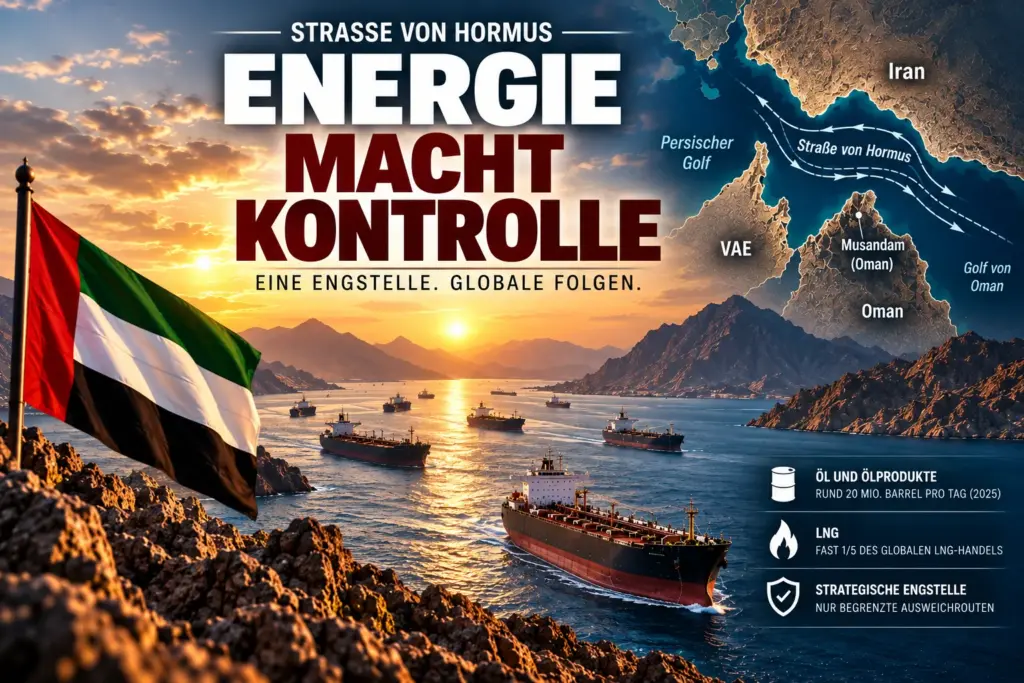
The economic significance of the strait alone shows why these words carry weight. The Strait of Hormuz connects the Persian Gulf with the Gulf of Oman and, onward, the Arabian Sea. According to the International Energy Agency IEA it is only 21 nautical miles, or around 39 kilometers, wide at its narrowest point. Inbound and outbound ships each have only shipping corridors around two nautical miles wide, separated by a buffer zone that is also two nautical miles wide.
According to the IEA, an average of around 20 million barrels of crude oil and petroleum products were transported through Hormuz every day in 2025. That was roughly one quarter of global seaborne oil trade. Around 80 percent of these volumes were destined for Asian markets.
Dependence is even more pronounced in liquefied natural gas. According to IEA calculations, around 93 percent of Qatar’s LNG exports and 96 percent of the UAE’s LNG exports passed through the strait in 2025. Together, this amounted to almost one-fifth of global LNG trade.
The crisis since the end of February 2026 has shown what happens when this route is severely disrupted. The IEA assessed the development as a major supply shock. On March 11, its 32 member states therefore decided to release a total of 400 million barrels of oil from their emergency reserves onto the market. It was the largest coordinated release of emergency stocks in the organization’s history.
LNG brought a second problem as well. Not only did passage through Hormuz largely come to a halt. Qatar’s production and export infrastructure was also hit. Facilities in Ras Laffan were damaged in March after QatarEnergy had already halted LNG production at the beginning of the month. The crisis therefore affected both the transport route and one of the world’s most important sites for the liquefaction and shipment of natural gas at the same time.

In 2025, around 20 million barrels of oil and petroleum products passed through the strait every day. Approximately 25 percent of global seaborne oil trade went through Hormuz. Qatar and the UAE were particularly dependent on the route for LNG: 93 and 96 percent of their LNG exports, respectively, used it.
Iran is trying to turn its geographic position into political power
For Tehran, Hormuz is therefore not merely a waterway, but a strategic lever. Anyone who can threaten, delay or control shipping there can create effects far beyond the region. Insurance premiums rise, shipping companies change routes or reduce voyages, energy prices react and governments come under pressure.
The current situation shows that this effect is by no means theoretical. According to data from the analytics company Kpler, reported by Reuters on September 9 only six registered cargo ships passed through the strait on Tuesday. That was below the already low ten-day average of around twelve ships.
This figure must not, however, be equated with total actual shipping traffic. Reuters explicitly points out that individual ships switch off their AIS transponders while passing through and therefore do not appear in such real-time assessments. These invisible voyages, now often referred to as “dark crossings,” make it considerably more difficult to determine the actual volumes transported.
Before the escalation, approximately 125 commercial ships were counted each day, according to Reuters. Even taking invisible transits into account, it is therefore clear that regularly trackable traffic remains substantially below prewar levels.
There is another point of conflict as well. The US Treasury Department imposed sanctions at the end of July on the Persian Gulf Marine Insurance Company and the HormuzSafe Marine Services Authority. Washington accuses both companies of being part of a system supported by Iran’s Islamic Revolutionary Guard Corps in which commercial vessels are allegedly required to purchase maritime insurance for passage.
According to the US Treasury Department, the system is intended to generate revenue under the guise of maritime services while also expanding control over shipping traffic. The allegations come from the US government and should accordingly be understood as its account.
Al Zeyoudi’s explicit reference to fees and tolls also has another background. At the end of July, Oman presented Iran with, according to Reuters a proposal supported by Gulf states for joint regional administration of the strait. Following the model of the Strait of Malacca, shipping companies would be able to make voluntary contributions for navigational aids, environmental protection and rescue services. Iran, by contrast, had insisted on stronger control of its own and mandatory payments. The question of a fee for Hormuz is therefore not a rhetorical thought experiment, but the subject of ongoing negotiations.
The US description of an Iranian “extortion system” is an official American assessment, not an independent judicial finding. It is established that Washington has sanctioned the companies involved and explicitly links the alleged insurance model to the Revolutionary Guard.
The UAE’s answer: Reduce dependence
Abu Dhabi is responding not only with political statements. As early as June, Al Zeyoudi announced that his country wanted to reduce its dependence on the Strait of Hormuz to zero in the long term. The alternatives being developed were not short-term emergency solutions, but lasting changes to the economic infrastructure.
To this end, the UAE are accelerating the expansion of their ports on the east coast. Fujairah and Khor Fakkan are located on the Gulf of Oman and therefore outside the Strait of Hormuz. At the same time, Abu Dhabi is working with Oman to handle freight through the ports of Sohar and Duqm. Roads, rail links and additional logistics corridors are intended to connect the different trade routes.
Energy infrastructure is particularly important. Since 2012, a pipeline around 400 kilometers long has connected the production region near Habshan with the export terminal in Fujairah. The IEA gives the Abu Dhabi Crude Oil Pipeline an original design capacity of 1.5 million barrels per day and a subsequently reported capacity of nearly 1.8 million barrels. Under normal conditions, around 1.1 million barrels of Emirati crude oil are already exported daily via this route.
The Emirates are also planning additional pipeline capacity. This could allow a larger share of the oil produced in Abu Dhabi to be transported directly to the Gulf of Oman without having to pass through the Strait of Hormuz.
But being outside Hormuz does not mean being beyond Iran’s reach. Fujairah itself became a target during the conflict. Emirati authorities confirmed a drone attack on the Fujairah Oil Industry Zone in March, in which a fire broke out. Ships off the east coast were also attacked or avoided the area. The bypass therefore reduces dependence on the strait, but does not eliminate the military vulnerability of the export infrastructure.

Hormuz can so far only be bypassed partially
The strategy has a clear technical limit. Oil can be transported comparatively easily by pipeline to alternative export ports. LNG is considerably more difficult. The IEA points out that no comparable alternative export routes are currently available for the large LNG volumes from Qatar and the UAE.
Nor can all trade simply be shifted to trucks, railways and other ports. During the particularly severe disruptions in the spring, land corridors were able to carry part of the urgently needed freight. However, the volumes were significantly below normal seaborne transport levels.
The UAE are not the only country seeking alternatives. Saudi Arabia has the region’s most important additional existing oil bypass in its East-West Pipeline from Abqaiq to the Red Sea port of Yanbu. According to the IEA, the system has a design capacity of five million barrels per day; Saudi Aramco reported an increase to seven million in 2025, although such permanently high throughput volumes have not yet been comprehensively tested. Countries such as Iraq, Kuwait, Qatar and Bahrain, by contrast, remain far more dependent on Hormuz.
This initially makes Al Zeyoudi’s goal of “zero” dependence a strategic direction rather than an already achieved state. And even a complete bypass of the strait would not be equivalent to complete security. Pipelines, ports and terminals replace a vulnerable chokepoint with a more widely distributed network of infrastructure that is also vulnerable to attack.
The law of the sea also places limits on control
The UAE’s call for free passage is also fundamentally reflected in international law of the sea. Part III of the UN Convention on the Law of the Sea UNCLOS governs straits used for international navigation. Article 38 provides for a right of transit passage through such straits. Article 44 stipulates that coastal states should not hamper or suspend this transit passage.
In Iran’s case, however, the legal situation cannot be settled in a single sentence. The United Nations Treaty Collection lists Iran as a signatory to the United Nations Convention on the Law of the Sea, but not as a ratifying state party. When signing, Tehran also issued its own declaration on the legal nature of the rules governing international straits.
Therefore, the blanket assertion that every Iranian obstruction is in itself an unequivocal violation of Article 44 of UNCLOS would be too simplistic. The law governing international navigation through Hormuz involves questions of customary international law in addition to treaty law. For Al Zeyoudi’s political statement, however, the central point remains clear: The Emirates reject the claim that a single state can control the most important gateway to the Persian Gulf according to its own political or economic interests.

Using a chokepoint as a weapon creates incentives for alternative routes
That is precisely where the development’s long-term strategic significance lies. Iran’s geographic position gives the country power as long as its neighbors remain dependent on the Strait of Hormuz. Every new pipeline, every expanded port and every alternative transport corridor reduces this dependence to some extent.
This does not happen overnight. Even the UAE cannot fully replace Hormuz today. Other Gulf states are even more heavily dependent on the strait. Moreover, the alternative is not to replace a vulnerable sea route with invulnerable infrastructure. Attacks on ports, energy facilities and ships outside the strait itself have shown that Iran can also direct its military pressure against alternative routes.
Tehran can generate enormous costs in the short term through the uncertainty surrounding Hormuz. At the same time, this very uncertainty gives its neighbors a strong economic and strategic reason to build alternatives. A lever of pressure can thus become, in the long term, an incentive to become less dependent on that lever of pressure.
The UAE are therefore not merely drawing a red line verbally. They are expanding ports, pipelines and trade routes intended to weaken Iran’s strategic leverage over Hormuz. The more often Tehran uses the strait as an instrument of political pressure, the greater the incentive for its neighbors to permanently undermine precisely this leverage.
The decisive question, then, is not whether Iran can use the Strait of Hormuz as a lever of pressure today. Tehran can. What matters is how long its neighbors will still be willing to allow it to retain this power through their own dependence.
ℹ️ Factual basis and primary sources for the article 📑
▶️ International Energy Agency:
Strait of Hormuz Factsheet
Data on the width and shipping lanes of the Strait of Hormuz, global oil and LNG trade, and existing bypass capacity.
▶️ International Energy Agency:
IEA Member countries to carry out largest ever oil stock release
Official statement on the release of 400 million barrels from emergency reserves, the largest coordinated release in the IEA’s history.
▶️ International Energy Agency:
Gas Market Report Q3 2026
Assessment of the severe supply shock on international gas markets and the consequences of the collapse in LNG deliveries from the Gulf.
▶️ US Department of the Treasury:
Treasury Disrupts Iranian Regime’s Strait of Hormuz Extortion Network
Official US sanctions justification concerning the alleged Iranian insurance and fee system for merchant ships.
▶️ Reuters:
Oman proposes Hormuz management system with voluntary fees
Report on Oman’s proposal for regional management of the strait with voluntary contributions modeled on the Strait of Malacca.
▶️ United Nations:
United Nations Convention on the Law of the Sea, Part III
Provisions governing transit passage through straits used for international navigation.
▶️ United Nations Treaty Collection:
Status and Iranian declaration on UNCLOS
Iran’s treaty status and the declaration it made upon signing concerning international straits.
▶️ The National:
Strait of Hormuz is a ‘red line’ and cannot be tolled
Original report on the statements by Minister of Foreign Trade Thani Al Zeyoudi at the Hili Forum and the UAE’s infrastructure strategy.
▶️ Reuters:
Shipping traffic via Strait of Hormuz stays below 10-day average
Current Kpler data on shipping through Hormuz, as well as a note on voyages not recorded because transponders were switched off.
▶️ Reuters:
One third of Gulf oil is still missing despite dark crossings
Assessment of the difficult-to-track oil shipments through Hormuz with AIS transponders switched off.
▶️ Gulf News:
Fire hits Fujairah Oil Industry Zone after drone strike
Report citing Emirati authorities on the drone attack and fire in the Fujairah Oil Industry Zone in March 2026.
▶️ OECD:
Shipping disruptions and maritime CO₂ emissions
Analysis of the limited bypass options via Saudi Arabia and the UAE, as well as Qatar’s LNG exports’ particular dependence.
▶️ MENA-Watch:
UAE minister: Strait of Hormuz is a “red line”
Original report on the Emirati foreign trade minister’s remarks and the expansion of alternative trade routes.
🔎 Spotted an error, criticism or addition?
SCHLAGSEITE.eu stands for careful research and transparent corrections. Have you discovered a factual error, unclear wording or a broken link? Then send me your note. If possible, please provide a verifiable source.