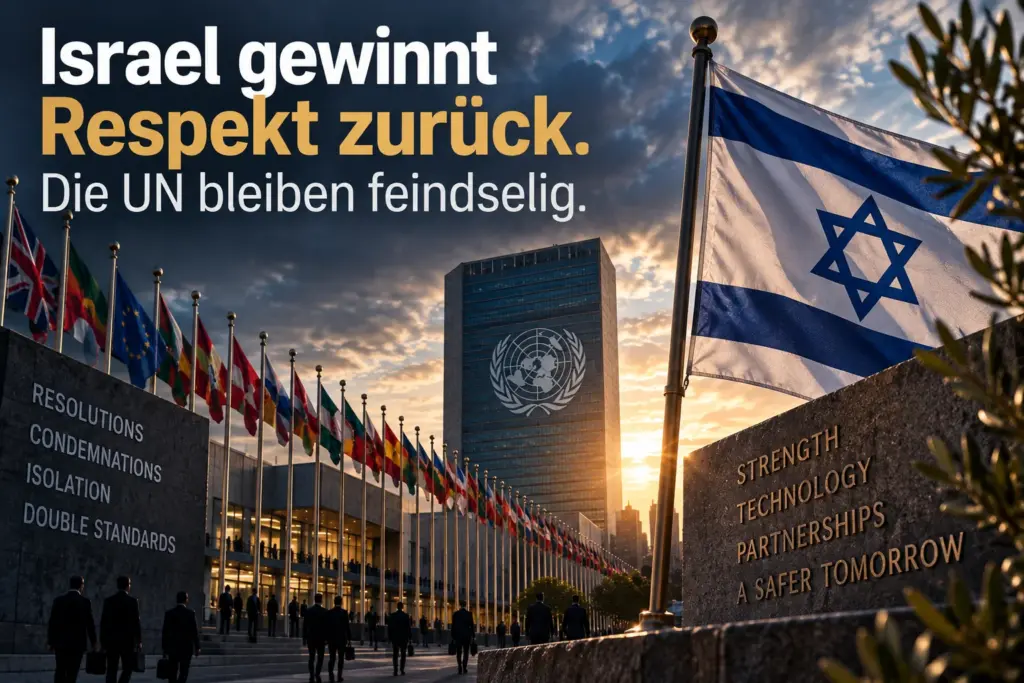


Israel continues to be condemned, outvoted and placed under political pressure at the United Nations. At the same time, something is changing behind the scenes. States that publicly criticize Israel are interested in its military capabilities, its technology and its security cooperation. Israel’s UN ambassador Danny Danon speaks of respect regained. But respect only has political value when it produces votes, alliances and concrete support.
Anyone who looks only at public votes at the United Nations might think that nothing has changed for Israel. The organization continues to produce reliable majorities against Israeli positions. At the UN Human Rights Council, the Israeli-Palestinian conflict even has its own permanently recurring agenda item, agenda item 7. No other state has its own permanent agenda item at the Human Rights Council.
On March 31, 2026, the Human Rights Council adopted a resolution on Israeli settlements by 34 votes to three, with ten abstentions. Just four days earlier, another resolution on the human rights situation had been adopted with 24 votes in favor, four against and 19 abstentions. The voting figures show what should be made of claims that Israel’s international isolation has supposedly been overcome: At the multilateral level, it continues to exist to a large extent. The vote of March 31, 2026 and the resolution of March 27, 2026 document these majorities in black and white.
Today at the UN, with the support of multiple countries, we launched the Task Force on Combating Antisemitism.
Antisemitism is rearing its ugly head around the world and within the UN itself. An institution founded in the wake of the Holocaust cannot turn a blind eye to it.… pic.twitter.com/5Bh4tNKdf7
— Danny Danon 🇮🇱 דני דנון (@dannydanon) September 9, 2026
Public Condemnation, Private Respect
When Danny Danon returned to New York in 2024 for his second term as Israel’s UN ambassador, he described the atmosphere after the October 7 massacre as exceptionally hostile. Israel’s opponents had mobilized, allies were exhausted, and even diplomats who had previously spoken regularly with Israeli representatives avoided public contact.
Two years later, the hostility has not disappeared. Danon says, however, that something has changed behind closed doors. Following Israel’s operations against Hezbollah and Iran, diplomats from Muslim states also closely observed Israel’s military capabilities. Military attachés analyzed, among other things, Israel’s operations in Lebanon and its ability to operate over Iran and quickly establish air superiority there. Danon describes to the Jerusalem Post a clear discrepancy between public condemnation and private recognition.
These confidential conversations cannot be independently verified. Nor do Israel’s export figures prove that Muslim military attachés expressed recognition to Danon behind closed doors. They prove something else: Israeli military technology is in strong demand internationally.
Israel’s defense exports reached a historic high of 19.2 billion dollars in 2025. Compared with the previous year, that represented an increase of almost 30 percent. Around ten billion dollars consisted of direct agreements between governments. Europe was the largest regional market, at 36 percent, followed by the Asia-Pacific region at 32 percent. Israel’s Defense Ministry attributes the strong demand, among other things, to the operational performance of Israeli systems and the experience gained from recent wars. The Defense Ministry’s official export data also document that the upward trend has been continuing for several years. The figures thus show interest in Israeli capabilities.
But they also show another remarkable contradiction. In 2025, Europe purchased more Israeli defense technology than any other region of the world. At the Human Rights Council, France, Italy, the Netherlands and Spain simultaneously voted on March 31, 2026, in favor of Resolution 61/32 against Israeli positions. The United Kingdom abstained. The export statistics do not break down which individual state purchased what share of the 36 percent. The political finding nevertheless remains: Security-policy interest and voting behavior at the United Nations can diverge widely.
On SCHLAGSEITE.eu, I have already placed this development in context in connection with Israel’s 2025 export record and the growing importance of Israeli defense technology for Europe .
This is the point at which diplomatic courtesy ends and strategic interest begins. States do not conclude billion-dollar contracts because they sympathize with Israel. They do so because they need capabilities that Israel can provide.

Passende X-Beiträge
Aus dem SCHLAGSEITE X-ArchivMilitary Strength Changes Diplomacy
International politics is not driven by affection. It is driven by interests, power, dependencies and utility.
Israel has paid a high price since October 7, 2023. The Hamas massacre led to war, international pressure and a worldwide wave of antisemitic mobilization. At the same time, Israel has demonstrated military and technological capabilities that are being closely observed even by states that publicly criticize Jerusalem.
This creates a contradiction that is logical: A state can vote against Israel in a UN vote while simultaneously using Israeli intelligence, acquiring Israeli security technology or seeking strategic cooperation. For Israel, however, this situation is still insufficient.
A confidential compliment does not change a resolution. An interested conversation with a military attaché does not prevent condemnation at the Human Rights Council. And an arms contract does not replace a vote on the Security Council. Danon’s real task therefore begins only where respect becomes interest, interest becomes cooperation and cooperation becomes political support.
Latin America Shows How Quickly Hostility Can End
Latin America currently shows how quickly foreign-policy fronts can collapse.
Israel and Venezuela had not had diplomatic relations since 2009. In August 2026, the two states agreed for the first time in 17 years to reestablish consular relations and set up an official coordination channel. Full diplomatic relations have not yet been restored. Venezuela’s foreign-policy shift followed the change of power in Caracas and the subsequent rapprochement between the new leadership and Washington. This was not a sudden change of heart toward Israel, but part of a broader geopolitical reorientation.
Danon now goes further and describes Venezuela as an ally of Israel. That is his political assessment. The substantiated finding is remarkable enough already: A state that had openly taken a hostile stance toward Israel for years is once again seeking institutionalized cooperation.
The development in Colombia is even clearer.
Under President Gustavo Petro, Colombia severed diplomatic relations with Israel in 2024. Following the change of government under President Abelardo de la Espriella, they were restored in August 2026. The two states again agreed to exchange ambassadors and lift the visa requirement. The new Colombian government also decided to move its embassy to Jerusalem. The move has been politically decided and agreed between the two sides. This is not the same as a Colombian embassy in Jerusalem that has already opened. On August 10, according to the Israeli embassy, Colombia also recognized Israeli sovereignty over the Golan Heights. The Israeli embassy documents the political shift in its chronology of bilateral relations.
And it could carry weight at the United Nations. Colombia has been a member of the Security Council since January 2026 and will remain there until the end of 2027. The current composition of the Security Council lists Colombia as one of the ten elected members.
The seat does not guarantee Israel a vote, however. The mandate runs until the end of 2027, but voting behavior is determined by the Colombian government in office. Petro’s Colombia and Espriella’s Colombia formally occupy the same seat, but politically they do not represent the same line.

UNIFIL: Decades of Presence, Yet Hezbollah Still Rearmed
Israel’s position toward the UN mission in southern Lebanon has also fundamentally changed.
As recently as 2024, Danon said Israel was not necessarily demanding UNIFIL’s withdrawal. The mission simply had to finally enforce the purpose for which it existed. That hope is over.
Hezbollah was able over the years to build up weapons, military infrastructure, positions and tunnel systems in southern Lebanon. The international mission was present at the same time. Resolution 1701 was intended to prevent armed forces outside the Lebanese state from operating south of the Litani. That is precisely what was not prevented.
The existence of a UN force did not eliminate Hezbollah’s military entrenchment. After beginning its operations in southern Lebanon, Israel’s armed forces encountered precisely the infrastructure whose construction effective enforcement of the resolution was supposed to have prevented.
In my article “Tehran’s Terror Axis Re-Forms” I have already examined the role of Hezbollah and the limits of the existing international security architecture in Lebanon in greater detail.
Danon’s position is now clear: UNIFIL must go. Israel will also oppose any attempt to reintroduce the same arrangement later under another name.
The Security Council has already decided to end the mission. Resolution 2790 extended UNIFIL’s mandate for the last time until December 31, 2026. An orderly withdrawal is then to begin and be completed within one year.
Danon’s warning about a possible successor structure is not merely Israeli distrust of the UN apparatus. The resolution itself already provides the basis for the subsequent debate. In paragraph 10, the UN secretary-general was expressly tasked with examining options for the further implementation of Resolution 1701 after UNIFIL’s withdrawal. These include, among other things, support for security and monitoring along the Blue Line as well as further UN instruments to support the Lebanese army south of the Litani.
In other words: UNIFIL is to end. The question of which UN structure will take over tasks afterward is already laid out in the decision itself.
From Israel’s perspective, there is therefore every reason to look closely. An international mission that remains present for decades while a terrorist organization builds up its military infrastructure directly within its area of operations has failed to fulfill its security promise. Simply renaming it would change nothing.
Guterres Is Leaving. The Structural Problem Remains
A change is also imminent at the helm of the United Nations. The second term of UN Secretary-General António Guterres ends on December 31, 2026. The selection process for his successor is already under way. The United Nations are considering several nominated candidates and have now handed the selection process over to the 81st General Assembly.
Danon’s judgment of Guterres is devastating. Speaking to the Jerusalem Post, he said, in essence, that any successor would be better. He accuses Guterres of giving in to the anti-Israel dynamic within the organization and of placing hostile individuals in influential positions.
This assessment comes from Danon. The structural problem can be recognized independently of his personal view.
A new secretary-general will not abolish the Human Rights Council’s permanent agenda item 7. He will not eliminate entrenched voting blocs. He will not automatically change the position of the Organization of Islamic Cooperation. He will not turn states that have reliably voted against Israel for years into allies overnight.
A change at the top can alter the tone, personnel decisions, and political priorities. The institution’s fixation on Israel runs deeper.
Israel would therefore be ill-advised to base its strategy on the hope that a new secretary-general will solve the problem.
Whoever leaves the room leaves it to their opponents
Danon draws a different conclusion from the United Nations’ hostility: Israel must remain there, object loudly, and build coalitions.
That is not only understandable but necessary. Whoever leaves a political space leaves it to others. If Israel does not answer accusations, they remain unchallenged. If Israel does not bring states together, its opponents will organize. And if Jerusalem does not represent its security interests itself, no one will take on this task out of pure sympathy. Precisely because parts of the UN system act in a structurally hostile manner toward Israel, a withdrawal would be the worst conceivable signal.
Diplomacy does not mean having illusions about the other side. Diplomacy means asserting one’s own interests even in a hostile environment.

Respect only counts when it has consequences
Danon’s most important observation is plausible: Israel’s military and technological strength influences how the country is perceived. The export figures demonstrate enormous international demand for Israeli systems. The confidential conversations Danon reports, by contrast, remain his account. The two must not be confused.
The political shifts in Latin America also have different causes. In Colombia, a change of government led to a foreign-policy reversal. In Venezuela, the rapprochement with Israel is part of a much broader realignment following the change in power and the rapprochement with Washington. Israel’s growing strategic importance plays a role in this environment, but does not by itself explain every policy shift.
And respect is not enough anyway. If states buy Israeli technology and then vote for resolutions against Israel, Jerusalem has gained customers but not yet political allies. If a diplomat privately admires Israel’s military capabilities and then remains silent or votes against Israel at the next public vote, Israel has recognition but no support.
The next step will therefore determine whether Danon’s optimism is more than an interesting snapshot: Israel must turn military deterrence into strategic partnerships and strategic partnerships into political power.

Israel has proven that it possesses military power, technological strength, and strategic utility. Now this must be turned into political weight. Because at the United Nations, approving conversations behind closed doors do not count in the end. Votes do.
At the United Nations, Israel continues to face deeply entrenched hostile structures and reliable majorities against Israeli positions. At the same time, this front is not immutable. Governments change, interests change, old hostilities can disappear, and strategic dependencies create new relationships. Private recognition is not yet a diplomatic victory. But if Israel turns military strength into lasting partnerships and those partnerships into political support, respect may eventually become power.
ℹ️ Factual basis and primary sources for the article 📑
▶️ United Nations, Human Rights Council:
Resolution A/HRC/RES/61/32 of March 31, 2026
Official voting result on the resolution concerning Israeli settlements: 34 votes in favor, three against, and ten abstentions, along with a complete breakdown of the voting behavior.
▶️ United Nations, Human Rights Council:
Resolution A/HRC/RES/61/4 of March 27, 2026
Official voting result on the human rights situation: 24 votes in favor, four against, and 19 abstentions.
▶️ Israeli Ministry of Defense:
All-Time Defense Export Record: Israel Crosses the $19 Billion Threshold
Official figures on $19.2 billion in Israeli defense exports in 2025, their regional distribution, and international demand for Israeli systems.
▶️ Israeli Ministry of Foreign Affairs:
Bilateral Relations between Israel and Colombia
Official chronology of the restoration of diplomatic relations, visa facilitation, and recognition of Israeli sovereignty over the Golan Heights.
▶️ Israeli Ministry of Foreign Affairs:
Meeting of Foreign Minister Gideon Sa’ar with President Abelardo de la Espriella
Official information on the agreed relocation of the Colombian embassy to Jerusalem and the restoration of bilateral relations.
▶️ UN Security Council:
Current Members of the Security Council
Official overview of the current members. Colombia is a member of the Security Council for 2026 and 2027.
▶️ UN Security Council:
Resolution 2790 on the UNIFIL mandate
Official decision on the final extension of the UNIFIL mandate until December 31, 2026, the subsequent orderly withdrawal, and the examination of possible UN instruments for further implementation of Resolution 1701.
▶️ United Nations:
Selection and Appointment of the Next Secretary-General
Official information on the ongoing selection process for António Guterres’s successor.
▶️ Jerusalem Post:
Inside the lion’s den: Israel is quietly regaining respect at the UN
Original interview with Israel’s UN ambassador Danny Danon on Israel’s position at the United Nations, international relations, UNIFIL, and the succession of António Guterres.
▶️ Reuters:
Venezuela and Israel establish consular coordination after 17-year break
Report on the resumption of consular contacts and Venezuela’s foreign-policy realignment following the change in power and rapprochement with Washington.
🔎 Spotted an error, criticism, or addition?
SCHLAGSEITE.eu stands for careful research and transparent corrections. Have you discovered a factual error, unclear wording, or a broken link? Then send me your note. If possible, please provide a verifiable source.