

Why Palestinian State Offers Keep Failing
Israel is frequently accused of having fundamentally prevented the creation of a Palestinian state. History, however, presents a considerably more complex picture. For almost ninety years, concrete partition and peace offers have repeatedly been on the table. Again and again, they were rejected by the Arab or Palestinian side. The question is therefore not only why there is still no Palestinian state, but also why so many opportunities remained unused.
One of the most persistent claims in the Israeli-Palestinian conflict is that Israel never seriously allowed for a Palestinian state. Such abbreviated portrayals are part of broader media manipulation in the Israeli-Palestinian conflict, in which historical developments are often presented only selectively. A closer look at history, however, reveals a different pattern. Whenever a concrete proposal for a Palestinian state was on the table that would also have recognized Israel’s existence as a Jewish state, the plan failed because of rejection by the Arab or, later, Palestinian leadership.
Zehn Mal wurde den Palästinensern ein eigener Staat angeboten. Zehn Mal haben sie abgelehnt. Warum?
In diesem Reel werfen wir einen kurzen Blick in die Geschichte und erkennen ein immer wiederkehrendes Muster. Am Ende geht es den palästinensischen und arabischen Führern nie um… pic.twitter.com/OiFqKaRdb0
— WerteInitiative. jüdisch-deutsche Positionen (@WerteInitiative) July 21, 2026
A pattern repeated for decades
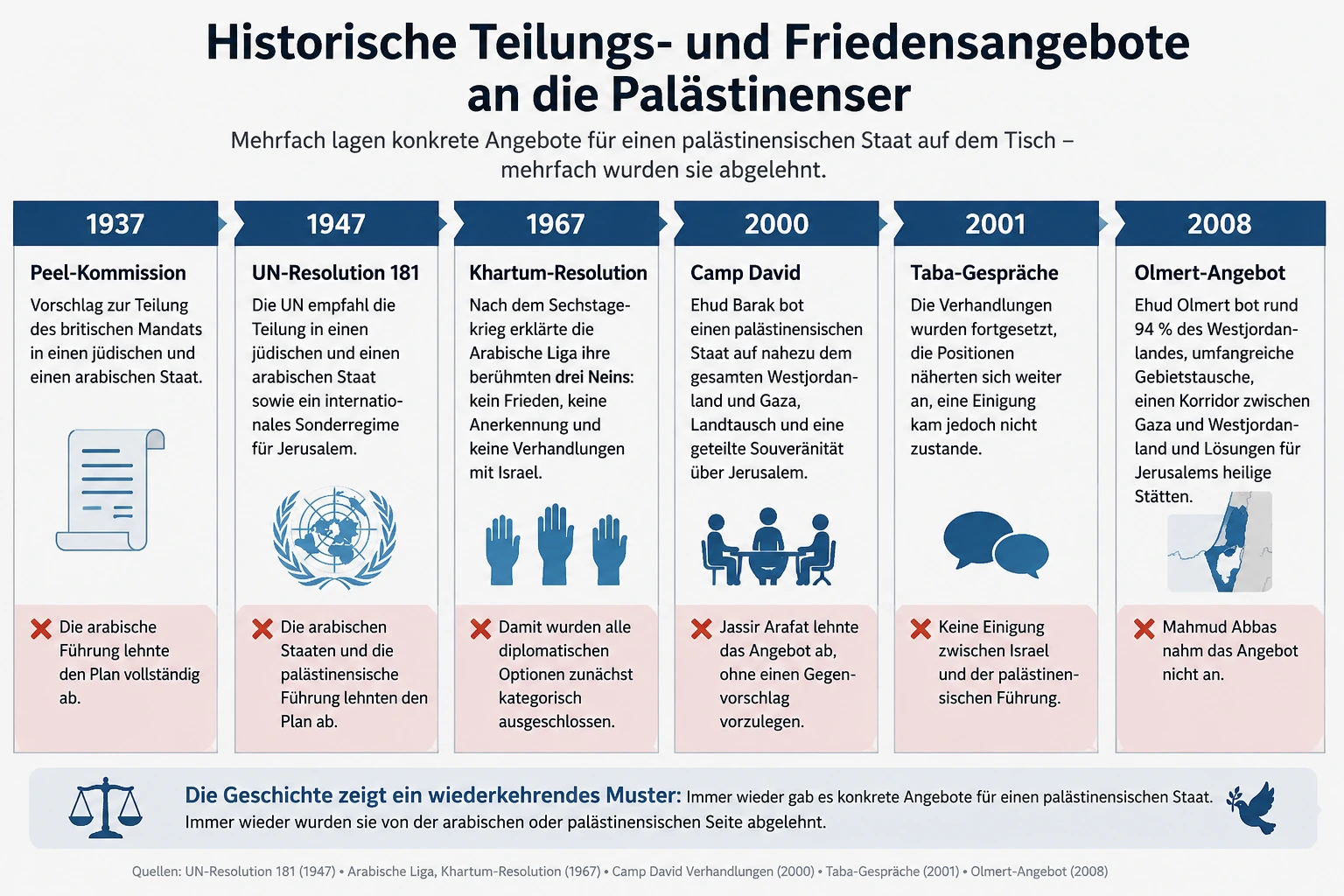
The first partition plan came as early as 1937
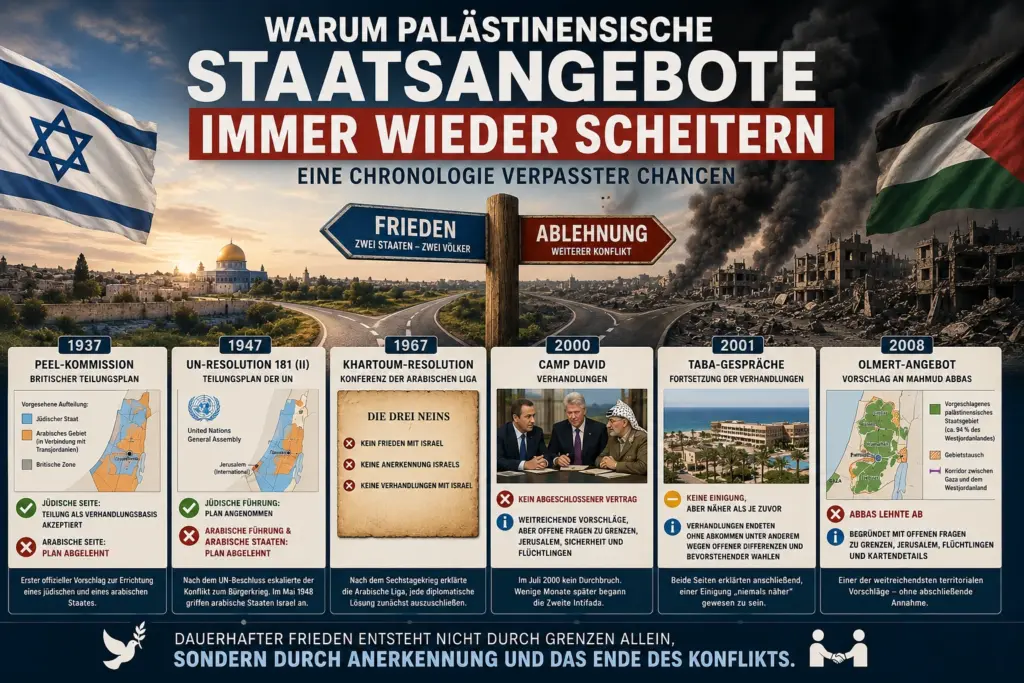
As early as 1937, the British Peel Commission proposed partitioning the Mandate territory. For the first time, the goal was to establish both a Jewish state and an Arab state . The Jewish side fundamentally accepted the proposal as a basis for negotiations, even though the proposed territory was small and fragmented. The Arab leadership rejected the plan in full.
Ten years later came the next historic opportunity. With UN Resolution 181, the United Nations once again recommended partitioning the territory into a Jewish and an Arab state. The Jewish leadership agreed. The Arab states and the Palestinian leadership, by contrast, rejected the plan and, following Israel’s declaration of independence in 1948, jointly launched a war against the newly established State of Israel.
Passende X-Beiträge
Aus dem SCHLAGSEITE X-Archivℹ️ Background
UN Resolution 181 was merely a recommendation by the General Assembly. Nevertheless, it formed the basis for the founding of Israel. An Arab state would have been possible as well, but it was never established because the Arab states unanimously rejected the partition plan.
1967: The Three Noes of Khartoum
After the Six-Day War in 1967, Israel signaled its willingness to negotiate territorial concessions in exchange for peace . The Arab League’s response came a few weeks later at the Khartoum Conference.
It went down in history as the famous Three Noes Resolution: no peace with Israel, no recognition of Israel and no negotiations with Israel. This initially categorically ruled out any diplomatic solution.
Camp David 2000: A Historic Opportunity
In 2000, Israeli Prime Minister Ehud Barak, together with US President Bill Clinton, put forward a far-reaching peace proposal. It included nearly the entire West Bank, the Gaza Strip, extensive land-swap areas and shared sovereignty over parts of Jerusalem.
The then PLO chairman Yasser Arafat rejected the offer without presenting a counterproposal of his own. Shortly afterward, the Second Intifada began, during which thousands of Israelis and Palestinians were killed or injured over several years.
Taba and Olmert: Even More Far-Reaching Offers
Talks continued after Camp David. At the beginning of 2001, both sides met again in Taba. Although their positions moved closer, no agreement was reached.
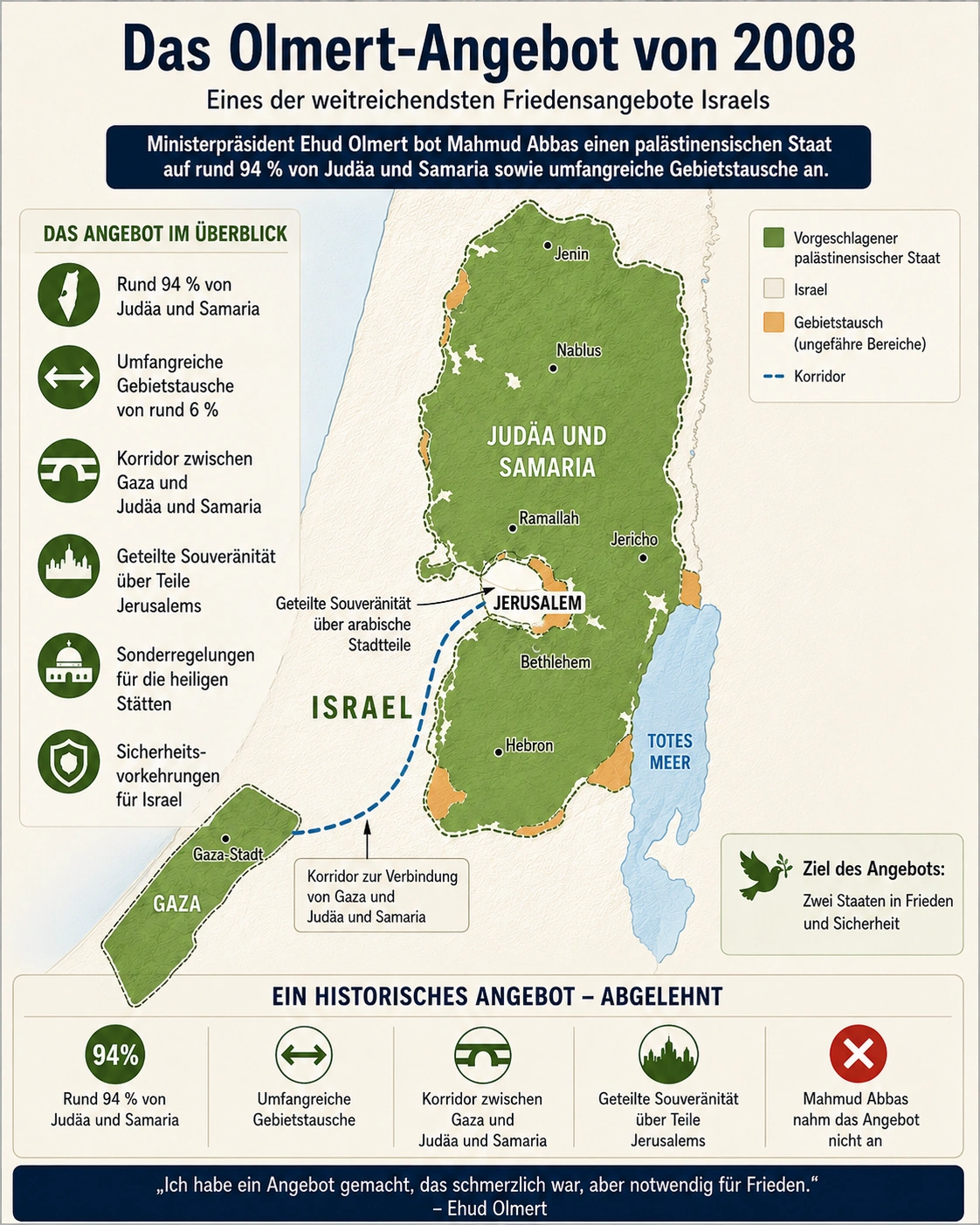
In 2008, Prime Minister Ehud Olmert finally presented Mahmoud Abbas with one of the most far-reaching offers in Israeli history. It comprised around 94 percent of the West Bank, extensive land swaps, a corridor between Gaza and the West Bank, and international solutions for Jerusalem’s holy sites. Abbas did not accept the offer.
Why Did the Offers Fail?
Critics point out that none of the offers met all Palestinian demands. In particular, the right of return for Palestinian refugees and their descendants remained a central point of dispute. Some objections are understandable and deserve fair consideration.
At the same time, however, one fact remains: Even the most far-reaching proposals failed to win agreement. An unrestricted right of return for several million descendants of Palestinian refugees would permanently eliminate Israel’s Jewish demographic majority. That is precisely why Israeli governments across the political spectrum regard this demand as incompatible with Israel’s continued existence as a Jewish state.
⚖️ What a Palestinian State Would Politically Cost
An independent state would give the Palestinians sovereignty, their own institutions and international responsibility. A permanently agreed two-state solution would, however, also require political maximalist demands to be abandoned or regulated in a binding manner.
This would include, in particular, the claim to the entire area between the Jordan River and the Mediterranean Sea, the demand for a comprehensive right of return for millions of descendants of Palestinian refugees to Israel, as well as the continuation of armed struggle by organizations acting independently of the state leadership. The issue of mutual recognition and the national self-determination rights of both peoples would also have to be conclusively settled in a peace treaty.
The special role of UNRWA would also become part of such a lasting solution. In addition to the original Palestinian refugees from 1948, the organization registers their descendants through the paternal line. The establishment of a Palestinian state would not automatically end UNRWA’s mandate, but it would intensify the political question of which people would henceforth be citizens of that state, what support they would need and how their refugee status should be regulated in the long term.
This would also raise the question of whether the existing UNRWA system should continue unchanged, gradually be transferred to Palestinian state structures or be replaced by other international aid programs. Neither Israel nor a Palestinian state could decide this alone, since UNRWA’s mandate is determined by the UN General Assembly.
A comprehensive peace treaty would also require binding borders, security arrangements, control over armed groups and an end to further territorial demands . The Palestinian state would be responsible for enforcing its monopoly on the use of force and preventing state institutions or forces under its control from attacking Israel.
If the regular armed forces of a sovereign Palestinian state were to attack Israel militarily, this would generally constitute an armed conflict between states. The prohibition on the use of force under the UN Charter prohibits states from using force against another state. In the event of an armed attack, Israel could generally invoke its right to self-defense, while international humanitarian law would still apply.
In the course of such self-defense, Israel could, under certain conditions, also temporarily occupy enemy territory militarily insofar as this were necessary to repel the attack and restore security. Such an occupation would not, however, automatically mean that Israel acquired sovereignty over the territory or could permanently annex it. A permanent change of borders would generally have to be established by a peace treaty, a border agreement or another legally effective arrangement under international law.
In the event of attacks by Hamas or other armed groups, it would be decisive whether their conduct could be legally attributed to the Palestinian state under international law. Not every unauthorized act of violence by an organization would automatically constitute an attack by the state. The state would nevertheless be politically and, where applicable, legally responsible for taking effective action against armed groups insofar as it was actually capable of doing so and had assumed corresponding obligations.
A violation of international law through an attack could result in state responsibility, diplomatic isolation, sanctions, the loss of foreign support and lawful countermeasures by other states . These consequences would not arise automatically, but would depend on the specific circumstances, international decisions and existing treaties.
This is precisely an often-overlooked part of the conflict: An independent state would not only be a gain in rights, but also the assumption of state duties and responsibility for the actions of its organs. Only a final peace treaty would also establish a binding obligation to permanently end the territorial conflict.
⚠️ Common Misconception
Rejecting individual peace offers does not automatically mean that every Palestinian position was unfounded. Conversely, however, it is equally impossible to claim that Israel never made serious offers. The historical record instead shows that several far-reaching proposals remained without formal acceptance.
The Gaza Strip as a Practical Test
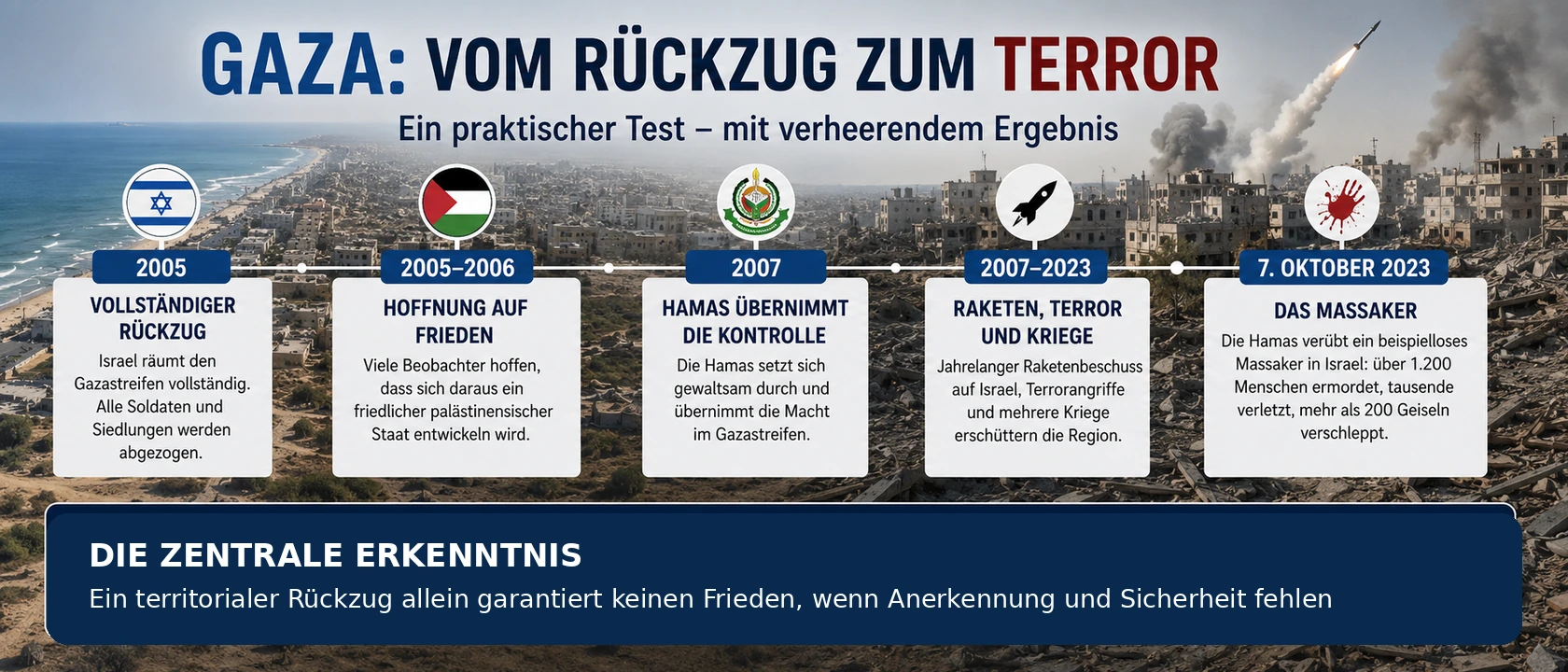
In 2005, Israel completely withdrew from the Gaza Strip. All Israeli soldiers and settlements were withdrawn. Many observers hoped that this could lead to the development of a peaceful Palestinian state.
Instead, Hamas forcibly took control of the Gaza Strip in 2007. Years of rocket fire and terrorist attacks followed, culminating in the massacre of October 7, 2023. For many Israeli politicians, Gaza is therefore evidence that a territorial withdrawal alone does not guarantee peace, as long as fundamental recognition of Israel is absent.
The Core Point of Dispute
The decisive question is therefore not only the course of a border. Equally decisive is whether a Jewish state will be accepted permanently.
The original PLO Charter fundamentally challenged Israel’s existence. Hamas, too, openly declares to this day that it wants to eliminate Israel. In addition, surveys, schoolbooks and public statements by individual officials show that recognition of Israel as a Jewish state to this day within broad sections of Palestinian society and politics.
This fundamental rejection extends far beyond the region. Israel has long since become a political enemy image around which different ideological extremes come together, even though they otherwise share hardly any positions.
As long as this fundamental problem remains unresolved, even new border proposals are unlikely to create lasting peace.
✔️ In summary
The history of the past nine decades shows a recurring pattern. On several occasions, concrete proposals for a Palestinian state were on the table. On several occasions, they were not accepted. The details remain open to debate to this day. More difficult to dispute, however, is that mutual recognition of Israel’s right to exist as a Jewish state remains one of the greatest obstacles to a lasting peace settlement to this day.
Anyone seeking to understand the Middle East conflict should therefore not only discuss what concessions Israel should have made. The question of why so many concrete offers of statehood were never accepted is equally important. In Germany’s debate, too, this historical record is often overshadowed by ideological interpretations, particularly regarding the difficult relationship between Germany’s Left, Israel and antisemitism. Only when both sides are prepared to permanently recognize the other’s legitimate existence can a two-state solution become more than a political slogan.
🎥 Further video by the WerteInitiative
▶️ Why did Palestinian offers of statehood repeatedly fail?
The WerteInitiative video summarizes the key historical stages of the partition and peace offers chronologically and supplements the events discussed in the article.
ℹ️ Factual basis and primary sources for the article 📑
▶️ UN Resolution 181 (II) of November 29, 1947
The resolution recommended partitioning the British Mandate into a Jewish and an Arab state, as well as an international special regime for Jerusalem.
▶️ Arab League Khartoum Resolution of September 1, 1967
Documentation of the resolution containing the so-called three noes: no peace with Israel, no recognition of Israel and no negotiations with Israel.
▶️ Yale Law School: Full text of the Khartoum Resolution
English version of the text of the resolution adopted at the Arab League summit in September 1967.
▶️ Dennis Ross: The Missing Peace
Account of the Middle East peace process and the Camp David negotiations from the perspective of Dennis Ross, the chief American negotiator at the time.
▶️ Economic Cooperation Foundation: The so-called Napkin Map of 2008
Documentation of a map of the territorial proposal that Mahmoud Abbas redrew, which Ehud Olmert had presented to him in September 2008.
▶️ Voice of America: Abbas confirms rejection of the Olmert offer
Report on an interview in which Mahmoud Abbas explained why he had not accepted Olmert’s peace proposal of 2008.
▶️ Times of Israel: Map and details of the Olmert offer
Contemporary reconstruction of the territorial offer, including the designated land-swap areas and the proposed Palestinian state territory.